Has your child been struggling to read, even after months of practice? Do they mix up letters, avoid books, or feel frustrated every time schoolwork involves writing? You are not alone, and neither is your child. Dyslexia is one of the most common learning differences in the world. It has nothing to do with intelligence, and everything to do with how the brain processes language. With the right support, children and adults with dyslexia can thrive. This guide explains what dyslexia is, how to spot it, and what actually helps.
What Is Dyslexia?
Dyslexia is a learning difference that affects reading, spelling, and writing. The brain processes written language differently — making it harder to connect letters with their sounds and decode words fluently.
It is not caused by laziness, poor parenting, or lack of effort. It is neurological — meaning it starts in the brain’s wiring, not in attitude or motivation.
Dyslexia affects around 1 in 10 people. Many cases go unidentified for years, especially in children who are “getting by” but quietly struggling.
Signs of Dyslexia
Symptoms look different depending on age. Here is what to watch for.
In Children
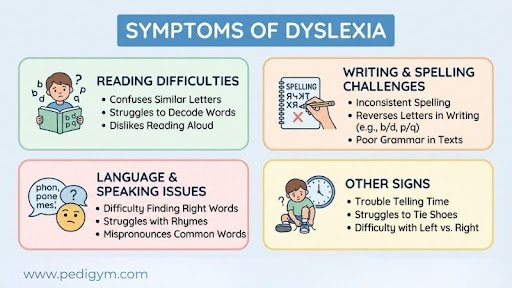
- Slow or laboured reading — reads word by word, often losing the thread of a sentence
- Letter confusion — mixes up “b” and “d,” or “p” and “q” beyond age 7
- Inconsistent spelling — may spell the same word differently in the same paragraph
- Difficulty with sounds — struggles to rhyme words or identify individual sounds in spoken words
- Avoidance — makes excuses to skip reading, or becomes anxious and upset around written tasks
- Gap between speaking and writing — explains things brilliantly aloud but cannot get the same ideas on paper
Early signs can appear even before school starts — delayed speech, trouble learning nursery rhymes, or difficulty remembering the names of letters.
In Adults
Many adults with dyslexia were not diagnosed during childhood. They built workarounds — and often assumed they were simply “not good with words.”
Common signs include:
- Re-reading the same line multiple times before it sticks
- Taking much longer than expected to write emails or reports
- Inconsistent spelling despite being otherwise capable and articulate
- Struggling to take notes while listening at the same time
- Preferring phone calls or conversations over anything written
If this feels familiar, a formal assessment is worth considering — at any age.
What Causes Dyslexia?
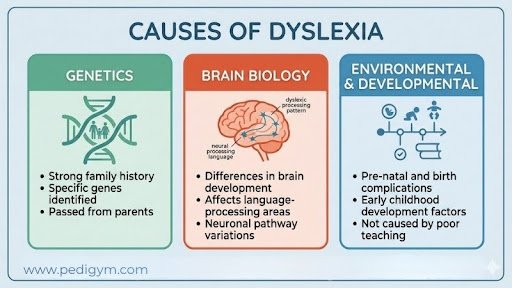
Dyslexia is a learning difference that mainly affects reading, spelling, and language processing. It is not caused by low intelligence, poor effort, or lack of motivation. In most cases, two main factors contribute to dyslexia: genetics and differences in how the brain processes language.
Genetics — Dyslexia runs in families. If a parent has dyslexia, their child has a significantly higher chance of having it too. When a child is diagnosed, parents often recognise their own school experiences in the description.
Brain processing differences — Research shows that the neural pathways linking written symbols to sounds work differently in people with dyslexia. This is a difference in how language networks are wired — not damage. With the right teaching, these pathways can strengthen over time.
Neither cause involves fault. Dyslexia is not the result of too much screen time, poor teaching, or anything a parent did or did not do.
How Is Dyslexia Diagnosed?
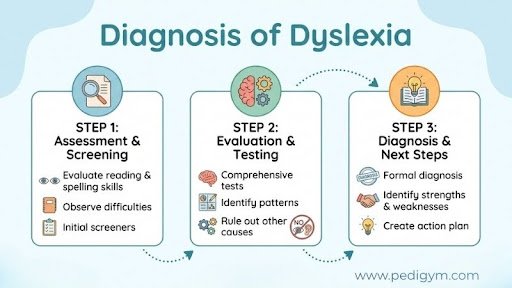
Early diagnosis makes a significant difference. The sooner a child’s learning difference is identified, the sooner targeted support can begin — before frustration and self-doubt set in.
Screening for early risk factors can begin at age 4–5. A formal assessment is typically most reliable from around age 7, once a child has had enough exposure to reading instruction.
A comprehensive assessment looks at phonological awareness, reading fluency, spelling, working memory, and processing speed. It is carried out by educational psychologists, clinical psychologists, or specialist literacy assessors.
In India, parents can seek assessments through developmental paediatric clinics, child psychology centres, and specialist therapy clinics that include learning assessments as part of their services.
If you have noticed persistent reading or writing difficulties in your child, an early assessment is the most useful step you can take. It does not label your child — it explains them.
Dyslexia Treatment for Kids
The earlier dyslexia treatment for kids begins, the better the outcomes. Here is what works.
Structured Literacy
This is the gold standard. Structured literacy is a systematic, step-by-step method that covers:
- Phonemic awareness — learning to hear and identify individual sounds in words
- Phonics — learning how letters reliably connect to sounds
- Fluency — building reading speed so the brain can focus on meaning, not just decoding
It is direct, explicit, and evidence-based — and it works for children who have not responded to general classroom reading instruction.
Multisensory Learning
Children with dyslexia often learn better when multiple senses are involved. Tracing letters while saying their sounds, building words with physical tiles, or using colour-coded spelling patterns creates stronger memory links — and makes learning more enjoyable.
Occupational Therapy
Many children with dyslexia also find handwriting physically tiring, struggle with attention, or have sensory sensitivities that affect learning. Occupational therapy addresses these foundations directly — helping children develop the motor, sensory, and organisational skills that classroom learning depends on.
Specialist therapy centres in India offer occupational therapy for children as part of structured developmental programs designed for children with learning differences.
Assistive Technology
Text-to-speech apps, audiobooks, and speech-to-text tools allow children to access content without being blocked by reading difficulty. These are not shortcuts — they let a child’s intelligence shine while literacy skills are being built in parallel.
Dyslexia Treatment for Adults
It is never too late. Dyslexia treatment for adults focuses on building practical skills and systems that work with your brain.
Specialist literacy tutoring: helps adults improve reading accuracy, spelling, and writing confidence with sessions focused on everyday tasks like emails, reports, and forms.
Assistive technology: changes daily life for many adults. Text-to-speech, voice typing, and grammar support tools are practical, not embarrassing. Using them is working smart.
Workplace adjustments: Adults with a formal dyslexia diagnosis are entitled to reasonable accommodations in most professional settings: extra time for written tasks, permission to record meetings, or assistive technology support.
Emotional support: A late diagnosis often brings complex feelings: relief, grief, sometimes anger. Peer support and counselling help adults process their story and move forward with clarity.
FAQs About Dyslexia
Can dyslexia be cured?
Dyslexia is a lifelong difference — it cannot be cured. But with the right dyslexia treatment and practical strategies, most people develop strong skills and go on to succeed in education, work, and daily life.
What is the best dyslexia treatment?
Structured literacy — explicit, systematic, phonics-based teaching — has the strongest evidence. For children, this is often combined with occupational therapy. Adults benefit from specialist tutoring and assistive technology.
At what age can dyslexia be diagnosed?
Risk factors can be identified from age 4–5. A formal diagnosis is most reliable from around age 7. Adults can be diagnosed at any age — and a late diagnosis is just as valuable.
Is dyslexia a disability?
In most educational and legal frameworks, dyslexia qualifies as a learning disability — giving individuals access to formal accommodations and support. Many prefer the term “learning difference,” recognising it as a different way of thinking, not a lesser one.
A Final Note for Parents
If your child is struggling with reading right now, the most important thing to know is this: they are not broken, and neither are you.
Dyslexia is common, well-understood, and very treatable. The difference between a child who spends years feeling like a failure and one who grows into a confident reader often comes down to one thing: early, targeted support.
Related Blog
https://pedigym.com/borderline-dyslexia-meaning-in-children/

Dr. Nitin, Founder of PediGym Child Development Center, is a dedicated pediatric therapy expert and DMI Level C Certified Therapist leading structured, evidence-based therapy programs in Faridabad and Gurgaon. Under his guidance, PediGym provides comprehensive pediatric rehabilitation focused on improving motor skills, coordination, sensory processing, speech clarity, and functional independence through personalized intervention plans.