
As a parent you notice the things first. Maybe your child avoids holding a pencil, needs help getting dressed, struggles to sit still or finds it hard to join other children in play. These moments can leave you wondering if they simply need time or if they need extra support.
The good news is that many children improve beautifully with the guidance. Occupational therapy helps children build skills through fun structured activities. It supports movement, attention, confidence and independence in a child- way. In this blog we will explain what occupational therapy is, why children may need therapy, the benefits occupational therapy offers and how PediGym Child Development Center supports families in Faridabad and Gurgaon.
What Is Occupational Therapy?
If you are asking what occupational therapy is, think of it as support for the skills children use every day. These include playing, eating, dressing, writing, learning and interacting with others.
Some children need help with these everyday tasks. A pediatric occupational therapist understands child development. Uses playful activities to strengthen the skills that feel difficult right now.
For example:
- A child who struggles to hold a spoon may work on hand strength through games
- A child who dislikes sounds or textures may learn sensory calming strategies
- A child who avoids coloring or writing may build finger control through tasks
- A child who finds routines may practice step-by-step daily skills
Everything is taught in a gentle encouraging way that matches your child’s age and pace.
At PediGym Child Development Center sessions are personalized, engaging and focused on progress that helps children at home in school and during play.
Why Do Children Need Occupational Therapy?
Every child develops in their way. Some children learn skills quickly while others need extra time and support. That is where occupational therapy can help.
- Parents often seek support when they notice:
- Difficulty holding crayons, pencils or small objects
- Trouble with balance, jumping, running or climbing
- attention span during learning or play
- Sensitivity to sound, touch, clothing or food textures
- Challenges with dressing, feeding or toileting
- Frustration during tasks other children manage easily
- Difficulty joining group play or following routines
Children with delays, autism spectrum disorder (ASD) ADHD, cerebral palsy or sensory processing differences may also benefit from occupational therapy.
Reaching out for help is a step. It does not mean something is wrong with your child. It means you are giving them the support they need to grow with confidence.
At PediGym families receive guidance, clear goals and occupational therapy that fits into everyday family life.
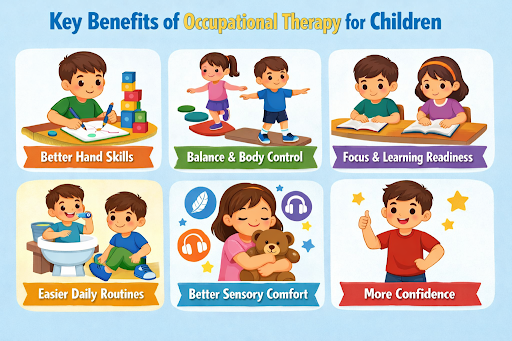
Key Benefits of Occupational Therapy for Children
The progress children make in therapy often becomes visible in everyday life. Parents may notice routines, fewer frustrations, better participation and growing confidence. The goal of therapy is not just skill practice inside a session. It is to help children use those skills at home in school and during play.
1. Better Hand Skills
Many daily tasks depend on coordinated hands. Children learn to improve grip strength, finger movement and control through fun activities. These skills are important for holding pencils, coloring neatly, turning pages, opening lunch boxes, buttoning clothes and using spoons or forks.
When hand skills improve children often become more independent and less frustrated during schoolwork or self-care tasks.
2. Balance and Body Control
Some children appear clumsy fall often avoid climbing or feel unsure during movement activities. Occupational therapy helps build posture, balance, coordination and body awareness through guided movement games.
As strength and control improve children may feel more confident on the playground during sports on stairs and in group games. Better body control can also support sitting posture during table work.
3. Focus and Learning Readiness
Learning is easier when a child can pay attention, follow instructions and stay engaged in a task. Occupational therapy activities help children practice listening, turn-taking, task completion and staying seated for age- periods.
These improvements can support classroom readiness, homework routines and smoother transitions between activities. Parents often notice children becoming more organized and cooperative during tasks.
4. Easier Daily Routines
Simple routines can feel stressful when a child struggles with self-care skills. Occupational therapy breaks tasks into steps and teaches children how to complete them with greater independence.
This may include dressing, brushing teeth, washing hands, feeding, packing a school bag or tidying toys. As these routines become easier, mornings and evenings often feel calmer for the family.
5. Better Sensory Comfort
Some children are highly sensitive to noise, touch, movement, clothing tags or food textures. Others may constantly seek movement or touch input. Occupational therapy helps children understand and manage needs in a safe and supportive way.
With the strategies children may feel calmer handle new environments better and participate more comfortably in school, family outings and social settings.
6. More Confidence
Confidence grows when children experience success. As they learn skills and become more independent they often feel proud of themselves and more willing to try new things.
This may look like joining group play attempting tasks speaking up or handling small challenges with less fear. Emotional growth is often one of the meaningful outcomes for parents to see.
At PediGym Child Development Center occupational therapy goals are always linked to what matters for your child and family making progress practical, meaningful and encouraging.
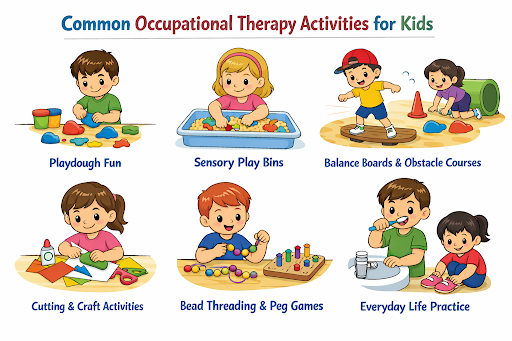
Common Occupational Therapy Activities for Kids
Children learn best when they feel happy, safe and engaged. That is why occupational therapy sessions are designed to feel playful and enjoyable while still building developmental skills. Each activity has a purpose even when it looks like fun.
Playdough Fun
Rolling, squeezing, pinching, flattening and shaping playdough helps strengthen hand muscles. It also improves finger coordination and control.
These skills support handwriting, pencil grip buttoning clothes, opening containers and other everyday hand tasks. Children usually enjoy the side of making shapes and objects.
Sensory Play Bins
Sensory bins may include rice, beans, sand, water beads or textured toys hidden inside containers. Children scoop, pour, search and explore textures.
This type of play can improve tolerance, attention span, calmness and curiosity. It also helps some children become more comfortable with textures they usually avoid.
Balance Boards and Obstacle Courses
Walking on balance boards stepping over obstacles crawling through tunnels or jumping between markers helps develop balance, coordination, planning and body awareness.
These movement-based activities are especially helpful for children who need support with confidence, posture or active play skills. They also provide an outlet for energy.
Cutting and Craft Activities
Using scissors, crayons, glue, stickers and paper builds motor control and two-hand coordination. Children also practice attention, patience and following steps.
Craft tasks can help prepare children for classroom activities such as writing, cutting worksheets and completing projects independently.
Bead Threading and Peg Games
Threading beads onto strings. Placing pegs into boards strengthens finger muscles and improves hand-eye coordination. These tasks also encourage focus, patience and problem-solving.
They are excellent for children who need support with precision hand movements used in writing and dressing tasks.
Everyday Life Practice
occupational therapy includes real-life practice such as zipping a jacket opening a lunch box packing a bag or learning table manners. These practical activities help children apply skills directly to routines.
At PediGym therapists choose activities based on your child’s age, goals and interests. When children enjoy the process they stay motivated and learning happens naturally.
What to Expect During an OT Session at PediGym
Starting therapy can feel like a big step for parents. At PediGym Child Development Center the process is designed to feel supportive and comfortable for both you and your child.
Step 1: Understanding Your Child
The therapist begins with an assessment to understand strengths, challenges and current skill levels. Parents can share concerns, routines and goals.
Step 2: Personalized Plan
An occupational therapy plan is created based on your childs needs. Goals may include handwriting, focus, dressing, sensory regulation or coordination.
Step 3: Fun, Guided Sessions
Your child joins engaging activities that build skills step by step in a motivating environment.
Step 4: Parent Support
Parents receive tips and home activities to continue progress outside sessions.
You can visit PediGym at:
Sector 17 Faridabad
Sector 85 Faridabad
DLF Phase 2 Gurgaon
At PediGym occupational therapy is not about exercises. It is about helping your child thrive in life.
When Should You Look for Occupational Therapy Near Me?
Many parents search for therapy near me when they notice daily struggles becoming more frequent. It may be time to speak with a specialist if your child:
- Avoids drawing, writing or craft tasks
- Needs help than expected with dressing or feeding
- Is very sensitive to noise, touch or textures
- Falls often or seems unsteady
- Struggles to focus during activities
- Becomes frustrated with tasks
- Is missing age-related milestones
Early support can make everyday life easier and more enjoyable for your child.
If you are looking occupational therapy centre in Faridabad or Gurgaon PediGym Child Development Center offers trusted care, personalized plans and a warm environment, for children and parents
Conclusion
Every child has their own strengths, and every child can grow with the right support. Occupational therapy helps children build the skills they need to feel more confident, independent, and ready for daily life.
If you have concerns, trust your instincts as a parent. Early guidance can make a lasting difference.
Book a session today at PediGym — visit www.pedigym.com or walk into our nearest center in Faridabad or Gurgaon.

Dr. Nitin, Founder of PediGym Child Development Center, is a dedicated pediatric therapy expert and DMI Level C Certified Therapist leading structured, evidence-based therapy programs in Faridabad and Gurgaon. Under his guidance, PediGym provides comprehensive pediatric rehabilitation focused on improving motor skills, coordination, sensory processing, speech clarity, and functional independence through personalized intervention plans.