

Proprioceptive activities are movements that make the muscles and joints work against resistance, such as pushing, pulling, lifting, carrying, or bearing weight. They give the brain feedback about body position and effort, helping children develop body awareness, control force, and regulate their responses to sensory input. Occupational therapists often call these movements heavy work.
Children who frequently seek movement, bump into objects, press too hard while writing, or struggle with sensory regulation may benefit from suitable proprioceptive input. Everyday activities such as kneading atta (chapati dough), pushing a laundry basket, animal walks, and carrying shopping bags can introduce heavy work into a child’s routine.
This article is for general information only and is not a substitute for an occupational therapy assessment or individualised clinical advice.
Key Takeaways for Proprioceptive Activities
- Proprioception helps children understand body position, movement, and physical effort.
- Heavy work activities involve pushing, pulling, lifting, carrying, and weight-bearing movements.
- Everyday household chores can provide opportunities for proprioceptive input.
- Activities should match the child’s age, physical abilities, and sensory preferences.
- An occupational therapist can recommend an individualised sensory diet when sensory difficulties affect daily participation.
What Is Proprioception and How Does It Support Sensory Regulation?
Proprioception is the body’s ability to sense the position and movement of different body parts, as well as the force and effort used during movement. Receptors in muscles, tendons, and other tissues send information to the brain about body position and movement.
For example, when a child climbs stairs, carries a school bag, squeezes playdough, or pushes a door, the proprioceptive system helps the body understand how much effort is required.
Proske and Gandevia (2012) explain that proprioception contributes to awareness of body position, movement, and muscle force. Read the research in Physiological Reviews.
Proprioception contributes to:
- Body awareness: Understanding where different body parts are positioned.
- Force grading: Adjusting pressure when holding a pencil, writing, or playing.
- Movement coordination: Managing activities such as climbing, jumping, and catching.
- Postural control: Maintaining stability while sitting, standing, or moving.
- Sensory regulation: Helping children manage sensory input during everyday routines.
Proprioceptive input is often described as organising for some children and may help them feel more settled during activities. However, every child responds differently, and an activity that is calming for one child may be uncomfortable or overstimulating for another.
What Are the Signs of Proprioceptive Sensory Seeking or Avoiding?
Children respond differently to sensory information. Some seek activities involving physical effort, while others avoid certain movements or physical experiences.
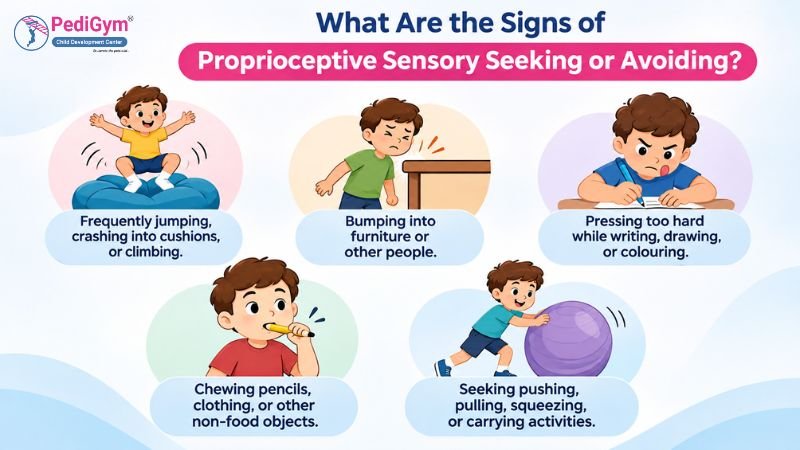
Common sensory-seeking behaviours include:
- Frequently jumping, crashing into cushions, or climbing.
- Bumping into furniture or other people.
- Pressing too hard while writing, drawing, or colouring.
- Chewing pencils, clothing, or other non-food objects.
- Seeking pushing, pulling, squeezing, or carrying activities.
Possible sensory-avoiding behaviours include:
- Avoiding climbing, jumping, or weight-bearing activities.
- Disliking physical play that involves resistance.
- Hesitating during activities that require balance or body coordination.
- Appearing stiff or guarded during movement.
- Preferring less physically demanding play.
Some children may also use too little force when holding objects or struggle to judge how much pressure an activity requires.
Not every behaviour indicates a proprioceptive difficulty. Discomfort with touch may also reflect tactile processing differences, while hesitation with balance may relate to vestibular processing. An occupational therapist can assess the child’s sensory and motor needs.
12 Proprioceptive Activities for Sensory Regulation at Home
Parents can introduce proprioceptive activities through household chores, play, and everyday routines.
Heavy work does not mean heavy loads. Resistance should be moderate and suited to the child’s size. Start with 3–5 minutes per activity and around 5–10 minutes per session, adjusting according to the child’s age, comfort, and response. These are practical starting suggestions, not fixed clinical prescriptions.
All activities should be adult-supervised. The age ranges below are general guides; choose activities according to your child’s abilities and developmental needs.
Heavy Work Activities
These activities involve pushing, pulling, lifting, and carrying objects. They use larger muscle groups and can be included in familiar household routines.
Kneading Atta Dough
Let your child help knead soft dough using their hands. Ask them to press, fold, and roll it.
- Age: Ages 3+.
- Why it helps: Provides resistance through the hands and arms while developing hand strength.
- Make it easier: Use a small portion of soft dough.
- Safety: Supervise young children, do not allow them to eat raw dough, and wash hands afterwards.
Pushing a Laundry Basket
Place a few clothes or soft toys inside a sturdy laundry basket. Ask your child to push it across a clear, flat floor.
- Age: Ages 3+.
- Why it helps: Engages the arms, shoulders, and trunk through pushing.
- Make it easier: Use fewer clothes.
- Make it harder: Gradually increase resistance to a level suitable for your child.
- Safety: Avoid overloading the basket or using slippery floors.
Carrying Shopping Bags
Ask your child to carry a moderately weighted bag appropriate for their size over a short distance.
- Age: Ages 5+.
- Why it helps: Encourages controlled lifting, carrying, and body awareness.
- Make it easier: Use a lighter bag and shorter distance.
- Safety: Never ask children to carry heavy grocery bags or sharp objects.
Helping with Household Chores
Involve your child in simple activities such as wiping a table, wringing a small wet cloth, arranging cushions, or sweeping with a child-sized broom.
- Age: Ages 3+.
- Why it helps: Combines purposeful movement with everyday participation.
- Make it easier: Choose one simple task at a time.
- Safety: Avoid cleaning chemicals and strenuous tasks.
Weight-Bearing and Resistance Activities
Weight-bearing activities involve supporting the body’s weight through the hands, arms, or legs. Other resistance activities involve pushing or pulling against resistance. Both provide opportunities to develop body awareness and muscle control.
Wall Push-Ups
Ask your child to stand facing a wall, place both palms against it, and slowly bend and straighten their elbows.
- Age: Ages 3+.
- Why it helps: Engages the shoulders and arms while supporting body awareness.
- Make it easier: Start with 5 repetitions.
- Safety: Use a stable wall and avoid locking the elbows.
Animal Walks
Try bear walks, crab walks, and frog jumps on a safe floor. Turn the movements into an animal imitation game.
- Age: Ages 3+.
- Why it helps: Encourages whole-body coordination and muscle engagement.
- Make it easier: Start with short distances.
- Safety: Stop if the child shows fatigue or loses movement control.
Tug-of-War
Use a soft towel or rope and invite your child to gently pull while you hold the other end.
- Age: Ages 5+.
- Why it helps: Provides resistance through the arms and shoulders.
- Make it easier: Reduce the pulling resistance.
- Safety: Avoid sudden pulling, twisting, or forceful movements.
Body-Awareness and Coordination Activities
These activities combine movement, resistance, and coordination challenges to help children understand how their bodies move and use force.
Playdough Squeezing
Give your child soft playdough to squeeze, pinch, flatten, and roll.
- Age: Ages 2+ with close supervision.
- Why it helps: Supports hand strength and fine motor coordination. Squeezing and flattening dough also give children a playful opportunity to practise using different amounts of hand pressure.
- Make it easier: Use softer dough and larger pieces.
- Safety: Use non-toxic materials and supervise children who may put objects in their mouths.
Pillow Obstacle Course
Arrange stable cushions on the floor. Let your child crawl around, step over, or move between them.
- Age: Ages 3+.
- Why it helps: Encourages body awareness and coordinated movement.
- Make it easier: Use fewer cushions and simple movements.
- Safety: Keep the course low and away from sharp furniture.
Gentle Yoga and Stretching
Introduce simple movements such as child’s pose and cat-cow stretches.
- Age: Ages 4+.
- Why it helps: Encourages controlled movement and body awareness.
- Make it easier: Demonstrate one movement at a time.
- Safety: Never force a stretch or push beyond a comfortable range.
Soft Ball Squeezing
Give your child an age-appropriate soft ball to squeeze and release with both hands.
- Age: Ages 2+ with close supervision.
- Why it helps: Encourages controlled hand pressure and muscle engagement. Practising gentle squeezing and releasing may help children become more aware of how much pressure they use with their hands.
- Make it easier: Use a softer ball.
- Safety: Avoid small balls that could cause choking.
Crawling Through a Play Tunnel
Use a suitable play tunnel and place a favourite toy at the other end. Let your child crawl through to collect it.
- Age: Ages 2+.
- Why it helps: Engages the arms, legs, and trunk while supporting coordination.
- Make it easier: Use a short, open crawling space.
- Safety: Ensure the tunnel is stable and well ventilated.
How Can You Include Proprioceptive Activities at School and Home?
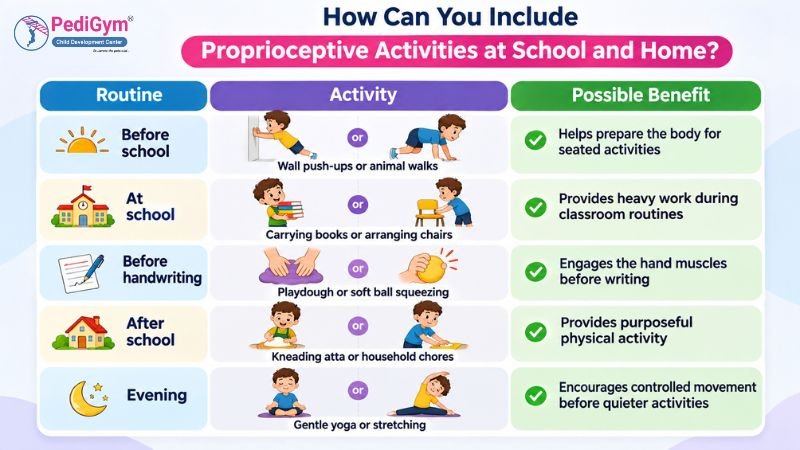
Add short 5–10-minute activity sessions at transition points, such as before school, before handwriting, after school, and during evening routines.
Routine | Activity | Possible benefit |
Before school | Wall push-ups or animal walks | Helps prepare the body for seated activities |
At school | Carrying books or arranging chairs | Provides heavy work during classroom routines |
Before handwriting | Playdough or soft ball squeezing | Engages the hand muscles before writing |
After school | Kneading atta or household chores | Provides purposeful physical activity |
Evening | Gentle yoga or stretching | Encourages controlled movement before quieter activities |
A sensory diet is an individualised plan of sensory activities recommended by an occupational therapist to support a child’s participation in daily routines. It is not a food-related diet. The activities and frequency depend on the child’s sensory preferences, abilities, and daily needs. Learn more about sensory integration therapy.
Can Oral Proprioceptive Input Support Children?
It can, for some children. Age-appropriate crunchy or chewy foods and drinking through a suitable straw can offer oral sensory experiences. These options may be useful for children who frequently seek oral input by chewing pencils, clothing, or other objects.
Always consider chewing ability, swallowing safety, allergies, and choking risks. These activities should not replace a feeding assessment when difficulties are present.
Can Proprioceptive Activities Help with Autism and ADHD?
For some children, yes. Suitable proprioceptive activities can provide opportunities for physical engagement, body awareness, and participation in everyday routines. However, they are not a treatment for autism or ADHD, and sensory needs vary between children.
Some children with autism may seek movement, struggle with body awareness, or find it difficult to manage sensory responses. Research by Blanche et al. (2012) examined proprioceptive processing difficulties among children with autism spectrum disorders and developmental disabilities. Read the study in the American Journal of Occupational Therapy.
Some children with ADHD may also benefit from planned movement opportunities. Evidence specifically examining proprioceptive input and ADHD is still developing, so activities should be selected according to individual needs rather than diagnosis alone.
Learn more about occupational therapy for children with autism.
Are There Proprioceptive Activities That Can Support Bedtime Routines?
Some children may find slow, predictable movements helpful during a quiet evening routine. Gentle stretching, slow wall push-ups, or pressing the palms together can be suitable options.
Observe your child’s response and avoid stimulating or physically demanding activities close to bedtime if they make settling difficult. Weighted blankets and other weighted equipment should only be considered with appropriate professional guidance.
Safety Tips for Proprioceptive Activities
- Supervise children during jumping, crawling, climbing, and pulling.
- Use stable, non-slip surfaces and age-appropriate equipment.
- Avoid loads that are too heavy for your child.
- Never force physical contact or movement.
- Do not perform manual joint compression without appropriate professional guidance.
- Avoid weighted vests and weighted blankets unless recommended and monitored by a qualified professional.
- Stop if your child experiences pain, distress, unusual fatigue, or discomfort.
If your child has a physical disability, joint concerns, or significant motor difficulties, consult an occupational therapist before introducing challenging activities.
When Should You Consult an Occupational Therapist?
If your child regularly seeks intense movement, struggles with handwriting pressure, bumps into objects, or avoids everyday physical activities, consider an occupational therapy assessment.
An occupational therapist evaluates sensory responses, motor skills, body awareness, and their effect on daily participation. Based on the findings, the therapist can recommend suitable activities, environmental adjustments, and an individualised sensory diet.
At PediGym Child Development Center, children and families can access structured pediatric therapy support in Faridabad and Gurugram. Recommendations should be based on each child’s developmental profile and therapy goals. Learn more about occupational therapy for kids.
Frequently Asked Questions
What are the best proprioceptive activities for children?
Wall push-ups, animal walks, kneading atta, carrying suitable objects, playdough squeezing, and household chores are practical examples. Choose activities according to your child’s age, abilities, and sensory preferences.
Can proprioceptive activities help calm an overstimulated child?
They may, depending on the child. Pushing, pulling, and controlled muscle effort may feel organising or calming. However, responses vary. Observe your child’s behaviour and consult an occupational therapist if sensory regulation difficulties affect daily activities.
How often should children do proprioceptive activities?
Many children can start with 5–10 minutes of suitable activities a few times daily. The appropriate amount depends on age, physical abilities, and sensory responses. An occupational therapist can recommend an individualised routine.
Are proprioceptive activities suitable for children with autism?
For some children, yes. Activities involving jumping, squeezing, crawling, and pushing may support body awareness and participation, but not every child has the same sensory preferences. Individual recommendations are important.
Can proprioceptive activities help children with ADHD?
Some children with ADHD may benefit from planned movement opportunities, such as wall push-ups, carrying classroom materials, or short movement breaks. These activities can support participation but are not a replacement for appropriate ADHD care. Evidence is still developing, and individual needs should guide activity choices.
Do proprioceptive activities require special equipment?
No. Many activities can be performed using everyday household items such as cushions, playdough, soft balls, laundry baskets, and towels. Appropriate supervision and suitable resistance are more important than specialised equipment.
What is heavy work?
Heavy work refers to physical activities that make muscles work against resistance. Examples include pushing a laundry basket, carrying suitable objects, kneading dough, and performing wall push-ups. Occupational therapists may recommend these activities as part of an individualised sensory plan.
What is the difference between proprioceptive and vestibular input?
Proprioceptive input comes from muscles and joints and helps the brain understand body position, movement, and force. Vestibular input comes from the inner ear and helps the brain understand head movement, balance, and orientation in space. Both systems work together to support coordination and movement.
Support Your Child's Sensory Development
Proprioceptive activities make everyday play and household routines more purposeful. From kneading atta to animal walks, simple heavy work activities provide opportunities for children to develop body awareness, movement coordination, and physical control.
If your child experiences ongoing sensory or motor difficulties, an individualised occupational therapy assessment can help identify suitable strategies.
Explore PediGym’s occupational therapy services or contact PediGym to learn about pediatric therapy services in Faridabad and Gurugram.
About the Author
Dr. Nitin Gupta is the Founder of PediGym Child Development Center and a DMI Level C Certified Therapist. DMI Level C refers to completion of the Introductory Level C training in Dynamic Movement Intervention, a therapeutic approach used by physical and occupational therapists.
References
- Proske, U. and Gandevia, S. C. (2012). The proprioceptive senses: Their roles in signaling body shape, body position and movement, and muscle force. Physiological Reviews, 92(4), 1651–1697. DOI: 10.1152/physrev.00048.2011.
- Blanche, E. I., Reinoso, G., Chang, M. C., and Bodison, S. (2012). Proprioceptive processing difficulties among children with autism spectrum disorders and developmental disabilities. American Journal of Occupational Therapy, 66(5), 621–624. DOI: 10.5014/ajot.2012.004234.

Dr. Nitin, Founder of PediGym Child Development Center, is a dedicated pediatric therapy expert and DMI Level C Certified Therapist leading structured, evidence-based therapy programs in Faridabad and Gurgaon. Under his guidance, PediGym provides comprehensive pediatric rehabilitation focused on improving motor skills, coordination, sensory processing, speech clarity, and functional independence through personalized intervention plans.