
Screen-free play gives toddlers and preschoolers opportunities to develop speech, language, coordination and movement through real-life interaction. Building blocks, pretend cooking, picture books, ball games and action songs encourage children to listen, communicate, explore and move without relying on screens.
Parents do not need expensive toys or complicated setups. Everyday household objects, Hindi rhymes and picture books can become language and movement practice for toddlers. Here are 15 practical activities for children aged 1–5 years, including what parents can say, which skills each activity supports, easier versions, challenging variations and safety tips.
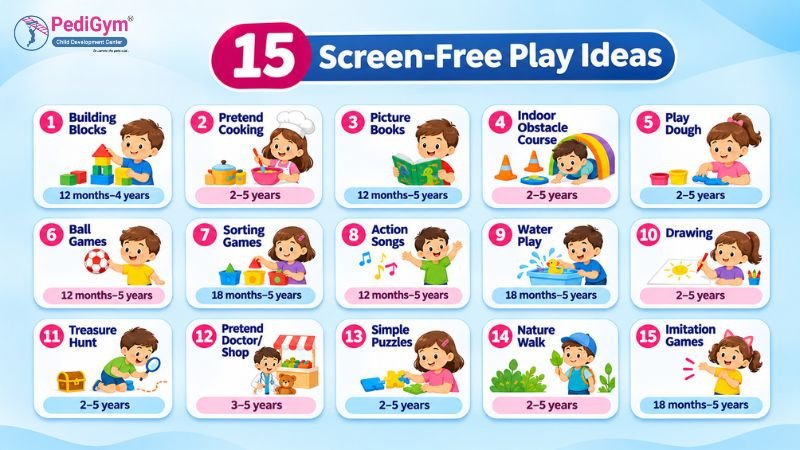
15 Screen-Free Play Ideas
The following activities use affordable materials and can be adapted according to your child’s age, interests and developmental abilities.
Activity | Suggested age | Skills supported |
1. Building blocks | 12 months–4 years | Vocabulary, grasp, coordination |
2. Pretend cooking | 2–5 years | Conversation, hand control |
3. Picture books | 12 months–5 years | Language, pointing |
4. Indoor obstacle course | 2–5 years | Balance, motor planning |
5. Play dough | 2–5 years | Finger strength, vocabulary |
6. Ball games | 12 months–5 years | Turn-taking, coordination |
7. Sorting games | 18 months–5 years | Concepts, pincer grasp |
8. Action songs | 12 months–5 years | Listening, body awareness |
9. Water play | 18 months–5 years | Hand control, descriptive language |
10. Drawing | 2–5 years | Pencil grasp, vocabulary |
11. Treasure hunt | 2–5 years | Understanding directions, movement |
12. Pretend doctor/shop | 3–5 years | Conversation, hand coordination |
13. Simple puzzles | 2–5 years | Problem-solving, visual-motor skills |
14. Nature walk | 2–5 years | Descriptive language, balance |
15. Imitation games | 18 months–5 years | Listening, motor planning |
These are suggested activity ranges, not developmental deadlines. Choose safe materials and adapt activities to your child’s abilities.
1. Building Blocks and Stacking Games
Ages: 12 months–4 years
Give your child large building blocks and encourage them to stack, arrange and knock down simple structures.
- Say: “Up, up, up! टावर गिर गया!” (The tower fell!)
- Speech skills: Introduces action words, colours, size concepts and requesting.
- Motor skills: Practises grasp and release, bilateral coordination and hand-eye coordination.
- Make it easier: Stack two or three large blocks together.
- Level up: Encourage your child to copy a simple three-block pattern.
Safety: For children under 3, use blocks that cannot pass through a toilet-roll tube. Avoid small detachable pieces.
2. Pretend Kitchen and Cooking Play
Ages: 2–5 years
Use empty containers, large toy utensils and pretend food to create a small kitchen.
- Say: “आज हम क्या बनाएँगे?” (What shall we cook today?)
- Speech skills: Encourages naming, requesting, vocabulary and simple conversations.
- Motor skills: Practises scooping, stirring, gripping and coordinated hand movements.
- Make it easier: Pretend to serve one familiar food.
- Level up: Take turns being the cook and customer.
3. Storytelling with Picture Books
Ages: 12 months–5 years
Choose picture books featuring animals, fruits, vehicles and familiar situations. Point to pictures and talk about what you see.
- Say: “Look, a dog! What is the dog doing?”
- Speech skills: Supports vocabulary, listening, sound imitation and sentence formation.
- Motor skills: Turning pages and pointing at pictures encourage finger control.
- Make it easier: Name familiar pictures and encourage your child to point.
- Level up: Ask your child to describe what happens next.
4. Indoor Obstacle Course
Ages: 2–5 years
Create a simple indoor obstacle course using cushions, soft mats and cardboard tunnels.
- Say: “Crawl through, step over and jump!”
- Speech skills: Practises action words and understanding instructions.
- Motor skills: Develops balance, body awareness and motor planning.
- Make it easier: Crawl over one soft cushion.
- Level up: Follow a two-step movement sequence.
5. Clay and Play-Dough Activities
Ages: 2–5 years
Use non-toxic, age-appropriate play dough to make balls, shapes and familiar objects.
- Say: “Roll the dough. Let’s make a round ball.”
- Speech skills: Introduces descriptive words, colours and object names.
- Motor skills: Strengthens finger muscles and practises pinching and the pincer grasp.
- Make it easier: Squeeze and flatten a large piece of dough.
- Level up: Create simple shapes or pretend fruits.
Safety: Supervise children closely, especially those who put objects in their mouths. Do not allow children to eat play dough.
6. Ball Rolling and Throwing Games
Ages: 12 months–5 years
Sit opposite your child and roll a soft ball between you. Introduce gentle throwing, catching and kicking as coordination improves.
- Say: “My turn. अब तुम्हारी बारी!” (Now your turn!)
- Speech skills: Encourages turn-taking, requesting and action-word understanding.
- Motor skills: Develops hand-eye coordination, balance and body control.
- Make it easier: Roll a large, lightweight ball.
- Level up: Encourage your child to catch or kick the ball towards a target.
7. Sorting Colours and Shapes
Ages: 18 months–5 years
Collect large coloured objects, shape blocks and containers. Encourage your child to match similar objects.
- Say: “Find the red one. Where does the circle go?”
- Speech skills: Practises colour names, shape vocabulary and understanding.
- Motor skills: Develops pincer grasp, controlled movements and visual-motor coordination.
- Make it easier: Match two different colours.
- Level up: Sort objects using two features, such as colour and size.
8. Action Songs and Hindi Rhymes
Ages: 12 months–5 years
Sing familiar Hindi rhymes such as Machhli Jal Ki Rani Hai and Lakdi Ki Kathi while performing simple actions.
- Say: Sing a familiar rhyme and pause before the final word: “मछली जल की रानी है, जीवन उसका…” Encourage your child to complete the line.
- Speech skills: Encourages listening, sound imitation and vocabulary development.
- Motor skills: Practises clapping, stomping, jumping and body coordination.
- Make it easier: Repeat simple hand movements.
- Level up: Encourage your child to perform actions in sequence.
9. Water Pouring and Splash Play
Ages: 18 months–5 years
Use a shallow basin, large cups and plastic containers for supervised water play.
- Say: “The cup is full. अब पानी डालो!” (Now pour the water!)
- Speech skills: Introduces words such as full, empty, more, less, wet and dry.
- Motor skills: Practises gripping, pouring and bilateral coordination.
- Make it easier: Transfer water using large cups.
- Level up: Compare containers with different amounts of water.
Safety: Maintain constant adult supervision around water, even when it is shallow.
10. Drawing and Finger Painting
Ages: 2–5 years
Provide large sheets of paper, washable crayons and child-safe paints.
- Say: “You made a blue circle. What shall we draw next?”
- Speech skills: Encourages naming, describing and expressing ideas.
- Motor skills: Supports pencil grasp, finger control and pre-writing movements.
- Make it easier: Make large lines and dots.
- Level up: Draw familiar objects and simple shapes.
11. Treasure Hunt at Home
Ages: 2–5 years
Hide familiar toys in safe, accessible places around the house. Give your child simple clues to find them.
- Say: “Find the ball under the table.”
- Speech skills: Practises location words and understanding directions.
- Motor skills: Encourages bending, reaching, walking and crossing the midline.
- Make it easier: Place a toy in an easy-to-see location.
- Level up: Give two-step clues.
12. Pretend Doctor or Shopkeeper
Ages: 3–5 years
Create a pretend clinic or grocery shop using toy medical instruments, empty food containers and large pretend products.
- Say: “What would you like? How can I help you?”
- Speech skills: Encourages greetings, questions and conversational turn-taking.
- Motor skills: Practises holding, arranging and exchanging objects.
- Make it easier: Name and exchange familiar items.
- Level up: Create short pretend conversations between a shopkeeper and customer.
13. Matching Cards and Simple Puzzles
Ages: 2–5 years
Use large picture cards or age-appropriate wooden puzzles featuring animals, fruits and familiar objects.
- Say: “Can you find the matching animal?”
- Speech skills: Builds vocabulary, identification and descriptive language.
- Motor skills: Develops visual-motor integration and controlled finger movements.
- Make it easier: Match two familiar pictures.
- Level up: Complete a simple puzzle independently.
14. Nature Walk and Object Collection
Ages: 2–5 years
Visit a nearby park or garden when outdoor conditions are suitable. Encourage your child to observe leaves, flowers, birds and trees.
- Say: “Look at the green leaf. Is it big or small?”
- Speech skills: Encourages descriptive language and observation.
- Motor skills: Practises walking, squatting, reaching and balance.
- Make it easier: Walk a short, level path together and point out one or two objects.
- Level up: Compare two leaves by colour, size or texture.
Safety: Collect only safe, fallen leaves with adult supervision. Avoid unknown plants, berries, sharp objects and anything your child might put in their mouth. On high-AQI days in Delhi NCR, choose indoor alternatives instead.
15. Imitation and Simon Says Games
Ages: 18 months–5 years
Perform simple actions such as clapping, waving, touching the head and jumping. Encourage your child to copy you.
- Say: “Clap your hands. अब नाक को छुओ!” (Now touch your nose!)
- Speech skills: Supports listening, action-word understanding and following instructions.
- Motor skills: Develops body awareness, bilateral coordination and motor planning.
- Make it easier: Copy one movement at a time.
- Level up: Introduce two- or three-step instructions.
Why Is Screen-Free Play Important for Child Development?
Screen-free play creates opportunities for children to communicate with parents, explore their surroundings and practise physical movements. During interactive play, children learn to respond to words, follow instructions, express their needs and develop coordination through hands-on activities.
The World Health Organization (WHO) highlights the importance of interactive, non-screen sedentary time with a caregiver. Activities such as reading, storytelling and doing puzzles give young children opportunities to engage with another person while learning and exploring.
A 2019 study by Madigan et al., published in JAMA Pediatrics, followed 2,441 children at 24, 36 and 60 months. The researchers used the Ages and Stages Questionnaire, Third Edition (ASQ-3), which screens five developmental domains: communication, gross motor, fine motor, problem-solving and personal-social skills.
The study found that higher screen time at 24 and 36 months was associated with poorer performance on developmental screening tests at later assessments. The reverse association—poorer developmental performance predicting increased screen time later—was not observed. The authors described this as a directional association, but the findings do not prove that screen time alone caused developmental differences. Read the Madigan et al. study.
A separate 2026 study by McQuaid et al., published in JAMA Network Open, examined a Scottish cohort of 3,786 children at age 5, followed up at ages 10 and 15. The researchers assessed emotional, behavioural and social difficulties using the Strengths and Difficulties Questionnaire (SDQ). They found that more than five hours of daily screen use at age 5 was associated with higher odds of emotional, behavioural and social difficulties at age 10. This association was not sustained at age 15. The study’s outcome was emotional, behavioural and social difficulties, not speech or motor skills, and its findings do not directly describe toddlers. Read the McQuaid et al. study.
These studies suggest that screen exposure should be considered alongside children’s ages, the type of content they use and the activities that screen time replaces. Parents can also read our guide to screen time and child development.
How Much Screen Time Is Recommended for Young Children?
The World Health Organization (WHO) and Indian Academy of Pediatrics (IAP) provide guidance for managing screen exposure:
- Children below 2 years: The IAP recommends avoiding screen exposure, apart from occasional video calls with relatives. WHO also advises against screen time for infants below 1 year and sedentary screen time for 1-year-olds.
- Children aged 24–59 months: The IAP recommends a maximum of one hour of supervised screen time per day.
- Children aged 2–4 years: WHO recommends no more than one hour of sedentary screen time daily, with less being better.
Interactive activities such as reading, storytelling, singing and puzzles with a caregiver should remain part of everyday routines. Video calls and supervised co-viewing of suitable content are different from children watching videos alone.
For additional guidance, parents can refer to the IAP screen-time guidelines published in Indian Pediatrics and the WHO recommendations for children under 5.
How Can Parents Encourage Speech During Everyday Play?
Parents can make everyday activities more useful for language development by creating natural opportunities for children to listen, respond and communicate.
Try these five techniques:
- Narrate actions: Describe what you and your child are doing. For example, “Mummy is washing the apple.”
- Expand words: If your child says “car”, respond with “Yes, a big red car!” This introduces additional vocabulary without pressuring the child to repeat.
- Pause before responding: Wait around five seconds after asking a question or making a comment. Give your child time to communicate through words, sounds or gestures.
- Offer choices: Ask, “Do you want the ball or blocks?” This encourages your child to express preferences.
- Repeat naturally: Use familiar words and phrases across different activities to help your child understand and remember them.
For Hindi-English bilingual families, speak in the languages you are most comfortable using. Children can learn more than one language through everyday interactions. If you have concerns about language development, a speech-language therapist should consider all the languages your child hears and uses when assessing communication skills.
When Should Parents Seek Professional Support?
Consider a developmental assessment if your child misses expected milestones, has difficulty communicating or moving, or loses skills they previously acquired. Early assessment can help identify areas where additional support may be useful.
Some CDC milestone examples parents can observe include:
Age | Communication milestone | Motor or physical milestone |
12 months | Calls a parent mama, dada or another special name | Picks up small items between thumb and finger |
18 months | Tries to say at least three words besides mama or dada | Scribbles |
2 years | Says at least two words together, such as “more milk” | Kicks a ball |
3 years | Has conversations using at least two back-and-forth exchanges | Draws a circle when shown how |
4 years | Says sentences with four or more words | Holds a crayon or pencil between fingers and thumb |
Source
CDC Milestone Checklists by Age
CDC milestone checklists help parents track development, but they are not substitutes for standardised, validated developmental screening tools or professional assessment. These are examples of milestones most children achieve by the listed ages, not diagnostic tests. Missing a milestone does not automatically mean a child has a developmental condition, but it is a reason to discuss concerns with a professional.
Parents should also consider a hearing assessment when speech or language development is a concern. Hearing difficulties can affect how children receive and learn language, so hearing should be checked as part of an appropriate evaluation.
The CDC advises parents to act early if a child misses milestones, loses previously acquired skills or has other developmental concerns. The American Academy of Pediatrics (AAP) recommends general developmental screening at 9, 18 and 30 months, and autism-specific screening at 18 and 24 months. Read the AAP’s developmental surveillance and screening recommendations.
For more information, read our guides on speech milestones and signs that a 2-year-old may need support and how a late talker differs from a child with speech delay.
Depending on the child’s individual needs, professional support may include:
- Speech Therapy: Supports speech, language, understanding and functional communication. Explore our speech therapy services for children.
- Occupational Therapy: Addresses fine motor skills, sensory processing, coordination and everyday activities. Learn more about Occupational Therapy for kids.
- Developmental Therapy: Supports individual developmental needs through structured activities.
Parents can also explore our month-by-month guide to developmental milestones to understand different areas of early childhood development.
Frequently Asked Questions
1. What are the best screen-free activities for speech development?
Picture books, pretend cooking, action songs, storytelling and imitation games are useful language development activities. For example, while playing with toy food, parents can ask, “What are you cooking?” and expand the child’s response. These activities encourage vocabulary, listening, requesting and conversational turn-taking.
2. Which screen-free activities improve fine motor skills?
Building blocks, play dough, drawing, sorting and simple puzzles help children practise finger strength, pincer grasp and hand-eye coordination. For example, asking a child to pick up large blocks and stack them encourages controlled hand movements. These activities also support visual-motor development. Parents can try these eye-hand coordination activities for children and explore Occupational Therapy for children for further information about fine motor development.
3. Can screen-free play help children with speech delay?
Interactive play provides opportunities to practise communication, but it does not replace professional assessment or speech therapy when a child needs additional support. If your toddler uses very few words or struggles to combine words, consult a speech-language therapist. Learn more about speech and language support for children.
4. How much screen time is okay for a 2-year-old?
WHO advises no more than one hour of sedentary screen time a day for a 2-year-old, and the IAP advises no more than one hour of supervised screen time, with less being better.
5. Are Hindi rhyme videos on YouTube okay for toddlers?
Hindi rhymes can introduce familiar words and songs, but children benefit from active participation rather than watching alone. If you use videos, choose suitable content, keep viewing short and watch together. Sing the rhyme, perform the actions and talk about the words. Avoid screens during meals and before bedtime.
6. When should I worry about speech delay?
Discuss your concerns with a professional if your child does not try at least three words besides mama or dada by 18 months, does not combine two words by age 2, or has difficulty with back-and-forth conversation by age 3. Hearing should also be checked. Read our guide to speech milestones at age 2 and when to seek help for more details.
7. How can I reduce my toddler’s screen time without tantrums?
Create predictable screen-free routines and give your child a warning before switching off a device. A visual timer can help children understand when screen time will end. Offer an alternative, such as blocks, picture books or pretend cooking, before your child asks for another video.
Support Your Child's Development Through Meaningful Play
Everyday play gives children opportunities to communicate, move and explore. These activities can become part of simple family routines using affordable household materials, familiar Hindi rhymes and interactive games.
At PediGym Child Development Center, we support children’s developmental needs through structured therapy programmes in Faridabad and Gurugram. Our services include support for speech, motor development, coordination and everyday functional skills.
Dr. Nitin Gupta is a paediatric physiotherapist and DMI Level C Certified Therapist at PediGym Child Development Center. Dynamic Movement Intervention (DMI) is a therapeutic approach that uses structured movement activities to address children’s motor development.
If you have concerns about your child’s speech, motor skills or overall development, explore our speech delay therapy services in Faridabad or child development services in Gurugram. You can also contact PediGym to discuss assessment and therapy options.

Dr. Nitin, Founder of PediGym Child Development Center, is a dedicated pediatric therapy expert and DMI Level C Certified Therapist leading structured, evidence-based therapy programs in Faridabad and Gurgaon. Under his guidance, PediGym provides comprehensive pediatric rehabilitation focused on improving motor skills, coordination, sensory processing, speech clarity, and functional independence through personalized intervention plans.