
Written by: Dr. Nitin Gupta, Founder, PediGym Child Development Center
Therapeutic tools are objects and activities that can help children practise movement, sensory exploration, participation, communication, play and emotional regulation. Examples include squeeze balls, therapy putty, visual timers, balance boards, colouring materials and puzzles.
What Are Therapeutic Tools?
Therapeutic tools are objects and activities that can help children practise movement, sensory exploration, attention, communication, play and emotional regulation. Examples include squeeze balls, therapy putty, visual timers, balance boards, colouring materials and puzzles.
These tools may support children who experience sensory sensitivities, difficulty with transitions, challenges with fine motor skills or trouble managing emotions. However, no single tool works for every child. Occupational therapy tools for kids should be chosen according to the child’s age, abilities, goals and safety needs.
Therapeutic tools can be used at home, in school or during therapy. They are not a substitute for an individual assessment or a personalised therapy plan. The goal is to help children participate more comfortably in meaningful everyday activities.
This article provides general educational information and is not a substitute for advice from a qualified healthcare professional. Always follow product instructions and seek professional guidance when a tool presents safety concerns.
Key Takeaways for Therapeutic Tools
- Therapeutic tools can help children practise sensory exploration, movement, fine motor skills, participation and emotional expression.
- The right tool depends on the child’s age, preferences, individual needs and the activity being practised.
- Some tools, including weighted products and movement equipment, require professional guidance and close supervision.
- Simple household activities can be a low-cost way to practise some everyday skills.
- Caregiver training and guidance on using sensory strategies at home can be important parts of a child’s support plan.
20 Therapeutic Tools
Tool | Common use | General age guidance | Safety guidance |
1. Squeeze ball | Hand activity and squeezing | Older toddlers and children, depending on size and product label | Choose an appropriate size and supervise young children |
2. Therapy putty | Hand strength and finger movements | Usually preschool-age children and older, if suitable for their developmental level | Check age recommendations and ingredients |
3. Tactile sensory bin | Exploring different textures | Preschool-age children and older; younger children need close supervision | Avoid small objects for children who mouth items |
4. Fidget tools | Occupying restless hands | School-age children and older, depending on the tool | Choose safe, durable items |
5. Chewable tools | Providing a designated chewing option | Only when age-appropriate and suitable for the child | Use products designed for oral use |
6. Weighted blanket | Comfort and deep-pressure input | Children only after individual suitability has been assessed | Seek professional advice before use |
7. Quiet-corner tent | Creating a quieter break space | Toddlers and older children with appropriate supervision | Ensure ventilation and an easy exit |
8. Resistance bands | Practising controlled pulling and pushing | School-age children and older, with supervision | Check for latex allergy and inspect for damage |
9. Therapy balls | Supported movement activities | Age and size dependent; use with appropriate supervision | Use the correct size and supervise closely |
10. Wobble cushion | Introducing movement while seated | School-age children and older, if suitable for the activity | Check stability; evidence for attention benefits is limited |
11. Balance board | Practising balance and coordination | Usually school-age children, depending on balance ability | Use on a stable surface with adult supervision |
12. Noise-reducing earmuffs | Reducing exposure to loud sounds | Children who can tolerate and safely use them | Ensure important safety sounds can still be heard when necessary |
13. Volume-limiting headphones | Listening to audio | Choose according to fit and manufacturer’s age guidance | Keep volume low and limit listening time |
14. Visual timer | Making transitions easier to understand | Toddlers and older children, using suitable visual cues | Keep the display clear and age-appropriate |
15. Colouring materials | Practising controlled hand movements | Toddlers and older children, with suitable materials | Choose non-toxic, age-appropriate products |
16. Art supplies | Exploring creativity and expression | Choose materials according to the child’s age and abilities | Check labels and supervise younger children |
17. Modelling clay or kinetic sand | Exploring textures and shaping materials | Usually preschool-age children and older, depending on the product label | Prevent swallowing or contact with the eyes |
18. Sand tray play | Exploring and creating with sand | Preschool-age children and older, with supervision | Use clean, suitable materials |
19. Drawing journal | Expressing ideas through drawing | Preschool-age children and older, according to their interests | Avoid pressuring children to explain their drawings |
20. Puzzles and sorting activities | Practising matching and problem-solving | Choose complexity according to developmental level | Avoid small pieces when there is a choking risk |
Age guidance is general, not a guarantee of suitability. Always check the product’s minimum-age label and consider the child’s individual abilities, mouthing behaviour and supervision needs.
Sensory and Tactile Tools
Sensory and tactile tools offer different ways for children to explore touch, pressure and textures. A child’s response can vary, so introduce one tool at a time and observe whether it helps with the intended activity.
1. Squeeze Ball
A squeeze ball is a soft object that a child can press, squeeze and release. It provides a simple hand activity that can be used during breaks or while practising controlled hand movements.
How to use: Offer the ball during a suitable activity and demonstrate slow squeezing and releasing. Let the child choose whether to use it.
Safety note: Choose a durable ball of an appropriate size. Inspect it for tears and loose parts, and supervise young children to reduce choking risks.
2. Therapy Putty
Therapy putty is a pliable material that children can stretch, pinch, roll and press. These movements can provide opportunities to practise finger control and hand strength.
How to use: Invite the child to roll the putty into a ball, flatten it or pinch small sections. Keep activities brief and matched to the child’s abilities.
Safety note: Check the ingredients for allergens, including latex. Use only products suitable for the child’s age, and do not allow putty to be swallowed.
3. Tactile Sensory Bin
A tactile sensory bin contains materials with different textures, such as large fabric pieces or other age-appropriate objects. It offers a structured way to explore touch through play.
How to use: Place a small selection of safe materials in a container and let the child explore at their own pace. A child who dislikes touching materials directly might prefer using a scoop or spoon.
Safety note: Avoid small items for children who put objects in their mouths. Check materials for sharp edges, allergens and choking hazards, and supervise the activity.
4. Fidget Tools
Fidget tools include small, hand-held objects that children can manipulate, such as textured rings or simple squeezable items. They may provide a movement activity for restless hands, although they do not improve attention for every child.
How to use: Introduce one fidget tool during an activity and observe whether it helps the child remain involved or becomes a distraction.
Safety note: Choose durable, age-appropriate products without loose pieces. Stop using a tool if the child chews, breaks or throws it in an unsafe way.
5. Chewable Tools
Chewable tools are products specifically designed to be chewed. They may offer an alternative to chewing clothing, pencils or other unsuitable objects for some children.
How to use: If chewing is a concern, ask an appropriate healthcare professional whether a chewable product is suitable and how it should be used.
Safety note: Use only products designed for oral use and follow the manufacturer’s instructions. Inspect regularly for damage, and seek professional advice if chewing creates concerns about swallowing, teeth or oral safety.
6. Weighted Blanket
A weighted blanket is heavier than a standard blanket and provides deep-pressure input. Some children may find this sensation comfortable, but a weighted blanket is not appropriate for every child and should not be assumed to improve sleep or behaviour.
How to use: Discuss suitability with a qualified healthcare professional before introducing a weighted blanket, particularly for a child with physical, breathing or mobility difficulties.
Safety note: Never use a weighted blanket to restrain a child. The child must be able to move it away independently, and it must not cover the face or interfere with breathing. Do not use it for an infant or a child who cannot remove it safely.
7. Quiet-Corner Tent
A quiet-corner tent or designated calm space can give a child an option to take a break from busy surroundings. It may be useful when a child wants a quieter place to pause or settle.
How to use: Set up a comfortable area with simple activities, such as a book, soft cushion or drawing materials. Let the child choose when to use the space, where appropriate.
Safety note: Ensure good ventilation, an easy exit and adult supervision suitable for the child’s age and needs. Never use a tent to confine a child or block their access to help.
Movement and Body Awareness Tools
Movement tools provide opportunities to practise balance, coordination and controlled body movements. These activities should match the child’s abilities and take place in a safe environment.
8. Resistance Bands
Resistance bands stretch when pulled and provide resistance during movement. They can be used for simple pushing and pulling activities under appropriate supervision.
How to use: An adult or therapist can demonstrate a gentle pulling activity with the band held securely. Keep movements controlled and avoid overstretching.
Safety note: Check for latex allergy and choose a suitable product. Inspect the band for tears, keep it away from the face and supervise use to reduce the risk of it snapping back.
9. Therapy Balls
Therapy balls are large inflatable balls used for supported movement and balance activities. A therapist may use one as part of an individualised activity plan.
How to use: Use the correct ball size and begin with a simple, supported activity on a non-slip surface. If a ball is used as a seat, monitor comfort and participation rather than assuming it will improve attention (see wobble cushion).
Safety note: Maintain close adult supervision and keep the activity away from hard edges or other hazards. Do not leave a child sitting or balancing on a therapy ball unattended.
10. Wobble Cushion
A wobble cushion is an inflatable or flexible cushion that allows small movements while a child is seated. Some children enjoy the movement, but reviews of the research have not found that alternative seating improves attention, so treat it as an option to trial rather than a solution.
How to use: Trial the cushion during a short seated activity and compare the child’s comfort and participation with their usual seating.
Safety note: Place the cushion on a stable chair and supervise as needed. Stop using it if it makes sitting less comfortable or creates a risk of falling.
11. Balance Board
A balance board is a platform that moves or tilts as weight shifts. It can be used for age-appropriate activities that involve balance and controlled movement.
How to use: Begin with simple supported activities on a stable, non-slip surface. A therapist can help decide whether the board is appropriate and how to progress safely.
Safety note: Use close supervision and provide a stable handhold where needed. Avoid raised surfaces, slippery floors and activities beyond the child’s current balance abilities.
Sound and Visual Support Tools
Lorem ipsum dolor sit amet, consectetur adipiscing elit. Ut elit tellus, luctus nec ullamcorper mattis, pulvinar dapibus leo.
Sound and visual tools can help families adapt activities and communicate what is happening next. The aim is to improve access and participation, not to eliminate every sound or movement from a child’s environment.
12. Noise-Reducing Earmuffs
Noise-reducing earmuffs lower the level of sound reaching the ears. They may be useful in some loud environments when a child finds noise uncomfortable.
How to use: Offer earmuffs for suitable situations, such as a particularly noisy event, and let the child indicate whether they are comfortable wearing them.
Safety note: Ensure the child can hear important instructions, alarms and traffic when necessary. Avoid relying on earmuffs in situations where hearing environmental sounds is essential.
13. Volume-Limiting Headphones
Volume-limiting headphones are designed to restrict audio output to a specified level. They can be useful for listening to music, stories or other appropriate audio content.
How to use: Choose headphones that fit comfortably, keep the volume low and limit listening time. Take breaks and monitor the child’s comfort.
Safety note: Ensure the child can hear important instructions and safety signals when needed. Check the manufacturer’s actual volume-limiting specifications rather than assuming all products offer the same protection. Stop use if the child experiences discomfort or reports ringing in the ears.
14. Visual Timer
A visual timer shows the passage of time through a visual display, such as a shrinking coloured section. It can help children understand how long an activity will continue and prepare for transitions.
How to use: Show the timer before an activity starts and explain what will happen when the time ends. Pair it with a clear verbal warning, especially when the child is moving between activities.
Safety note: Keep the display simple and appropriate for the child’s understanding. A timer should support communication, not be used to pressure or punish a child who needs additional time.
Creative and Expressive Tools
Creative activities provide ways to practise hand movements, make choices and express ideas. Children should be allowed to participate at their own pace without pressure to produce a particular result.
15. Colouring Materials
Crayons, pencils and colouring sheets provide opportunities to practise grasp, controlled movements and creative choice.
How to use: Offer simple pictures or blank paper and allow the child to choose colours and how much to complete. Larger crayons or adapted grips may be useful for some children.
Safety note: Select non-toxic materials suitable for the child’s age. Supervise younger children and avoid products with small parts that could be swallowed.
16. Art Supplies
Art supplies can include paint, paper, brushes, stamps and other age-appropriate materials. They offer opportunities for creative exploration and making choices.
How to use: Provide a small selection of materials and demonstrate how to use them. Allow the child to choose whether to paint, draw, stamp or explore another option.
Safety note: Check product labels and supervise younger children. Use materials intended for children, protect the work area and avoid products that could trigger known allergies.
17. Modelling Clay or Kinetic Sand
Modelling clay and kinetic sand offer different textures that children can press, roll, shape and explore. These activities can also create opportunities for pretend play and simple hand movements.
How to use: Start with a small amount of material and invite the child to make shapes or follow their own ideas. If the child dislikes the texture, offer a tool such as a spoon or mould instead of insisting on direct contact.
Safety note: Choose age-appropriate products and supervise closely. Prevent swallowing or contact with the eyes, and stop the activity if the material causes irritation or distress.
18. Sand Tray Play
Sand tray play involves moving, arranging or drawing in sand using hands or simple tools. It can provide a structured creative activity with opportunities to explore texture and make patterns.
How to use: Use a shallow tray with clean, suitable sand. The child can draw lines, make patterns or arrange safe objects in the tray.
Safety note: Keep sand away from the eyes and mouth. Check for allergies or skin irritation, maintain cleanliness and supervise children who may put materials in their mouths.
19. Drawing Journal
A drawing journal is a notebook where a child can draw pictures, make marks or record ideas. It can offer a way to express preferences or experiences without requiring a spoken explanation.
How to use: Keep the journal available for voluntary drawing. A child may choose to draw a favourite activity, a place they enjoy or something they would like to do.
Safety note: Do not assume that a drawing reveals a particular emotion or diagnosis. Let the child decide whether to talk about their work, and avoid pressuring them to share private thoughts.
20. Puzzles and Sorting Activities
Puzzles and sorting activities involve matching pieces, grouping objects or completing simple patterns. They can provide opportunities to practise visual matching, problem-solving and hand–eye coordination.
How to use: Start with a small number of pieces and demonstrate the activity if needed. Increase the difficulty gradually according to the child’s interest and abilities.
Safety note: Choose pieces appropriate for the child’s age and avoid small parts when there is a choking risk. Stop or simplify the task if it becomes frustrating or unsafe.
How to Choose the Right Therapeutic Tools for Your Child
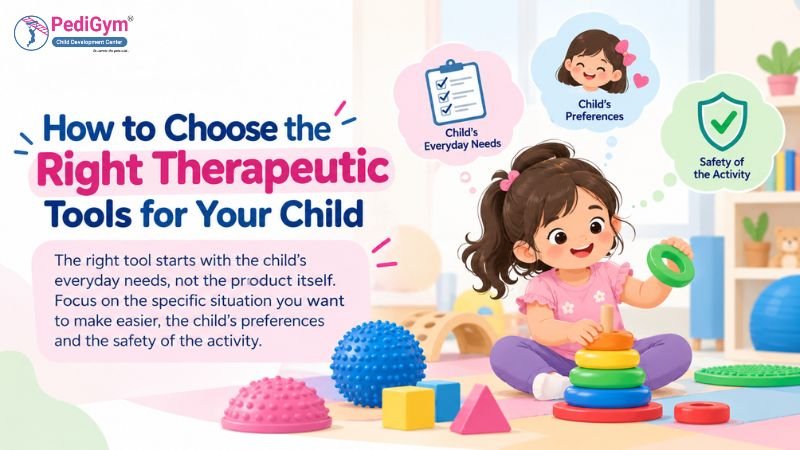
The right tool starts with the child’s everyday needs, not the product itself. Focus on the specific situation you want to make easier, the child’s preferences and the safety of the activity.
The American Academy of Pediatrics’ 2012 policy statement says sensory-based therapies delivered within occupational therapy may be acceptable as one part of a comprehensive plan, but families should be told that the research is limited and should learn how to judge whether a therapy is working.
Evidence for sensory-based approaches is mixed and varies by intervention and outcome, so improvement should be monitored rather than assumed.
Research reviews have found strong evidence for caregiver training in using sensory strategies. Learning from a therapist how to adapt activities at home can be a useful part of a support plan.
Which Calming Tools for Children Should You Try First?
Start with the lowest-risk option that matches the difficulty:
- Difficult transitions: a visual timer and a clear verbal warning.
- Noisy places: earmuffs for short periods when reducing sound is appropriate.
- Restless hands: a squeeze ball or simple fidget tool.
- Need for a break: a quiet-corner tent or designated calm space.
- Hard to put feelings into words: drawing materials.
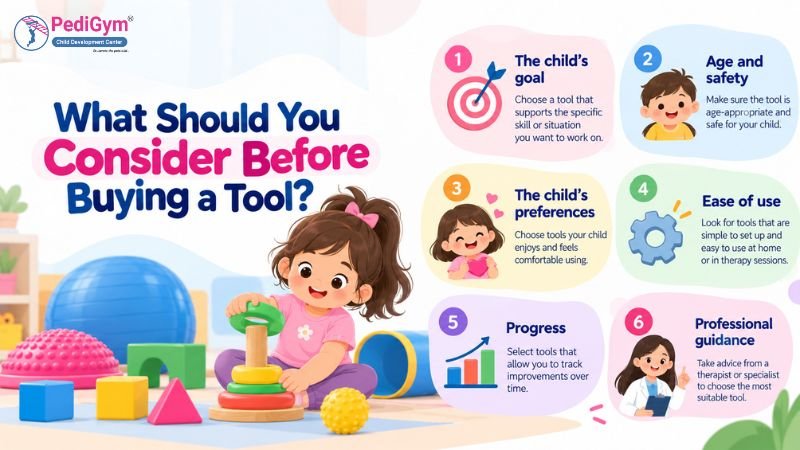
What Should You Consider Before Buying a Tool?
- The child’s goal: Decide what everyday activity you want to make easier, such as transitioning, drawing or participating in a family routine.
- Age and safety: Check the manufacturer’s age guidance, small parts, materials and supervision requirements.
- The child’s preferences: Offer choices and respect signs of discomfort or refusal.
- Ease of use: Choose something that can be used safely and consistently in the child’s daily environment.
- Progress: Observe whether the tool helps with the intended activity. If it does not, reconsider the approach rather than assuming the child needs to try harder.
- Professional guidance: Ask a qualified professional for advice when a tool involves weight, oral use, balance challenges or other safety concerns.
How Can You Tell a Tool Is Not Working?
A tool is not automatically helpful just because it is designed for therapy. Look at the child’s comfort and participation before, during and after using it.
Consider changing or stopping the activity if:
- The child consistently avoids the tool or appears distressed.
- The tool makes the intended activity harder rather than easier.
- The child becomes distracted by the tool.
- There is no noticeable improvement in the specific everyday activity you are targeting.
- The tool creates a safety concern or causes physical discomfort.
Discuss ongoing concerns with an appropriate healthcare professional. A tool should fit the child’s needs, and it is reasonable to try a different approach when the current one is not useful.
A Simple 10-Minute Home Routine
This example combines short activities using common tools. It is a general illustration, not an individual therapy prescription. Adapt it to the child’s interests, abilities and safety needs.
Time | Activity | Tool | Purpose |
2 minutes | Show the activity sequence and explain what comes next | Visual timer | Prepare for transitions |
2 minutes | Squeeze and release a ball | Squeeze ball | Practise controlled hand movements |
3 minutes | Draw, colour or make simple shapes | Colouring materials | Explore creative choices |
3 minutes | Complete a simple matching or sorting task | Puzzle or sorting activity | Practise matching and problem-solving |
Keep the routine flexible. Some children may prefer a shorter activity, a movement break or more time to complete a task. The aim is comfortable participation rather than completing every activity on schedule.
Low-Cost Therapeutic Tools and Alternatives
Families do not always need specialised equipment to create opportunities for everyday practice. Simple activities using familiar household materials can be a starting point when they are safe and suitable for the child.
Examples include:
- Picture schedule or paper countdown: Draw simple pictures showing the order of activities, or use a paper countdown to help prepare for a transition.
- Blanket-and-cushion corner: Set up a comfortable, quiet space using a blanket and cushions, ensuring the child can enter and leave easily.
- Sorting with large lids or cups: Group safe, large items by colour or type. Check that every item is too large to pose a choking risk for the child.
- Dry rice or lentils with a scoop: Offer a small bowl and scoop for supervised texture exploration, but only for children who do not mouth or swallow objects. Keep the materials away from the eyes and mouth.
Basic art supplies and activity materials are available at local stationery or toy shops and through online retailers in India. Choose age-appropriate products, check the manufacturer’s safety instructions and avoid DIY items with small parts, sharp edges or unsafe materials.
How Can PediGym Help Your Child?
PediGym Child Development Center, founded by Dr. Nitin Gupta, provides child-development support for families in Faridabad and Gurgaon. If you are concerned about your child’s sensory responses, movement, participation or daily routines, contact PediGym to enquire about its services and assessment options.
A discussion with the centre can help you understand the available support and possible next steps for your child.
Frequently Asked Questions
1. What are therapeutic tools for children?
Therapeutic tools are objects and activities that children can use to practise everyday skills, explore sensory experiences, move, create or communicate. Examples include squeeze balls, visual timers, puzzles and art materials. The right choice depends on the child’s needs, preferences, age and safety requirements.
2. Do therapeutic tools help autistic children?
Some therapeutic tools may help autistic children participate more comfortably in specific activities, depending on their individual preferences and support needs. A visual timer may help make transitions clearer, while drawing materials can provide a way to express ideas. No single tool is suitable for every autistic child, so observe the child’s response and seek professional guidance when needed.
3. Are sensory tools suitable for every child?
No. Sensory tools affect children differently. A child may enjoy a particular texture or movement, while another may find it uncomfortable or distracting. Introduce tools gradually, respect the child’s preferences and consider professional guidance if sensory differences interfere with daily activities.
4. Can I use therapeutic tools at home?
Yes, many simple activities can be practised at home when they are safe and suitable for the child. Drawing, sorting larger objects and using a visual timer are possible starting points. Equipment involving weights, chewing, balance or other specific risks should be considered carefully, with professional advice where appropriate.
5. Are sensory processing difficulties a separate diagnosis?
No. The American Academy of Pediatrics’ 2012 policy statement advises that sensory processing disorder generally should not be diagnosed as a separate condition, because there is no universally accepted diagnostic framework. Sensory differences occur in autism, ADHD, developmental coordination disorder and anxiety, so assessment should look at the whole child [4].
6. How do I know which therapeutic tool is right for my child?
Start by identifying the everyday activity that is difficult and the support the child prefers. Consider the child’s age, safety needs and interests, then trial a suitable tool and observe whether it improves participation. A qualified professional can help you select activities and decide how to monitor progress.
References
- American Occupational Therapy Association (AOTA). Sensory Integration Approaches for Children and Youth Within Occupational Therapy Practice. American Journal of Occupational Therapy. 2023. https://doi.org/10.5014/ajot.2023.77S3004
- Piller A, et al , McHugh Conlin J, Glennon TJ, Andelin L, Auld-Wright K, Teng K and Tarver T. Systematic review of sensory-based interventions for children and youth (2015–2024). Frontiers in Pediatrics. 2025;13:1720179. https://doi.org/10.3389/fped.2025.1720179
- American Occupational Therapy Association (AOTA). Sensory-Based Interventions in Occupational Therapy for Children and Youth (May 2015–January 2024). American Journal of Occupational Therapy. 2025. https://doi.org/10.5014/ajot.2025.79S102
- American Academy of Pediatrics. Sensory Integration Therapies for Children With Developmental and Behavioral Disorders. Pediatrics. 2012;129(6):1186–1189. https://doi.org/10.1542/peds.2012-0876

Dr. Nitin, Founder of PediGym Child Development Center, is a dedicated pediatric therapy expert and DMI Level C Certified Therapist leading structured, evidence-based therapy programs in Faridabad and Gurgaon. Under his guidance, PediGym provides comprehensive pediatric rehabilitation focused on improving motor skills, coordination, sensory processing, speech clarity, and functional independence through personalized intervention plans.