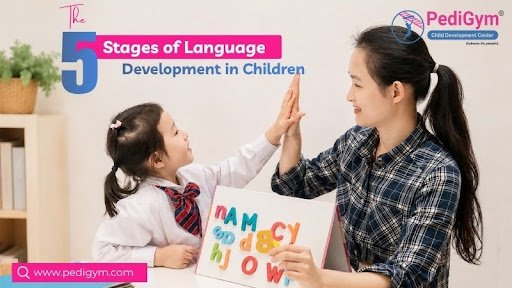
Every parent looks forward to hearing their child’s first word. But language development starts much earlier than that. Long before children begin speaking clearly, they are already learning how to listen, respond, understand, and communicate with the people around them.
Understanding the stages of language development can help parents recognize important milestones, support communication at home, and identify when a child may need extra help.
Language development is generally divided into two important areas:
- Receptive language – the ability to understand words, sounds, instructions, and communication from others.
- Expressive language – the ability to use sounds, gestures, words, and sentences to express thoughts and needs.
Both skills develop together throughout childhood.
Why Language Development Matters
Language is much more than speaking words. It helps children:
- Express emotions and needs
- Build relationships
- Learn and solve problems
- Follow instructions
- Develop confidence in social situations
Strong communication skills also support school readiness, emotional regulation, and learning later in life.
When children struggle to communicate, they may become frustrated because they cannot express themselves clearly. That’s why understanding early speech milestones is important for parents during the early years.
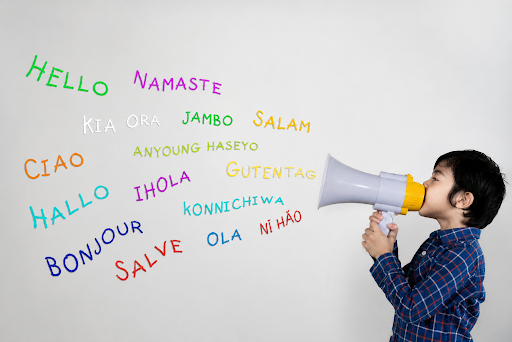
How Speech and Language Development Begins
Many parents think speech starts when a child says “mama” or “papa.” In reality, communication development begins from birth.
Before children speak clearly, they first learn to:
- Listen to sounds
- Recognize familiar voices
- Watch facial expressions
- Understand simple words
- Copy sounds and gestures
This natural progression is part of typical speech and language development.
Every stage builds the foundation for the next.
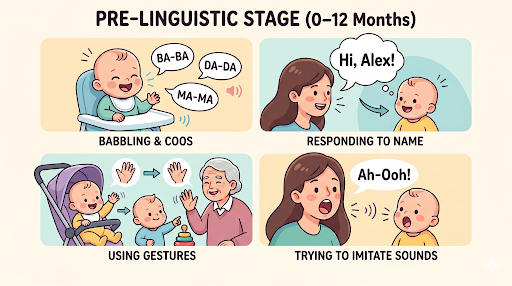
1. Pre-Linguistic Stage (0–12 Months)
The pre-linguistic stage is the earliest phase of communication development. During this stage, babies are not using meaningful words yet, but they are learning how communication works.
This stage includes two important phases.
Early Pre-Linguistic Phase (0–6 Months)
Babies usually:
- Cry differently for different needs
- React to familiar voices
- Smile socially
- Make cooing sounds
- Turn toward sounds
- Begin simple turn-taking during interaction, such as smiling or vocalizing back and forth
Babbling Phase (6–12 Months)
As babies grow, communication becomes more interactive. They begin:
- Babbling with sounds like “ba-ba” and “da-da”
- Responding to their name
- Using gestures like waving or pointing
- Trying to imitate sounds
- Understanding simple words like “no” by around 9–12 months
Babbling is an important milestone because it helps babies practice controlling their lips, tongue, breathing, and voice.
How Parents Can Support This Stage
Parents can encourage communication by:
- Talking during daily routines
- Singing songs and rhymes
- Responding to the baby’s sounds
- Maintaining eye contact
- Playing interaction games like peek-a-boo
Real-life interaction is one of the strongest foundations for language development.
2. Holophrastic Stage (12–18 Months)
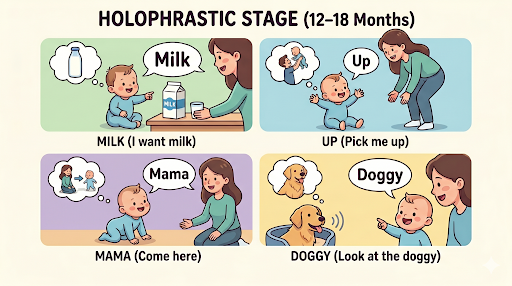
The holophrastic stage is also known as the “one-word stage.”
At this stage, children begin using single words to express complete ideas.
For example:
- “Milk” may mean “I want milk”
- “Up” may mean “Pick me up”
- “Mama” may mean “Come here”
One word can represent an entire sentence.
Common Language Milestones
Children may:
- Use a small but growing vocabulary, often around 10–50 meaningful words by 18 months, though some children naturally have fewer words
- Point to request or show interest
- Understand simple instructions
- Combine gestures with sounds
- Recognize names of familiar people or objects
Vocabulary growth varies between children. Some children speak earlier, while others rely more on gestures before verbal language increases.
What Parents Should Observe
Parents should pay attention if a child:
- Rarely attempts communication
- Does not respond to their name by 12 months
- Shows limited eye contact
- Appears uninterested in interaction
Communication attempts are often more important than the exact number of spoken words.
3. Two-Word and Telegraphic Stage (18–24 Months)
This stage marks a major communication leap.
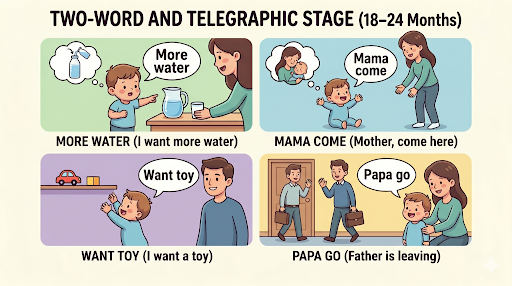
Children begin combining words to form meaningful phrases such as:
- “More water”
- “Mama come”
- “Want toy”
- “Papa go”
This type of speech is often called telegraphic speech because children use key words while leaving out smaller grammar words.
For example:
- “Want juice” instead of “I want juice”
- “Baby sleeping” instead of “The baby is sleeping”
Important Speech Milestones
By age 2, many children:
- Use around 50 or more words
- Combine two-word phrases
- Follow simple instructions
- Ask simple one- or two-word questions
- Become about 50% understandable to unfamiliar listeners
This means about half of what your child says may still be unclear to people outside the family — this is completely normal at this age.
As children approach age 3, speech becomes more consistent and expressive.
How Parents Can Help
Parents can support language growth by:
- Expanding what the child says
Example: Child says “milk” → Parent says “You want milk?” - Offering simple choices
“Do you want an apple or banana?” - Encouraging conversations during play
- Reading simple picture books together
Speech Milestones Chart by Age
Age | Expected Speech & Language Skills | How Parents Can Support |
0–6 Months | Cooing, smiling, responding to sounds | Talk often, sing songs, maintain eye contact |
6–12 Months | Babbling, gestures, responding to name | Encourage imitation and interactive play |
12–18 Months | First words, pointing, understanding simple commands | Read picture books and name objects clearly |
18–24 Months | Two-word phrases, vocabulary growth | Encourage choices and short conversations |
2–3 Years | Short sentences, asking questions | Expand sentences and encourage storytelling |
3–5 Years | Conversations, storytelling, clearer speech | Read daily and encourage pretend play |
This speech milestones chart is a general guide. Every child develops differently, but consistent delays should not be ignored.
4. Early Sentence Stage (24–36 Months)
At this stage, children begin using longer and more meaningful sentences.
Their vocabulary grows quickly, and they begin using language socially during play and daily interaction.
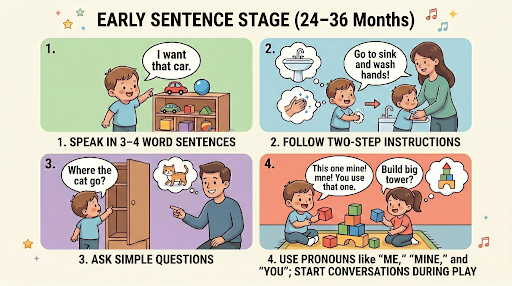
Children may:
- Speak in 3–4 word sentences
- Follow two-step instructions
- Ask simple questions
- Use pronouns like “me,” “mine,” and “you”
- Start conversations during play
By around age 3, children are often about 75% understandable to unfamiliar listeners.
This stage is important because children are learning not only to speak, but also to use language for social interaction, imagination, and problem-solving.
How Parents Can Support This Stage
Parents can help by:
- Encouraging pretend play conversations
- Asking open-ended questions
- Expanding short sentences naturally
- Reading stories and discussing pictures
- Giving children enough time to respond
Interactive conversation is more beneficial than passive listening.
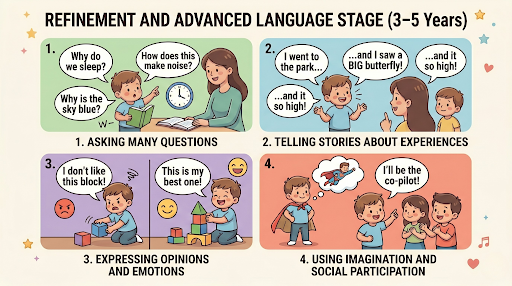
5. Refinement and Advanced Language Stage (3–5 Years)
This stage involves rapid development in vocabulary, grammar, storytelling, and conversation skills.
Children begin:
- Asking many questions
- Telling stories about experiences
- Expressing opinions and emotions
- Using imagination during conversations
- Participating more confidently in social situations
By age 4–5, many children can:
- Speak in complete sentences
- Describe events clearly
- Follow longer instructions
- Hold simple conversations
- Be nearly 100% understandable to unfamiliar listeners for most sounds and words
Children also begin developing important pre-literacy skills such as:
- Rhyming and sound play
- Listening to longer stories
- Understanding story order (beginning, middle, end)
- Recognizing some letters and sounds
These skills support reading readiness, classroom learning, and overall school preparation
Early Signs of Speech or Language Delay
Every child develops at their own pace, but some signs should not be ignored.
Parents should consider professional guidance if their child:
- Does not babble by 9–12 months
- Does not respond to their name by 12 months
- Does not point to show interest by 12 months
- Has no meaningful words by 18 months
- Cannot combine words by age 2
- Struggles to understand instructions
- Has speech that is difficult for strangers to understand after age 3
- Loses previously learned speech or communication skills
- Gets frustrated frequently while communicating
Early support can make communication development easier and more effective during the early years.
Depending on the child’s needs, support may include speech-language therapy, occupational therapy, or play-based intervention approaches that focus on communication, interaction, and social development.
How Parents Can Support Language Development at Home
Children learn language best through everyday interaction.
Talk Throughout the Day
Describe activities naturally:
- “Let’s wash your hands”
- “Look at the blue car”
Hearing language repeatedly helps children learn new words and understand meaning.
Read Together Daily
Reading supports:
- Vocabulary growth
- Listening skills
- Attention span
- Imagination
Even short reading sessions every day can improve communication development.
Encourage Turn-Taking
Pause during conversations and give your child time to respond, even if they use gestures or sounds.
Expand Their Sentences
If your child says:
- “Dog”
You can respond:
- “Yes, the dog is running!”
This helps children hear correct sentence structure naturally.
Reduce Passive Screen Time
Health experts generally recommend avoiding passive screen time for children under 2 and limiting screen time for ages 2–5, while encouraging more face-to-face interaction, reading, and play-based communication activities.
Final Thoughts
The stages of language development in children are an important part of overall growth. From cooing and babbling to storytelling and conversation, every stage helps children build communication, social, and learning skills.
Understanding important language milestones and tracking early speech milestones can help parents recognize whether development is progressing normally.
Every child develops differently, but consistent interaction, encouragement, and early support can make a lasting difference in communication confidence and future learning success.

Dr. Nitin, Founder of PediGym Child Development Center, is a dedicated pediatric therapy expert and DMI Level C Certified Therapist leading structured, evidence-based therapy programs in Faridabad and Gurgaon. Under his guidance, PediGym provides comprehensive pediatric rehabilitation focused on improving motor skills, coordination, sensory processing, speech clarity, and functional independence through personalized intervention plans.