
If your child regularly melts down before school, avoids activities, becomes distressed by certain sounds or movements, or struggles with transitions, the most important question is not, “How do I stop this behaviour?” It is, “What is making my child feel unable to cope?”
That question is the starting point of a practical anxiety care plan for children.
Children experience fears and worries as part of normal development. Babies and toddlers may show separation anxiety, while preschoolers may develop fears of being alone or the dark. Generalised worry is not common in the preschool years and typically becomes more apparent as children reach school age, when worries may relate to school, criticism, social situations, performance, or future events.
The important thing is to look at the pattern and the impact. Anxiety does not always look like a child saying, “I feel worried.” It may appear as crying, irritability, physical complaints, refusal, clinginess, sleep difficulties, or repeated meltdowns. For some children, particularly those with sensory, motor, communication, or developmental challenges, the anxiety may be connected to something very specific.
At PediGym Child Development Center, we believe the behaviour is often the starting point for understanding the child – not the problem to be corrected first.
What Should You Do When Your Child Is Having an Anxiety Meltdown?
When your child is already overwhelmed, do not try to win an argument or explain why the fear is unreasonable. Long explanations and repeated reassurance rarely help a distressed child think clearly in that moment.
Instead, keep your response simple. First, name the feeling without confirming that the feared situation is actually dangerous: “I can see that you are scared.” Then use calm, realistic reassurance such as, “You are safe. I am here. We will take this one step at a time.”
Try to avoid phrases such as “There is nothing to be scared of,” “Stop crying,” or “You are fine.” These statements may be intended to reassure your child, but they can make the child feel misunderstood or dismissed. Child Mind Institute recommends respecting a child’s feelings without reinforcing the fear or making avoidance the long-term solution.
Also, reduce your own intensity. Speak slowly, keep your body calm, and look at whether sensory input around the child can be reduced.
These are in the moment strategies, not a complete treatment plan. If the same anxiety pattern keeps returning, the next step is understanding what is triggering it.
Why Avoiding Every Trigger Can Make Anxiety Stronger
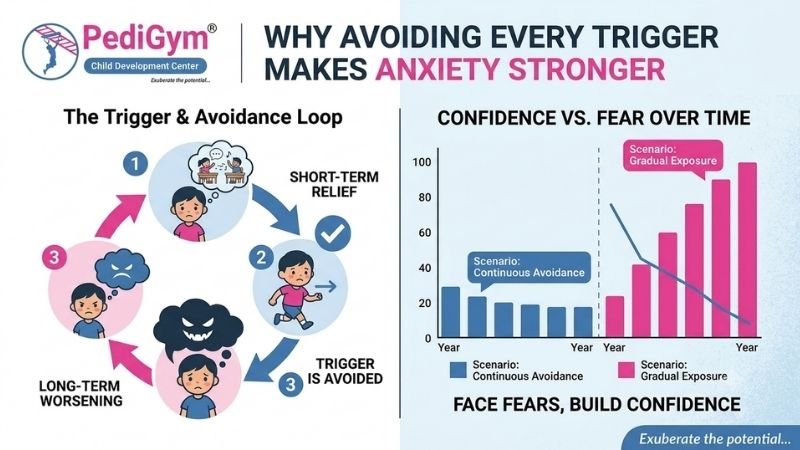
Imagine a child who is afraid of a noisy playground. The child refuses to go, the parent takes them home, and the anxiety drops. Everyone feels relief. But the child’s brain may learn, “Avoiding the playground kept me safe.”
The next visit may then feel even more difficult.
This is the anxiety-avoidance cycle. Avoidance can reduce anxiety in the short term while reinforcing the fear over time. That is why recognised anxiety approaches such as Cognitive Behavioural Therapy use coping skills and gradual, supported steps to help children face fears rather than continually escape them.
This does not mean forcing a distressed child into a frightening situation. A child may first look at the playground from a distance, enter for a few minutes, or try one activity before moving to the next step. The challenge needs to be manageable.
For a child with sensory or motor difficulties, the first step may look different. It may involve gradually tolerating a specific sensory input, practising a movement in a controlled environment, or building enough body confidence to attempt an activity that previously felt difficult.
The goal is not to make a child “push through” fear. It is to help them gradually experience, “I can manage this.”
Why the Reason Behind the Anxiety Matters
A child who refuses a PE activity may not be afraid of the activity itself. They may be worried about falling, overwhelmed by the noise in the gym, or unable to explain why the activity feels difficult. The behaviour looks similar. The reason may be completely different.
This is particularly important when anxiety appears alongside sensory processing difficulties, developmental delays, motor challenges, or communication difficulties. A child who struggles with balance may feel genuinely insecure during physical activities. A child with speech or communication delays may avoid group play because expressing themselves is difficult. A child who becomes overwhelmed by noise, touch, or movement may appear defiant when their nervous system is overloaded.
That is why a meaningful anxiety care plan for children should look at the trigger and the child’s developmental profile not just the final behaviour.
What Does an Anxiety Care Plan for Children Include?
At PediGym, our approach is diagnosis-led and individualised. The goal is not to apply the same therapy to every child. It is to understand the child’s developmental and functional needs and create a structured therapy plan around them.
1. A Detailed Assessment
Before choosing therapy, we look at the bigger picture. What situations trigger the anxiety? Is it connected to sound, touch, movement, balance, communication, or transitions? What happens immediately before the child becomes distressed?
This step is critical because two children can show the same anxious behaviour for completely different reasons. A child who refuses a playground activity may be overwhelmed by noise, worried about social interaction, or physically insecure because of balance and coordination difficulties.
2. Sensory Integration Therapy When Sensory Processing Is Part of the Problem
Some children find sounds, touch, movement, or busy environments difficult to process. When sensory processing difficulties are part of the child’s broader developmental picture, Sensory Integration Therapy may be considered as part of the therapy plan.
The aim is not to force a child through distress. It is to understand the child’s sensory needs and support more functional participation through appropriate, guided activities. For a child whose anxiety consistently appears after sensory overload, addressing the sensory challenge may be an important part of their wider care plan.
3. Dynamic Movement Intervention for Motor Confidence
Dynamic Movement Intervention, or DMI, is used at PediGym as part of its specialised pediatric therapy programs. PediGym’s founder, Dr. Nitin Gupta, is a DMI Level C Certified Therapist. The centre provides personalised intervention focused on motor skills, coordination, sensory processing, and functional development.
DMI is not a treatment for an anxiety disorder. However, when a child feels physically insecure or struggles with movement, improving motor skills and body confidence may support better participation in everyday activities. A child who once avoided physical play may become more willing to try when the activity feels more manageable.
4.Occupational Therapy for Everyday Independence
Anxiety can increase when a child repeatedly struggles with everyday tasks. Dressing, eating, writing, playing, and managing daily routines can become frustrating when these skills are difficult.
For example, a child may avoid a birthday party not because they are afraid of the other children, but because opening a party favour, handling unfamiliar objects, or joining a group activity feels difficult. Occupational therapy supports functional skills such as fine motor control, sensory processing, coordination, and independence in everyday activities.
Our experience-based perspective at PediGym is simple: a child who repeatedly feels “I can’t do this” may eventually start avoiding situations before even trying them. Building practical independence can therefore become an important part of a wider care plan.
5. Parent Involvement Beyond the Therapy Room
A child may spend only a few hours each week in therapy. The rest of their development happens at home, at school, and during everyday routines.
That is why parents are not treated as spectators at PediGym. Families are involved through home guidance, progress communication, and ongoing therapy planning.
A good anxiety care plan for children does not end when the therapy session ends.
Where Does CBT Fit?
Cognitive Behavioural Therapy, or CBT, is a recognised evidence-based treatment for childhood anxiety. It helps children develop coping skills and, when appropriate, face fears in smaller, manageable steps.
PediGym does not position DMI, Sensory Integration Therapy, or Occupational Therapy as replacements for CBT or mental health treatment. If a child has an anxiety disorder, a mental health professional may be needed to assess and treat the anxiety. At the same time, sensory, motor, communication, or functional difficulties may also need their own assessment and support.
The right care plan is about understanding what each professional is addressing.
When Should Parents Seek Professional Help?
Do not label your child “anxious” or “shy” because of one difficult day. Look at the pattern.
If your child’s anxiety is persistent or unusually severe and interferes with school, home, play, sleep, or everyday activities, it is worth seeking professional evaluation. Cleveland Clinic notes that anxiety in children is considered a disorder when worries or fears interfere with a child’s life for more than six months. CDC guidance similarly highlights severe and persistent symptoms that interfere with school, home, or play activities as a reason to seek evaluation.
You should pay particular attention if your child repeatedly avoids school or activities, stops doing things they previously managed, has frequent anxiety-related meltdowns, or shows anxiety alongside sensory, motor, communication, or developmental difficulties.
You do not need to wait for the problem to become severe before asking for help.
At PediGym Child Development Center, we look beyond the behaviour to understand what the child may be finding difficult. Through detailed assessment, personalised therapy planning, DMI, Sensory Integration Therapy, Occupational Therapy, and active parent collaboration, we help families understand the right next step for their child’s development.
Concerned about your child’s anxiety or frequent meltdowns? Book a comprehensive assessment with PediGym. The right anxiety care plan for children begins with understanding the reason behind the behaviour not blaming the child for how they are reacting.

Dr. Nitin, Founder of PediGym Child Development Center, is a dedicated pediatric therapy expert and DMI Level C Certified Therapist leading structured, evidence-based therapy programs in Faridabad and Gurgaon. Under his guidance, PediGym provides comprehensive pediatric rehabilitation focused on improving motor skills, coordination, sensory processing, speech clarity, and functional independence through personalized intervention plans.