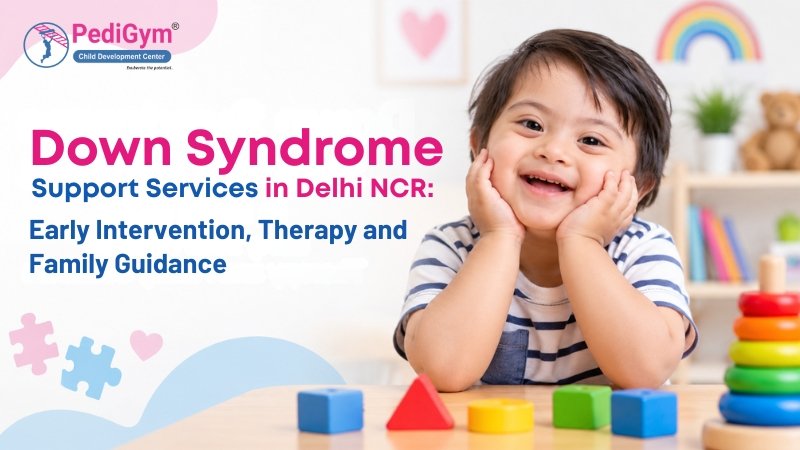
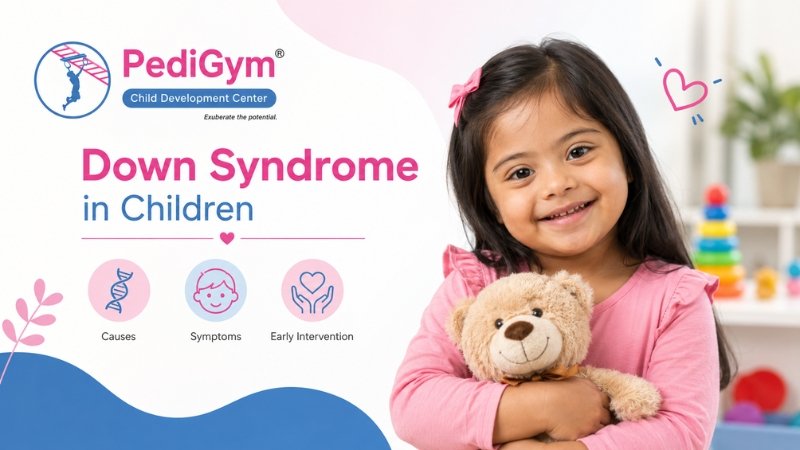
Down syndrome in children is a genetic condition caused by an extra copy of chromosome 21, and early, personalised support can help children develop movement, communication, learning, and daily living skills. Every child develops differently, so a diagnosis does not predict exactly what your child will be able to do.
If your baby or child has recently been diagnosed, you may be asking: What caused Down syndrome? What symptoms should I look for? Can it be prevented? And when should therapy begin? The most important thing to know is that understanding your child’s individual needs early can help you make better decisions about their care and development.
Quick facts: Down syndrome is caused by an extra copy of chromosome 21. About 5,775 babies are born with Down syndrome each year in the United States. About 95% of cases are trisomy 21, 3% are translocation Down syndrome, and 2% are mosaic Down syndrome.
What Is Down Syndrome in Children?
Down syndrome is a genetic condition in which a child has an extra copy of chromosome 21. This additional genetic material can influence how the brain and body develop, which may affect physical features, muscle tone, learning, communication, and developmental milestones.
There are three main types of Down syndrome:
- Trisomy 21: This is the most common type and accounts for about 95% of cases. Each cell has three copies of chromosome 21 instead of two.
- Translocation Down syndrome: This accounts for about 3% of cases. An extra full or partial chromosome 21 is attached to another chromosome.
- Mosaic Down syndrome: This accounts for about 2% of cases. Some cells have three copies of chromosome 21, while other cells have the usual two.¹
The type explains the genetic difference, but it does not tell parents exactly how their child will develop.
At PediGym, we believe a diagnosis should be the starting point for understanding a child—not a label that defines their potential. Our approach begins with a detailed assessment and personalised therapy planning based on each child’s strengths, challenges, and developmental goals.
What Causes Down Syndrome?
Down syndrome is caused by an extra copy of chromosome 21, and most cases happen randomly during cell division. It is not caused by something a parent did before or during pregnancy.
Maternal age is a recognised risk factor, particularly when a woman is 35 or older during pregnancy. However, Down syndrome can occur in pregnancies at any age. Many babies with Down syndrome are born to mothers younger than 35 because there are more births in that age group.
Down syndrome cannot be prevented through parenting choices or lifestyle changes. Parents should not blame themselves after a diagnosis.
For families, understanding the cause may answer “Why did this happen?” But once a diagnosis is known, the more useful question is often: “What support does my child need now?”
What Are the Symptoms of Down Syndrome?
Physical signs of Down syndrome in babies may include a flatter facial profile, upward-slanting eyes, low muscle tone, and certain differences in the hands, feet, and neck. These features can be present at birth or become more noticeable as a baby grows.
Common features may include:
- A flatter facial profile and nose bridge
- Almond-shaped eyes that slant upward
- A tongue that may tend to protrude
- Small ears, hands, or feet
- A short neck
- A single crease across the palm
- Small pinky fingers
- Low muscle tone
- Loose joints
Physical signs alone cannot confirm Down syndrome. A healthcare professional uses a hands-on physical exam and genetic testing to confirm the diagnosis.¹
Parents may also notice developmental differences such as delayed head control, sitting, standing, walking, first words, feeding, or self-care skills.
Some children with Down syndrome also have associated health conditions, including congenital heart defects, hearing loss, obstructive sleep apnea, thyroid problems, vision concerns, and digestive problems. The American Academy of Pediatrics recommends ongoing, age-specific health supervision for children and adolescents with Down syndrome.
These health and developmental concerns deserve proper monitoring, but they do not define the whole child.
Down Syndrome in Babies and Infants: When Should Parents Seek Help?
Parents should seek developmental guidance early if they have concerns about Down syndrome in babies or infants. Early assessment can help families understand a child’s current abilities and identify appropriate support.
Babies with Down syndrome may experience challenges related to low muscle tone, strength, posture, and body control. These differences can affect early skills such as holding the head, rolling, sitting, standing, and later movement milestones.
At PediGym, we recommend that parents focus on understanding their child’s developmental needs rather than waiting for concerns to become more significant.
An early assessment does not mean something is wrong with your child. It gives parents a clearer picture of how their child is moving and developing.
PediGym’s therapy approach includes detailed assessment, individualised therapy planning, progress tracking, and parent guidance so families can support development beyond the therapy session.
How Is Down Syndrome Diagnosed?
Down syndrome diagnosis is confirmed through genetic testing, although healthcare providers may first identify physical signs that suggest the condition.
During pregnancy, screening tests estimate the chance of Down syndrome but do not confirm it. Diagnostic tests are used to confirm the diagnosis. After birth, a healthcare provider may use a physical examination and genetic testing, such as chromosome analysis—a blood test that examines the chromosomes—to confirm the presence of an extra chromosome 21.
It is important for parents to understand that screening and diagnostic tests cannot predict exactly how Down syndrome will affect an individual child.
This is why a developmental assessment remains valuable after diagnosis. Genetic testing confirms the condition; developmental assessment helps families understand the child’s everyday needs and the next practical step.
Can Down Syndrome Be Prevented?
There is no known way to prevent Down syndrome because it is a genetic chromosome condition that usually occurs randomly during cell division.
Parents should not blame themselves for a child’s diagnosis.
If you are pregnant and have questions about Down syndrome screening or diagnostic testing, discuss your options with your obstetrician or a qualified healthcare professional.
For families who already have a child with Down syndrome, the focus can shift from “How could this have been prevented?” to “How can we support our child’s health and development?”
What Is the Treatment for Down Syndrome?
There is no treatment that removes Down syndrome, but medical care and therapy can help children develop important skills and become more independent in daily life. Support may include physical therapy, occupational therapy, speech therapy, early intervention, educational support, and management of associated health conditions.
Depending on the child’s needs, therapy may support:
- Head and trunk control
- Strength and body control
- Balance and coordination
- Gross motor development
- Fine motor skills
- Speech and communication
- Sensory processing
- Feeding and mouth-muscle skills
- Everyday independence
At PediGym, therapy is not designed as a standard checklist for every child with Down syndrome. We begin with assessment and create a structured, goal-oriented plan based on the child’s individual needs.
Our team-based therapy programs include early intervention, neurodevelopmental therapy, occupational therapy, speech therapy, sensory integration, and other pediatric therapy services.
Our approach is simple: children should not be treated according to a diagnosis alone. Therapy should be based on what the individual child needs next.
Why Is Early Intervention Important for Down Syndrome?
Early intervention provides additional support while important movement, communication, and everyday skills are developing.
A child may benefit from therapy to improve posture, movement patterns, coordination, strength, or everyday activities.
However, early intervention is not about forcing a child to meet a milestone by a particular date.
It is about creating more opportunities for your child to learn and participate.
For example, a therapy goal may not simply be “walk faster.” It may be improving balance so a child can move more safely, play with other children, or take part more independently in daily activities.
The American Academy of Pediatrics recommends ongoing, age-specific health supervision for children and adolescents with Down syndrome, with attention to developmental and health needs across childhood.
Does Down Syndrome Follow a Fixed Developmental Timeline?
No. Down syndrome does not follow one fixed developmental timeline, and children may reach milestones at different times.
Some children may take longer to sit, walk, speak, or complete daily tasks independently. That does not mean development has stopped.
At PediGym, we encourage parents to compare their child’s current progress with their own previous progress—not with another child’s timeline.
Therapy should not be about forcing a child to “catch up” at any cost. It should focus on meaningful skills that improve everyday life: moving more comfortably, communicating needs, playing, participating, and becoming more independent.
What Is the Outlook for Children With Down Syndrome?
Children with Down syndrome can live meaningful, active lives, and life expectancy has increased significantly with improvements in medical care and ongoing support. Many people with Down syndrome now live into their 60s or beyond, although individual health conditions can affect long-term health and outlook.
Children with Down syndrome may attend school, develop relationships, participate in activities, and build greater independence.
Their abilities vary widely. This is why generalisations about what a child “will never do” are not helpful or fair.
A better approach is to understand a child’s strengths, identify areas where support is needed, and create realistic developmental goals.
What Down Syndrome Care and Support Do Families Need?
The best Down syndrome care combines regular medical follow-up, developmental assessment, appropriate therapy, and active family involvement.
Parents can start by:
- Discussing developmental concerns with their child’s pediatrician.
- Arranging a developmental assessment when needed.
- Following recommended health screenings.
- Asking therapists for practical home activities.
- Tracking progress without constantly comparing their child with others.
Families can also explore trusted information and support from the CDC’s Down syndrome resources and the National Down Syndrome Society. For age-specific health supervision guidance, families can also refer to the American Academy of Pediatrics clinical report.
If you are looking for structured pediatric therapy and early developmental support, you can learn more about PediGym’s child development and pediatric therapy approach.
The Right Support Can Start Early
Down syndrome in children does not come with one fixed developmental outcome. But early, personalised support can give a child more opportunities to develop movement, communication, confidence, and everyday independence.
At PediGym, we do not focus on changing who your child is. We focus on understanding your child better and helping them make meaningful progress—one developmental goal at a time.
If you have concerns about your child’s movement, strength, balance, communication, or developmental progress, an early assessment can help you understand the next practical step.
This article is for educational purposes only and does not replace diagnosis or medical advice from a qualified healthcare professional.
Medical Review & Article Information
Medically Reviewed By: Dr. Nitin Gupta, DMI Level C Certified Therapist and Founder of PediGym Child Development Center
Medical Review Note: This article was reviewed for medical accuracy using current information from the CDC and the American Academy of Pediatrics, along with PediGym’s clinical perspective on child development and pediatric therapy.
References
- Centers for Disease Control and Prevention (CDC). Down Syndrome
- Cleveland Clinic. Down Syndrome: Symptoms & Causes
- American Academy of Pediatrics. Health Supervision for Children and Adolescents With Down Syndrome

Dr. Nitin, Founder of PediGym Child Development Center, is a dedicated pediatric therapy expert and DMI Level C Certified Therapist leading structured, evidence-based therapy programs in Faridabad and Gurgaon. Under his guidance, PediGym provides comprehensive pediatric rehabilitation focused on improving motor skills, coordination, sensory processing, speech clarity, and functional independence through personalized intervention plans.