The most common signs of autism involve differences in social communication, interaction, language, play, repetitive behavior, sensory responses, and flexibility with routines. Early signs of autism may include limited eye contact, not responding to a name, fewer gestures such as pointing or waving, delayed speech, repetitive play, difficulty with changes, or unusual reactions to sounds and textures. Some children show these differences during infancy, while others become more noticeable during the toddler or preschool years.
Understanding Autism Spectrum Disorder
Autism spectrum disorder (ASD) is a developmental condition that can affect communication, social interaction, behavior, learning, and everyday participation. Because it is a spectrum, its presentation and support needs can vary considerably from one child to another.
For parents, recognizing autism signs and symptoms means looking at the overall pattern rather than focusing on one behavior. A child may have communication difficulties, social differences, repetitive behaviors, restricted interests, or sensory differences in varying combinations.
Signs of Autism in Babies
The signs of autism in babies can sometimes be subtle. During the first year, parents may notice differences in the way their baby responds to people or participates in early back-and-forth communication.
Possible signs include:
- Limited or inconsistent eye contact
- Few warm or joyful facial expressions
- Limited back-and-forth sharing of smiles or sounds
- Not consistently responding when their name is called
- Few gestures such as reaching, waving, or showing
- Limited interest in sharing attention with a parent or caregiver
- Reduced imitation of sounds, expressions, or actions
The CDC lists milestones such as responding to a name by around 9 months, using gestures by 12 months, sharing interests by 15 months, and pointing to show something interesting by 18 months.
These milestones are useful guides, not a diagnostic checklist. If several concerns persist, parents should discuss them with a pediatrician or qualified child-development professional.
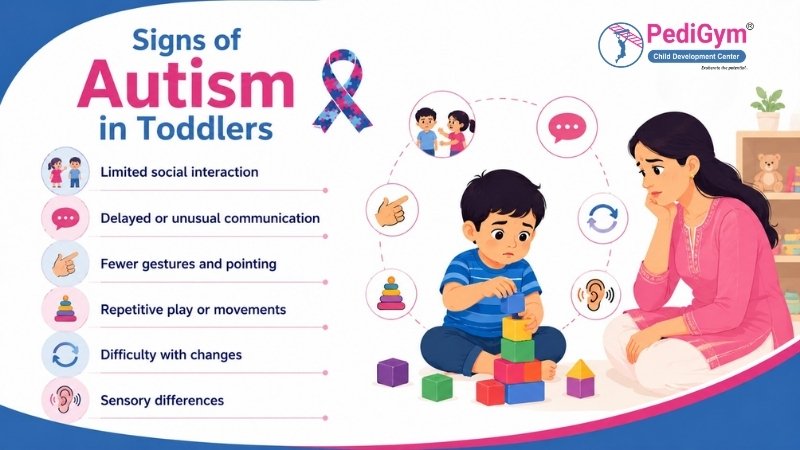
Signs of Autism in Toddlers
As children become more independent, their communication, play, and social skills become easier to observe. This is why signs of autism in toddlers often attract greater attention.
Limited social interaction
A toddler may show less interest in engaging with parents or other children. They may not consistently share enjoyment, show an interesting object to someone else, or look toward a caregiver to share an experience.
Delayed or unusual communication
Autism symptoms in children can include delayed speech, limited vocabulary, repeated words or phrases, or difficulty using language for meaningful communication.
Some toddlers may speak but struggle with two-way conversation. Others may communicate primarily through sounds, gestures, or behaviors.
Fewer gestures and pointing
Pointing is an important communication skill because children use it both to request things and to share interest. Limited pointing, waving, showing, reaching, or other gestures can be an important early concern.
Repetitive play or movements
Some children repeatedly line up toys, spin objects, arrange items in a particular order, flap their hands, rock, or focus strongly on parts of toys.
Repetition alone is not unusual in childhood. It becomes more relevant when it is persistent, rigid, or accompanied by social-communication differences.
Difficulty with changes
A toddler may become very upset when a familiar routine changes. A different route, changed activity sequence, or rearranged toys can sometimes cause significant distress.
Sensory differences
Some children react strongly to sounds, touch, smells, lights, clothing, or food textures. Others may actively seek particular sensory experiences.
Autism Red Flags by Age
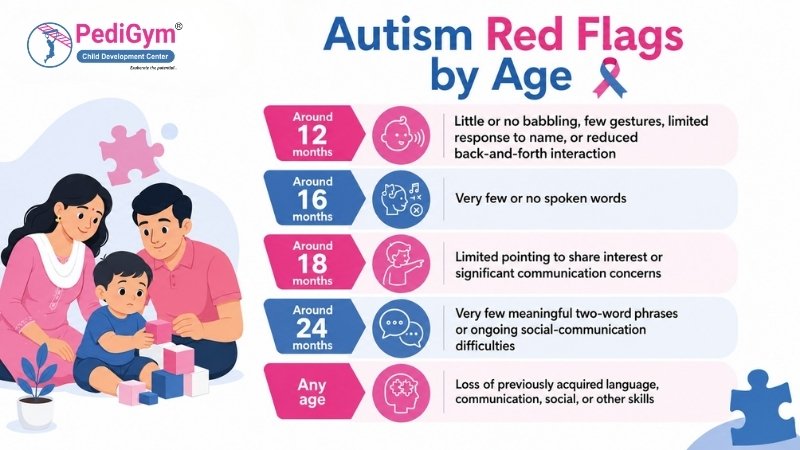
The following table provides a simple reference for parents. These autism red flags indicate when it may be helpful to seek professional guidance; they do not establish a diagnosis.
Age | Red flags to discuss with a professional |
Around 12 months | Little or no babbling, few gestures, limited response to name, or reduced back-and-forth interaction |
Around 16 months | Very few or no spoken words |
Around 18 months | Limited pointing to share interest or significant communication concerns |
Around 24 months | Very few meaningful two-word phrases or ongoing social-communication difficulties |
Any age | Loss of previously acquired language, communication, social, or other skills |
The CDC and American Academy of Pediatrics emphasize monitoring milestones and acting on concerns rather than waiting for difficulties to become more pronounced.
Autism Signs and Symptoms Beyond the Toddler Years
Not every child shows obvious differences during infancy or the early toddler period. For some children, concerns become clearer when school introduces greater expectations for communication, friendships, flexibility, and independent participation.
Possible autism signs and symptoms at this stage include:
- Difficulty making or maintaining friendships
- Trouble understanding social cues or other people’s feelings
- Difficulty with pretend or imaginative play
- Challenges with back-and-forth conversation
- Highly focused interests
- Repetitive language or behaviors
- Strong distress when routines change
- Difficulty coping with crowded or noisy environments
- Unusual reactions to textures, sounds, smells, or other sensory experiences
A child can have a good vocabulary and still experience difficulties with the social use of language.
What Causes Autism?
There is no single known cause of ASD. Research points to a combination of genetic and biological factors, with scientists continuing to study how different influences may contribute to its development.
Parents should not blame themselves for their child’s condition. Vaccines do not cause autism, and the condition is not caused by parenting.
Understanding ASD Levels
Under the DSM-5 framework, clinicians may describe support needs using three levels:
- Level 1: Requires support
- Level 2: Requires substantial support
- Level 3: Requires very substantial support
These levels describe the amount of support a person may need. They are not a measure of intelligence and do not determine a child’s potential.
Autism vs. Speech Delay: Are They the Same?
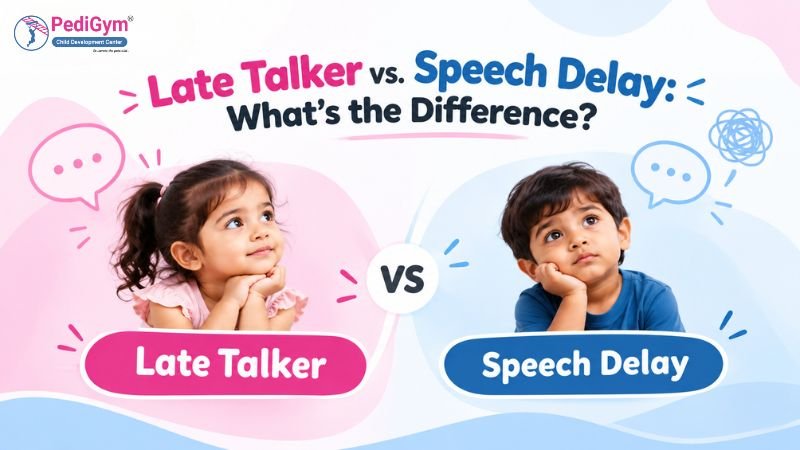
Speech delay and ASD are not the same thing.
A child with an isolated language delay may still demonstrate age-appropriate social interest, eye contact, gestures, pretend play, and attempts to communicate with others.
When language difficulties occur alongside differences in social communication and restricted or repetitive behaviors, further assessment may be appropriate. Some children can also have both a language disorder and ASD.
This is why the number of words a child says should not be used as the only measure of their communication development.
How to Identify Autism in Children
Parents searching for how to identify autism in children should understand the difference between screening and diagnosis.
The American Academy of Pediatrics recommends general developmental screening at 9, 18, and 30 months, along with autism-specific screening at 18 and 24 months.
The M-CHAT-R/F (Modified Checklist for Autism in Toddlers, Revised with Follow-Up) is one commonly used autism-specific screening tool for toddlers. A screening result indicates whether further assessment may be useful; it does not by itself establish a diagnosis.
Parents do not need to wait until a scheduled screening appointment if they are already concerned. A pediatrician or qualified child-development professional can advise on the appropriate next step.
What Support May Help?
Once concerns have been identified, support can be tailored to the child’s individual strengths and needs. Depending on the child’s profile, this may include:
- Speech and language therapy for communication and language skills
- Occupational therapy (OT) for sensory, motor, play, and daily-living skills
- Behavioral or developmental intervention for learning, communication, behavior, and participation
- Parent guidance to help families support skills during everyday routines
Early intervention can address identified needs without requiring families to wait for a formal diagnosis before seeking appropriate developmental support.
When Should Parents Seek Professional Help?
Professional guidance is worth considering if your child:
- Rarely responds to their name
- Uses very few gestures
- Does not point to share interest
- Has significant communication difficulties
- Shows persistent repetitive behaviors
- Has difficulty interacting socially
- Becomes extremely distressed by routine changes
- Has unusual sensory responses
- Loses skills they previously developed
The important consideration is the overall developmental pattern, not an isolated behavior. Some of these characteristics can also occur in children who do not have ASD.
Expert Perspective: Dr. Nitin at PediGym
Early recognition gives parents an opportunity to understand their child’s needs and seek suitable support.
Dr. Nitin is the Founder of PediGym Child Development Center. He is a dedicated pediatric therapy expert and DMI Level C Certified Therapist.
He leads structured, evidence-based therapy programs in Faridabad and Gurgaon, with an individualized approach to children’s communication, motor, sensory, interaction, and everyday functional needs.
If you are noticing possible autism warning signs in your child, an initial developmental screening can help you understand whether further evaluation or therapy support may be appropriate.
Frequently Asked Questions
What are the earliest signs of autism?
Early concerns can involve social communication, such as limited eye contact, reduced response to a name, fewer gestures, or less back-and-forth interaction. Repetitive behaviors and unusual sensory responses may also become noticeable as the child grows.
What are the main signs of autism in toddlers?
Parents may notice differences in communication, pointing, social engagement, play, flexibility, or sensory responses. The combination and intensity of these characteristics vary from child to child.
Can a child have speech delay without autism?
Yes. A child may have a language delay while maintaining age-appropriate social interaction, gestures, eye contact, and pretend play. An assessment can help determine the reason for the communication difficulty.
At what age can ASD be identified?
Some children show differences during the first year, while others become easier to identify during the second year or later. Autism-specific screening is recommended at 18 and 24 months.
Does missing one milestone mean my child has autism?
No. A missed milestone can have many explanations. However, persistent concerns, multiple missed skills, or regression should be discussed with a qualified professional.
What should parents do after noticing warning signs?
Keep track of specific behaviors, communication changes, and missed milestones, then discuss them with your pediatrician or a qualified child-development professional. Families in Faridabad and Gurgaon can also consider an initial developmental screening at a specialized child-development center.
Final Takeaway
Knowing the signs of autism can help parents recognize when additional guidance may be useful. Key areas to watch include communication, social interaction, gestures, play, repetitive behaviors, sensory responses, and flexibility with routines.
Whether you have noticed early autism symptoms in a baby, signs of autism in toddlers, or new concerns after your child begins preschool, timely professional guidance can provide clarity. Online checklists can help parents organize their concerns, but they should not replace proper screening or clinical evaluation.
For families in Faridabad and Gurgaon, an initial developmental screening with PediGym Child Development Center can be a practical starting point for understanding a child’s strengths, challenges, and appropriate next steps.

Dr. Nitin, Founder of PediGym Child Development Center, is a dedicated pediatric therapy expert and DMI Level C Certified Therapist leading structured, evidence-based therapy programs in Faridabad and Gurgaon. Under his guidance, PediGym provides comprehensive pediatric rehabilitation focused on improving motor skills, coordination, sensory processing, speech clarity, and functional independence through personalized intervention plans.