

Retained primitive reflexes are automatic movement responses that remain active beyond the age when they would typically become less prominent as a child’s nervous system matures. Most primitive reflexes become less prominent by around 4–6 months, although some normally persist longer.
When primitive reflexes remain unusually strong or interfere with a child’s everyday activities, a healthcare professional may recommend further assessment. Parents may notice difficulties with balance, coordination, posture, handwriting, or certain movements. However, these signs can have many causes, and the presence of a retained reflex alone does not diagnose a developmental condition.
What Are Primitive Reflexes?
Primitive reflexes are involuntary movements mediated largely by the brainstem and spinal cord. They are present at birth or emerge during early infancy and support early functions such as feeding, protection, and sensorimotor development.
As the brain matures, many primitive reflexes become less prominent and voluntary movement develops. This process is often called reflex integration. Some postural reactions develop during infancy and continue throughout life because they help with balance and protective movement.
When Should Primitive Reflexes Integrate?
The ages below are approximate, not strict deadlines. Published sources sometimes report different ranges, so a clinician should interpret a reflex in the context of a child’s age and overall development.
Primitive reflex or reaction | What it looks like | Approximate timeline |
Moro reflex | A sudden sound or movement may cause a baby to extend the arms and legs, then bring the arms inward. | Usually less prominent by 3–6 months |
Palmar grasp | Touching a baby’s palm causes the fingers to curl around the object or finger. | Usually less prominent by 4–6 months |
Rooting reflex | Touching a baby’s cheek prompts the head to turn toward the touch and the mouth to open. | About 3–6 months; reported ranges vary |
Asymmetrical tonic neck reflex (ATNR) | Turning the head to one side is accompanied by extension of the arm and leg on that side and bending of the opposite limbs. | About 3–6 months; upper limits vary across sources |
Stepping reflex | When held upright with the feet touching a surface, a newborn makes stepping-like movements. | About 2–5 months |
Galant reflex | Stroking one side of the back may cause the trunk or hips to curve toward that side. | About 4–6 months |
Plantar grasp | Touching the sole near the base of the toes causes the toes to curl. | About 9–12 months |
Babinski response | Stroking the sole may cause the big toe to move upward and the other toes to fan out. | Can be normal until around 12–24 months |
Tonic labyrinthine reflex (TLR) | Head position in relation to gravity influences the posture of the arms, legs, and trunk. | Estimates range from 2–4 months (Healthline), 6 months (Physiopedia infant table), to about 24 months (Physiopedia TLR page) |
Symmetrical tonic neck reflex (STNR) | Bending the head forward may bend the arms and straighten the legs; moving the head backward may produce the opposite pattern. | Sources vary from about 8–12 months to 1–2 years |
Parachute reaction | When an infant is gently moved forward toward a surface, the arms extend as if to protect against a fall. | Often develops around 5–9 months and persists; it is a protective postural reaction, not a reflex that should disappear |
The timelines for TLR and STNR differ between sources. Physiopedia also gives different TLR estimates on its own pages, so these figures should not be treated as a single agreed cutoff. A reflex remaining active at the end of an approximate age range does not automatically mean a child has a disorder.
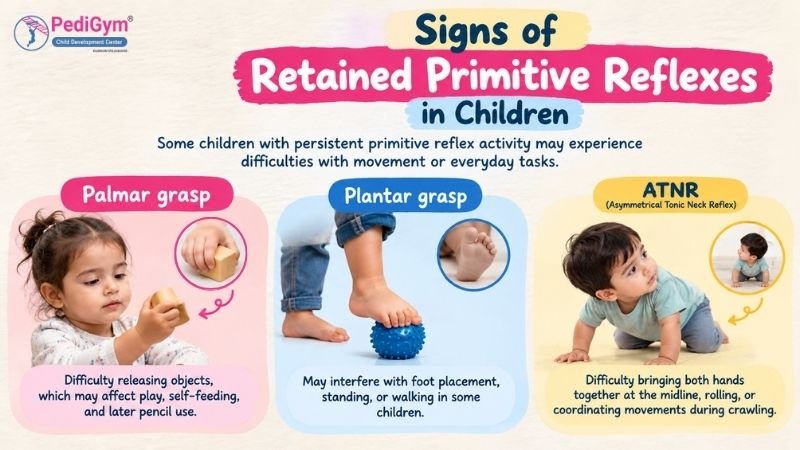
Signs of Retained Primitive Reflexes in Children
Some children with persistent primitive reflex activity may experience difficulties with movement or everyday tasks. These are reported associations, not diagnostic signs. Studies of healthy preschool children have reported associations between persistent reflex activity and motor or sensory-motor difficulties, but association does not prove cause.
Reflex | Reported associations if activity persists |
Palmar grasp | Difficulty releasing objects, which may affect play, self-feeding, and later pencil use |
Plantar grasp | May interfere with foot placement, standing, or walking in some children |
ATNR | Difficulty bringing both hands together at the midline, rolling, or coordinating movements during crawling |
Galant reflex | Some sources report fidgeting while seated, concentration difficulties, or bedwetting; these associations do not prove that the reflex causes the problem |
Moro reflex | Research has discussed possible associations with heightened responses to sudden stimuli, sensory sensitivity, or anxiety-like behaviours; these are not specific to a retained Moro reflex |
Other concerns parents may notice include:
- Balance and posture: frequent loss of balance, awkward movement, or difficulty maintaining a stable position.
- Coordination: difficulty learning movements that require both sides of the body to work together.
- Fine motor skills: challenges with manipulating small objects, drawing, or using utensils.
- Feeding and oral movement: persistent feeding difficulties, unusual tongue positioning, or excessive drooling may warrant an oral-motor or feeding assessment.
- Sensory responses: unusual sensitivity to touch, sound, movement, or unexpected changes.
These observations are reasons to discuss a child’s development with a qualified professional, not a checklist for diagnosing retained primitive reflexes at home.
What Causes Retained Primitive Reflexes?
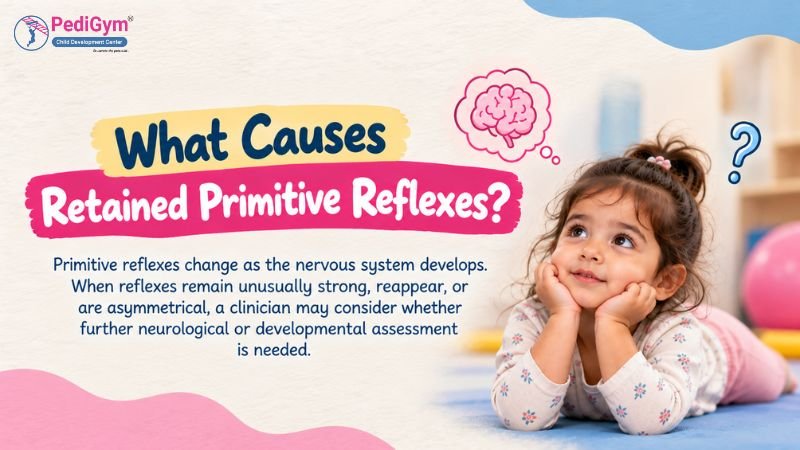
Primitive reflexes change as the nervous system develops. When reflexes remain unusually strong, reappear, or are asymmetrical, a clinician may consider whether further neurological or developmental assessment is needed.
Prematurity, low birth weight, and complications such as oxygen deprivation around birth are among the factors associated with abnormal reflex findings in newborns. These factors do not prove that a child will develop retained primitive reflexes.
Healthline notes that a reflex that does not integrate as expected may signal that the central nervous system has not matured as anticipated or may indicate neurological injury]. Such findings are not a diagnosis on their own; a healthcare professional must assess the child’s age, history, and overall development.
Retained Primitive Reflexes and Cerebral Palsy
Children with cerebral palsy may show persistent, exaggerated, or asymmetrical primitive reflexes as part of their neurological presentation. For example, a strongly expressed ATNR may make it harder for a child to bring both hands together or coordinate head and arm movements.
StatPearls reports that five or more abnormal primitive reflexes can have high predictive value for cerebral palsy in the relevant clinical context. This finding is not a home-screening rule or a diagnosis on its own. Diagnosis requires a comprehensive developmental and neurological assessment.
Are Retained Primitive Reflexes Linked to Autism?
Some research has explored associations between retained primitive reflexes and autism spectrum disorder. A 2022 review discussed the potential for reflex-based interventions in autistic children, but this does not establish that retained reflexes cause autism or that reflex-integration treatment is an established treatment for autism.
Primitive reflex findings should not be used to diagnose autism. If a child has communication, social interaction, sensory, or developmental concerns, seek an appropriate developmental assessment.
How Are Retained Primitive Reflexes Assessed?
A qualified healthcare professional considers the child’s developmental history, observed movements, neurological findings, and everyday functional challenges. The assessment method depends on the child’s age and the reason for referral.
Commonly discussed tools include:
- Hammersmith Infant Neurological Examination (HINE): a structured neurological examination used by trained professionals to assess infants, generally between 2 and 24 months of age.
- Capute Primitive Reflex Profile: a structured method for rating activity across seven primitive reflexes.
- Goddard-Blythe assessment methods: used in some preschool- and school-age assessment settings to examine selected reflexes and related movement skills.
These tools are not interchangeable, and no single reflex test provides a complete diagnosis. A trained professional selects and interprets assessments according to the child’s age and clinical needs.
Parents should not repeatedly trigger reflexes at home to try to diagnose a problem. If you have concerns, describe the movements or activities you have observed and let a trained professional decide which examinations are suitable.
Retained Primitive Reflexes Treatment and Exercises
Treatment depends on the child’s needs and the functional difficulties identified during assessment. The aim should be to improve meaningful activities, such as balance, mobility, coordination, play, self-care, or feeding, rather than simply to change a reflex score.
A child’s plan may include:
- Gross motor activities: age-appropriate tasks to practise posture, balance, and movement.
- Bilateral coordination: activities that encourage the two sides of the body to work together.
- Fine motor practice: everyday play and tasks involving grasping, releasing, drawing, or using utensils.
- Feeding support: assessment and intervention from an appropriately qualified feeding or speech-language therapist when oral-motor or feeding difficulties are present.
- Home activities: exercises selected for the child and explained by the treating professional, with progress reviewed over time.
Examples described in the clinical literature include positioning to support movement, practising voluntary movements, core-strengthening activities, and a developmental progression from tummy time to sitting and crawling. For a persistent palmar grasp, occupational therapy approaches may include tactile desensitisation and activities that practise opening the hand. A therapist should choose and adjust these activities for each child rather than applying one routine to everyone.
Research on home-based exercises and reflex-focused interventions is still developing. A 2019 clinical article describes targeted home-based approaches. A 2026 systematic review found associations between persistent reflex activity and motor or academic outcomes. It also reported that movement programmes could be beneficial, while intervention evidence remained limited and findings varied across studies. More research is needed to determine which approaches help which children and how reliably.
Exercises should be individualised. Avoid forceful movements or programmes that promise to treat autism, cerebral palsy, learning difficulties, or other conditions solely by “integrating” reflexes.
Primitive Reflexes in Adults (Frontal Release Signs)
Primitive reflex-like responses can reappear in adults and are often referred to as frontal release signs. These include responses such as the grasp, snout, palmomental, or glabellar reflex. They may be associated with frontal lobe dysfunction, neurological conditions, or cognitive decline, but their presence alone does not establish a diagnosis.
A new or unexpected change in movement, strength, coordination, or neurological function in an adult should be assessed by a healthcare professional.
When Should Parents Seek Professional Advice?
Consider speaking with your child’s paediatrician or another qualified child-development professional if you notice:
- Delays in movement or other developmental milestones.
- Persistent difficulty with balance, coordination, or everyday motor tasks.
- Marked differences between the two sides of the body.
- Unusual muscle stiffness, floppiness, or movement patterns.
- Ongoing feeding or oral-motor difficulties.
- Concerns that affect play, learning, self-care, or participation in daily activities.
Seek urgent medical care if a child develops sudden weakness, a sudden loss of previously acquired skills, or another sudden and significant neurological change.
Frequently Asked Questions
At what age should primitive reflexes disappear?
Most primitive reflexes become less prominent by about 4–6 months. The plantar grasp may last until about 9–12 months, and the Babinski response can be normal until around 12–24 months. A paediatrician should interpret any concern in the context of the child’s development. Estimates for the TLR vary from about 2–4 months to 24 months, while STNR estimates range from about 8–12 months to 1–2 years, depending on the source.
Can retained primitive reflexes affect learning?
Studies have reported associations between persistent primitive reflex activity and motor difficulties. A 2026 systematic review also found that several studies linked higher reflex activity with lower reading, spelling, or mathematics performance. These findings do not prove that retained reflexes cause learning difficulties. A child who struggles at school may need a broader assessment.
What exercises help retained primitive reflexes?
There is no single exercise programme suitable for every child. Depending on the assessment, a therapist may recommend positioning, voluntary movement practice, core strengthening, and age-appropriate activities that progress from tummy time to sitting and crawling. For a persistent palmar grasp, occupational therapy may include tactile desensitisation and hand-opening activities. Exercises should be matched to the child’s age, abilities, and goals.
Are primitive reflexes normal in newborns?
Yes. Primitive reflexes are expected in newborns and help with early functions such as feeding and responding to touch. Their presence, strength, and development over time are interpreted in the context of the infant’s age and health.
Are retained primitive reflexes a sign of cerebral palsy or autism?
No—not by themselves. Persistent or unusual reflexes can be one part of a wider clinical picture, but neither cerebral palsy nor autism can be diagnosed from a reflex alone. Appropriate developmental and neurological assessment is important.
What does reflex integration mean?
Reflex integration is often described as primitive reflexes becoming less prominent or being folded into voluntary movement as the nervous system matures. This does not mean that all reflexes and postural reactions disappear; protective reactions such as the parachute response continue to serve a function.
Can a retained Galant reflex cause bedwetting?
Bedwetting has been reported alongside persistent Galant reflex activity, but this does not prove that the reflex causes bedwetting. Bedwetting is common in childhood and may have several developmental, medical, or behavioural contributors. Seek advice from your child’s healthcare professional if you are concerned, particularly if symptoms begin suddenly or occur with pain or other urinary symptoms.
Are retained primitive reflexes linked to ADHD?
Healthline notes that researchers have suggested links between retained primitive reflexes and attention-related difficulties. However, findings about reflex activity cannot diagnose attention-deficit/hyperactivity disorder (ADHD), and a retained reflex is not a diagnostic test. If a child has ongoing attention, impulsivity, or activity-level concerns, discuss them with a qualified healthcare professional.
Can parents test primitive reflexes at home?
Home observations can help parents describe movement or developmental concerns, but they cannot confirm a retained primitive reflex or diagnose a condition. Avoid repeatedly provoking reflexes. Share your observations with a qualified professional who can decide whether a formal examination is needed.
Paediatric Therapy at PediGym Child Development Center
PediGym Child Development Center supports children and families seeking help with movement, coordination, and developmental concerns in Faridabad and Gurgaon. If you are concerned about your child’s reflexes or motor development, a professional assessment can help clarify the observed difficulties and identify suitable next steps.
The assessment and care plan should be based on the child’s individual history, functional needs, and clinical findings, not on a reflex checklist alone.
About the Author
Written by Dr. Nitin Gupta, Founder of PediGym Child Development Center and a DMI Level C Certified Therapist. He leads paediatric therapy programmes in Faridabad and Gurgaon.
Dynamic Movement Intervention (DMI) is a therapist-guided approach used in paediatric rehabilitation to work on motor skills and postural control. It is used with children with conditions such as cerebral palsy and Down syndrome, as well as children with hypotonia or motor delays . Sanford Health describes Level C as the highest DMI training level.
References
- Chamarthi VS, Gunasekaran V, Daley SF. “Primitive Reflexes: Comprehensive Neurological Assessment Across the Lifespan.” StatPearls. Updated June 17, 2026. https://www.ncbi.nlm.nih.gov/books/NBK554606/
- Lewis R. “What Are the Primitive Reflexes and How Are They Useful?” Medically reviewed by Karen Gill, MD. Healthline. May 19, 2020. https://www.healthline.com/health/baby/primitive-reflexes
- Physiopedia. “Tonic Labyrinthine Reflex.” https://www.physio-pedia.com/Tonic_labyrinthine_reflex
- Zafeiriou DI. “Primitive reflexes and postural reactions in the neurodevelopmental examination.” Pediatric Neurology. 2004;31(1):1–8. https://pubmed.ncbi.nlm.nih.gov/15246484/
- Chamarthi VS, Yoo H. “Rooting Reflex.” StatPearls. Updated January 31, 2026. https://www.ncbi.nlm.nih.gov/books/NBK557636/
- Gieysztor EZ, Choińska AM, Paprocka-Borowicz M. “Persistence of primitive reflexes and associated motor problems in healthy preschool children.” Archives of Medical Science. 2018;14(1):167–173. https://pmc.ncbi.nlm.nih.gov/articles/PMC5778413/
- Pecuch A, Gieysztor E, Telenga M, Wolańska E, Kowal M, Paprocka-Borowicz M. “Primitive Reflex Activity in Relation to the Sensory Profile in Healthy Preschool Children.” International Journal of Environmental Research and Public Health. 2020;17(21):8210. https://doi.org/10.3390/ijerph17218210
- Melillo R, Leisman G, Machado C, et al. “Retained Primitive Reflexes and Potential for Intervention in Autistic Spectrum Disorders.” Frontiers in Neurology. 2022;13:922322. https://doi.org/10.3389/fneur.2022.922322
- Chandradasa M, Rathnayake L. “Retained primitive reflexes in children, clinical implications and targeted home-based interventions.” Nursing Children and Young People. 2019;32(1):37–42. https://doi.org/10.7748/ncyp.2019.e1132
- Provazník A, Musálek M, Bob P, Větrovský T, Malambo C, Silva AF, Anderson D. “Persisting primitive reflexes and motor and cognitive development in children: A systematic review.” Acta Psychologica. 2026;266:106915. https://pubmed.ncbi.nlm.nih.gov/42061063/
- Schott JM, Rossor MN. “The grasp and other primitive reflexes.” Journal of Neurology, Neurosurgery & Psychiatry. 2003;74(5):558–560. https://pmc.ncbi.nlm.nih.gov/articles/PMC1738455/
- Altunkalem Seydi K, Kaya D, Yavuz I, Ontan MS, Dost FS, Isik AT. “Primitive reflexes and dementia in older adults: a meta-analysis of observational and cohort studies.” Psychogeriatrics. 2024;24(3):688–700. https://pubmed.ncbi.nlm.nih.gov/38400649/
- Sanford Health. Information on Dynamic Movement Intervention training. https://news.sanfordhealth.org/?p=80693

Dr. Nitin, Founder of PediGym Child Development Center, is a dedicated pediatric therapy expert and DMI Level C Certified Therapist leading structured, evidence-based therapy programs in Faridabad and Gurgaon. Under his guidance, PediGym provides comprehensive pediatric rehabilitation focused on improving motor skills, coordination, sensory processing, speech clarity, and functional independence through personalized intervention plans.