Written by: Dr. Nitin, Founder, PediGym Child Development Center, Faridabad & Gurgaon
Clinical expertise: Dynamic Movement Intervention (DMI) Level C Certified Therapist
Key Takeaways
- Global developmental delay (GDD) means significant delay in at least two developmental domains in a child younger than 5 years.
- The IAP definition uses performance at least 2 standard deviations below the mean on standardized developmental tests in at least two domains. Children whose delay is explained primarily by motor problems or severe uncorrected visual or hearing impairment are excluded from this definition.
- GDD can affect motor skills, speech and language, cognition, social-personal development and activities of daily living.
- Causes may include genetic or chromosomal conditions, prenatal and perinatal complications, infections, nutritional or endocrine conditions, brain injury and environmental exposures.
- Diagnosis involves developmental history, physical and neurological examination, hearing and vision assessment, standardized developmental testing and targeted investigations when indicated.
- Early multidisciplinary intervention should begin soon after developmental delay is recognized, even before a formal underlying diagnosis is established.
- Treatment may include speech therapy, occupational therapy, physiotherapy, developmental therapy, behavioral support and parent coaching, depending on the child’s needs.
- A GDD diagnosis does not by itself determine a child’s long-term outcome. Development should be reassessed as the child grows.
If your child is delayed in more than one developmental area, arrange a developmental assessment rather than waiting for the delay to resolve on its own.
What Is Global Developmental Delay (GDD)?
Global developmental delay (GDD) is significant developmental delay in at least two domains in a child younger than 5 years. According to the Indian Academy of Pediatrics (IAP), GDD is defined as performance at least 2 standard deviations below the mean on standardized developmental tests in at least two developmental domains. Children whose delay can be explained primarily by motor issues or severe uncorrected visual or hearing impairment are excluded from this definition.
The developmental domains commonly considered include:
- Gross motor: sitting, standing, walking, running and jumping
- Fine motor: reaching, grasping and manipulating objects
- Speech and language: understanding and using communication
- Cognition: learning, attention and problem-solving
- Social-personal development: interaction and play
- Activities of daily living: feeding, dressing and other age-appropriate self-care skills
GDD describes a child’s current developmental functioning; it does not, by itself, identify the underlying medical or genetic cause.
For example, a child who walks late but talks, plays and feeds themselves at the expected age may have a motor delay rather than GDD. GDD is considered when significant delays affect at least two developmental areas.
If delays occur in several developmental areas, discuss the overall developmental pattern with a pediatrician or developmental specialist.
How Common Is GDD?
GDD affects approximately 1%–3% of children under 5 years of age.
An Indian observational study of children with GDD also cites the estimated prevalence of 1%–3% and found a range of prenatal, perinatal and postnatal causes.
The frequency varies between populations because studies use different definitions, assessment methods and clinical settings.
If your child is behind in several areas of development, early assessment can help identify the child’s needs and guide further evaluation.
Signs and Symptoms of GDD
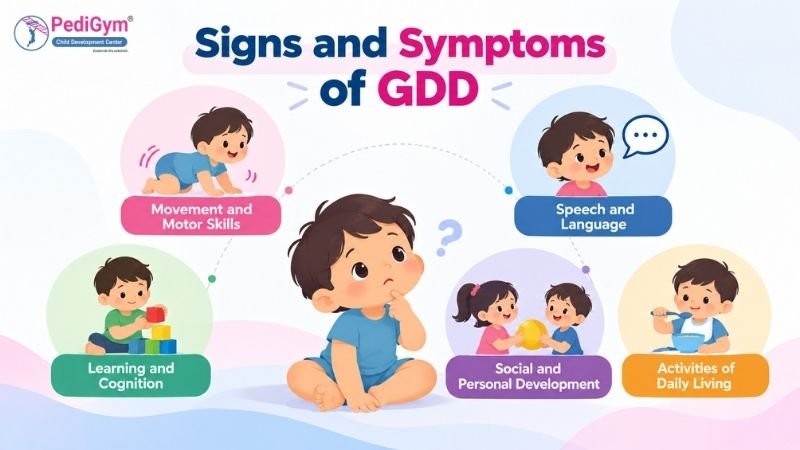
The signs of GDD vary with age and with the developmental domains affected. Common patterns include:
Movement and Motor Skills
- Delayed sitting, standing, crawling or walking
- Difficulty with balance or coordination
- Difficulty using the hands for age-appropriate activities
- Delay in running, jumping or climbing
Speech and Language
- Limited babbling, gestures or words
- Difficulty understanding age-appropriate instructions
- Difficulty combining words
- Communication skills that are significantly behind those of peers
Learning and Cognition
- Difficulty learning new skills
- Difficulty following age-appropriate instructions
- Delayed problem-solving or play skills
- Difficulty applying newly learned skills
Social and Personal Development
- Limited interaction or social play
- Difficulty copying actions
- Reduced participation in age-appropriate play
- Delayed self-help skills
Activities of Daily Living
- Difficulty feeding independently
- Delayed use of a cup or spoon
- Difficulty with dressing or other self-care activities
- Greater-than-expected dependence on caregivers
One delayed skill does not automatically mean GDD. Concern increases when delays are present across several developmental domains or when a child loses skills they previously acquired.
If you notice delays in more than one area, discuss them with your child’s doctor.
Milestones by Age and When to Ask for Help
Developmental milestones are useful for recognizing when a child may need further assessment, but they do not replace standardized developmental screening. The CDC describes milestones as skills that most children, at least 75%, can do by a particular age.
If your child is not yet doing one or more expected skills, has lost a skill or you have another developmental concern, act early and discuss it with the child’s doctor.
Age | Examples of CDC developmental milestones |
12 months | Calls a parent “mama” or “dada” or another special name; pulls up to stand; plays games such as pat-a-cake. |
18 months | Points to show something interesting; tries to say three or more words besides “mama” or “dada”; follows a one-step direction without gestures; walks without holding on; tries to use a spoon. |
2 years | Says at least two words together; points to at least two body parts when asked; tries to use switches, knobs or buttons; kicks a ball; eats with a spoon. |
3 years | Has at least two back-and-forth exchanges in conversation; asks “who,” “what,” “where” or “why” questions; notices other children and joins them to play. |
4 years | Uses sentences of four or more words; answers simple questions; names some colors; catches a large ball; unbuttons some buttons. [8] |
For children born more than 3 weeks prematurely, the CDC recommends using corrected age when completing milestone checklists.
If a child was born prematurely and appears behind on milestones, use corrected age when appropriate and discuss any continuing concerns with the child’s doctor.
What Causes Global Developmental Delay?
GDD has many possible causes, and sometimes no single cause is identified. The evaluation is guided by the child’s history, examination and developmental profile.
Timing/category | Examples | What may be investigated |
Genetic or chromosomal | Genetic syndromes, chromosomal abnormalities, copy-number changes | Genetic testing when clinically indicated |
Pregnancy-related | Congenital infections, fetal growth problems, significant nutritional or other prenatal factors | Pregnancy and birth history; targeted testing |
Perinatal | Hypoxic-ischemic encephalopathy, intracranial hemorrhage, complications of prematurity | Neonatal history, neurological examination and imaging when indicated |
Nutritional/endocrine | Severe malnutrition, iodine deficiency, congenital hypothyroidism and selected micronutrient deficiencies | Targeted nutritional, thyroid or biochemical testing |
Environmental | Lead exposure and other relevant toxic exposures | Exposure history and targeted testing |
Postnatal/neurological | Brain injury, meningitis sequelae and other neurological conditions | Neurological examination, imaging or other targeted investigations |
Unknown | No clear cause despite evaluation | Ongoing developmental follow-up and reassessment |
In an Indian tertiary-care study, prenatal causes accounted for half of the cases, while perinatal causes accounted for 34.6%; hypoxic-ischemic encephalopathy was identified in 26.9% of the children studied.
Some conditions, such as cerebral palsy or neuromuscular disorders, may explain particular developmental difficulties or may occur alongside GDD and therefore require separate clinical assessment.
Parents should ask whether their child’s history suggests a treatable nutritional, endocrine, environmental, neurological or genetic cause.
How Is GDD Diagnosed?
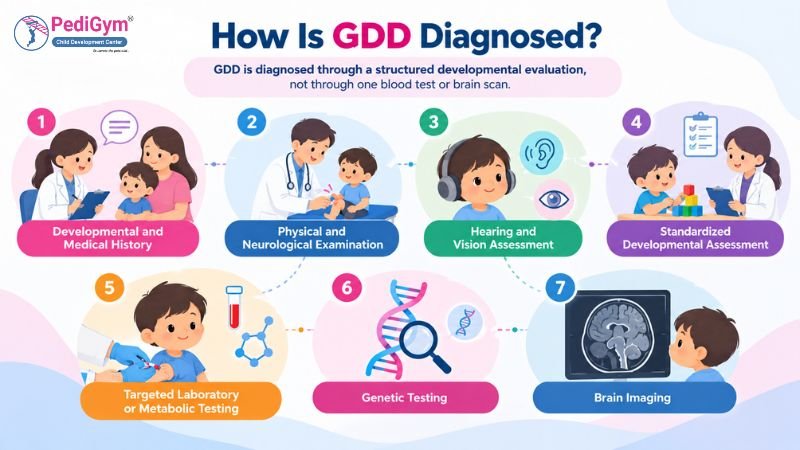
GDD is diagnosed through a structured developmental evaluation, not through one blood test or brain scan. The IAP recommends that investigations follow a careful history and examination and that hearing and vision be assessed before standardized developmental testing.
1. Developmental and Medical History
The clinician reviews:
- Developmental milestones and the age at which they were achieved
- Any loss of previously acquired skills
- Pregnancy and birth history
- Feeding, sleep and medical history
- Family history
- Seizures or other neurological symptoms
2. Physical and Neurological Examination
The examination may assess:
- Growth and head circumference
- Muscle tone and strength
- Reflexes and coordination
- Neurological signs
- Congenital or dysmorphic features
- General health and nutrition
3. Hearing and Vision Assessment
Hearing and vision should be checked before standardized developmental testing. Hearing or vision impairment can affect communication and developmental performance and should be identified before interpreting developmental results.
4. Standardized Developmental Assessment
Standardized developmental tools help measure skills across different developmental domains. Developmental surveillance and standardized screening complement each other; milestone checklists alone should not be treated as diagnostic tests.
5. Targeted Laboratory or Metabolic Testing
Testing depends on the child’s presentation. When clinically indicated, it may include:
- Thyroid function testing
- Lead level when exposure is possible
- Selected metabolic investigations
- Nutritional or biochemical testing
The IAP recommends targeted biochemical and metabolic investigations rather than indiscriminate testing of every child.
6. Genetic Testing
Genetic testing may be considered when there is clinical suspicion of a genetic syndrome or when no clear etiology is found. Exome or genome sequencing may be considered as a first- or second-tier test in children with developmental delay or intellectual disability, depending on the clinical situation and availability.
In India, availability and cost of advanced genetic testing vary between centers.
7. Brain Imaging
MRI may be considered when specific clinical indicators are present, such as neurological abnormalities, seizures, abnormal head growth or other concerning findings. It is not automatically required for every child with GDD.
If developmental delay is recognized, assessment and intervention should not be postponed simply because the underlying cause has not yet been identified.
Is GDD a Provisional Diagnosis?
Yes. GDD can function as a provisional diagnosis in young children because the full developmental and intellectual profile may not yet be reliably measurable.
The DSM-5-TR includes Global Developmental Delay for children younger than 5 years when the severity of intellectual disability cannot be reliably assessed during early childhood because of developmental limitations or young age.
As the child grows, clinicians may reassess:
- Whether the child continues to meet criteria for GDD
- Which developmental domains remain affected
- Whether intellectual disability can now be assessed reliably
- Whether autism, language disorder or another neurodevelopmental condition is present
- Whether a genetic, neurological or other underlying cause has become clearer
The IAP also recommends regular targeted follow-up, preferably with a developmental pediatrician or pediatric neurologist and the relevant therapy team.
Parents can ask at follow-up: What has improved, what remains delayed, and what needs to be reassessed next?
What Is the ICD-10 Code for GDD?
F88 is commonly used for GDD under ICD-10-CM, the U.S. clinical modification. Coding should be checked against the ICD version used in the country and healthcare system where the child is being treated.
For India, the World Health Organization’s ICD-10 classification is the relevant international reference; F88 falls within the group of disorders of psychological development.
The DSM-5-TR separately recognizes GDD in young children when the severity of intellectual disability cannot yet be reliably assessed.
The treating clinician should confirm the diagnosis and the appropriate coding system used for documentation.
GDD vs Speech Delay, Motor Delay, Autism and Intellectual Disability
Condition | Main distinction |
Speech/language delay | Primarily affects communication. It may be part of GDD when other developmental domains are also significantly delayed. |
Motor delay | Primarily affects gross or fine motor development. If other domains are not significantly delayed, it is not GDD. |
Autism spectrum disorder | A separate neurodevelopmental diagnosis involving persistent social-communication differences and restricted or repetitive behaviors. |
Intellectual disability | Involves intellectual functioning and adaptive functioning. A young child with GDD may later be reassessed for intellectual disability. |
GDD | Significant delay in at least two developmental domains in a child younger than 5 years. |
The IAP recommends autism screening for children, especially those with GDD, at 18–24 months and again at 3 years if the earlier screen was negative. The AAP also recommends autism-specific screening at 18 and 24 months alongside ongoing developmental surveillance.
Parents should seek broader developmental assessment when delays extend beyond a single developmental area.
Treatment for Global Developmental Delay
There is no single treatment for GDD. Treatment is individualized according to the child’s developmental profile and any underlying condition that is identified. The IAP recommends multidisciplinary intervention soon after developmental delay is recognized, even before a formal diagnosis is made.
Speech and Language Therapy
Speech-language therapy can target:
- Understanding and using language
- Vocabulary and sentence development
- Functional communication
- Social communication
- Alternative communication when needed
Occupational Therapy
Occupational therapy may support:
- Fine motor skills
- Hand function
- Sensory and functional skills
- Feeding
- Dressing and other daily activities
Physiotherapy
Physiotherapy may focus on:
- Strength
- Balance
- Postural control
- Walking
- Gross motor skills
- Coordination and mobility
Developmental and Behavioral Support
Developmental therapy and behavioral support may help with learning, participation, communication, play and everyday routines.
Parent Coaching
Parents can be taught practical ways to practice communication, movement, play and self-care skills during everyday activities. Parent participation can help carry therapy goals into the home environment.
Medical Management
Some children also need treatment for associated medical conditions such as epilepsy, hearing or vision impairment, nutritional deficiencies, endocrine disorders or identified genetic or neurological conditions.
The therapy plan should be based on the child’s assessment rather than on the GDD label alone.
Can Children With GDD Catch Up?
Some children with GDD make significant developmental progress, while others continue to need support. Outcomes vary according to the underlying cause, severity of delay, number of domains affected, medical or neurological conditions and response to intervention.
A child’s developmental profile can also change with age. Some children may later meet criteria for another neurodevelopmental diagnosis, including intellectual disability, while others may make substantial gains.
Regular reassessment helps determine whether therapy goals, educational support or further medical investigations need to change.
Parents should focus on measurable developmental progress and regular reassessment rather than expecting a fixed recovery timeline.
How Parents Can Support Development at Home
Parents can support development through short, repeated opportunities during everyday routines.
Everyday ways to practice include:
- Talk with your child during meals, dressing and play.
- Read picture books and name familiar objects.
- Encourage gestures, pointing and other communication attempts.
- Offer simple choices such as “apple or banana?”
- Encourage safe movement and active play.
- Practice age-appropriate self-care skills.
- Follow the home activities recommended by the child’s therapist.
- Prioritize interactive play and conversation.
For screen use, follow age-appropriate guidance from your child’s pediatrician; the CDC’s current milestone guidance emphasizes learning through talking, playing and interacting with others.
The most useful home program is one that parents can repeat consistently as part of normal daily routines.
GDD, Disability Certification and School Support in India
A GDD diagnosis alone does not automatically establish eligibility for disability certification in India. Eligibility depends on the disability category, functional assessment and applicable government criteria.
The Rights of Persons with Disabilities (RPwD) Act, 2016 recognizes specified disabilities including intellectual disability, autism spectrum disorder, cerebral palsy, speech and language disability, specific learning disabilities, multiple disabilities and other specified categories. GDD itself is not simply interchangeable with one of these categories.
Therefore, a child with GDD may need further assessment to determine whether the child meets criteria for a specified disability category and the required degree of disability.
How Does the UDID Process Start?
Families seeking disability certification can begin through the Government of India’s Unique Disability ID (UDID) system. The child’s eligibility and disability percentage are determined through the designated assessment process rather than by the GDD diagnosis alone.
What Are DEICs?
District Early Intervention Centres (DEICs) under RBSK provide assessment, intervention, referral and follow-up services, primarily for children from birth to 6 years.
The official DEIC guidance includes developmental concerns involving motor development, cognition, speech and hearing, autism spectrum disorder, behavioral and learning concerns and other childhood disabilities.
The DEIC referral pathway can include community referral, mobile health teams, health facilities and parent self-referral.
Parents can ask their pediatrician or local health authority about the nearest DEIC if government early-intervention services are needed.
When Should Parents Seek Urgent Medical Help?
Most developmental concerns can be assessed through a planned pediatric appointment. Prompt medical assessment is important when a child:
- Loses previously acquired developmental skills
- Develops seizures
- Develops sudden weakness or a major change in movement
- Has difficulty swallowing or breathing
- Has a sudden change in alertness or neurological function
Loss of previously acquired skills is particularly important and should not be treated as ordinary developmental delay.
If your child has regression or new neurological symptoms, seek medical evaluation promptly.
Expert Perspective
Dr. Nitin’s Perspective
“When a child is late in speaking, parents often ask, ‘Is it just speech delay?’ The first step is to look beyond speech and check movement, learning, social interaction, play and daily living skills. A child with delays in several areas needs a broader developmental assessment rather than assuming the problem is limited to speech.”
At PediGym Child Development Center, the initial assessment focuses on the child’s developmental history, milestone progression, movement, communication, play, learning and functional skills. The aim is to identify the child’s strengths and areas needing support and to build a practical intervention plan.
Families in Faridabad and Gurgaon can contact PediGym Child Development Center to arrange a developmental assessment.
Frequently Asked Questions
Is GDD common in toddlers?
Yes. GDD is estimated to affect approximately 1%–3% of children under 5 years of age. It is recognized when significant delays affect at least two developmental domains. Early assessment is useful when parents notice delays rather than waiting for several more milestones to be missed.
At what age can GDD be diagnosed?
GDD is generally used for children younger than 5 years when significant delays are present in at least two developmental domains. Assessment can begin as soon as developmental concerns are identified; parents do not need to wait until a child reaches age 5.
Is GDD a disability?
GDD and disability certification are not the same thing. GDD is a developmental diagnosis or description in young children. In India, disability certification depends on whether the child meets the criteria for a specified disability under the applicable rules and on formal functional assessment.
Is GDD permanent or provisional?
GDD is often considered a provisional diagnosis in young children because developmental and intellectual functioning may become easier to assess as the child grows. Regular reassessment helps determine whether the developmental profile changes or another diagnosis becomes clearer.
How long does therapy for GDD take?
There is no fixed treatment duration. Therapy length depends on the child’s developmental profile, underlying cause, goals and progress. Some children need short-term targeted intervention, while others require longer-term support. Goals should be reviewed regularly so therapy remains focused on current needs.
Can a child have GDD with normal speech?
Yes. A child may have relatively stronger speech and language skills while having significant delays in other developmental domains. However, if only one developmental domain is affected, another diagnosis such as isolated motor delay may be more appropriate.
Is GDD the same as autism?
No. GDD and autism spectrum disorder are different diagnoses. Some children can have both, while others have GDD without autism. The IAP recommends ASD screening at 18–24 months and again at 3 years if the earlier screen was negative.
Can GDD be diagnosed before the cause is known?
Yes. GDD describes the child’s developmental pattern, while the underlying cause may require a separate medical, genetic or neurological evaluation. The IAP recommends beginning multidisciplinary intervention soon after delay is recognized rather than waiting for every investigation to be completed.
What if genetic tests are normal?
A normal genetic test does not mean that the developmental delay is not real. Genetic testing identifies only some causes. If the initial testing is normal, the child’s developmental progress, medical history and examination should continue to guide follow-up and any additional investigations.
Can GDD be prevented?
Not all cases of GDD can be prevented because many have genetic or developmental causes that cannot be predicted or prevented. Some risks can be reduced through appropriate prenatal care, prevention and treatment of infections, adequate nutrition, safe pregnancy and delivery care, newborn care and timely management of medical conditions.
Can GDD be cured?
There is no single cure for GDD, but some children make substantial developmental progress with early, individualized support. The goal is to improve communication, movement, learning, independence and participation while addressing any treatable underlying condition.
Final Takeaway
If your child is delayed in two or more developmental areas, arrange a developmental assessment and start recommended support early.
Families in Faridabad and Gurgaon can contact PediGym Child Development Center for a developmental assessment and individualized therapy planning.
References
- Juneja M, et al. Diagnosis and Management of Global Development Delay: Consensus Guidelines of Growth, Development and Behavioral Pediatrics Chapter, Neurology Chapter and Neurodevelopment Pediatrics Chapter of the Indian Academy of Pediatrics. Indian Pediatrics. 2022. DOI: 10.1007/s13312-022-2522-5.
- Sharma AR, Siddiqui MS, Magar S, et al. The Etiological Profile of Global Developmental Delay at a Tertiary Care Hospital in India: An Observational Study. Cureus. 2023;15(6):e41066. DOI: 10.7759/cureus.41066.
- Mithyantha R, et al. Current evidence-based recommendations on investigating children with global developmental delay. Archives of Disease in Childhood. 2017. DOI: 10.1136/archdischild-2016-311271.
- Centers for Disease Control and Prevention. Developmental Milestones: Learn the Signs. Act Early. Updated 2026.

Dr. Nitin, Founder of PediGym Child Development Center, is a dedicated pediatric therapy expert and DMI Level C Certified Therapist leading structured, evidence-based therapy programs in Faridabad and Gurgaon. Under his guidance, PediGym provides comprehensive pediatric rehabilitation focused on improving motor skills, coordination, sensory processing, speech clarity, and functional independence through personalized intervention plans.