Medically reviewed by: Dr. Nitin, Founder, PediGym Child Development Center
Credentials: DMI Level C Certified Therapist
Childhood Apraxia of Speech (CAS) is a neurological motor speech disorder that makes it difficult for a child to plan and coordinate the movements needed for clear speech. A child may know what they want to say but struggle to move their lips, tongue and jaw in the correct sequence. Common childhood apraxia of speech symptoms include inconsistent sound errors, difficulty moving smoothly between sounds or syllables, unusual pauses, incorrect stress or rhythm, and difficulty imitating words.
CAS does not simply go away as a child grows. However, individualized speech-language therapy can help children improve speech production, intelligibility and functional communication. A comprehensive evaluation by a qualified speech-language pathologist (SLP) is important because CAS can resemble other speech and language disorders.
What Is Childhood Apraxia of Speech?
Childhood Apraxia of Speech is a motor speech disorder involving difficulty planning and programming the movements required for speaking. The challenge is not simply learning a particular sound. Instead, the brain has difficulty organizing the timing, sequence and coordination of movements needed to produce speech.
The speech muscles themselves are not necessarily weak. This helps distinguish CAS from some conditions involving weakness or impaired muscle control, such as dysarthria. A child with CAS may understand what others say and know what they want to communicate but have difficulty expressing those ideas clearly through spoken words.
CAS may also be called developmental apraxia of speech or developmental verbal dyspraxia. Terminology can vary between clinical and educational settings.
Recognizing the Signs
The childhood apraxia of speech signs can vary according to a child’s age and the severity of the disorder. No single symptom confirms CAS because several characteristics can also occur with other speech sound disorders.
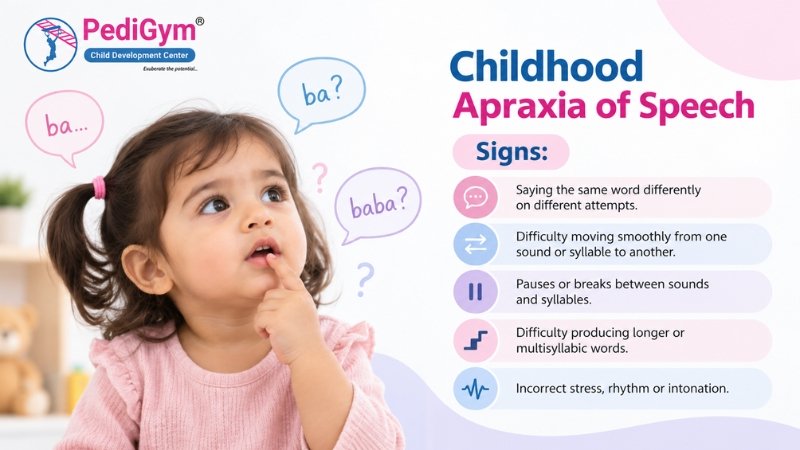
Common Signs Include:
- Saying the same word differently on different attempts.
- Difficulty moving smoothly from one sound or syllable to another.
- Pauses or breaks between sounds and syllables.
- Difficulty producing longer or multisyllabic words.
- Incorrect stress, rhythm or intonation.
- Difficulty imitating sounds, words or phrases.
- Distorted vowels or consonants.
- Limited variety of consonant and vowel sounds.
- Visible searching or “groping” movements of the mouth while trying to speak.
- Speech that is particularly difficult for unfamiliar listeners to understand.
These childhood apraxia of speech symptoms may become more noticeable as children attempt increasingly complex words and sentences.
Early Signs in Toddlers
The signs of apraxia of speech in toddlers can be difficult to identify because speech and language skills are developing rapidly during the first few years.
Possible Early Indicators Include:
- Fewer vocalizations or less varied babbling.
- Fewer consonant sounds.
- A limited range of syllable or word shapes.
- Delayed acquisition of consonants.
- First words appearing later than expected.
- Difficulty combining sounds into words.
- Inconsistent attempts at familiar words.
- Long pauses between sounds.
- Difficulty imitating simple words.
Some age-related signs can be more specific. For example, reduced babbling or fewer vocal sounds may be noticed between 7 and 12 months, while first words may be delayed beyond 12 to 18 months. Speech concerns may become more noticeable between approximately 18 months and 2 years, although a young child’s speech development can vary considerably.
These observations do not automatically mean a child has CAS. They are reasons to consider professional assessment and ongoing monitoring.
What Causes CAS?
In many children, the exact cause of Childhood Apraxia of Speech is not identified. CAS can occur without an obvious structural change in the brain. In other children, it may be associated with neurological conditions or brain injury, including stroke, infection or traumatic brain injury.
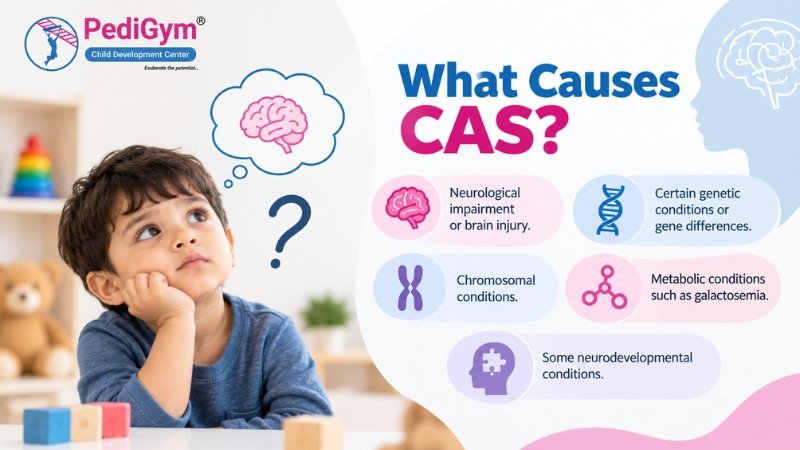
Possible contributing factors include:
- Neurological impairment or brain injury.
- Certain genetic conditions or gene differences.
- Chromosomal conditions.
- Metabolic conditions such as galactosemia.
- Some neurodevelopmental conditions.
Genetic factors may play a role in some children. Changes involving the FOXP2 gene, for example, have been associated with speech and language disorders and may increase the likelihood of speech-motor difficulties. Genetic causes are not present in every child with CAS.
Who Is More Likely to Have It?
Childhood Apraxia of Speech is considered relatively rare, although an exact prevalence figure is difficult to establish because diagnostic definitions and identification methods vary.
CAS can occur in children of any sex, although it has been reported more often in boys. Family history and certain genetic or developmental conditions may also be relevant when a clinician evaluates a child.
CAS can occur alongside other developmental difficulties. Some children may also experience language delays, motor coordination difficulties, literacy challenges or social communication difficulties. These associated difficulties should be evaluated separately rather than automatically being attributed to CAS.
Speech and Language Are Not Always Affected in the Same Way
A child with CAS may have a different level of understanding compared with their ability to speak.
For example, a child may understand many words and instructions but have difficulty producing those words clearly. Other children may have both motor speech difficulties and a language disorder affecting vocabulary, sentence structure or comprehension.
This is why assessment should look beyond pronunciation alone and consider the child’s overall communication skills.
How Is CAS Diagnosed?
A childhood apraxia of speech diagnosis is based on a comprehensive clinical assessment rather than one simple test.
An SLP May Evaluate:
- Speech sound production.
- Consistency of errors.
- Ability to move between sounds and syllables.
- Word and phrase production.
- Stress, rhythm and intonation.
- Oral-motor and speech-motor performance.
- Receptive and expressive language.
- Functional communication.
- Hearing and other factors that may affect speech.
There is no single standardized CAS-specific screening tool or single symptom that can definitively diagnose the disorder. Clinicians use multiple observations, speech tasks and clinical judgment to distinguish CAS from other speech sound disorders.
Diagnosis can be particularly challenging in children younger than 3 because they may have limited spoken language. Even so, young children with communication concerns can be referred for appropriate evaluation. In some cases, a clinician may describe a child as having suspected CAS and recommend continued assessment and monitoring.
CAS vs. Other Speech Disorders
CAS is sometimes confused with articulation or phonological disorders because all can involve unclear speech.
In an articulation or phonological disorder, a child may have difficulty learning or using particular speech sounds. CAS primarily involves difficulty planning and programming the movements required for speech. Dysarthria is different because it can involve weakness, abnormal muscle tone or difficulty executing speech movements.
A professional evaluation helps identify which factors are contributing to a child’s communication difficulties.
Treatment Options That Can Help
Childhood apraxia of speech treatment is individualized. There is no single therapy approach that is appropriate for every child.
The primary intervention is speech-language therapy focused on improving accurate speech movements and functional communication. Therapy may include frequent practice of sounds, syllables, words and phrases, with the therapist adjusting the level of difficulty as the child’s skills develop.
What Does Therapy Usually Involve?
Repeated speech practice
Children may practice carefully selected sounds, syllables and words repeatedly to develop more accurate and consistent movement patterns.Motor-learning principles
Therapy may use structured repetition, feedback, cueing and gradual changes in task difficulty to support speech-movement learning.Visual, verbal and tactile cues
Different cues may help a child understand how to produce a particular sound or transition between sounds. The therapist can adjust these cues as the child becomes more independent.Gradual progression
Therapy can progress from simpler speech targets to longer words, phrases and everyday communication.Alternative communication when needed
For children whose spoken communication is very limited, gestures, signs, communication boards or speech-generating devices may provide additional ways to express needs and ideas while speech skills develop.
How Often Is Therapy Needed?
The appropriate frequency depends on the child’s individual needs, severity and response to intervention. Some children may benefit from frequent, intensive practice because developing motor speech skills requires repeated opportunities to learn and refine movement patterns.
Parents can also support progress by practicing recommended targets at home in short, positive sessions. Home activities should follow the child’s individualized therapy plan rather than introducing exercises without professional guidance.
What Is the Outlook for Children With CAS?
Children with CAS can make meaningful improvements with appropriate intervention, although progress varies from child to child. Some children may continue to need speech and language support for an extended period, particularly when speech difficulties are severe or other communication challenges are present.
CAS is not considered a condition that children simply outgrow. Early identification and appropriate therapy can help children develop more effective communication skills and address difficulties as they emerge.
Expert Guidance at PediGym Child Development Center
Dr. Nitin, Founder of PediGym Child Development Center, is a dedicated pediatric therapy expert and DMI Level C Certified Therapist leading structured, evidence-based therapy programs in Faridabad and Gurgaon.
His pediatric therapy approach focuses on structured, individualized intervention based on each child’s developmental needs. For children showing possible childhood apraxia of speech signs, an individualized assessment is important before selecting a therapy plan.
If your child has persistent difficulty producing words, frequently changes how the same word sounds, struggles to imitate speech or remains difficult to understand, consider discussing these concerns with a qualified pediatrician and speech-language pathologist.
Frequently Asked Questions
Can a toddler have Childhood Apraxia of Speech?
Yes. Toddlers may show early indicators such as limited vocalizations, fewer consonants, limited syllable shapes and difficulty combining sounds. However, diagnosing CAS in very young children can be challenging, so professional assessment and monitoring are important.
Does CAS go away on its own?
Children do not simply outgrow CAS. With appropriate speech and language services, many children can improve their communication skills. The amount and duration of support vary according to individual needs.
What is the main Childhood Apraxia of Speech treatment?
Speech-language therapy is the primary treatment. It generally focuses on improving speech-movement accuracy, consistency and functional communication through individualized practice. AAC may also be considered when spoken communication is significantly limited.
Is CAS the same as a speech delay?
No. A general speech delay and CAS are different. CAS involves difficulty planning and programming the movements required for speech, while a speech delay can have other developmental causes. A professional assessment can help determine the difference.
Can parents practice at home?
Yes. Home practice can support therapy when parents follow the speech-language pathologist’s recommendations. Short, consistent and positive practice is generally more useful than pressuring a child to repeat words.
When should I seek an evaluation?
Consider an evaluation when your child has persistent speech difficulties, inconsistent pronunciation, limited speech sounds, difficulty imitating words or speech that remains unusually difficult to understand. Young children can also be referred when there are communication or hearing concerns.
References
- American Speech-Language-Hearing Association (ASHA): Childhood Apraxia of Speech Practice Portal — clinical guidance on assessment, diagnosis and treatment.
- Mayo Clinic: Childhood apraxia of speech — Symptoms and causes — information on symptoms, causes, risk factors and associated conditions.
- Cleveland Clinic: Childhood Apraxia of Speech (CAS): Symptoms & Treatment — information on symptoms, diagnosis, treatment and outlook.
- National Institute on Deafness and Other Communication Disorders (NIDCD): Apraxia of Speech — background information on apraxia and speech-motor difficulties.
disclaimer
This article is for educational purposes and does not replace an individual medical, developmental or speech-language evaluation.

Dr. Nitin, Founder of PediGym Child Development Center, is a dedicated pediatric therapy expert and DMI Level C Certified Therapist leading structured, evidence-based therapy programs in Faridabad and Gurgaon. Under his guidance, PediGym provides comprehensive pediatric rehabilitation focused on improving motor skills, coordination, sensory processing, speech clarity, and functional independence through personalized intervention plans.