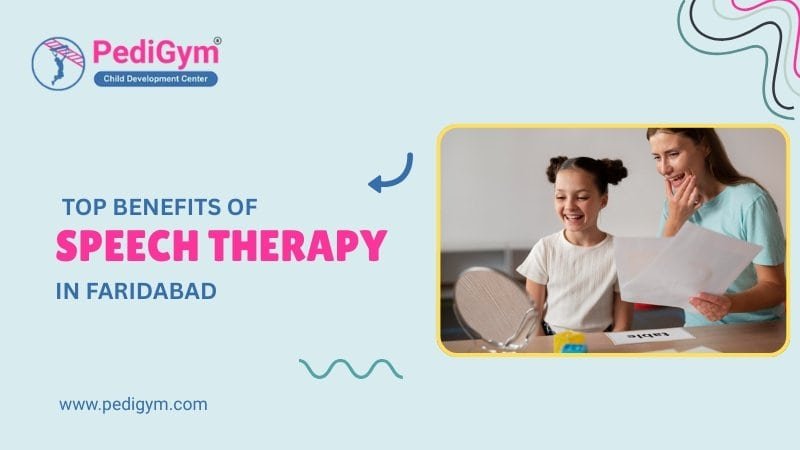
Speech therapy plays a crucial role in helping children develop clear communication, confident interaction, and strong language skills. In Faridabad, parents today are seeking professional speech therapy services to support children facing challenges like delayed speech, unclear sounds, stammering, limited vocabulary, or social communication difficulties. With the right guidance from trained speech therapists, children can learn to express themselves better, understand language effectively, and participate more confidently at home, school, and in social settings.
Modern speech therapy in Faridabad focuses on personalized assessments, child-friendly activities, and evidence-based techniques that address each child’s unique needs. At Pedigym, Faridabad, our certified Speech-Language Pathologists (SLPs) offer evidence-based therapy designed to support clear speech, better language skills, and confident communication.
What is Speech Therapy?
Speech therapy is a specialised program that helps children improve how they speak, understand language, express their thoughts, and communicate socially. It supports children with unclear speech, delayed language, stuttering, voice issues, social communication challenges, and oral-motor difficulties. Using play-based activities and scientific techniques, speech therapy helps children develop clear, confident, and meaningful communication.
Key Areas of Speech Therapy
- Speech sound training (articulation & phonology): Correcting unclear or incorrect sounds.
- Language development: Improving comprehension, vocabulary, and sentence formation.
- Fluency improvement: Managing stuttering and promoting smooth speech.
- Oral-motor strengthening: Enhancing tongue, lip, and jaw movement for better clarity and feeding.
- Voice therapy: Correcting pitch, volume, and voice quality issues.
- Social communication training: Building eye contact, turn-taking, and conversation skills.
Modern speech therapy combines play-based activities, scientific techniques, and family involvement to create meaningful, long-lasting progress.

What Does Speech Therapy Do?
Speech therapy supports children in many important areas of communication, making it easier for them to express themselves, understand others, and participate confidently in daily life. Here’s how it helps:
1. Helps Children Speak Clearly
Many children struggle with sounds like /r/, /s/, /l/, /th/, /k/, /g/ and more. Speech therapy teaches them how to place their tongue, lips, and jaw correctly so these sounds come out more naturally. Over time, their words become clearer, and people can understand them without repeating.
2. Strengthens Language Understanding
A big part of communication is understanding what others say. Therapists work on skills like following daily instructions, recognising objects and actions, understanding grammar, and answering WH-questions such as who, what, where, why, and how.
This builds the foundation children need for school learning and everyday conversations.
3. Expands Expressive Language
Some children know what they want to say but struggle to put words together. Speech therapy helps them form sentences, describe things, tell simple stories, and use correct grammar. It also teaches them how to express their needs, feelings, and ideas with confidence.
4. Controls Stuttering and Improves Fluency
If a child stutters, therapy uses techniques like slow-paced speaking, smooth breathing, and rhythm-based speech. These methods reduce blocks, repetitions, and tension, helping the child speak more comfortably and fluently.
5. Builds Social Communication Skills
Talking is more than words — it includes how we behave while communicating. Therapists teach children social rules such as maintaining eye contact, taking turns during conversations, understanding facial expressions, responding to social cues, and solving problems during peer interactions.

When Should You Consider Speech Therapy?
Parents should seek speech therapy support if their child shows any of the signs listed below. Noticing these early can make a big difference in your child’s communication and learning.
Speech Signs
- Speech is unclear, and others struggle to understand the child
- Difficulty producing sounds like /r/, /s/, /l/, /k/, /g/, /th/
- Stuttering, repeating words, or getting “stuck” while speaking
- Speaking too fast, too slow, or with uneven rhythm
Language Signs
- Limited vocabulary for their age
- Delay in saying first words or combining words
- Difficulty forming sentences or expressing thoughts
- Not following simple or multi-step instructions
- Trouble answering basic WH-questions like who, what, where, or why
Social Signs
- Avoids talking or prefers to stay silent in groups
- Poor eye contact or difficulty understanding social cues
- Struggles to play, share, or take turns with peers
- Has trouble starting or maintaining conversations
What Age Is Best for Speech Therapy?
Speech therapy is helpful at any age, but some stages are especially important for building strong communication skills.
Age 1–3 Years – This is the most important stage for early speech and language growth. If a child has limited words, slow vocabulary, or reduced gestures and eye contact, therapy helps build a strong communication base early.
Age 3–5 Years- During preschool years, children develop pronunciation, vocabulary, and sentence skills quickly. Therapy at this age improves clarity, grammar, and social communication needed for school readiness.
Age 6+ Years – For school-age children, therapy focuses on fluency, reading–writing support, grammar correction, and academic communication. It also boosts confidence in classroom speaking and interaction.
At Pedigym, every speech therapy session is thoughtfully planned to match a child’s age, challenges, and learning style. Activities are designed to improve pronunciation, language, fluency, social communication, and academic readiness.
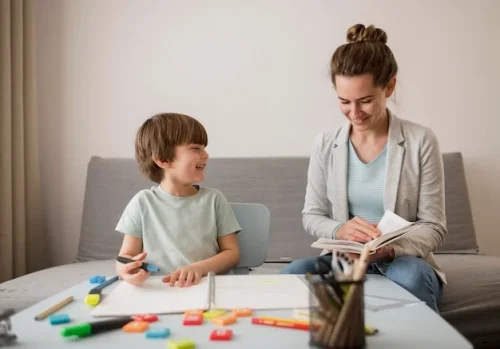
What Activities Are Done in Speech Therapy?
1. Articulation & Sound Practice
These activities help children learn how to produce sounds accurately and improve overall speech clarity.
Activities include:
- Repetition drills: Practising the same sound in words, phrases, and sentences
- Mirror exercises: Children observe lip and tongue placement for correct sound production
- Sound discrimination tasks: Learning to hear the difference between correct and incorrect sounds
- Minimal pair activities: Practising similar-sounding words to fix sound errors (e.g., tap–cap, tea–key)
This training improves clarity and boosts the child’s confidence while speaking.
2. Oral-Motor Strengthening
These exercises strengthen the mouth muscles needed for clear speech, feeding, and breath control.
Includes:
- Tongue movement activities (side-to-side, elevation, circles)
- Lip-strengthening tasks (lip closure, blowing, puckering)
- Breathing exercises to support voice and fluency
- Jaw stability tasks to improve coordination and reduce unclear speech
These activities are especially helpful for children with weak oral muscles or unclear articulation.
3. Language Activities
Designed to improve understanding and expressive communication.
Activities include:
- Story-based learning to build comprehension
- Picture description games to improve vocabulary and sentence formation
- Sequencing tasks to develop logical storytelling (first–next–last)
- Vocabulary worksheets to learn new words and concepts
These activities build the child’s ability to think, express, and understand everyday language.
4. Fluency Techniques
Used for children who stutter, speak too fast, or have uneven speech.
Techniques include:
- Slow-rate speech training to reduce pressure while talking
- Pacing boards to control speed and improve fluency
- Relaxed breathing techniques to prevent speech blocks
- Smooth speech methods that help children talk more freely
These help children speak comfortably without fear or pressure.
5. Social Communication Training
Focuses on improving how children interact with others.
Activities include:
- Role-play games (shopping, classroom, greetings)
- Turn-taking activities to build conversation skills
- Group interaction tasks to build confidence in social settings
- Emotion-recognition activities using expressions, pictures, and real-life scenarios
These are essential for children who struggle with social cues, eye contact, or making friends.
7. Parent-Training Activities
Parents are given simple strategies, home routines, and daily practice ideas so the child continues improving outside therapy. This leads to faster, more consistent progress.
Top Benefits of Speech Therapy
Speech therapy provides essential developmental, emotional, social, and academic benefits to children.
1. Clear and Confident Speech
Children learn to speak clearly and correctly, making communication easier at home, school, and with peers.
2. Improved Understanding and Expression
Stronger vocabulary, comprehension, grammar, and sentence formation help children explain their thoughts clearly and follow daily instructions.
3. Stronger Social Interaction
Children become more confident in group activities, conversations, and friendships, enhancing overall social development.
4. Reduced Behavioural Issues
When communication improves, frustration decreases. This reduces tantrums, withdrawal, and behaviour-related stress.
5. Improved Reading and Academic Skills
Speech therapy builds the foundation for:
- Phonics
- Reading comprehension
- Writing
Classroom communication
Children perform better academically and participate more confidently in class.
How Speech Therapy Works at Pedigym?
Speech therapy at Pedigym follows a scientific, child-friendly, and family-centered approach. Every step is designed to ensure that the child receives the right support at the right time, leading to consistent and measurable improvement.
1. Initial Evaluation & Parent Interview
The process begins with a detailed understanding of the child’s developmental history.
- Parents share concerns about speech, behaviour, school performance, or social interaction.
- Therapists observe the child’s communication style, play behaviour, and interaction pattern.
- This helps in identifying specific challenges and establishing a clear starting point.
2. Standardised Assessments
Pedigym uses scientifically validated tools to assess every aspect of communication, such as:
- Speech clarity (articulation & phonology)
- Language understanding (receptive language)
- Expressive language skills
- Fluency/stuttering patterns
- Voice quality and breath support
- Oral-motor strength
- Social interaction and pragmatic skills
These assessments help create an accurate communication profile for each child.
3. Goal-Setting Based on the Child’s Abilities
After assessment, therapists prepare a personalised goal plan, which includes:
- Short-term goals (weekly or monthly progress)
- Long-term goals (larger milestones over time)
- Strategies that match the child’s learning style
- Expectations and timelines for parents
Goals are realistic, age-appropriate, and designed to build core communication skills step-by-step.
4. Play-Based & Activity-Focused Therapy Sessions
Sessions at Pedigym are engaging, fun, and interactive.
Therapists use:
- Toys, puzzles, and interactive games
- Flashcards and visual aids
- Social stories and role-play
- Sound drills, oral-motor tools, and worksheets
This play-based approach keeps children motivated and improves attention, participation, and learning.
5. Weekly Progress Tracking & Updates
Parents receive regular updates where therapists:
- Discuss improvements and challenges
- Review goals achieved
- Share new strategies for home practice
- Suggest modifications if needed
Tracking ensures that therapy remains consistent, effective, and aligned with the child’s development.
6. Home Exercises for Faster Improvement
To speed up progress, therapists provide simple home activities that fit into daily routines.
Parents learn:
- Speech clarity drills
- Vocabulary games
- Social communication prompts
- Reading–speaking practice
- Behaviour and interaction strategies
Home reinforcement doubles the effectiveness of therapy.
Why Choose Pedigym for Speech Therapy in Faridabad?
Choosing Pedigym means choosing expert care, structured learning, and a child-friendly environment that supports steady communication growth.
Certified & Experienced Speech Therapists
Our therapists are trained to work with a wide range of speech, language, fluency, and social communication challenges, using proven and age-appropriate techniques.
Play-Based, Child-Friendly Therapy Rooms
Therapy spaces are designed to be fun, engaging, and comfortable, helping children stay motivated and enjoy every session.
Individualised Therapy Plans
Every child receives a personalised plan based on detailed assessment, learning style, and developmental needs to ensure targeted, meaningful progress.
Parent Training for Home Support
Parents are taught simple strategies to use at home, which helps children continue improving outside therapy sessions.
Conclusion
Speech therapy is a powerful tool that strengthens communication, learning, and confidence. With the right support, children achieve clear speech, stronger language skills, and improved social interactions.
At Pedigym, Faridabad, our expert therapists ensure every child receives personalised, engaging, and effective therapy to reach their full potential.

Dr. Nitin, Founder of PediGym Child Development Center, is a dedicated pediatric therapy expert and DMI Level C Certified Therapist leading structured, evidence-based therapy programs in Faridabad and Gurgaon. Under his guidance, PediGym provides comprehensive pediatric rehabilitation focused on improving motor skills, coordination, sensory processing, speech clarity, and functional independence through personalized intervention plans.