Reviewed by: Nitin Gupta, DMI Level C Therapist & Founder of Pedigym
Last Updated: June 2026
This article has been reviewed using guidance from recognized developmental and communication resources and is intended for educational purposes only. It should not replace professional assessment or individualized therapy recommendations.
Speech and language development forms the foundation of a child’s learning, behavior, and social interaction. While every child develops at their own pace, some children experience delays that can affect their ability to communicate effectively. Early speech therapy helps identify and address these challenges during the most critical developmental years. At PediGYM, early intervention is designed to support children in building strong communication skills that positively impact their future growth.
What Is Early Speech Therapy?
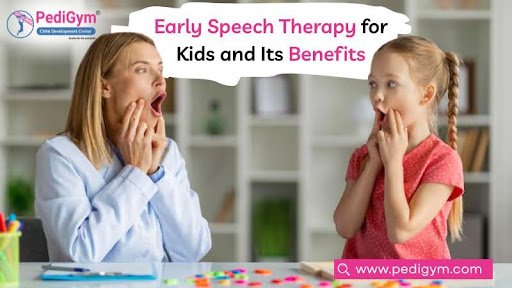
Early speech therapy is a structured and individualized therapeutic approach designed to support children in developing age-appropriate speech, language, and communication skills during the early years of development. Therapy may focus on:
- Improving speech sound production and clarity
- Increasing vocabulary and word usage
- Developing proper sentence structure and grammar
- Enhancing listening skills and language comprehension
- Building social communication, eye contact, and interaction skills
At PediGYM, early speech therapy is play-based and child-centered, allowing children to learn naturally through fun activities, games, songs, and everyday interactions. This engaging approach keeps children motivated, reduces pressure, and helps them develop communication skills in a comfortable and supportive environment.
Importance of Early Years in Brain Development
Early childhood is an important period for communication development because the brain develops rapidly during the first years of life. Children build language skills through interaction, repetition, play, and everyday experiences that support listening, understanding, and communication. Research suggests that the early years provide strong opportunities for developing communication skills, which is why identifying concerns and introducing support early may be beneficial for some children—particularly when communication differences begin affecting speech, language, learning disabilities, or social interaction.
Early speech therapy may offer several potential advantages during this developmental period, including the ability to:
- Support communication skill development during early learning years
- Take advantage of the brain’s natural adaptability through repeated communication experiences
- Encourage stronger participation in everyday interaction and social communication
- Help children build confidence when expressing needs and ideas
- Potentially reduce the likelihood of requiring more intensive support later, depending on individual developmental needs
Because the brain is highly responsive during these early years, identifying communication concerns and introducing support early may help children build communication skills over time and support participation, confidence, and everyday development.
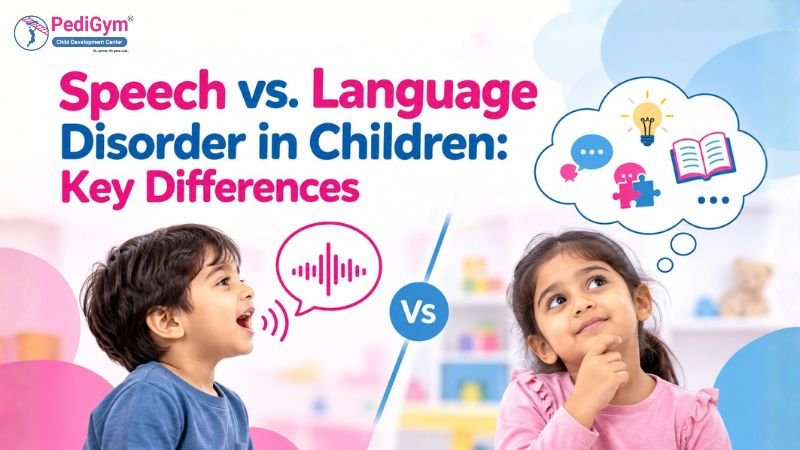
Understanding Speech vs. Language Development
Many parents use speech and language interchangeably, but they are different:
- Speech refers to how sounds are produced, including clarity, articulation, and fluency.
- Language refers to understanding and using words to communicate ideas, thoughts, and emotions.
Language development includes:
- Receptive language – understanding instructions and spoken language
- Expressive language – using words, gestures, and sentences to express needs
Delays in either area can impact a child’s daily functioning and learning.
Common Conditions That Benefit from Speech Therapy
Speech therapy can support children with different communication and developmental needs. Each child’s experience is unique, and therapy goals are adapted accordingly.
- Speech Delay — when a child develops spoken language more slowly than expected for their age.
- Language Delay — difficulty understanding language, expressing ideas, or both.
- Autism Spectrum Disorder (ASD) — a developmental condition that may influence communication, social interaction, and language use.
- Down Syndrome — may affect speech clarity, language development, and communication skills.
- Global Developmental Delay — when development progresses more gradually across multiple areas, including communication.
- Childhood Apraxia of Speech — a motor speech condition that affects planning and coordinating the movements needed for speech.
- Fluency Disorders — interruptions in speech flow, including stuttering.
- Oral-Motor Communication Challenges — difficulty coordinating movements of the lips, tongue, jaw, or breath support that may affect speech production, sound clarity, and overall communication.
- Feeding and Swallowing Difficulties — challenges with chewing, swallowing, or oral coordination during eating that may sometimes overlap with the same oral-motor skills used in speech production.
- Hearing-Related Communication Delays — communication challenges that may occur when hearing differences affect language exposure and speech development.
A speech therapist can help determine which communication approaches best support a child’s individual strengths and needs.
Signs That Indicate a Need for Speech Therapy
Every child develops at their own pace, but certain signs may indicate that a child needs additional support with speech and language development. Recognizing these signs early allows parents to seek timely professional guidance and avoid future challenges.
- Does not babble or make sounds as an infant.
- Has fewer words than expected for their age.
- Struggles to combine words into sentences.
- Has unclear or repetitive speech patterns.
- Finds it difficult to follow simple commands.
- Shows limited eye contact or social interaction.
- Gets frustrated when trying to communicate.
Early evaluation helps identify the root cause of communication difficulties and provides parents with clear guidance, reassurance, and an effective plan for supporting their child’s speech and language development.
Noticing These Signs in Your Child?
Every child develops differently, but if communication challenges are becoming more noticeable or affecting daily interaction, an early conversation with a specialist can provide clarity.
A professional assessment can help identify strengths, understand developmental needs, and guide you toward the most appropriate next steps.
Book a consultation to discuss your child’s communication development.
How Early Speech Therapy Works?
Speech therapy sessions are designed to help children communicate in ways that feel engaging, supportive, and appropriate for their age and developmental stage. Rather than following the same routine for every child, therapists adapt activities and goals based on each child’s communication needs.
Assessment and Personalized Goal Setting
The first step usually involves understanding how your child currently communicates. A speech therapist may observe how your child responds to language, uses words or gestures, interacts during play, follows instructions, and expresses needs.
This assessment helps identify strengths as well as areas where additional support may be beneficial. Based on these observations, therapy goals are created to focus on practical communication skills that support everyday life.
For example, if a child understands instructions but rarely uses words, therapy may focus on encouraging expressive language through structured interaction and play.
Play-Based Language Stimulation
Young children often learn best through meaningful experiences rather than formal teaching. For this reason, speech therapy commonly includes play-based activities that naturally encourage communication.
Therapists may use books, songs, pretend play, puzzles, movement activities, or interactive games to create opportunities for language development.
For example, during a pretend kitchen activity, a therapist may model simple phrases such as “more juice,” “my turn,” or “wash hands,” encouraging the child to imitate and gradually use language independently.
Modeling and Guided Communication Practice
Children often benefit from hearing language demonstrated in clear, supportive ways. During therapy, the therapist may model speech sounds, words, or short phrases and encourage the child to respond naturally.
Instead of correcting mistakes directly, therapists typically provide gentle prompts and repetition to build confidence and reduce pressure.
For example:
Therapist: “Ball”
Child: “Ba”
Therapist: “Great! Ball.”
As communication improves, support is gradually reduced to encourage independent use of language.
Oral-Motor and Speech Production Support
For some children, therapy may include activities that support the movements involved in speech production and feeding-related communication skills when clinically appropriate. Depending on the child’s needs, sessions may focus on coordination of the lips, tongue, jaw, breath support, articulation practice, and improving clarity of speech during functional communication.
For example, a therapist may use structured sound practice, imitation activities, or age-appropriate exercises during play to encourage clearer speech production while keeping communication meaningful and engaging.
Social Communication and Interaction Skills
Communication involves more than producing words. Some children benefit from support in areas such as turn-taking, responding to others, maintaining attention during interaction, understanding social cues, and participating in conversations.
Therapists may use structured play, shared activities, visual supports, and guided interaction to help children practice communication in real-life situations.
For example, during a turn-taking game, the therapist may encourage waiting, requesting, commenting, and responding to another person naturally.
Key Benefits of Early Speech Therapy
Early speech therapy provides long-lasting benefits that support a child’s overall growth and development. Addressing communication challenges early helps children build essential skills that positively influence learning, behavior, and social participation.
1. Improved Communication Skills
Children develop clearer speech, stronger vocabulary, and better sentence formation. Therapy helps improve pronunciation, word usage, and expressive language, allowing children to communicate their thoughts and needs more effectively.
2. Enhanced Social Interaction
Speech therapy encourages meaningful interaction with peers, family members, and teachers. Children learn important social communication skills such as eye contact, turn-taking, listening, and responding appropriately in conversations.
3. Emotional Regulation and Behavior Improvement
When children are able to express their needs, feelings, and emotions, frustration levels reduce significantly. Improved communication often leads to fewer tantrums, better emotional control, and more positive behavior.
4. Academic Readiness
Strong speech and language skills form the foundation for reading, writing, and classroom learning. Early speech therapy supports attention, comprehension, and communication skills essential for success in school.
5. Long-Term Developmental Success
Early therapy builds a strong foundation for independence, confidence, and lifelong communication skills. Children are better prepared to handle social, academic, and daily life challenges as they grow.
What to Expect: Timeline for Progress
One of the most common questions parents ask is how quickly they will notice improvement. The answer varies because progress depends on factors such as age, communication goals, consistency, home practice, and the child’s individual developmental profile.
During the First Few Weeks
Children may begin showing increased engagement, stronger responses during interaction, or more attempts to communicate.
Within 2–3 Months
Some families notice meaningful changes such as new words, improved understanding, better participation in conversation, or increased confidence during communication.
Over the Longer Term
Continued support may contribute to stronger communication skills, improved social participation, greater independence, and increased readiness for learning environments.
Progress is often gradual, and even small communication changes can have meaningful effects in everyday life.
Supporting Communication at Home
Parents and caregivers play an important role in helping children practice communication beyond therapy sessions. Therapists may recommend simple strategies that fit naturally into daily routines, such as expanding a child’s words, encouraging turn-taking, reading together, and creating opportunities for interaction.
The goal is not to recreate therapy at home but to build communication opportunities into everyday moments in ways that feel realistic and sustainable for families.
Why Choose PediGYM for Early Speech Therapy?
Choosing the right support early can make a meaningful difference in a child’s communication journey. At PediGYM, therapy is designed to be individualized, engaging, and aligned with each child’s developmental needs.
What families can expect:
- Individualized therapy planning tailored to each child’s communication goals, strengths, and developmental profile.
- Child-centered sessions that create opportunities for learning through interaction, play, and everyday communication.
- Evidence-informed approaches that combine structured support with age-appropriate, engaging activities.
- A supportive, child-friendly environment designed to help children feel comfortable, motivated, and confident during sessions.
- Active family involvement, with practical strategies that help parents and caregivers support communication beyond therapy sessions.
Our approach emphasizes early support, consistent progress tracking, and building communication skills that can support children across everyday routines, learning environments, and social experiences.
References
- American Speech-Language-Hearing Association (ASHA) — Early Identification of Speech, Language and Hearing Disorders
- Centers for Disease Control and Prevention (CDC) — Developmental Milestones
- National Institute on Deafness and Other Communication Disorders (NIDCD) — Speech and Language Development
- American Academy of Pediatrics (AAP) — Developmental Surveillance and Early Intervention Guidance
Frequently Asked Questions
At what age should speech therapy start?
Children can be evaluated whenever concerns about communication appear. Early support may help create more opportunities to strengthen communication skills during important developmental years.
How long until I see results?
Every child progresses differently. Some families notice changes within a few months, while others see gradual improvement over a longer period depending on goals and consistency.
Is speech delay the same as autism?
No. Speech delay and autism are different. While some children with autism may experience communication differences, many children with speech delay do not have autism.
Can I support my child’s speech development at home?
Yes. Talking during daily routines, reading together, encouraging interaction, and using therapist recommendations consistently can support progress.
Will my child always need therapy?
Not necessarily. Therapy goals are reviewed regularly and adjusted based on progress and changing communication needs.
Conclusion
Early speech therapy is a powerful tool that supports a child’s communication, social, emotional, and academic development. Addressing speech and language concerns early leads to better outcomes and greater confidence. At PediGYM, we are committed to helping children reach their full potential through compassionate, effective, and evidence-based speech therapy. Early support today can shape your child’s communication success tomorrow.
Disclaimer
Please note that progress timelines are general guidance only and should not be interpreted as a prediction or guarantee of individual outcomes.

Dr. Nitin, Founder of PediGym Child Development Center, is a dedicated pediatric therapy expert and DMI Level C Certified Therapist leading structured, evidence-based therapy programs in Faridabad and Gurgaon. Under his guidance, PediGym provides comprehensive pediatric rehabilitation focused on improving motor skills, coordination, sensory processing, speech clarity, and functional independence through personalized intervention plans.