Speech delay is one of the most common developmental concerns parents notice in early childhood—and the good news is that with the right guidance and timely intervention, children make remarkable progress. Effective speech delay treatment focuses on understanding why a child is facing communication challenges and building a personalized plan that strengthens their speech, language, social, and cognitive skills.
A well-structured treatment program usually includes speech therapy, early intervention techniques, play-based learning, and strong parent involvement. Therapists work on essential skills like vocabulary building, sentence formation, clarity of speech sounds, understanding instructions, and boosting confidence during communication. Along with professional therapy, home practice, daily routines, and interactive activities help accelerate progress.
What Is Speech Delay?
Speech delay in children simply means that a child is taking longer than usual to develop speech and language skills. Every child grows at their own pace, but when there is a noticeable gap between what a child should be saying and what they are able to express, it may be considered a speech delay. Children with speech delay may:
- Start talking late compared to other kids their age
- Use fewer words or repeat only a small set of familiar words
- Struggle to make clear sounds, making it hard for others to understand them
- Use shorter or simpler sentences, even when children of the same age are speaking longer phrases
- Rely more on gestures (pointing, pulling, showing) instead of using words to express their needs
It does not always mean something is wrong — sometimes children just need the right support and the right environment.

What Can Cause Speech Delay?
There are many reasons for speech delay, and every child is different. Understanding the root cause helps parents take the right steps early. Below are some of the most common speech delay causes and reasons for speech delay, explained in simple language:
Hearing Problems
Hearing is the foundation of speech. If a child cannot hear words clearly, they cannot copy or learn them well. Even mild hearing issues—like fluid in the ears, frequent ear infections, or partial hearing loss—can make sounds unclear or muffled.
Oral-Motor Difficulties
Some children have trouble coordinating the oral motor muscles of the mouth—tongue, lips, and jaw—needed for speech. They may:
- Drool more
- Struggle with chewing or blowing
- Find it hard to make certain sounds
Family History
Speech or language delay often runs in families. If parents, siblings, or close relatives spoke late as children, it increases the chance that the child might also take longer to develop speech.
Limited Language Exposure
Children learn to talk by listening, watching, and imitating. If they are not exposed to:
- Meaningful conversations
- Interactive play
- Storytelling
- Songs or talking routines
This does not mean bad parenting — even busy environments or too much screen time can limit natural language exposure.
Developmental Delays
Some children with global developmental delay (GDD) or slow overall development take more time to learn speech. Their milestones—sitting, walking, playing, and talking—may all be a bit late.
Speech Delay Symptoms for Children
Every child grows differently, and small variations in speech development are completely normal. However, certain signs can help parents identify when a child may need extra support. Recognizing these speech delay symptoms early can make a big difference in treatment and progress.
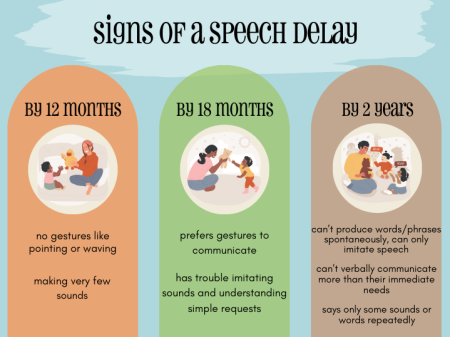
- No babbling or limited sounds by 12 months
- No meaningful words like “mama,” “papa,” “ball” by 16–18 months
- Not using two-word combinations by 24 months
- Difficulty understanding simple commands
- Using gestures more than words
- Not trying to imitate sounds or words
- Speech difficult to understand compared to other children
Spotting these symptoms early helps parents take action at the right time. Remember, early intervention gives the best results and helps children gain confidence in communication.
Early Signs Parents Should Not Ignore
This heading is important for parents because early identification can make a big difference in a child’s communication journey.
- Child does not respond to their name
- No pointing, waving, or making eye contact
- Very quiet child with limited attempts to communicate
- Regression: the child used to say words but stopped
- Frustration, tantrums, or behavior issues due to communication difficulty
If you notice 2–3 of these signs, an evaluation is recommended.
Difference Between Speech Delay and Autism
Understanding the difference helps parents choose the right support.
Speech Delay
Speech delay mainly affects a child’s ability to talk, but their social skills remain typical. Children with speech delay maintain good eye contact, try to communicate using gestures, point to objects, and enjoy playing with others
Autism
Autism affects communication, social interaction, and behavior together. Children may show reduced eye contact, fewer gestures, prefer playing alone, and engage in repetitive actions. They may also have sensory sensitivities like covering ears or watching spinning objects.
Speech Delay ICD-10 Code
Doctors and therapists use ICD-10 codes for diagnosis. Common codes include:
- F80.0 – Speech sound disorder
- F80.1 – Expressive language delay
- F80.2 – Mixed receptive-expressive delay
- F80.9 – Unspecified speech delay
Parents don’t need to worry about these codes, but it’s useful to know what they mean.
Step-by-Step Treatment Plan for Speech Delay
This is one of the most important sections for parents because it explains exactly how speech delay treatment works and what steps you should follow to help your child improve.
Step 1: Speech & Language Assessment
The first step is a detailed evaluation by a certified Speech-Language Pathologist (SLP).
During the assessment, the therapist looks at several areas:
- Vocabulary: How many words the child uses and understands
- Sound Production: Whether the child can say speech sounds clearly
- Understanding (Receptive Language): How well the child follows instructions
- Social Interaction: Eye contact, gestures, joint attention, turn-taking
Step 2: Hearing Test
A hearing test is essential, even if the child responds to sounds sometimes. Because mild hearing loss or repeated ear infections can make speech unclear, causing delays. Audiologists check if the child can hear sounds clearly across all frequencies needed for speech.
Step 3: Personalized Therapy Plan
Once the assessment is done, the therapist creates a tailored speech delay treatment plan based on the child’s unique needs.
- Sound correction exercises
- Vocabulary-building activities
- Play-based language stimulation
- Picture-based communication
- Early literacy skills
Step 4: Parent Training
Parents play the biggest role in supporting speech development. During parent training, the therapist teaches simple techniques like:
- Talking slowly and clearly
- Naming objects during daily routines
- Expanding the child’s one-word phrases
- Giving choices to encourage talking
Step 5: Multidisciplinary Approach
Depending on the child’s needs:
- Behavioral therapy
- Physiotherapy
- Developmental pediatric consultation
Step 6: Regular Progress Check
Therapists review the child’s progress every few weeks and adjust therapy accordingly.
Home-Based Activities to Improve Speech
Parents can support speech growth with simple activities:
- Reading picture books together
- Playing pretend games
- Naming objects around the house
- Singing action songs
- Talking during meals and bath time
- Giving opportunities to request instead of guessing their needs
How PediGYM Supports Your Child?
At PediGYM, children receive:
- Friendly, play-based speech therapy
- Certified and experienced therapists
- Home-practice guidance for parents
- Multidisciplinary therapy options
- A warm environment that encourages communication
Conclusion
Early identification and support can make a big difference for children with speech delay. With the right therapy and parent involvement, most children improve significantly. A trusted Child Development Center like PediGYM provides expert assessment, personalized therapy, and a nurturing environment to help children develop strong communication skills and confidence.

Dr. Nitin, Founder of PediGym Child Development Center, is a dedicated pediatric therapy expert and DMI Level C Certified Therapist leading structured, evidence-based therapy programs in Faridabad and Gurgaon. Under his guidance, PediGym provides comprehensive pediatric rehabilitation focused on improving motor skills, coordination, sensory processing, speech clarity, and functional independence through personalized intervention plans.