
Stammering in children, also known as stuttering in children, is a speech-fluency difficulty in which a child may repeat sounds, syllables or words, prolong sounds, experience blocks, or pause unexpectedly while speaking. It commonly begins during early childhood, when speech and language skills are developing rapidly. Many children become more fluent as they grow, while persistent, worsening, or physically effortful stammering may benefit from professional assessment and speech therapy for stuttering.
Dr. Nitin, Founder of PediGym Child Development Center, is a dedicated pediatric therapy expert and DMI Level C Certified Therapist leading structured, evidence-based therapy programs in Faridabad and Gurgaon.
What Is Stammering in Children?
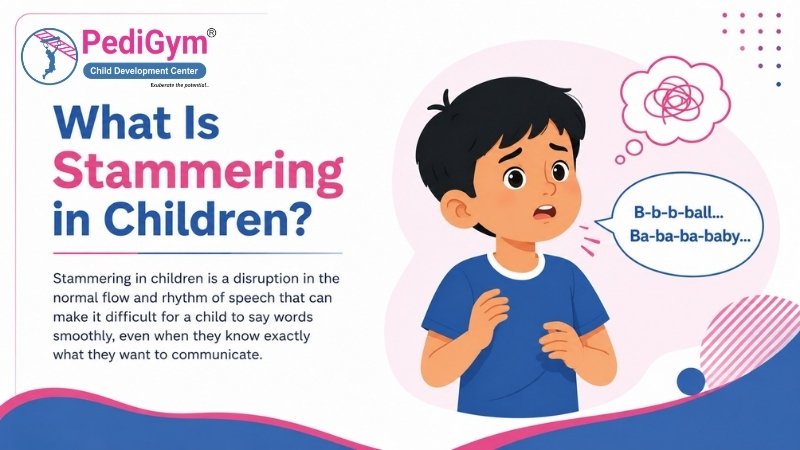
Stammering in children is a disruption in the normal flow and rhythm of speech that can make it difficult for a child to say words smoothly, even when they know exactly what they want to communicate. A child may repeat sounds or words, stretch sounds, become temporarily stuck, or have noticeable pauses while speaking.
For example, a child may say:
- “B-b-b-ball” — sound repetition
- “Ba-ba-ba-baby” — syllable repetition
- “I-I-I want juice” — word repetition
- “Mmmmmummy” — sound prolongation
- “I want… [pause]… that toy” — a block or interruption
Stammering can change from day to day and from one situation to another. A child may speak more fluently at one time and stammer more noticeably when excited, tired, rushed, or under communication pressure.
These situations do not mean that parents have caused the problem. They can simply make an existing fluency difficulty more noticeable. Mayo Clinic describes stuttering as a disruption in the normal flow of speech and notes that “stammering” is another name for the condition.
Stammering vs Stuttering: Is There a Difference?
Stammering and stuttering generally refer to the same speech-fluency condition, with “stammering” commonly used in India and British English and “stuttering” more common in American English.
Therefore, terms such as stammering in children, stuttering in children, childhood stammering, and childhood stuttering generally refer to the same communication concern.
It is also useful to distinguish stuttering from cluttering. Stuttering involves disruptions such as repetitions, prolongations, and blocks, while cluttering is more closely associated with an unusually rapid or irregular speech pattern that can make speech difficult to understand.
How Common Is Childhood Stammering?
Childhood stuttering affects approximately 1% to 2.4% of children, and boys are considerably more likely to develop it than girls. Cleveland Clinic reports that males are about four times more likely to develop stuttering.
Developmental stuttering can begin as early as age 2 or as late as age 7, with average onset around age 3. Cleveland Clinic reports that approximately 95% of children who develop developmental stuttering begin before age 4.
These figures help put stuttering in kids into perspective. Periods of disfluency during the toddler and preschool years are not unusual, but the overall pattern, duration, physical effort, and effect on communication are important when deciding whether professional assessment would be useful.
What Are the Symptoms of Stammering in Children?
The symptoms of stammering in children can include repeated sounds or syllables, repeated words, prolonged sounds, blocks, unusual pauses, and visible physical effort while speaking. Some children may also develop word-avoidance behaviours, become frustrated during conversations, or feel anxious about speaking.
Recognizing the signs of stuttering in children early can help parents understand whether a child’s disfluency may be part of typical speech development or whether professional guidance may be appropriate.
1. Sound or Syllable Repetition
Sound or syllable repetition happens when a child repeats a sound or part of a word several times before being able to complete the word, making it one of the most recognizable signs of childhood stuttering. The repetition may occur at the beginning of a word and can vary in frequency and intensity from one conversation to another.
Examples include:
“B-b-b-bus.”
“Ba-ba-ba-ball.”
“M-m-m-mommy.”
Occasional repetitions can occur during normal speech development, particularly when young children are learning new vocabulary and forming longer sentences. However, frequent repetitions or increasing difficulty may be worth discussing with a speech-language professional.
2. Word Repetition
Word repetition occurs when a child repeats an entire word or phrase before continuing with the sentence, even though they already know what they want to communicate. The child may repeat the same word several times while attempting to continue speaking.
For example:
“I want, I want, I want the red car.”
“Can, can, can I go?”
Young children can occasionally repeat words while organizing their thoughts, so word repetition by itself does not necessarily indicate persistent stuttering. The frequency, pattern, accompanying behaviours, and child’s reaction should be considered together.
3. Sound Prolongation
A sound prolongation occurs when a child stretches a particular speech sound for longer than intended because they are having difficulty moving smoothly to the next sound or word. Unlike normal emphasis, the prolonged sound may interrupt the natural rhythm of speech.
Examples include:
“Sssssssssun.”
“Mmmmmmilk.”
A child may appear to know exactly what they want to say but remain on the initial sound before completing the word. Prolongations can occur together with repetitions or blocks.
4. Blocks
A block occurs when a child temporarily cannot produce a sound or word even though they know what they want to say, creating a noticeable interruption or period of silence. Blocks may be particularly difficult for parents to recognize because there may be no repeated sound.
For example:
“I want my… [pause] …toy.”
During a block, a child may appear to be trying to speak but no sound comes out. Some children may also show physical tension around the lips, jaw, face, or neck while attempting to complete the word.
Frequent or effortful blocks are an important reason to consider an assessment by a speech-language professional.
5. Physical Tension or Secondary Movements
Some children who stutter may develop physical tension or additional movements when they are trying to complete a word, particularly when speaking becomes physically demanding or they anticipate difficulty. These behaviours do not occur in every child, but they can indicate increased effort during speech.
Parents may notice:
- Eye blinking
- Facial tension
- Lip or jaw movements
- Head movements
- Tightening around the mouth
- Hand movements
- Increased effort when beginning a word
These behaviours should not be interpreted as deliberate actions. They can develop as a child’s attempt to move through a difficult speaking moment.
6. Unusual Pauses and Interruptions
Children who stutter may have unexpected pauses or interruptions in their speech when they have difficulty moving smoothly from one sound, word, or phrase to the next. A pause may occur before a particular word, in the middle of a sentence, or while the child is attempting to overcome a block.
For example:
“Yesterday I went to… [pause] …the park.”
Not every pause represents stuttering. Children naturally pause while thinking, searching for words, or planning what they want to say. The overall speech pattern is more important than an isolated pause.
7. Avoidance Behaviours
Some children may begin avoiding particular words, conversations, or speaking situations because they anticipate difficulty or worry about how other people will react to their stammering. Avoidance can occur at both the word level and the situation level.
At the word level, a child may:
- Replace a difficult word with an easier one.
- Avoid saying a person’s name.
- Use a different phrase to avoid a particular sound.
- Say “I don’t know” despite knowing the answer.
- Ask someone else to say the word.
At the situation level, a child may:
- Avoid answering questions at school.
- Refuse to read aloud.
- Avoid introducing themselves.
- Avoid speaking to unfamiliar people.
- Ask parents to speak for them.
- Avoid conversations or social activities.
Avoidance can become more noticeable as children become increasingly aware of their speech. A child who appears relatively fluent because they are avoiding difficult words may still need support.
8. Frustration During Speaking
Some children become frustrated when they cannot say what they want to say smoothly, particularly when they know the word but feel unable to produce it. Younger children may show frustration by becoming upset, abandoning a sentence, changing the subject, or withdrawing from a conversation.
A child might begin repeating a word several times and then stop talking because they cannot complete it.
Parents should respond calmly rather than asking the child to repeat the sentence or speak faster. Giving the child sufficient time can reduce unnecessary communication pressure.
9. Fear or Anxiety About Speaking
Some children may develop worry or anxiety about speaking when they become increasingly aware of their stammering or experience negative reactions from other people. This may affect classroom participation, social interaction, answering questions, or talking to unfamiliar people.
A child may say:
“You say it.”
“I don’t want to talk.”
“I can’t say it.”
Stuttering itself does not mean that a child has an anxiety disorder. However, persistent stuttering, teasing, or bullying can contribute to emotional distress and should be taken seriously. Mayo Clinic also identifies anxiety, communication difficulties, avoidance, teasing and low self-esteem among possible complications associated with stuttering.
Symptoms Can Change Over Time
The symptoms of childhood stuttering are not necessarily the same every day, and a child’s fluency can change depending on communication demands, emotions, fatigue, excitement, and developmental stage. A child may speak relatively fluently at home but stutter more at school or during a highly demanding conversation.
Therefore, parents should look at the overall pattern of speech rather than judging severity from a single conversation.
What Are the Types of Stuttering in Children?
There are two useful ways to classify stuttering in children: by the pattern of speech disfluency and by the form or underlying cause of the stuttering.
Types Based on Speech Pattern
Repetitions: Sounds, syllables, or words are repeated before speech continues.
Prolongations: A sound is stretched longer than intended.
Blocks: The child temporarily cannot produce a sound or word despite trying.
Mixed patterns: A child may experience repetitions, prolongations, and blocks at different times.
Forms of Stuttering
Developmental stuttering begins during childhood while speech and language abilities are developing and is the form most commonly associated with young children.
Persistent stuttering refers to developmental stuttering that continues rather than resolving during childhood.
Acquired stuttering develops following an illness, injury, or neurological condition affecting the brain. Cleveland Clinic similarly distinguishes developmental, persistent, and acquired forms.
What Causes Stammering in Children?
Developmental stuttering is thought to involve a combination of genetic and speech-motor factors, while acquired stuttering can result from neurological illness or injury. There is no single cause that explains every child’s stuttering.
Genetic and Family Factors
Family history is an important factor associated with developmental stuttering, meaning children with close relatives who stutter may have a higher likelihood of developing it.
Having a family history does not mean that a child will definitely stutter. It is one factor considered when understanding a child’s overall risk and speech development.
Speech-Motor Factors
Differences in the timing and coordination involved in speech production may contribute to developmental stuttering. Fluent speech requires precise coordination between the brain, breathing system, voice, and muscles used for speaking.
Mayo Clinic identifies speech-motor control and genetics among possible contributors to developmental stuttering.
Developmental Factors
Young children are rapidly developing vocabulary, sentence structure, and communication skills, and periods of disfluency can occur during this stage of development.
This is particularly relevant during toddler and preschool years, when children may have many ideas to express while their speech and language abilities are still developing.
Neurogenic or Acquired Causes
Stuttering can sometimes develop after a neurological condition or injury affecting the brain, such as traumatic brain injury or stroke. This is known as acquired or neurogenic stuttering and is different from developmental stuttering.
A sudden and unexplained change in a child’s speech should therefore be medically evaluated rather than automatically considered ordinary developmental stuttering.
Does Stress Cause Stuttering?
Stress does not simply cause developmental stuttering, but tiredness, excitement, anxiety, pressure, or being rushed can make existing disfluency more noticeable.
Parents should therefore avoid blaming themselves or assuming that emotional stress is the underlying cause. Mayo Clinic notes that stress and pressure can worsen existing stuttering.
Toddler and Preschool Stammering
Toddler stammering and preschool stammering can occur during early speech development, but persistent, increasing, or physically effortful disfluency should be professionally assessed.
Many children begin developmental stuttering during the preschool years. Because speech and language are changing rapidly at this age, a child’s fluency may naturally vary.
Parents should observe whether the child:
- Is becoming increasingly disfluent
- Shows physical tension
- Appears frustrated
- Avoids speaking
- Avoids specific words
- Is concerned about stammering
- Has difficulty participating at preschool
- Has additional speech or language concerns
An assessment does not automatically mean that a child needs intensive therapy. It can help parents understand the child’s communication pattern and determine whether monitoring, parent guidance, or active intervention is appropriate.
Does Speaking Two Languages Cause Stammering?
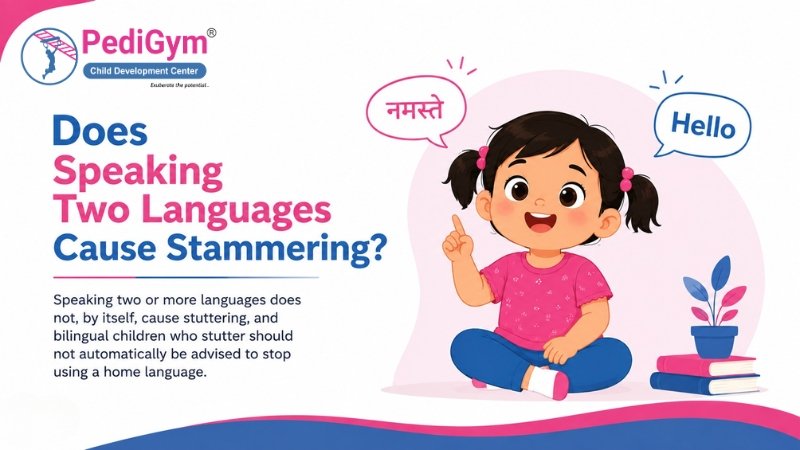
Speaking two or more languages does not, by itself, cause stuttering, and bilingual children who stutter should not automatically be advised to stop using a home language.
Assessment should consider the child’s complete linguistic environment, including the languages used at home, school, and socially.
This is especially relevant for families in India, where many children regularly communicate in two or more languages.
How Is Stuttering Diagnosed?
Stuttering is usually assessed by observing the child’s speech, understanding when the difficulty started, identifying the pattern of disfluency, and considering how it affects communication and wellbeing.
A speech-language professional may consider:
- The child’s age
- When stuttering started
- Frequency of disfluencies
- Types of disfluencies
- Physical tension or secondary behaviours
- Situations that increase or decrease stuttering
- Family history
- Other speech or language concerns
- The child’s feelings about speaking
- Effects on home, school, and social communication
A thorough assessment is important because the same amount of disfluency can affect two children very differently.
What Is Speech Therapy for Stammering?
Speech therapy for stammering is individualized intervention designed to support communication, manage speech-fluency difficulties, reduce struggle, and address the emotional or social impact of stuttering. The appropriate approach depends on the child’s age, communication profile, severity, and therapy goals.
Treatment does not necessarily mean trying to eliminate every moment of stuttering. Depending on the child, therapy may focus on smoother speech, easier communication, reducing physical struggle, improving confidence, reducing avoidance, and helping the child participate comfortably in everyday conversations.
Evidence-Based Speech Therapy Approaches
1. Lidcombe Program
The Lidcombe Program is a behavioral treatment approach developed for young children who stutter, particularly preschool-age children, and involves structured parent participation under the guidance of a speech-language professional.
It has an established research base for early childhood stuttering. The program should be delivered or adapted by a clinician appropriately trained in the approach rather than treated as a collection of generic home exercises.
2. Fluency-Shaping Approaches
Fluency-shaping approaches teach speech strategies intended to support smoother and more controlled speech, with techniques selected according to the child’s age and communication needs.
Therapy may address areas such as speaking rate, pausing, speech initiation, and other fluency-supporting behaviours.
3. Stuttering Modification
Stuttering-modification approaches focus on reducing struggle and negative reactions associated with moments of stuttering rather than demanding perfect fluency in every situation.
The goal can be to make communication easier and less stressful while helping the child become more comfortable speaking.
4. Parent-Child Interaction Approaches
Parent-child interaction approaches involve coaching parents to create supportive communication conditions and use specific strategies during everyday conversations.
Parent involvement can be an important component of intervention for young children, although the specific strategies vary according to the treatment approach.
5. Cognitive Behavioral Therapy Support
Cognitive behavioral therapy may be considered when anxiety, negative thoughts, avoidance, or self-esteem difficulties significantly affect a child’s experience of stuttering.
It focuses on the emotional and psychological effects associated with communication difficulties rather than directly treating the speech-fluency mechanism itself.
The most appropriate approach should be selected following an individualized assessment.
How to Help a Child Who Stammers
The best way to help a child who stammers is to reduce unnecessary communication pressure, listen patiently, and focus on what the child is communicating rather than correcting every disfluency.
Instead of Saying:
“Slow down.”
“Take a breath.”
“Start again.”
“Think before you speak.”
Try Saying:
“Take your time. I’m listening.”
“It’s okay. Finish when you’re ready.”
“I have time to listen.”
Parents can also:
- Allow the child to finish without interruption.
- Avoid completing sentences.
- Maintain natural eye contact.
- Take turns during conversations.
- Speak naturally and calmly.
- Reduce unnecessary time pressure.
- Give the child opportunities to talk.
- Praise ideas and participation.
- Talk openly about stammering if the child wants to discuss it.
- Support the child if teasing or bullying occurs.
The goal is not to make a child feel that stammering is wrong. The goal is to create an environment in which the child feels comfortable communicating.
What Are Stuttering Exercises for Children?
Stuttering exercises for children should be selected according to the child’s age, speech pattern, communication needs, and therapy goals rather than used as generic online drills.
Depending on the treatment approach, activities may include:
- Turn-taking games
- Storytelling
- Picture description
- Role-play
- Structured conversation
- Gentle pausing activities
- Speech-rate awareness
- Parent-child communication activities
- Real-life speaking activities
For younger children, therapy activities can be incorporated into play so that speaking remains natural rather than feeling like a performance test.
Parents should avoid independently introducing intensive fluency exercises without professional guidance, particularly when a child is becoming anxious or physically tense while speaking.
When to Worry About Child Stammering
Parents should seek professional guidance when stuttering lasts more than six months, becomes more frequent or severe, involves physical struggle, affects communication, or causes anxiety or emotional difficulties. These factors are also consistent with Mayo Clinic’s guidance on when children with stuttering should be referred for professional assessment.
Consider an assessment if your child:
- Continues to stutter for more than six months.
- Is becoming increasingly disfluent.
- Shows facial or body tension while speaking.
- Avoids words or speaking situations.
- Becomes frustrated or embarrassed.
- Avoids participating at school.
- Experiences teasing or bullying.
- Has additional speech or language concerns.
- Becomes anxious about communicating.
- Has a family history of persistent stuttering.
The amount of stuttering is not the only factor that matters. A child who stammers relatively infrequently but becomes highly distressed or avoids speaking may need support just as much as a child with more frequent disfluency.
A sudden onset of stuttering, particularly when accompanied by other neurological symptoms or following an injury, also warrants prompt medical evaluation.
Stammering Treatment for Children at PediGym
Stammering treatment for children should be individualized according to the child’s age, developmental profile, fluency pattern, communication environment, and specific therapy goals.
At PediGym Child Development Center, Dr. Nitin, Founder and DMI Level C Certified Therapist, leads structured, evidence-based pediatric therapy programs in Faridabad and Gurgaon.
For families concerned about childhood stammering, stuttering in kids, or persistent child stuttering, an appropriate assessment can help determine whether the child would benefit from monitoring, parent guidance, speech therapy, or a broader developmental assessment.
The objective is not simply to demand perfectly fluent speech. Effective support should also consider communication participation, confidence, family interaction, and the child’s overall developmental needs.
Frequently Asked Questions
Is stammering common in children?
Yes. Childhood stuttering affects approximately 1% to 2.4% of children. It often begins during early childhood, with average onset around age 3. Boys are considerably more likely to develop stuttering than girls.
Can childhood stammering go away?
Yes, many children become more fluent as they develop, while some continue to stutter. The course varies, so persistent, worsening, or physically effortful stammering should be assessed by a qualified professional.
Does stammering mean my child has a speech delay?
No. Stammering and speech or language delay are different communication concerns. A child can have age-appropriate language skills and still stutter, although both concerns can occur together.
Does bilingualism cause stammering?
No. Speaking two languages does not by itself cause stuttering. Bilingual children who stutter should be assessed within their complete linguistic and cultural environment.
Can parents treat stammering at home?
Parents can provide valuable support at home, but individualized stammering treatment should be guided by a qualified professional. Patient listening, reduced pressure, and parent coaching can complement formal intervention.
What is the best treatment for toddler stammering?
Treatment depends on the individual child, but the Lidcombe Program is an established behavioral approach for young children who stutter. A qualified professional should determine whether it is appropriate.
Can anxiety cause stammering?
Anxiety does not simply cause developmental stuttering, but anxiety and stuttering can influence each other. Pressure or anxiety may make existing disfluency more noticeable, while persistent stuttering can contribute to anxiety or avoidance.
When should my child see a speech therapist?
Consider an assessment when stammering persists beyond six months, worsens, involves physical tension, affects school or social communication, or causes emotional distress.
Conclusion
Stammering in children is a common speech-fluency concern that may involve repetitions, prolongations, blocks, and pauses, particularly during the early years of development. Many children become more fluent naturally, but persistent or distressing childhood stammering deserves appropriate professional attention.
Understanding the causes of stuttering in children, recognizing the signs of stuttering in children, and knowing how to help a child who stammers can help parents respond without unnecessary pressure.
When intervention is appropriate, speech therapy for children who stutter can address fluency, communication effectiveness, confidence, and the child’s individual needs. Approaches such as the Lidcombe Program, fluency-shaping approaches, stuttering modification, parent-child interaction approaches, and psychological support when appropriate may be considered based on the child’s assessment and treatment goals.
A child does not need to speak perfectly to be a confident communicator. The right support should help the child feel heard, understood, and comfortable participating in everyday communication.
Disclaimer
This article is for educational purposes and does not replace an individualized assessment or medical advice from a qualified healthcare professional.

Dr. Nitin, Founder of PediGym Child Development Center, is a dedicated pediatric therapy expert and DMI Level C Certified Therapist leading structured, evidence-based therapy programs in Faridabad and Gurgaon. Under his guidance, PediGym provides comprehensive pediatric rehabilitation focused on improving motor skills, coordination, sensory processing, speech clarity, and functional independence through personalized intervention plans.