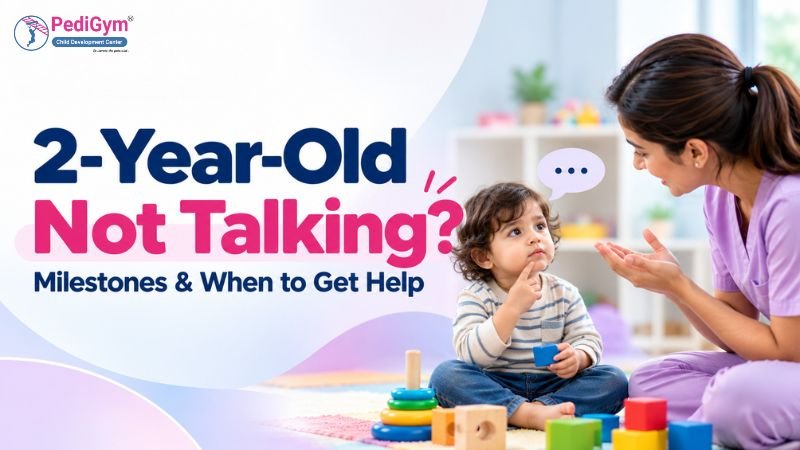
If your 2-year-old is not talking yet, uses very few words, or is not combining two words, arrange a speech and language assessment rather than waiting until age 3. Some children develop language later than others, and early assessment can help identify whether your toddler needs support. This does not mean you have done anything wrong. Understanding your child’s communication needs is the first step towards helping them.
PediGym Child Development Center supports families in Faridabad and Gurugram (Gurgaon). Contact PediGym to enquire about assessment and therapy options.
2-Year-Old Speech Milestones
By 2 years, many toddlers are beginning to combine two words, such as “more milk” or “mummy come.” They may also point to pictures or body parts when named and use gestures to communicate.
Age | Examples of communication milestones |
12 months | Waves bye-bye, calls a parent “mama” or “dada,” and understands “no.” |
15 months | Tries to say one or two words besides “mama” or “dada,” looks at a familiar object when named, and points to ask for something or get help. |
18 months | Tries to say three or more words besides “mama” or “dada.” |
24 months | Uses two-word combinations, points to pictures or body parts when asked, and uses more gestures than just waving or pointing. |
30 months | Says around 50 words and combines two or more words, including an action word. |
Sources: CDC 12-month milestones, CDC 15-month milestones, CDC 2-year milestones, and CDC 30-month milestones.
Developmental milestones are a guide, not a diagnosis. The CDC describes milestones as skills that most children (75% or more) can do by a particular age.
For multilingual children, words may be distributed across the languages they use. Tell the professional which languages your child hears and speaks, and count words across all those languages.
When Should You Worry About Speech Delay?
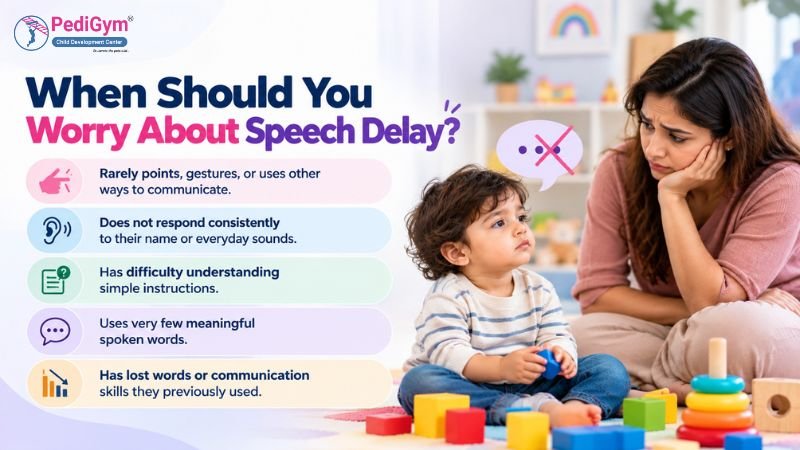
Consider a speech and language assessment if your 2-year-old has difficulty using words to communicate, understanding simple instructions, or combining words. Other signs that may need attention include:
- Rarely points, gestures, or uses other ways to communicate.
- Does not respond consistently to their name or everyday sounds.
- Has difficulty understanding simple instructions.
- Uses very few meaningful spoken words.
- Has lost words or communication skills they previously used.
If your child loses previously acquired words or other skills, seek prompt professional advice. Do not wait for the next milestone.
My 2-Year-Old Understands but Isn’t Talking
Yes, it’s worth an assessment. A toddler who understands instructions but says very few words may have a delay in expressive language. Understanding language and using spoken words are related but different skills.
Even when a child appears to understand well, an assessment can help identify their communication strengths, expressive language needs, and next steps. Good understanding does not rule out a speech or language difficulty.
My 2-Year-Old Babbles but Doesn’t Say Words
Babbling is an important part of early communication, but by age 2, children are generally expected to use meaningful words and begin combining them. If your toddler babbles but does not use meaningful words, arrange a speech and language assessment.
A professional may consider your child’s hearing, understanding, gestures, play, developmental history, and attempts to communicate. Respond to babbling and other communication attempts, but do not rely on babbling alone as evidence that speech will develop without support.
Why Is My 2-Year-Old Not Talking?
There is no single reason why a toddler may not be talking. Possible explanations include:
- Hearing difficulties: A child may hear some sounds but still have difficulty hearing speech clearly.
- Expressive language delay: The child may understand more than they can say.
- Receptive language difficulties: The child may also have trouble understanding words or instructions.
- Speech sound or motor-speech difficulties: The child may find it hard to produce speech sounds. One possible condition is childhood apraxia of speech, which affects the planning of movements needed for speech.
- Broader developmental differences: Communication differences may occur alongside other developmental needs, including autism or developmental language disorder.
- Individual variation: Some children develop spoken language more slowly, although assessment is still important when milestones are not met.
Family history of language delay, prematurity, and recurrent ear infections may be relevant risk factors. Boys are about three times more likely than girls to show late language emergence in the research cited by ASHA. This is a population-level finding, not a way to predict an individual child’s development.
A hearing assessment can help rule out hearing difficulties. Depending on the child’s needs, a professional may recommend tests such as otoacoustic emissions (OAE) or auditory brainstem response (ABR, also called BERA). The American Academy of Pediatrics guidance on language delay also supports seeking professional advice when a child’s communication development is a concern.
Avoid assuming the cause based on one sign alone. A qualified professional can help identify the areas that need support.
Late Talker vs Speech Delay
A late talker is generally a toddler who is developing language more slowly than expected, particularly expressive language. This pattern is often described as late language emergence: a delay in the onset of language without another diagnosed disability or developmental delay. It is often identified during the toddler years.
The term “speech delay” is commonly used when a child’s communication development is behind what is expected for their age. An assessment can help distinguish difficulties with expressing words, understanding language, producing speech sounds, or communicating more broadly.
For more information, read PediGym’s guide to the difference between a late talker and speech delay.
Is It Normal for a 2-Year-Old Not to Talk?
Late language emergence is not uncommon, but it should not be dismissed as something every child will automatically outgrow. ASHA reports different prevalence estimates depending on which language skills are considered and how late language emergence is defined.
If your 2-year-old is not using two-word combinations or has very few words, an assessment can help you understand whether their language development needs monitoring or additional support. Read ASHA’s guidance on late language emergence.
Will My Late Talker Catch Up?
Some children with late language emergence catch up with their peers, while others continue to experience language difficulties. It can be difficult to predict which children will catch up and which will need ongoing support.
A child’s understanding of language, vocabulary, gestures, and overall development can help a professional assess their needs. Rather than waiting until age 3 without guidance, arrange an assessment if your toddler is not meeting communication milestones.
Assessment does not mean a child will necessarily need long-term therapy. It helps families make informed decisions about monitoring, home strategies, and intervention when needed.
How Can Speech Therapy Help?
Speech and language therapy can help a toddler develop communication skills through activities suited to their age, abilities, and needs. The focus may include understanding language, learning words, combining words, using gestures, and communicating during everyday activities.
A speech and language professional may:
- Assess your child’s understanding and use of language.
- Identify communication strengths and areas needing support.
- Use play-based activities to encourage communication.
- Help your child develop vocabulary and combine words.
- Guide parents on how to support communication during daily routines.
- Recommend a hearing assessment or further developmental evaluation when needed.
How Does Parent Coaching Help?
Parents are important communication partners. A therapist may demonstrate how to follow a child’s interests, model simple words, expand the child’s attempts, offer choices, and pause to encourage interaction.
These strategies can be practised during play, meals, reading, and other daily routines. The approach should suit the child and family rather than putting pressure on the child to repeat words or speak on demand.
Read more about PediGym’s speech delay treatment services.
What Happens in a Speech and Language Assessment?
A speech and language assessment helps a professional understand how your child communicates, what they understand, and where they may need support. It may include:
- Reviewing your child’s developmental and communication history.
- Discussing the words, sounds, and gestures your child uses in every language.
- Observing how your child plays, interacts, and communicates.
- Assessing understanding of words and instructions, as well as spoken language.
- Reviewing hearing history and recommending a hearing test if needed.
- Discussing suitable next steps, which may include parent strategies, therapy, monitoring, or further evaluation.
What Should I Bring to an Assessment?
Bring any previous assessment reports and hearing test results, if available. It can also help to note the words and gestures your child uses, the languages they hear and speak, and any changes or loss of previously acquired skills.
Speech and language assessments should be conducted by an appropriately qualified speech-language professional. Contact PediGym to enquire about its assessment and therapy arrangements.
What Parents Can Do at Home
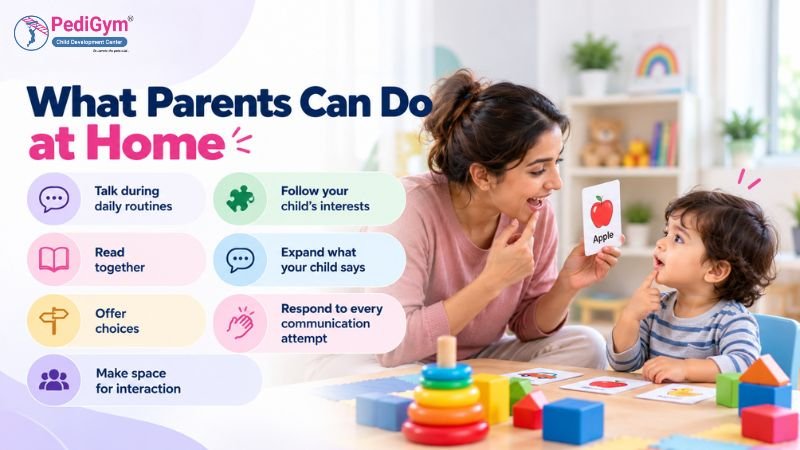
You can support your toddler’s communication through everyday interactions:
- Talk during daily routines: Describe what you are doing while eating, dressing, bathing, or playing.
- Follow your child’s interests: Talk about the toy or activity your child is focused on.
- Read together: Name pictures, pause, and let your child point, gesture, or try a word.
- Expand what your child says: If your child says “car,” you could respond with “big car” or “car goes.”
- Offer choices: Ask “milk or water?” and give your child time to respond.
- Respond to every communication attempt: Acknowledge gestures, sounds, signs, and words instead of insisting on perfect speech.
- Make space for interaction: Pause during play and conversation so your child has a chance to communicate.
Avoid pressuring your child to repeat words over and over. Home strategies can support communication, but they should not replace an assessment when you are concerned about development.
Does Speaking More Than One Language Cause Speech Delay?
No. Learning Hindi, English, Punjabi, or multiple languages does not, by itself, cause a language disorder. Tell the professional which languages your child hears and uses, and count words across all those languages when describing your child’s vocabulary.
Can Screen Time Affect Language Development?
It can, particularly when screen time replaces talking, reading, and play with caregivers. Research on screen time and language outcomes is mostly observational, so the practical advice is to prioritise interaction and shared activities.
The World Health Organization’s guidance for children under 5 recommends no more than one hour of sedentary screen time per day for children aged 2–4 years, with less being better.
Speech and Language Assessment and Therapy in Faridabad and Gurugram
PediGym Child Development Center has centres in Faridabad and Gurugram. Contact the team to enquire about speech and language assessment and therapy options for your toddler.
Centre 1: Sector 85, Faridabad
3rd Floor, D-72, Greater Faridabad, Sector 85, Faridabad, Haryana 121007.
Centre 2: Sector 17, Faridabad
382, Sector 17, Faridabad, Haryana 121002.
Centre 3: DLF Phase 2, Gurugram
Site No. 2120, Udgam Pre-School, 1st Floor, behind Police Station, DLF Phase 2, Gurugram, Haryana 122002.
Contact details
- Phone: +91 98739 71012 / +91 83684 30528
- Email: pedigym@gmail.com
- Hours: 10:00 am–8:00 pm
Contact the centre to confirm appointment availability and assessment arrangements.
Frequently Asked Questions
Is it normal for a 2-year-old not to talk?
In a study of children aged 24 months in Western Australia, ASHA reports that late language emergence was estimated at 13.4% when both receptive and expressive language were considered and 19.1% when expressive language alone was considered. These estimates relate to that population and are not prevalence figures for India. If your child is not combining words or uses very few words at age 2, arrange an assessment rather than relying on statistics to predict their progress.
How many words should a 2-year-old say?
A commonly used indicator of late language emergence at 24 months is fewer than 50 words and no two-word combinations. This criterion is based mainly on monolingual English-speaking children. The CDC’s 2-year milestone focuses on combining at least two words, while the milestone of around 50 words appears in its 30-month guidance. For multilingual children, count words used across all their languages.
Should I wait until my child turns 3 to seek help?
No. If your 2-year-old is not using two-word combinations or has very few words, arrange a speech and language assessment. Early advice can help you understand your child’s needs and decide on appropriate next steps.
Will my late talker catch up?
ASHA reports that approximately 50%–70% of children with late language emergence catch up to their peers by late preschool or school age. However, some children continue to experience language difficulties. An assessment can help identify your child’s strengths and needs and guide monitoring or intervention.
Does a 2-year-old not talking mean autism?
Not necessarily. Delayed speech can have different explanations, including hearing difficulties, language delay, and speech or motor-speech difficulties. Autism is identified through a broader assessment of social communication, behaviour, and development—not speech delay alone. Discuss your concerns with a qualified professional.
What should I bring to a speech and language assessment?
Bring any previous assessment reports and hearing test results, if available. Note the words and gestures your child uses in every language, the languages they hear and speak, and any changes or loss of previously acquired skills.
Where can I enquire about assessment options?
You can contact PediGym Child Development Center through its contact page or use the Google Maps links above to locate a centre in Faridabad or Gurugram. Ask the team about its assessment arrangements and the qualifications of the professional who will assess your child.
Final Takeaway
If your 2-year-old is not talking yet, uses very few words, or is not combining two words, do not wait until age 3 to ask for help. A speech and language assessment can clarify your child’s communication needs and help you decide on appropriate next steps. Early support and everyday, responsive communication can help you support your child’s development.
Author Information
Dr. Nitin Gupta is the founder of PediGym Child Development Center and a DMI Level C Certified Therapist. DMI stands for Dynamic Movement Intervention, a therapeutic approach focused on improving motor function and movement skills. PediGym supports children and families through child development and therapy services in Faridabad and Gurugram.
References
- Centers for Disease Control and Prevention (CDC). Important milestones: 1 year.
- Centers for Disease Control and Prevention (CDC). Important milestones: 15 months.
- Centers for Disease Control and Prevention (CDC). Important milestones: 2 years.
- Centers for Disease Control and Prevention (CDC). Important milestones: 30 months.
- American Speech-Language-Hearing Association (ASHA). Late Language Emergence.
- American Academy of Pediatrics (AAP). Language Delays in Toddlers: Information for Parents.
- World Health Organization (WHO). Guidelines on physical activity, sedentary behaviour and sleep for children under 5 years of age.
- Zubrick, S. R., Taylor, C. L., Rice, M. L., & Slegers, D. W. (2007). Late language emergence at 24 months: An epidemiological study of prevalence, predictors, and covariates. Journal of Speech, Language, and Hearing Research, 50(6), 1562–1592. https://doi.org/10.1044/1092-4388(2007/106)

Dr. Nitin, Founder of PediGym Child Development Center, is a dedicated pediatric therapy expert and DMI Level C Certified Therapist leading structured, evidence-based therapy programs in Faridabad and Gurgaon. Under his guidance, PediGym provides comprehensive pediatric rehabilitation focused on improving motor skills, coordination, sensory processing, speech clarity, and functional independence through personalized intervention plans.