A mother once came to PediGym concerned that her 2-year-old was "behind" — he hadn't grown much in height over the past few months. But when we assessed him, his language, play skills, and social interaction were all progressing beautifully. He was growing slower than average, but developing well. Another child that same week was tall and sturdy for his age — yet had almost no words and avoided eye contact. These two children reminded us why growth and development must never be treated as the same thing — and why understanding the difference changes everything about how we support a child.
Dr. Nitin Gupta, Founder, PediGym
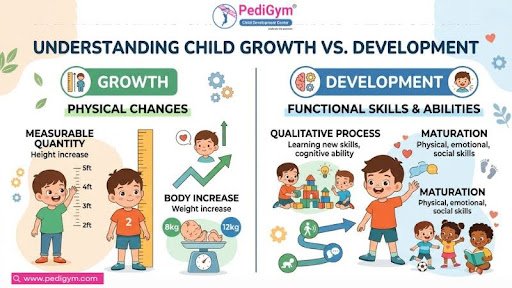
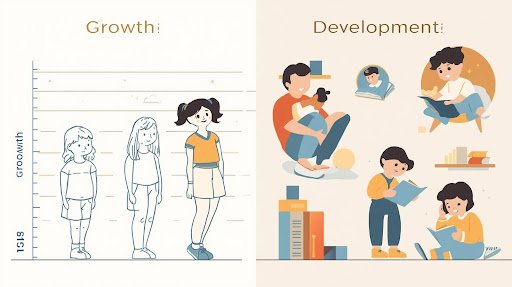
Growth is the physical increase in a child’s body — height, weight, and organ size. Development is the improvement of a child’s functional abilities — thinking, communicating, moving, and relating to others. Growth tells you about a child’s size. Development tells you about a child’s function. At PediGym, we assess both together — because one without the other gives an incomplete and sometimes misleading picture.
Growth mainly focuses on physical changes like height and weight, whereas overall progress includes emotional, social, and cognitive aspects. Both play a crucial role in shaping a child’s future learning abilities and behavior.
At Pedigym, founded by Dr. Nitin Gupta (DMI Level C Therapist), a structured and scientific approach is used to monitor a child’s overall progress across Faridabad and Gurgaon.
What is Growth?
Growth refers to the increase in the physical size and structure of the body. It is quantitative — it can be objectively measured and tracked over time using tools like growth charts, weighing scales, and height measurements.
Key Characteristics:
- Measurable: Tracked through height, weight, and head circumference using medical growth charts.
- Quantitative: Expressed in numbers — centimetres, kilograms — making it easy to compare over time.
- Time-bound: Most physical growth slows or stops after adolescence, unlike development which is lifelong.
- Irreversible: Once a child increases in physical size, that change does not reverse under normal conditions.
Example: A child gaining 2–3 cm in height or increasing in weight over a few months is showing physical growth. Growth is also an indicator of a child’s health and nutritional status, making regular monitoring during paediatric visits vital.
What is Development?
Development refers to the functional and behavioural changes in a child — how they think, communicate, move, and interact with the world. It is qualitative and continues throughout life, encompassing multiple domains simultaneously.
Types of Development
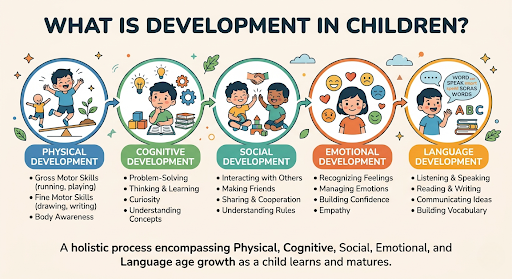
Cognitive Development
Thinking, reasoning, memory, and problem-solving. Includes learning numbers, shapes, and cause-and-effect relationships.
Emotional Development
Understanding, expressing, and managing emotions. Building self-confidence, self-awareness, and resilience.
Social Development
Building relationships, developing empathy, learning cooperation, and practising social norms.
Motor Development
Divided into two key types:
- Gross Motor Skills — large muscle movements like running, jumping, climbing, and walking.
- Fine Motor Skills — small, precise movements like writing, drawing, buttoning, and using cutlery.
Language Development
Speaking, understanding, and using language effectively. Progresses from babbling and gestures to forming full sentences and complex communication.
Example: A child learning to share toys, completing their sentences, or waving to communicate shows developmental progress — not just physical change.
Difference Between Growth and Development
| Basis | Growth | Development |
|---|---|---|
| Meaning | Physical increase in size | Overall improvement in function & ability |
| Nature | Quantitative | Qualitative |
| Measurement | Height, weight, head circumference | Skills, behaviour, emotional maturity |
| Duration | Slows/stops after adolescence | Lifelong and continuous |
| Scope | Narrow — physical only | Broad — cognitive, social, emotional, motor |
| Reversibility | Irreversible under normal conditions | Can regress without proper support |
| Observation | Objective, tool-measured | Observed through behaviour & interaction |
A child may show healthy physical growth but still need support in communication or social skills. That is why both aspects must be observed together — neither tells the full story on its own.
Real-Life Examples of Growth vs Development
GROWTH EXAMPLES
- Baby doubles birth weight by 5 months
- Toddler grows from 90 cm to 100 cm in height
- Child’s foot size increases by one shoe size
- Head circumference increases in infancy
- Organ size increases (e.g. brain weight)
DEVELOPMENT EXAMPLES
- Baby starts waving and pointing to communicate
- Toddler learns to name colours and follow instructions
- Child learns to share toys and take turns
- Child forms complete sentences while speaking
- Child improves coordination in writing or sports
Principles of Growth and Development
These principles serve as scientifically established guidelines for predicting and interpreting a child’s progress:
- Development Is Continuous and Cumulative: Skills build on one another — a child must crawl before walking, and babble before speaking. Progress is never isolated.
- Cephalocaudal Direction (Head to Toe): Motor control develops from the head downward. A baby gains control of the head before the neck, trunk, and legs.
- Proximodistal Direction (Centre to Extremities): Control develops from the centre of the body outward — children control their arms before their hands and fingers. This is why fine motor skills emerge later than gross motor skills.
- Follows Predictable Patterns: Milestones such as crawling, walking, and speaking occur in a predictable, sequential order across all children regardless of culture or geography.
- Individual Rates of Development: No two children develop at exactly the same pace. Variation within a normal range is expected and should not cause alarm.
- Different Areas Are Interrelated: Physical, cognitive, and emotional growth influence one another. A child with delayed motor skills may also show delays in social confidence and learning.
Stages of Growth and Development
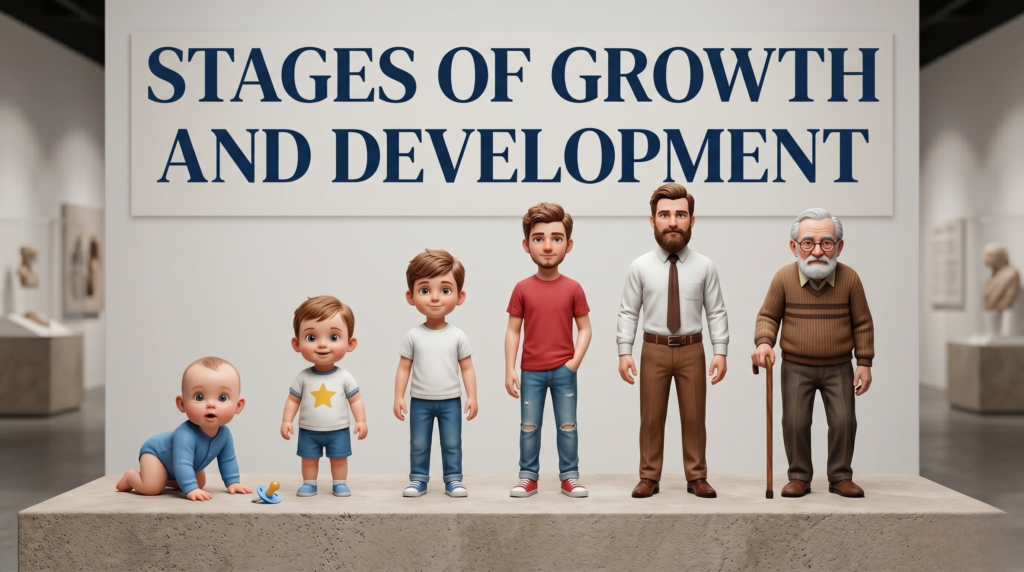
Understanding age-wise stages helps parents and educators track progress and identify concerns early. Each stage involves both physical changes and functional skill development occurring simultaneously.
INFANCY (0–1 YEAR)
TODDLERHOOD (1–3 YEARS)
PRESCHOOL AGE (3–5 YEARS)
MIDDLE CHILDHOOD (6–12 YEARS)
ADOLESCENCE (12–18 YEARS)
Early Childhood (0–6 years) is the most critical window. Early support during this stage can prevent long-term developmental delays. At PediGym, milestones across all stages are carefully assessed under the guidance of Dr. Nitin Gupta.
Can Development Regress?
This is one of the most important and least discussed aspects of child development. Unlike physical growth, developmental skills can regress: temporarily or persistently, when a child faces significant stress, illness, trauma, or environmental disruption.
A toilet-trained toddler may revert to bedwetting after a new sibling arrives. A child who was speaking in full sentences may become withdrawn after a prolonged illness. A previously confident child may become clingy or non-communicative following a major family change. This is called developmental regression — and it is fundamentally different from a developmental delay.
Regression vs. Delay The Clinical Distinction
Regression is a step back in skills a child previously had, typically triggered by an identifiable stressor. A delay is when a child has not yet reached an expected milestone. Both need attention, but they require different responses.
Developmental regression is typically temporary and resolves with consistent routine, reassurance, and emotional support. However, if regression persists beyond 4–6 weeks, or affects multiple developmental domains simultaneously, a structured developmental assessment is strongly recommended. At PediGym, we frequently see children referred for regression who, on full evaluation, present with an underlying sensory processing or language difficulty that had gone unnoticed until the stressor made it visible.
Factors Affecting Growth and Development
In our assessments at PediGym, no two children present with the same picture — and that reflects how deeply individual these influences are. Across hundreds of evaluations, Dr. Nitin Gupta consistently finds that the children who thrive are those whose caregivers understand and actively address the following factors:
Genetic Inheritance
Determines baseline potential for height, cognitive profile, and even temperament. Genetics sets the range — but environment determines where within that range a child lands.
Nutrition
Critical for both physical growth and brain architecture. ⚠ Malnutrition during the first 1,000 days of life — from conception to age 2 — can cause irreversible cognitive and developmental delays that persist into adulthood.
Physical Activity
At PediGym, we see consistent evidence that children with adequate daily movement show better bone density, improved muscle tone, and stronger gross-to-fine motor transitions. Sedentary screen-based routines delay these pathways.
Environment & Stimulation
Children from language-rich home environments — where caregivers name objects, ask questions, and read aloud — consistently demonstrate faster vocabulary and cognitive development in our assessments.
Parenting Style & Attachment
Secure attachment to a responsive caregiver is the single strongest predictor of healthy social and emotional development. Children who feel emotionally safe explore more boldly, recover from setbacks faster, and build stronger peer relationships.
Health & Illness
Recurrent infections, chronic illness, or prolonged hospitalisation can stall developmental progress during critical windows. Early and regular paediatric monitoring ensures any medical factors are identified and managed before they compound.
Early Learning & Exposure
Quality early childhood education not just schooling, but play-based exposure to language, problem-solving, and social interaction has a measurable, lasting impact on cognitive and social outcomes. The earlier, the better.
How to Support Your Child's Growth and Development
Based on years of clinical work at PediGym, these are the practices Dr. Nitin Gupta recommends most consistently to families:
- Track milestones proactively — not just at annual check-ups. Use a developmental checklist quarterly for children under 3. Early patterns matter more than any single data point.
- Prioritise nutrition in the first 3 years especially. Brain development is most rapid — and most vulnerable — during this window. Iron, zinc, omega-3s, and iodine are particularly critical.
- Encourage movement-based and sensory play daily. Climbing, crawling through tunnels, drawing, and tearing paper all build the neural pathways underpinning motor and cognitive development.
- Be a responsive, present caregiver. Warm, consistent responses to a child’s emotional signals — especially in infancy — build the secure attachment that underpins lifelong emotional regulation.
- Talk, read, and narrate constantly. Children need to hear a rich variety of words and sentence structures — not from screens, but from the people they love — to build language and thinking skills.
- Set firm screen time limits. WHO guidelines recommend no screens under age 2, and a maximum of 1 hour per day for ages 3–4. Replace passive viewing with interactive, conversation-rich play.
- Don’t wait to seek help. If something feels off — trust your instinct. A developmental assessment at PediGym takes under an hour and will clarify whether what you’re seeing is within the normal range or warrants early support.
Developmental Red Flags: When to Seek Help
Every child develops at their own pace — and variation is entirely normal. However, certain signs consistently indicate that a structured developmental evaluation is warranted. Dr. Nitin Gupta recommends seeking a professional assessment if you observe any of the following:
By 12 Months
- Not babbling or using gestures (pointing, waving).
- Not responding to their name consistently.
- Minimal or no eye contact during face-to-face interaction.
By 18 Months
- No single meaningful words spoken.
- Not walking independently
- Loss of skills that were previously present (regression without obvious cause).
By 24 Months
- Fewer than 50 words, or not yet combining two words.
- Not following simple two-step instructions.
- Limited interest in or awareness of other children.
By 3–4 Years
- Speech difficult to understand by unfamiliar adults.
- Unable to engage in simple pretend or imaginative play.
- Significant and consistent difficulty separating from caregivers.
Important: Identifying a red flag is not about labelling a child — it is about giving them the right support at the right time. Research consistently shows that the earlier an intervention begins, the greater the improvement in long-term outcomes. If you notice any of the above signs, book a developmental assessment at PediGym rather than wait.
Frequently Asked Questions
What is the main difference between growth and development in children?
Growth is a physical, measurable increase in body size — height, weight, and head circumference. Development is the improvement of functional abilities: thinking, speaking, moving, and relating to others. A child can grow well physically while still needing developmental therapy support, and vice versa. Both processes are independent and must each be tracked.
Can a child grow normally but still have developmental delays?
Yes — and this is one of the most important points for parents to understand. A child can be tall, well-nourished, and physically healthy while simultaneously showing delays in language, social skills, or sensory processing. At PediGym, this is one of the most common presentations in our developmental assessments. Physical growth offers no reassurance about developmental progress.
At what age is child development most critical?
The 0–6 year window is the most critical period. Brain plasticity is highest during this time, meaning early interventions — in speech and language, motor skills, or sensory processing — produce the greatest and fastest long-term gains. Early action consistently leads to better outcomes.
What is developmental regression and is it normal?
Developmental regression is when a child temporarily loses skills they previously had — such as reverting to bedwetting after being toilet-trained, or going silent after using full sentences. It is usually triggered by stress, illness, or a major life change. Short-term regression of 2–3 weeks is common. If it persists beyond 4–6 weeks or affects multiple domains simultaneously, a structured assessment is recommended.
What factors affect a child’s development the most?
In our assessments at PediGym, the most consistently impactful factors are: nutrition in the first 1,000 days (malnutrition during this window can cause irreversible cognitive delays), secure caregiver attachment, language-rich home environments, daily physical activity, and quality of early learning exposure. Genetics sets the potential range — but environment determines where within that range a child develops.
How much screen time is appropriate for young children?
WHO guidelines recommend avoiding screens entirely for children under 2, and limiting to 1 hour per day of high-quality, co-viewed content for ages 3–4. At PediGym, we consistently observe that children with high passive screen exposure show slower vocabulary growth and reduced attention regulation compared to peers with active play-based routines.
Conclusion
Growth and development together give a complete picture of a child’s progress. Growth measures physical changes, while development reflects cognitive, social, emotional, and motor skills.
A child may appear physically healthy but still face developmental challenges, which is why both areas need equal attention.
If you have concerns about your child’s progress, a professional assessment can help identify the right support early. Book a consultation with PediGym for guidance and developmental support.

Dr. Nitin, Founder of PediGym Child Development Center, is a dedicated pediatric therapy expert and DMI Level C Certified Therapist leading structured, evidence-based therapy programs in Faridabad and Gurgaon. Under his guidance, PediGym provides comprehensive pediatric rehabilitation focused on improving motor skills, coordination, sensory processing, speech clarity, and functional independence through personalized intervention plans.