![{"type":"elementor","siteurl":"https://pedigym.com/wp-json/","elements":[{"id":"21793229","elType":"widget","isInner":false,"isLocked":false,"settings":{"__dynamic__":{"image":"[elementor-tag id=\"\" name=\"post-featured-image\" settings=\"%7B%22fallback%22%3A%7B%22url%22%3A%22%22%2C%22id%22%3A%22%22%7D%7D\"]"},"image_size":"full","width":{"unit":"%","size":100,"sizes":[]},"height":{"unit":"px","size":500,"sizes":[]},"height_tablet":{"unit":"px","size":400,"sizes":[]},"object-fit":"cover","image_border_radius":{"unit":"px","top":"10","right":"10","bottom":"0","left":"0","isLinked":false},"image":{"id":2680,"url":"https://pedigym.com/wp-content/uploads/2025/10/placeholder-18.png"},"image_custom_dimension":{"width":"","height":""},"caption_source":"none","caption":"","link_to":"none","link":{"url":"","is_external":"","nofollow":"","custom_attributes":""},"open_lightbox":"default","align":"","align_tablet":"","align_mobile":"","width_tablet":{"unit":"%","size":"","sizes":[]},"width_mobile":{"unit":"%","size":"","sizes":[]},"space":{"unit":"%","size":"","sizes":[]},"space_tablet":{"unit":"%","size":"","sizes":[]},"space_mobile":{"unit":"%","size":"","sizes":[]},"height_mobile":{"unit":"px","size":"","sizes":[]},"object-fit_tablet":"","object-fit_mobile":"","object-position":"center center","object-position_tablet":"","object-position_mobile":"","opacity":{"unit":"px","size":"","sizes":[]},"css_filters_css_filter":"","css_filters_blur":{"unit":"px","size":0,"sizes":[]},"css_filters_brightness":{"unit":"px","size":100,"sizes":[]},"css_filters_contrast":{"unit":"px","size":100,"sizes":[]},"css_filters_saturate":{"unit":"px","size":100,"sizes":[]},"css_filters_hue":{"unit":"px","size":0,"sizes":[]},"opacity_hover":{"unit":"px","size":"","sizes":[]},"css_filters_hover_css_filter":"","css_filters_hover_blur":{"unit":"px","size":0,"sizes":[]},"css_filters_hover_brightness":{"unit":"px","size":100,"sizes":[]},"css_filters_hover_contrast":{"unit":"px","size":100,"sizes":[]},"css_filters_hover_saturate":{"unit":"px","size":100,"sizes":[]},"css_filters_hover_hue":{"unit":"px","size":0,"sizes":[]},"background_hover_transition":{"unit":"px","size":"","sizes":[]},"hover_animation":"","image_border_border":"","image_border_width":{"unit":"px","top":"","right":"","bottom":"","left":"","isLinked":true},"image_border_width_tablet":{"unit":"px","top":"","right":"","bottom":"","left":"","isLinked":true},"image_border_width_mobile":{"unit":"px","top":"","right":"","bottom":"","left":"","isLinked":true},"image_border_color":"","image_border_radius_tablet":{"unit":"px","top":"","right":"","bottom":"","left":"","isLinked":true},"image_border_radius_mobile":{"unit":"px","top":"","right":"","bottom":"","left":"","isLinked":true},"image_box_shadow_box_shadow_type":"","image_box_shadow_box_shadow":{"horizontal":0,"vertical":0,"blur":10,"spread":0,"color":"rgba(0,0,0,0.5)"},"caption_align":"","caption_align_tablet":"","caption_align_mobile":"","text_color":"","caption_background_color":"","caption_typography_typography":"","caption_typography_font_family":"","caption_typography_font_size":{"unit":"px","size":"","sizes":[]},"caption_typography_font_size_tablet":{"unit":"px","size":"","sizes":[]},"caption_typography_font_size_mobile":{"unit":"px","size":"","sizes":[]},"caption_typography_font_weight":"","caption_typography_text_transform":"","caption_typography_font_style":"","caption_typography_text_decoration":"","caption_typography_line_height":{"unit":"px","size":"","sizes":[]},"caption_typography_line_height_tablet":{"unit":"em","size":"","sizes":[]},"caption_typography_line_height_mobile":{"unit":"em","size":"","sizes":[]},"caption_typography_letter_spacing":{"unit":"px","size":"","sizes":[]},"caption_typography_letter_spacing_tablet":{"unit":"px","size":"","sizes":[]},"caption_typography_letter_spacing_mobile":{"unit":"px","size":"","sizes":[]},"caption_typography_word_spacing":{"unit":"px","size":"","sizes":[]},"caption_typography_word_spacing_tablet":{"unit":"em","size":"","sizes":[]},"caption_typography_word_spacing_mobile":{"unit":"em","size":"","sizes":[]},"caption_text_shadow_text_shadow_type":"","caption_text_shadow_text_shadow":{"horizontal":0,"vertical":0,"blur":10,"color":"rgba(0,0,0,0.3)"},"caption_space":{"unit":"px","size":"","sizes":[]},"caption_space_tablet":{"unit":"px","size":"","sizes":[]},"caption_space_mobile":{"unit":"px","size":"","sizes":[]},"_title":"","_margin":{"unit":"px","top":"","right":"","bottom":"","left":"","isLinked":true},"_margin_tablet":{"unit":"px","top":"","right":"","bottom":"","left":"","isLinked":true},"_margin_mobile":{"unit":"px","top":"","right":"","bottom":"","left":"","isLinked":true},"_padding":{"unit":"px","top":"","right":"","bottom":"","left":"","isLinked":true},"_padding_tablet":{"unit":"px","top":"","right":"","bottom":"","left":"","isLinked":true},"_padding_mobile":{"unit":"px","top":"","right":"","bottom":"","left":"","isLinked":true},"_element_width":"","_element_width_tablet":"","_element_width_mobile":"","_element_custom_width":{"unit":"%","size":"","sizes":[]},"_element_custom_width_tablet":{"unit":"px","size":"","sizes":[]},"_element_custom_width_mobile":{"unit":"px","size":"","sizes":[]},"_grid_column":"","_grid_column_tablet":"","_grid_column_mobile":"","_grid_column_custom":"","_grid_column_custom_tablet":"","_grid_column_custom_mobile":"","_grid_row":"","_grid_row_tablet":"","_grid_row_mobile":"","_grid_row_custom":"","_grid_row_custom_tablet":"","_grid_row_custom_mobile":"","_flex_align_self":"","_flex_align_self_tablet":"","_flex_align_self_mobile":"","_flex_order":"","_flex_order_tablet":"","_flex_order_mobile":"","_flex_order_custom":"","_flex_order_custom_tablet":"","_flex_order_custom_mobile":"","_flex_size":"","_flex_size_tablet":"","_flex_size_mobile":"","_flex_grow":1,"_flex_grow_tablet":"","_flex_grow_mobile":"","_flex_shrink":1,"_flex_shrink_tablet":"","_flex_shrink_mobile":"","_element_vertical_align":"","_element_vertical_align_tablet":"","_element_vertical_align_mobile":"","_position":"","_offset_orientation_h":"start","_offset_x":{"unit":"px","size":0,"sizes":[]},"_offset_x_tablet":{"unit":"px","size":"","sizes":[]},"_offset_x_mobile":{"unit":"px","size":"","sizes":[]},"_offset_x_end":{"unit":"px","size":0,"sizes":[]},"_offset_x_end_tablet":{"unit":"px","size":"","sizes":[]},"_offset_x_end_mobile":{"unit":"px","size":"","sizes":[]},"_offset_orientation_v":"start","_offset_y":{"unit":"px","size":0,"sizes":[]},"_offset_y_tablet":{"unit":"px","size":"","sizes":[]},"_offset_y_mobile":{"unit":"px","size":"","sizes":[]},"_offset_y_end":{"unit":"px","size":0,"sizes":[]},"_offset_y_end_tablet":{"unit":"px","size":"","sizes":[]},"_offset_y_end_mobile":{"unit":"px","size":"","sizes":[]},"_z_index":"","_z_index_tablet":"","_z_index_mobile":"","_element_id":"","_css_classes":"","e_display_conditions":"","_element_cache":"","motion_fx_motion_fx_scrolling":"","motion_fx_translateY_effect":"","motion_fx_translateY_direction":"","motion_fx_translateY_speed":{"unit":"px","size":4,"sizes":[]},"motion_fx_translateY_affectedRange":{"unit":"%","size":"","sizes":{"start":0,"end":100}},"motion_fx_translateX_effect":"","motion_fx_translateX_direction":"","motion_fx_translateX_speed":{"unit":"px","size":4,"sizes":[]},"motion_fx_translateX_affectedRange":{"unit":"%","size":"","sizes":{"start":0,"end":100}},"motion_fx_opacity_effect":"","motion_fx_opacity_direction":"out-in","motion_fx_opacity_level":{"unit":"px","size":10,"sizes":[]},"motion_fx_opacity_range":{"unit":"%","size":"","sizes":{"start":20,"end":80}},"motion_fx_blur_effect":"","motion_fx_blur_direction":"out-in","motion_fx_blur_level":{"unit":"px","size":7,"sizes":[]},"motion_fx_blur_range":{"unit":"%","size":"","sizes":{"start":20,"end":80}},"motion_fx_rotateZ_effect":"","motion_fx_rotateZ_direction":"","motion_fx_rotateZ_speed":{"unit":"px","size":1,"sizes":[]},"motion_fx_rotateZ_affectedRange":{"unit":"%","size":"","sizes":{"start":0,"end":100}},"motion_fx_scale_effect":"","motion_fx_scale_direction":"out-in","motion_fx_scale_speed":{"unit":"px","size":4,"sizes":[]},"motion_fx_scale_range":{"unit":"%","size":"","sizes":{"start":20,"end":80}},"motion_fx_transform_origin_x":"center","motion_fx_transform_origin_y":"center","motion_fx_devices":["desktop","tablet","mobile"],"motion_fx_range":"","motion_fx_motion_fx_mouse":"","motion_fx_mouseTrack_effect":"","motion_fx_mouseTrack_direction":"","motion_fx_mouseTrack_speed":{"unit":"px","size":1,"sizes":[]},"motion_fx_tilt_effect":"","motion_fx_tilt_direction":"","motion_fx_tilt_speed":{"unit":"px","size":4,"sizes":[]},"handle_motion_fx_asset_loading":"","sticky":"","sticky_on":["desktop","tablet","mobile"],"sticky_offset":0,"sticky_offset_tablet":"","sticky_offset_mobile":"","sticky_effects_offset":0,"sticky_effects_offset_tablet":"","sticky_effects_offset_mobile":"","sticky_anchor_link_offset":0,"sticky_anchor_link_offset_tablet":"","sticky_anchor_link_offset_mobile":"","sticky_parent":"","_animation":"","_animation_tablet":"","_animation_mobile":"","animation_duration":"","_animation_delay":"","_transform_rotate_popover":"","_transform_rotateZ_effect":{"unit":"px","size":"","sizes":[]},"_transform_rotateZ_effect_tablet":{"unit":"deg","size":"","sizes":[]},"_transform_rotateZ_effect_mobile":{"unit":"deg","size":"","sizes":[]},"_transform_rotate_3d":"","_transform_rotateX_effect":{"unit":"px","size":"","sizes":[]},"_transform_rotateX_effect_tablet":{"unit":"deg","size":"","sizes":[]},"_transform_rotateX_effect_mobile":{"unit":"deg","size":"","sizes":[]},"_transform_rotateY_effect":{"unit":"px","size":"","sizes":[]},"_transform_rotateY_effect_tablet":{"unit":"deg","size":"","sizes":[]},"_transform_rotateY_effect_mobile":{"unit":"deg","size":"","sizes":[]},"_transform_perspective_effect":{"unit":"px","size":"","sizes":[]},"_transform_perspective_effect_tablet":{"unit":"px","size":"","sizes":[]},"_transform_perspective_effect_mobile":{"unit":"px","size":"","sizes":[]},"_transform_translate_popover":"","_transform_translateX_effect":{"unit":"px","size":"","sizes":[]},"_transform_translateX_effect_tablet":{"unit":"px","size":"","sizes":[]},"_transform_translateX_effect_mobile":{"unit":"px","size":"","sizes":[]},"_transform_translateY_effect":{"unit":"px","size":"","sizes":[]},"_transform_translateY_effect_tablet":{"unit":"px","size":"","sizes":[]},"_transform_translateY_effect_mobile":{"unit":"px","size":"","sizes":[]},"_transform_scale_popover":"","_transform_keep_proportions":"yes","_transform_scale_effect":{"unit":"px","size":"","sizes":[]},"_transform_scale_effect_tablet":{"unit":"px","size":"","sizes":[]},"_transform_scale_effect_mobile":{"unit":"px","size":"","sizes":[]},"_transform_scaleX_effect":{"unit":"px","size":"","sizes":[]},"_transform_scaleX_effect_tablet":{"unit":"px","size":"","sizes":[]},"_transform_scaleX_effect_mobile":{"unit":"px","size":"","sizes":[]},"_transform_scaleY_effect":{"unit":"px","size":"","sizes":[]},"_transform_scaleY_effect_tablet":{"unit":"px","size":"","sizes":[]},"_transform_scaleY_effect_mobile":{"unit":"px","size":"","sizes":[]},"_transform_skew_popover":"","_transform_skewX_effect":{"unit":"px","size":"","sizes":[]},"_transform_skewX_effect_tablet":{"unit":"deg","size":"","sizes":[]},"_transform_skewX_effect_mobile":{"unit":"deg","size":"","sizes":[]},"_transform_skewY_effect":{"unit":"px","size":"","sizes":[]},"_transform_skewY_effect_tablet":{"unit":"deg","size":"","sizes":[]},"_transform_skewY_effect_mobile":{"unit":"deg","size":"","sizes":[]},"_transform_flipX_effect":"","_transform_flipY_effect":"","_transform_rotate_popover_hover":"","_transform_rotateZ_effect_hover":{"unit":"px","size":"","sizes":[]},"_transform_rotateZ_effect_hover_tablet":{"unit":"deg","size":"","sizes":[]},"_transform_rotateZ_effect_hover_mobile":{"unit":"deg","size":"","sizes":[]},"_transform_rotate_3d_hover":"","_transform_rotateX_effect_hover":{"unit":"px","size":"","sizes":[]},"_transform_rotateX_effect_hover_tablet":{"unit":"deg","size":"","sizes":[]},"_transform_rotateX_effect_hover_mobile":{"unit":"deg","size":"","sizes":[]},"_transform_rotateY_effect_hover":{"unit":"px","size":"","sizes":[]},"_transform_rotateY_effect_hover_tablet":{"unit":"deg","size":"","sizes":[]},"_transform_rotateY_effect_hover_mobile":{"unit":"deg","size":"","sizes":[]},"_transform_perspective_effect_hover":{"unit":"px","size":"","sizes":[]},"_transform_perspective_effect_hover_tablet":{"unit":"px","size":"","sizes":[]},"_transform_perspective_effect_hover_mobile":{"unit":"px","size":"","sizes":[]},"_transform_translate_popover_hover":"","_transform_translateX_effect_hover":{"unit":"px","size":"","sizes":[]},"_transform_translateX_effect_hover_tablet":{"unit":"px","size":"","sizes":[]},"_transform_translateX_effect_hover_mobile":{"unit":"px","size":"","sizes":[]},"_transform_translateY_effect_hover":{"unit":"px","size":"","sizes":[]},"_transform_translateY_effect_hover_tablet":{"unit":"px","size":"","sizes":[]},"_transform_translateY_effect_hover_mobile":{"unit":"px","size":"","sizes":[]},"_transform_scale_popover_hover":"","_transform_keep_proportions_hover":"yes","_transform_scale_effect_hover":{"unit":"px","size":"","sizes":[]},"_transform_scale_effect_hover_tablet":{"unit":"px","size":"","sizes":[]},"_transform_scale_effect_hover_mobile":{"unit":"px","size":"","sizes":[]},"_transform_scaleX_effect_hover":{"unit":"px","size":"","sizes":[]},"_transform_scaleX_effect_hover_tablet":{"unit":"px","size":"","sizes":[]},"_transform_scaleX_effect_hover_mobile":{"unit":"px","size":"","sizes":[]},"_transform_scaleY_effect_hover":{"unit":"px","size":"","sizes":[]},"_transform_scaleY_effect_hover_tablet":{"unit":"px","size":"","sizes":[]},"_transform_scaleY_effect_hover_mobile":{"unit":"px","size":"","sizes":[]},"_transform_skew_popover_hover":"","_transform_skewX_effect_hover":{"unit":"px","size":"","sizes":[]},"_transform_skewX_effect_hover_tablet":{"unit":"deg","size":"","sizes":[]},"_transform_skewX_effect_hover_mobile":{"unit":"deg","size":"","sizes":[]},"_transform_skewY_effect_hover":{"unit":"px","size":"","sizes":[]},"_transform_skewY_effect_hover_tablet":{"unit":"deg","size":"","sizes":[]},"_transform_skewY_effect_hover_mobile":{"unit":"deg","size":"","sizes":[]},"_transform_flipX_effect_hover":"","_transform_flipY_effect_hover":"","_transform_transition_hover":{"unit":"px","size":"","sizes":[]},"motion_fx_transform_x_anchor_point":"","motion_fx_transform_x_anchor_point_tablet":"","motion_fx_transform_x_anchor_point_mobile":"","motion_fx_transform_y_anchor_point":"","motion_fx_transform_y_anchor_point_tablet":"","motion_fx_transform_y_anchor_point_mobile":"","_background_background":"","_background_color":"","_background_color_stop":{"unit":"%","size":0,"sizes":[]},"_background_color_stop_tablet":{"unit":"%","size":"","sizes":[]},"_background_color_stop_mobile":{"unit":"%","size":"","sizes":[]},"_background_color_b":"#f2295b","_background_color_b_stop":{"unit":"%","size":100,"sizes":[]},"_background_color_b_stop_tablet":{"unit":"%","size":"","sizes":[]},"_background_color_b_stop_mobile":{"unit":"%","size":"","sizes":[]},"_background_gradient_type":"linear","_background_gradient_angle":{"unit":"deg","size":180,"sizes":[]},"_background_gradient_angle_tablet":{"unit":"deg","size":"","sizes":[]},"_background_gradient_angle_mobile":{"unit":"deg","size":"","sizes":[]},"_background_gradient_position":"center center","_background_gradient_position_tablet":"center center","_background_gradient_position_mobile":"center center","_background_image":{"url":"","id":"","size":""},"_background_image_tablet":{"url":"","id":"","size":""},"_background_image_mobile":{"url":"","id":"","size":""},"_background_position":"","_background_position_tablet":"","_background_position_mobile":"","_background_xpos":{"unit":"px","size":0,"sizes":[]},"_background_xpos_tablet":{"unit":"px","size":0,"sizes":[]},"_background_xpos_mobile":{"unit":"px","size":0,"sizes":[]},"_background_ypos":{"unit":"px","size":0,"sizes":[]},"_background_ypos_tablet":{"unit":"px","size":0,"sizes":[]},"_background_ypos_mobile":{"unit":"px","size":0,"sizes":[]},"_background_attachment":"","_background_repeat":"","_background_repeat_tablet":"","_background_repeat_mobile":"","_background_size":"","_background_size_tablet":"","_background_size_mobile":"","_background_bg_width":{"unit":"%","size":100,"sizes":[]},"_background_bg_width_tablet":{"unit":"px","size":"","sizes":[]},"_background_bg_width_mobile":{"unit":"px","size":"","sizes":[]},"_background_video_link":"","_background_video_start":"","_background_video_end":"","_background_play_once":"","_background_play_on_mobile":"","_background_privacy_mode":"","_background_video_fallback":{"url":"","id":"","size":""},"_background_slideshow_gallery":[],"_background_slideshow_loop":"yes","_background_slideshow_slide_duration":5000,"_background_slideshow_slide_transition":"fade","_background_slideshow_transition_duration":500,"_background_slideshow_background_size":"","_background_slideshow_background_size_tablet":"","_background_slideshow_background_size_mobile":"","_background_slideshow_background_position":"","_background_slideshow_background_position_tablet":"","_background_slideshow_background_position_mobile":"","_background_slideshow_lazyload":"","_background_slideshow_ken_burns":"","_background_slideshow_ken_burns_zoom_direction":"in","_background_hover_background":"","_background_hover_color":"","_background_hover_color_stop":{"unit":"%","size":0,"sizes":[]},"_background_hover_color_stop_tablet":{"unit":"%","size":"","sizes":[]},"_background_hover_color_stop_mobile":{"unit":"%","size":"","sizes":[]},"_background_hover_color_b":"#f2295b","_background_hover_color_b_stop":{"unit":"%","size":100,"sizes":[]},"_background_hover_color_b_stop_tablet":{"unit":"%","size":"","sizes":[]},"_background_hover_color_b_stop_mobile":{"unit":"%","size":"","sizes":[]},"_background_hover_gradient_type":"linear","_background_hover_gradient_angle":{"unit":"deg","size":180,"sizes":[]},"_background_hover_gradient_angle_tablet":{"unit":"deg","size":"","sizes":[]},"_background_hover_gradient_angle_mobile":{"unit":"deg","size":"","sizes":[]},"_background_hover_gradient_position":"center center","_background_hover_gradient_position_tablet":"center center","_background_hover_gradient_position_mobile":"center center","_background_hover_image":{"url":"","id":"","size":""},"_background_hover_image_tablet":{"url":"","id":"","size":""},"_background_hover_image_mobile":{"url":"","id":"","size":""},"_background_hover_position":"","_background_hover_position_tablet":"","_background_hover_position_mobile":"","_background_hover_xpos":{"unit":"px","size":0,"sizes":[]},"_background_hover_xpos_tablet":{"unit":"px","size":0,"sizes":[]},"_background_hover_xpos_mobile":{"unit":"px","size":0,"sizes":[]},"_background_hover_ypos":{"unit":"px","size":0,"sizes":[]},"_background_hover_ypos_tablet":{"unit":"px","size":0,"sizes":[]},"_background_hover_ypos_mobile":{"unit":"px","size":0,"sizes":[]},"_background_hover_attachment":"","_background_hover_repeat":"","_background_hover_repeat_tablet":"","_background_hover_repeat_mobile":"","_background_hover_size":"","_background_hover_size_tablet":"","_background_hover_size_mobile":"","_background_hover_bg_width":{"unit":"%","size":100,"sizes":[]},"_background_hover_bg_width_tablet":{"unit":"px","size":"","sizes":[]},"_background_hover_bg_width_mobile":{"unit":"px","size":"","sizes":[]},"_background_hover_video_link":"","_background_hover_video_start":"","_background_hover_video_end":"","_background_hover_play_once":"","_background_hover_play_on_mobile":"","_background_hover_privacy_mode":"","_background_hover_video_fallback":{"url":"","id":"","size":""},"_background_hover_slideshow_gallery":[],"_background_hover_slideshow_loop":"yes","_background_hover_slideshow_slide_duration":5000,"_background_hover_slideshow_slide_transition":"fade","_background_hover_slideshow_transition_duration":500,"_background_hover_slideshow_background_size":"","_background_hover_slideshow_background_size_tablet":"","_background_hover_slideshow_background_size_mobile":"","_background_hover_slideshow_background_position":"","_background_hover_slideshow_background_position_tablet":"","_background_hover_slideshow_background_position_mobile":"","_background_hover_slideshow_lazyload":"","_background_hover_slideshow_ken_burns":"","_background_hover_slideshow_ken_burns_zoom_direction":"in","_background_hover_transition":{"unit":"px","size":"","sizes":[]},"_border_border":"","_border_width":{"unit":"px","top":"","right":"","bottom":"","left":"","isLinked":true},"_border_width_tablet":{"unit":"px","top":"","right":"","bottom":"","left":"","isLinked":true},"_border_width_mobile":{"unit":"px","top":"","right":"","bottom":"","left":"","isLinked":true},"_border_color":"","_border_radius":{"unit":"px","top":"","right":"","bottom":"","left":"","isLinked":true},"_border_radius_tablet":{"unit":"px","top":"","right":"","bottom":"","left":"","isLinked":true},"_border_radius_mobile":{"unit":"px","top":"","right":"","bottom":"","left":"","isLinked":true},"_box_shadow_box_shadow_type":"","_box_shadow_box_shadow":{"horizontal":0,"vertical":0,"blur":10,"spread":0,"color":"rgba(0,0,0,0.5)"},"_box_shadow_box_shadow_position":" ","_border_hover_border":"","_border_hover_width":{"unit":"px","top":"","right":"","bottom":"","left":"","isLinked":true},"_border_hover_width_tablet":{"unit":"px","top":"","right":"","bottom":"","left":"","isLinked":true},"_border_hover_width_mobile":{"unit":"px","top":"","right":"","bottom":"","left":"","isLinked":true},"_border_hover_color":"","_border_radius_hover":{"unit":"px","top":"","right":"","bottom":"","left":"","isLinked":true},"_border_radius_hover_tablet":{"unit":"px","top":"","right":"","bottom":"","left":"","isLinked":true},"_border_radius_hover_mobile":{"unit":"px","top":"","right":"","bottom":"","left":"","isLinked":true},"_box_shadow_hover_box_shadow_type":"","_box_shadow_hover_box_shadow":{"horizontal":0,"vertical":0,"blur":10,"spread":0,"color":"rgba(0,0,0,0.5)"},"_box_shadow_hover_box_shadow_position":" ","_border_hover_transition":{"unit":"px","size":"","sizes":[]},"_mask_switch":"","_mask_shape":"circle","_mask_image":{"url":"","id":"","size":""},"_mask_image_tablet":{"url":"","id":"","size":""},"_mask_image_mobile":{"url":"","id":"","size":""},"_mask_size":"contain","_mask_size_tablet":"","_mask_size_mobile":"","_mask_size_scale":{"unit":"%","size":100,"sizes":[]},"_mask_size_scale_tablet":{"unit":"px","size":"","sizes":[]},"_mask_size_scale_mobile":{"unit":"px","size":"","sizes":[]},"_mask_position":"center center","_mask_position_tablet":"","_mask_position_mobile":"","_mask_position_x":{"unit":"%","size":0,"sizes":[]},"_mask_position_x_tablet":{"unit":"px","size":"","sizes":[]},"_mask_position_x_mobile":{"unit":"px","size":"","sizes":[]},"_mask_position_y":{"unit":"%","size":0,"sizes":[]},"_mask_position_y_tablet":{"unit":"px","size":"","sizes":[]},"_mask_position_y_mobile":{"unit":"px","size":"","sizes":[]},"_mask_repeat":"no-repeat","_mask_repeat_tablet":"","_mask_repeat_mobile":"","hide_desktop":"","hide_tablet":"","hide_mobile":"","_attributes":"","custom_css":""},"defaultEditSettings":{"defaultEditRoute":"content"},"elements":[],"widgetType":"theme-post-featured-image","htmlCache":"\t\t\t\t\t\t\t\t\t\t\t\t\t\t\t\t\t\t\t\t\t\t\t\t\t\t","editSettings":{"defaultEditRoute":"content","panel":{"activeTab":"content","activeSection":"section_image"}}}]}](https://pedigym.com/wp-content/uploads/2025/10/DMI-Therapy-image-from-Pedigym-A-Complete-Guide-for-Parents-in-India.jpg)
TL;DR: DMI therapy (Dynamic Movement Intervention) retrains the brain to improve motor control in children with cerebral palsy, Down syndrome, and other neurological delays. It works by using guided postures that challenge the brain-body connection, helping children build strength, balance, and coordination. This guide explains how DMI works, who it helps, what sessions look like, expected results, and how to find the best DMI therapy centre in Faridabad, Gurgaon (Gurugram), Delhi NCR, and across India. Starting early leads to faster, stronger progress.
Your child’s brain is forming over one million new neural connections every single second. That’s not a typo. One million, every second, especially in the first three years of life.
Now imagine your child has cerebral palsy, Down syndrome, or a motor delay. Their brain still has that incredible potential. It just needs the right kind of input to build those connections properly. That’s exactly what DMI therapy does.
If you’re a parent in Faridabad, Gurgaon, Delhi NCR, or anywhere else in India searching for DMI therapy that actually works, you’ve come to the right place. Thousands of parents search for “DMI therapy in Faridabad” and “DMI therapy in Gurgaon” every month. Most find confusing medical jargon or vague promises. This guide is different.
We’re going to explain everything about DMI therapy in plain language. How it works. Who it helps. What a real session looks like. What results to expect. And how to find the right centre for your child, whether you’re in Gurugram, Noida, Mumbai, Bangalore, or a smaller city. No jargon. No sales pitch. Just clear answers from a team that works with these children every day.
This blog is written by the team at Pedigym, the only chain of child development centres in Delhi NCR where every single centre is led by DMI Level C certified therapists, the highest level of DMI certification available
What Is DMI Therapy? A Simple Explanation for Parents.
DMI therapy, or Dynamic Movement Intervention, is a therapeutic technique that uses specific body postures and guided movements to stimulate brain development and improve motor control in children. Unlike conventional exercises that target individual muscles, DMI targets the brain-body connection itself, helping children with cerebral palsy, Down syndrome, and other neurological conditions build strength, balance, and coordination from the inside out.
Here’s the simplest way to understand it.
Most therapies for motor delays focus on the muscles. “Let’s strengthen this leg.” “Let’s stretch this arm.” DMI takes a completely different approach. It focuses on the brain.
Children with neurological conditions don’t just have weak muscles. Their brain struggles to send the right signals to those muscles. So instead of only exercising the body, DMI therapy retrains the brain to control the body better.
The DMI method was developed based on principles of neurodevelopmental treatment and motor learning theory. A trained therapist places the child in carefully chosen postures that challenge their balance and postural control. Each posture sends new signals to the brain. Over time, the brain builds stronger neural pathways for movement.
Think of it like this: if your child’s brain is a computer, DMI therapy doesn’t just upgrade the hardware (muscles). It rewrites the software (brain signals) that controls how the hardware works.
This is why parents across India, from Faridabad and Gurugram to Chennai and Kolkata, are increasingly choosing DMI therapy for neurological motor conditions. It treats the root cause, not just the symptoms.
Which Children Benefit Most from DMI Therapy?
DMI therapy is most effective for children with neurological conditions that affect motor development. This includes cerebral palsy, Down syndrome, global developmental delay, hypotonia (low muscle tone), traumatic brain injury, genetic syndromes affecting movement, and other conditions where the brain struggles to control posture and coordination properly.
Let’s look at each condition so you know exactly where DMI makes the biggest difference.
Cerebral palsy (CP) is the most common condition treated with DMI therapy. The National Institute of Neurological Disorders and Stroke (NINDS) describes CP as a group of disorders that affect a child’s ability to move, maintain balance, and control posture. CP happens because of abnormal brain development or damage, usually before or during birth. DMI therapy helps by creating new neural pathways that work around the damaged areas of the brain. This is why DMI is considered one of the best therapy approaches for cerebral palsy in children.
Down syndrome causes low muscle tone (called hypotonia) and delayed motor milestones. Children with Down syndrome often take longer to sit, crawl, stand, and walk compared to typically developing children. DMI therapy strengthens the brain-body connection so these milestones come sooner than they would without intervention.
Global developmental delay (GDD) means a child is significantly behind in two or more areas of development. When motor skills are one of those areas, DMI therapy can help close the gap.
Other conditions that respond well to DMI include hypotonia from unknown causes, traumatic brain injuries, and rare genetic conditions that affect motor control and coordination.
How do you know if your child might need DMI therapy? Here are signs to watch for, based on the CDC’s updated developmental milestone guidelines:
- Poor head control after 4 months of age
- Not sitting with support by 6 months
- Not sitting independently by 9 months
- Not pulling to stand by 12 months
- Not walking by 18 months
- Unusual “floppiness” or stiffness throughout the body
- Persistent difficulty with balance during movement
The Indian Academy of Pediatrics (IAP) recommends developmental screening at regular intervals during the first five years. If your child shows even one or two of these signs, getting a professional developmental assessment is the smartest first step you can take.
DMI therapy can start as early as 2 to 3 months of age. But the biggest, fastest gains happen when therapy begins during the period of peak brain plasticity: the first three years of life.
How Does a DMI Therapy Session Actually Work?
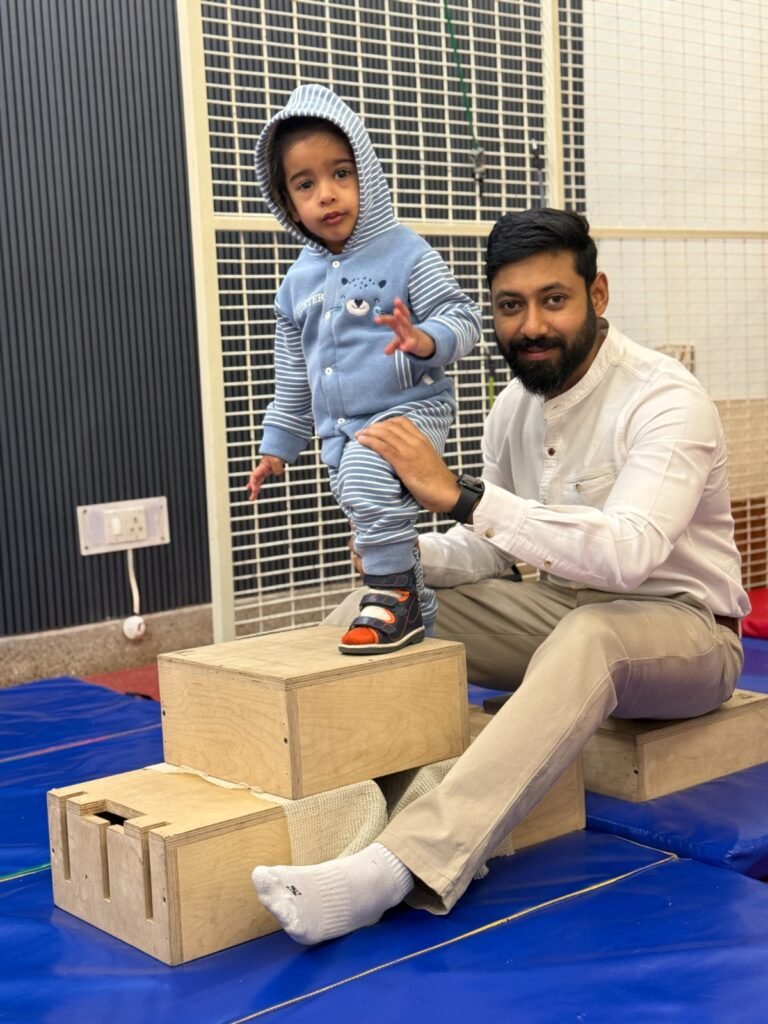
If you’ve never seen DMI therapy, it’s natural to wonder what your child will actually go through. Here’s a clear, honest walkthrough of what happens during a real session, from start to finish.
Step 1: Comprehensive initial assessment. Before your child’s first DMI session, a trained therapist evaluates their current motor abilities in detail. They assess head control, trunk stability, limb strength and range of motion, reflex patterns, and overall postural control. This evaluation determines which DMI postures and difficulty levels are right for your child’s starting point.
Step 2: Personalized posture selection. DMI uses a structured system of therapeutic postures organized by difficulty level. The therapist selects postures that are just above your child’s current ability. This is called the “provocation” approach. The idea is to challenge the brain enough to trigger new neural responses, without frustrating or overwhelming the child.
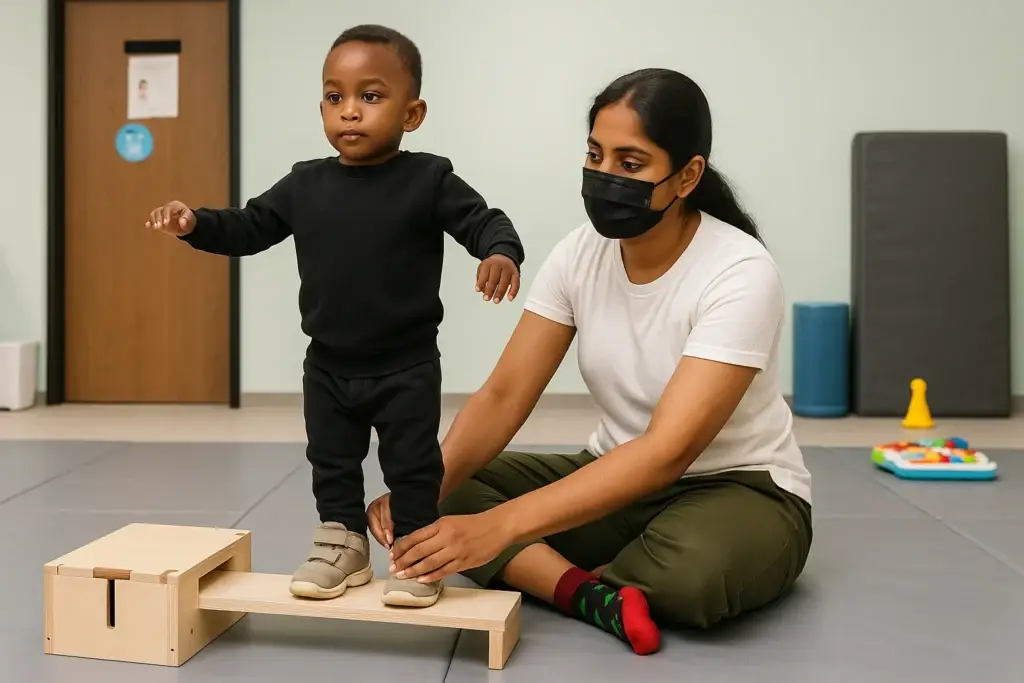
Step 3: Hands-on guided therapy (30 to 45 minutes). During the session, the therapist physically guides your child into each selected posture. They provide the right amount of support while allowing the child’s brain and nervous system to actively work on maintaining balance and control. This is not passive stretching or massage. Your child’s brain is doing real work the entire time.
Step 4: Targeted repetition. Each posture is held or repeated multiple times within the session. This repetition is essential because the brain needs consistent input to form and strengthen new neural pathways. Over weeks and months, these pathways become stronger, more reliable, and more automatic.
At our centres in Sector 17 Faridabad, Sector 85 Faridabad, and DLF Phase 2 Gurugram, we typically recommend 2 to 3 DMI sessions per week for the best results. We also combine DMI therapy with occupational therapy and sensory integration therapy when a child’s needs extend beyond motor control. Research consistently shows that this kind of multi-disciplinary approach produces the strongest outcomes.
Step 5: Parent training and home program. This is a step many centres skip, but we believe it’s one of the most important parts of the process. A good DMI therapist will teach you specific positions and activities to practice with your child at home between sessions. In our experience, the children who make the fastest progress are always the ones whose parents stay consistent with daily home practice.
DMI Therapy vs. Traditional Physiotherapy: Which One Does Your Child Need?
Traditional physiotherapy for children focuses on strengthening individual muscles, improving joint flexibility, and building physical endurance through repetitive exercises. DMI therapy takes a fundamentally different approach by targeting the brain’s ability to control posture and movement as one integrated system, which makes it significantly more effective for children whose motor challenges originate from neurological conditions rather than muscle or joint problems.
This is the most common question we hear from parents visiting our centres in Faridabad and Gurgaon. The honest answer: it depends entirely on your child’s diagnosis.
Choose traditional physiotherapy when the problem is in the muscles or joints. Fracture recovery, post-surgical rehabilitation, or isolated muscle weakness are all situations where conventional physio is the right fit.
Choose DMI therapy when the problem starts in the brain. Cerebral palsy, Down syndrome, brain injuries, and other neurological conditions involve the brain’s failure to properly control movement. In these cases, just strengthening muscles isn’t enough. You need to retrain the brain itself, and that’s precisely what DMI does.
Studies indexed on PubMed show that children with cerebral palsy who received DMI therapy demonstrated faster improvements in gross motor function (head control, sitting, standing) compared to children who received only conventional physiotherapy.
Traditional Physiotherapy | DMI Therapy | |
Primary target | Muscles and joints | Brain-body connection |
Best for | Injuries, post-surgery, muscle weakness | Cerebral palsy, Down syndrome, neurological delays |
Method | Repetitive strengthening exercises | Guided postures challenging postural control |
How it works | Builds muscle strength directly | Retrains the brain’s movement control system |
Starting age | Any age | As early as 2 to 3 months |
Session approach | Child performs active exercises | Therapist guides the child into therapeutic postures |
Best results for | Musculoskeletal problems | Neurological motor conditions |
Can you combine both?
Absolutely, and in many cases you should. Many children at our Faridabad and Gurugram centres receive DMI therapy alongside conventional physiotherapy and occupational therapy as part of one coordinated plan.
What sets Pedigym apart is that all our centres are led by DMI Level C certified therapists. Level C is the highest certification in the DMI method, which means your child’s therapy is designed and supervised by professionals with the most advanced DMI training available. Research published in the Journal of Physical Therapy Science shows that combined, multi-disciplinary approaches led by highly trained specialists produce better long-term outcomes than any single method used alone.
What Results Can You Realistically Expect from DMI Therapy?
Most children show measurable improvements in head control, sitting balance, standing stability, and early walking skills within 2 to 4 months of consistent DMI therapy (2 to 3 sessions per week). However, the speed and extent of progress depend on the child’s specific condition, severity, the age at which therapy began, and how consistently sessions are maintained.
Let’s be straightforward about expectations. This is where many therapy centres overpromise, and parents end up disappointed.
DMI therapy is not a miracle cure. It won’t make cerebral palsy or Down syndrome disappear. What it does, and does very well, is help your child’s brain build the strongest possible motor pathways given their specific condition. For some children, that means walking independently. For others, it means sitting without support or gaining reliable head control. Every single one of those milestones changes a family’s life.
The science behind this is clear. The Harvard Center on the Developing Child explains that neuroplasticity (the brain’s ability to rewire itself by forming new connections) is at its absolute peak during the first few years of life. A 1-year-old’s brain can adapt and build new pathways far more easily than a 5-year-old’s brain. This is the core reason why starting DMI therapy early, whether you’re in Faridabad, Gurugram, Delhi, or any other city in India, gives your child the biggest possible advantage.
Realistic timelines based on condition:
- Cerebral palsy (mild to moderate): Improved head control and sitting balance often visible within 8 to 12 weeks. Standing and walking milestones may take 6 to 12 months depending on severity and type of CP.
- Down syndrome: Faster achievement of motor milestones compared to children receiving no therapy. Many children reach independent sitting and standing earlier than typical projections suggest.
- Global developmental delay: Progress varies widely, but most families notice clear changes in posture, stability, and movement quality within the first 3 months of consistent therapy.
Five factors that make DMI therapy more effective:
- Starting as early as possible (ideally before age 3)
- Maintaining 2 to 3 sessions per week without extended breaks
- Combining DMI with complementary therapies like speech therapy and sensory integration therapy
- Practicing therapist-recommended activities at home every single day
- Regular progress reviews with goal adjustments every 6 to 8 weeks
Research from Zero to Three confirms that children who receive coordinated, multi-disciplinary early intervention show the most consistent and lasting developmental gains. At Pedigym, we structure every child’s plan with this evidence in mind.
How to Find the Best DMI Therapy Centre in Faridabad, Gurgaon, and Delhi NCR
Choosing the right DMI therapy centre can feel overwhelming, especially when you’re already worried about your child. Not every centre is the same, and the quality of care your child receives depends directly on the team providing it. Here’s a clear checklist of what to look for and what to avoid.
- Certified DMI therapists are non-negotiable. DMI is a specialized technique with multiple certification levels, ranging from introductory training to Level C, which is the highest and most advanced. Not every physiotherapist or occupational therapist is trained in it, and among those who are, the certification level matters. The higher the level, the more complex conditions and postures the therapist can handle. Before enrolling your child anywhere, ask the centre directly: “What level of DMI certification do your therapists hold?” Pedigym is the only chain of centres in Delhi NCR where all locations are led by DMI Level C certified therapists. This means your child gets therapy designed and supervised by professionals with the deepest possible expertise in the DMI method. If a centre can’t clearly tell you their therapists’ certification level, look elsewhere.
- A multi-disciplinary team matters. Children with motor delays rarely have motor-only challenges. They often need occupational therapy, speech therapy, sensory integration support, or some combination of all three. The best DMI therapy centres in Faridabad, Gurgaon, and across India offer all these services under one roof with a team that communicates and coordinates your child’s treatment plan together.
- Demand a proper assessment before therapy starts. A trustworthy centre will always conduct a thorough developmental evaluation before beginning any treatment. They should set clear, measurable goals and commit to sharing regular progress reports. If a centre wants to start therapy on day one without assessing your child first, that’s a serious red flag.
- Parent training should be standard practice. Therapy sessions happen a few hours per week. Your child is at home the rest of the time. Centres that actively train parents on specific home activities and exercises consistently get better results. At Pedigym, parent training is built into every single treatment plan.
- Consider location and consistency carefully. DMI therapy requires 2 to 3 visits per week, often for many months. Choose a centre you can reach easily and commit to visiting consistently. In Delhi NCR, Pedigym has centres in Sector 17 Faridabad, Sector 85 Faridabad, Sector 48, and DLF Phase 2 Gurgaon (Gurugram). This means families across south Delhi, Faridabad, Gurugram, Noida, and greater NCR have a quality option within reasonable distance.
Red flags to avoid when choosing a centre:
- Any centre that promises specific outcomes or uses the word “cure”
- Therapists who can’t explain the DMI methodology in simple terms
- No initial assessment or evaluation before starting therapy
- No parent involvement, home program, or guidance
- Unwillingness to share written progress reports
For families outside Delhi NCR: Ask your child’s pediatrician for referrals to DMI-certified therapists in your city. The Indian Academy of Pediatrics (IAP) maintains resources for finding developmental therapy services across India, covering cities from Mumbai and Bangalore to Chennai, Hyderabad, Kolkata, and beyond.
Conclusion
Here are three things to remember from this guide.
First, DMI therapy retrains the brain, not just the muscles. That fundamental difference is what makes it so effective for children with cerebral palsy, Down syndrome, and other neurological motor conditions. It addresses the root cause of motor delays, not just the visible symptoms.
Second, starting early is the single most powerful factor in your child’s progress. Your child’s brain is at its most adaptable during the first three years of life. Every month of early intervention counts.
Third, the right centre makes a measurable difference. Look for certified DMI therapists, a multi-disciplinary team, meaningful parent training, and transparent, honest progress tracking.
If you’re in Faridabad, Gurgaon (Gurugram), Delhi NCR, or anywhere in India and your child has motor delays, take action today. Book a free consultation at Pedigym to get a professional assessment and a personalized therapy plan built around your child’s unique needs. Visit us at Sector 17 Faridabad, Sector 85 Faridabad, Sector 48, or DLF Phase 2 Gurgaon.
Your child’s brain is ready. Give it the right input.
Frequently Asked Questions
Children can begin DMI therapy as early as 2 to 3 months of age. The Harvard Center on the Developing Child confirms that neuroplasticity is strongest in the first three years. Centres like Pedigym in Faridabad and Gurugram offer DMI for infants, toddlers, and older children based on their specific developmental needs and assessment results.
DMI therapy retrains the brain's control over gross motor movements like head control, sitting, standing, and walking. Occupational therapy focuses on fine motor skills (grasping, writing), sensory processing, and daily living activities. Many children with neurological conditions benefit from both therapies together as part of a coordinated, multi-disciplinary treatment plan.
Most DMI therapists recommend 2 to 3 sessions per week, with each session lasting 30 to 45 minutes. Consistent attendance is critical because the brain requires repeated stimulation to build and strengthen new neural pathways. Extended gaps between sessions can significantly slow your child's progress.
Yes. DMI therapy helps children with autism who experience motor coordination difficulties, low muscle tone, or delayed gross motor milestones. While it doesn't directly address communication or social skills, it builds the physical foundation that supports better participation in speech therapy and sensory integration therapy.
Look for certified DMI therapists, a multi-disciplinary team, a thorough initial assessment process, and an active parent training program. Pedigym is the only chain of centres in Delhi NCR where every location is led by DMI Level C certified therapists, the highest DMI certification level. Pedigym operates in Sector 17 Faridabad, Sector 85 Faridabad, Sector 48, and DLF Phase 2 Gurugram (Gurgaon), offering DMI therapy alongside occupational therapy, speech therapy, and sensory integration under one roof. Book a free consultation to begin your child's evaluation.