Written by Dr. Nitin Gupta, DMI Level C Certified Therapist | PediGym Child Development Center
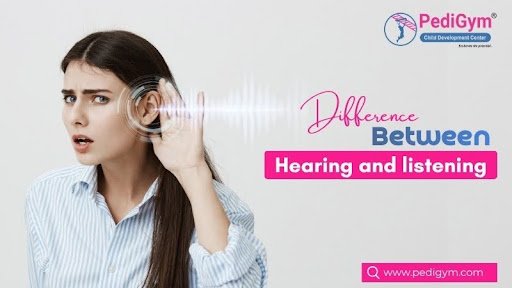
Children often hear sounds without fully paying attention to them. Hearing is the ability to detect sounds through the ears, while understanding spoken information involves focusing on meaning and responding appropriately. Although these two processes work together, they are not the same, and understanding the hearing and listening difference is important for communication, learning, and child development.
Many parents notice situations where their child reacts to sounds but still struggles to follow instructions, stay focused during conversations, or pay attention in the classroom. In many cases, the challenge may not be hearing itself but how the child processes and interprets information.
This difference may seem small, but it can affect language learning, school readiness, social interaction, and overall development. According to the World Health Organization (WHO), more than 63 million people in India experience significant hearing difficulties, and many concerns begin during childhood. Early awareness and support can help children build stronger communication and learning abilities.
Understanding hearing and listening can help parents identify concerns earlier and support healthier developmental outcomes for their children.
What Is Hearing?
Hearing is the natural ability to detect sounds. It is a physical process that occurs when sound waves travel through the ears and are sent to the brain for processing.
One important thing about hearing is that it happens automatically. We do not consciously decide to hear sounds. Our ears continuously collect information from the environment, even when we are not paying attention.
For example, a child may hear:
- A school bell ringing
- A dog barking outside
- Music playing in another room
- A fan running nearby
Even if the child is busy doing another activity, these sounds are still reaching the ears.
Hearing mainly depends on the proper functioning of the auditory system, including the outer ear, middle ear, inner ear, and auditory nerves.
Characteristics of Hearing
- Automatic process: Hearing happens naturally without requiring conscious effort. Sounds reach the ears whether a person is paying attention or not.
- Continuous in nature: The ears constantly receive sounds from the environment throughout the day, even during other activities.
- Does not always involve understanding: A person may hear sounds or words without fully interpreting their meaning.
- Supports communication but is not enough alone: Hearing helps detect sound, but effective communication also requires understanding and response.
- Involuntary process: People do not actively decide to hear; the auditory system automatically receives sound signals.
What Is Listening?
Listening goes beyond simply hearing sounds. It is an active process that requires attention, understanding, interpretation, and response.
Imagine a teacher saying:
“Please take out your notebook and write today’s date.”
A child who only hears the instruction may recognize the teacher’s voice. A child who pays attention and understands the message will be able to follow the instruction correctly.
This is why communication and understanding abilities are important during childhood development.
Strong communication abilities help children:
- Learn language more effectively
- Follow instructions in school
- Build stronger relationships
- Improve communication confidence
- Understand emotions and social cues
This ability develops gradually as children grow and gain more communication experiences.
Characteristics of Listening
- Active process: It requires attention and mental effort to understand spoken information.
- Purpose-driven: It usually happens with an intention to understand, learn, or respond.
- Improves understanding: It helps individuals interpret messages and respond meaningfully during conversations.
- Strengthens relationships: Effective communication encourages stronger personal and social connections.
- Supports emotional understanding: It helps children recognize emotions, tone of voice, and different perspectives, improving empathy and social interaction.
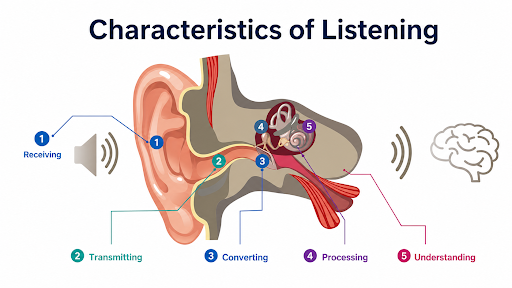
Hearing and Listening Difference: Understanding It Clearly
Many people assume hearing and listening mean the same thing, but they involve very different processes.
A simple way to understand the hearing and listening difference is:
Hearing = Detecting sound
Listening = Understanding sound
The following comparison makes the distinction easier:
Feature | Hearing | Listening |
How it works | Happens naturally | Requires active involvement |
Need for attention | Not necessary | Important |
What it is | A sensory ability | A learned skill |
Main purpose | To notice sounds | To understand messages |
Level of effort | Very little effort | Requires focus and concentration |
Emotional involvement | Usually not involved | Helps understand emotions and feelings |
Mental processing | Limited | Involves thinking, memory, and understanding |
Body systems used | Ears and auditory system | Brain, attention, memory, and language areas |
Need for a response | Not always | Often requires a response |
Connection between both | Can happen on its own | Usually begins with hearing |
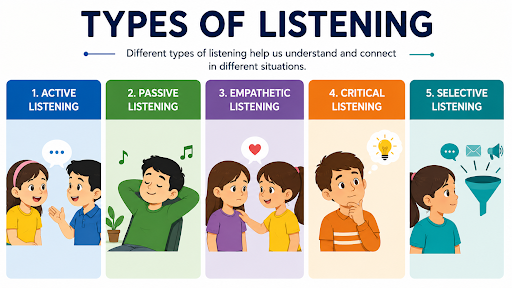
Types of Listening
Listening is not just one skill. Children use different ways of understanding and responding during different situations every day. Understanding these styles can help parents and teachers support better communication development and interaction skills.
1. Active Listening
Active listening happens when a child gives full attention to the speaker and tries to understand the message. It involves focusing, understanding, and responding appropriately.
Child example: A child listens carefully while the teacher explains homework instructions and follows them correctly.
2. Passive Listening
Passive listening happens when a child hears sounds but is not fully focused on them. The sounds are received, but the information may not always be processed completely.
Child example: A child hears television sounds while playing with toys but may not remember what was being said.
3. Reflective Listening
Reflective listening involves understanding not only the words but also the emotions behind them. It helps children respond thoughtfully and build empathy.
Child example: A child notices a friend is upset and asks, “Are you sad because you lost your toy?”
4. Critical Listening
Critical listening involves thinking carefully about information before responding. Children use this ability to understand, compare, and make decisions.
Child example: A child hears two different answers to a question and decides which one makes more sense.
Developing these communication styles can strengthen overall understanding abilities, communication skills, and social interactions in children.
How Listening Works in the Brain
Listening involves much more than simply hearing sounds. When children pay attention to spoken information, their brains are doing several things at the same time—recognizing words, understanding meaning, focusing, remembering information, and deciding how to respond.
Since a child’s brain is still developing, especially the areas responsible for attention and decision-making, this process can require more effort compared to adults. This is one reason why children may hear an instruction clearly but still forget it a few moments later or need it repeated.
For example, a child may hear “Put your bag away and wash your hands,” but only remember one part of the instruction. This does not always mean they were not paying attention; their brain may still be learning how to process and organize information efficiently.
How Hearing Affects Listening
Hearing and listening work closely together. For a child to understand spoken information properly, they first need to hear sounds clearly. When sounds are not received clearly, understanding and responding can become more difficult.
For example, if a child cannot clearly hear words during a conversation or in the classroom, they may miss important information. Over time, this can affect communication, learning, and everyday interactions.
Children with hearing difficulties may experience:
- Difficulty understanding words and conversations
- Trouble following instructions
- Frequently asking others to repeat information
- Reduced attention during activities
- Delays in communication or learning
Strong hearing and listening skills in children help support better communication, improve classroom participation, and strengthen overall learning abilities.
Barriers to Listening in Children
Sometimes children can hear sounds clearly but still struggle to listen properly. This can happen for many reasons, especially when their attention or understanding is affected by the environment around them.
Here are some common barriers that can affect listening in children:
Background noise
Loud classrooms, television sounds, traffic, or crowded places can make it difficult for children to focus on conversations or instructions.
Distractions
Toys, mobile screens, or other activities around them can easily take a child’s attention away from listening.
Emotional state
When children feel upset, anxious, excited, or frustrated, they may find it harder to concentrate on what others are saying.
Fatigue
Tired children often struggle to stay focused and may forget instructions quickly.
Processing difficulties
Some children need extra time to understand and respond to spoken information, especially during long conversations or fast instructions.
Lack of interest
Children usually pay more attention to topics or activities they enjoy, while less interesting tasks may reduce their focus.
Recognizing these barriers can help parents and teachers create a calmer and more supportive environment that improves listening and communication skills.
Hearing and Listening Skills in Children: Development Milestones
Children develop hearing and listening skills gradually as they grow. From recognizing familiar voices as babies to understanding conversations during preschool years, these abilities continue to improve over time.
While every child develops at their own pace, knowing common milestones can help parents understand what to expect at different ages.
Age | Hearing and Listening Development |
0–6 months | Babies may respond to loud sounds, become calm when hearing familiar voices, and show reactions such as smiling or turning toward sounds. |
6–12 months | Children often begin turning their heads toward sounds, responding when their name is called, and recognizing common words. |
1–2 years | Toddlers start understanding simple words and can follow basic instructions like “Come here” or “Give me the ball.” |
2–4 years | Children become better at identifying sounds, following short directions, and understanding everyday conversations. |
4–6 years | At this stage, children can usually understand longer conversations, follow more detailed instructions, and participate actively in communication. |
Keep in mind that small differences in development are normal. However, if a child regularly struggles to respond to sounds, understand instructions, or communicate appropriately, seeking professional guidance may be helpful.
Hearing and Speech Development
Hearing and speech development are closely linked during childhood. Children learn language by hearing sounds, listening to conversations, and imitating the words they hear around them. From an early age, babies begin recognizing voices and sounds, and as they grow, they gradually start repeating words and forming sentences.
When hearing is affected, children may miss important language information, which can influence speech and communication development. This may affect vocabulary growth, pronunciation, and the ability to understand or express ideas clearly.
Parents can watch for some common signs of concern, including:
- Delayed speech development
- Difficulty understanding instructions
- Limited vocabulary for age
- Not responding consistently when called
- Frequent need for repetition
Early identification and support can help children strengthen communication skills and improve developmental outcomes.
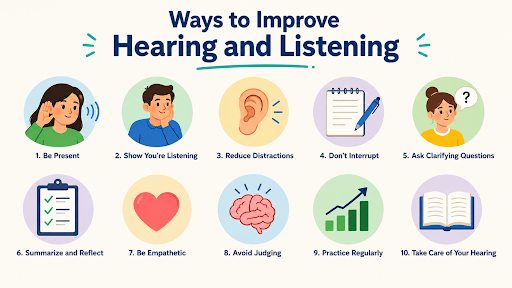
Ways to Improve Hearing and Listening
Parents can support and improve hearing and listening skills through simple everyday activities. Small changes in daily routines can help children focus better, understand information more easily, and strengthen communication abilities.
Read stories aloud regularly: Reading stories helps children pay attention to words, understand language, and improve their listening and memory skills. Asking simple questions during the story can also encourage active participation.
Reduce background noise: Too many sounds at the same time can make listening difficult for children. Try turning off televisions, lowering music volume, or reducing distractions during conversations and learning activities.
Encourage eye contact during communication: Looking at the speaker helps children stay focused and understand both verbal and non-verbal cues such as facial expressions and gestures.
Practice auditory listening exercises: Fun activities can strengthen attention and sound recognition abilities. Some useful exercises include:
- Sound identification games: Ask children to recognize everyday sounds such as bells, animals, or household objects.
- Story recall activities: Read a short story and encourage children to remember and explain key details.
- Following multi-step directions: Give instructions like “Pick up your book and place it on the table.”
- Music and rhythm games: Singing songs, clapping patterns, or rhythm activities can improve attention and response skills.
Regular practice through these activities can gradually strengthen children’s listening skills and support better communication development.
Professional Support for Children
Some children may need additional support when listening difficulties begin affecting communication, learning, or everyday activities. If a child regularly struggles to follow instructions, respond during conversations, or meet speech and developmental milestones, professional guidance can help identify the underlying cause.
Depending on a child’s needs, support may involve professionals such as speech-language therapists, occupational therapists, developmental specialists, or child psychologists. The process usually begins with understanding the child’s strengths and challenges through observations, assessments, and discussions with parents.
Based on the findings, professionals may recommend strategies such as communication support, sensory-based activities, speech and language intervention, or exercises designed to strengthen attention and processing skills.
For children who may benefit from structured support, programs such as Therapeutic Listening Program can help improve attention, sensory processing, and response abilities. Children with broader developmental concerns may also benefit from services like Early Intervention Program or communication-focused therapies based on their individual needs. Parents looking for more child development guidance can also explore PediGym Blogs.
Frequently Asked Questions (FAQs)
1. What is the difference between hearing and listening?
Hearing is the natural ability to detect sounds through the ears, while listening involves actively paying attention and understanding what those sounds mean. For example, a child may hear a teacher speaking in class, but listening happens when the child understands the instruction and responds appropriately. Hearing receives sound, while listening helps process and understand it.
2. Can someone listen without hearing?
Yes. Understanding and communication are not limited to hearing sounds through the ears. Individuals with hearing loss or deafness may communicate through sign language, lip reading, facial expressions, body language, and visual cues. The ability to understand and connect with information can happen through different forms of communication beyond sound alone.
3. Why does my child hear me but not listen?
Many parents notice that their child responds to sounds but does not seem to follow instructions consistently. In some cases, the child may hear words clearly but struggle with attention, auditory processing, distractions, or understanding the information being given. If your child frequently ignores instructions, asks for repeated explanations, or has difficulty following conversations across different situations, professional guidance may help identify the reason.
4. Why are listening skills important for children?
Listening skills are important because they support communication, learning, and social development. Strong communication abilities help children understand instructions, participate in classroom activities, build relationships, and improve language skills. Good attention and understanding also help children express their thoughts more confidently.
5. At what age do listening skills develop in children?
Listening skills start developing from the earliest stages of life. Babies begin responding to familiar voices and sounds shortly after birth. As children grow, they gradually learn to recognize words, respond to their names, follow simple instructions, and participate in conversations. By the age of 5–6 years, many children can usually understand and follow more detailed conversations, although every child develops at their own pace.

Dr. Nitin, Founder of PediGym Child Development Center, is a dedicated pediatric therapy expert and DMI Level C Certified Therapist leading structured, evidence-based therapy programs in Faridabad and Gurgaon. Under his guidance, PediGym provides comprehensive pediatric rehabilitation focused on improving motor skills, coordination, sensory processing, speech clarity, and functional independence through personalized intervention plans.