Have you noticed that your child is not walking like other kids, falls more often, or gets tired quickly during play? If that sounds familiar, you are not alone — and your concern is completely valid.
Locomotor disability affects how a child moves, controls their body, and carries out physical actions. It can involve the legs, arms, joints, spine, or the nervous system. Some children find it hard to walk. Others struggle to use their hands, stay balanced, or sit upright without support.
The encouraging news is this: when parents act early and find the right therapy, children grow stronger. They become more capable and more confident over time.
This blog covers what locomotor disability is, its types, warning signs, causes, and which therapies help most.
Takeaway: Acting early is the most important thing a parent can do for a child with locomotor disability.
What Is Locomotor Disability?
Locomotor disability is when a person has trouble moving their limbs or body because of a problem in their muscles, joints, bones, or nervous system. It changes how a child walks, runs, lifts objects, holds posture, or handles everyday physical tasks.
Every time your child takes a step, climbs a stair, or picks up a toy, their entire body has to work together. When one part of that system is not working the way it should, movement becomes difficult. That is what locomotor disability means in daily life.
India’s Rights of Persons with Disabilities (RPWD) Act defines it as an inability to carry out activities involving moving oneself or objects. In short, it means a child struggles to move their body or things around them from place to place. Children with 40% or more physical impairment qualify for legal support — including assistive devices, educational accommodations, and financial benefits.
Locomotor disability can be present from birth — called congenital — or it can appear later because of an illness or injury — called acquired. How mild or severe it is, and whether it is short-term or lifelong, depends entirely on what is causing it.
Takeaway: Locomotor disability is about how the body moves. Finding it early gives your child the strongest possible start.
Types of Locomotor Disability
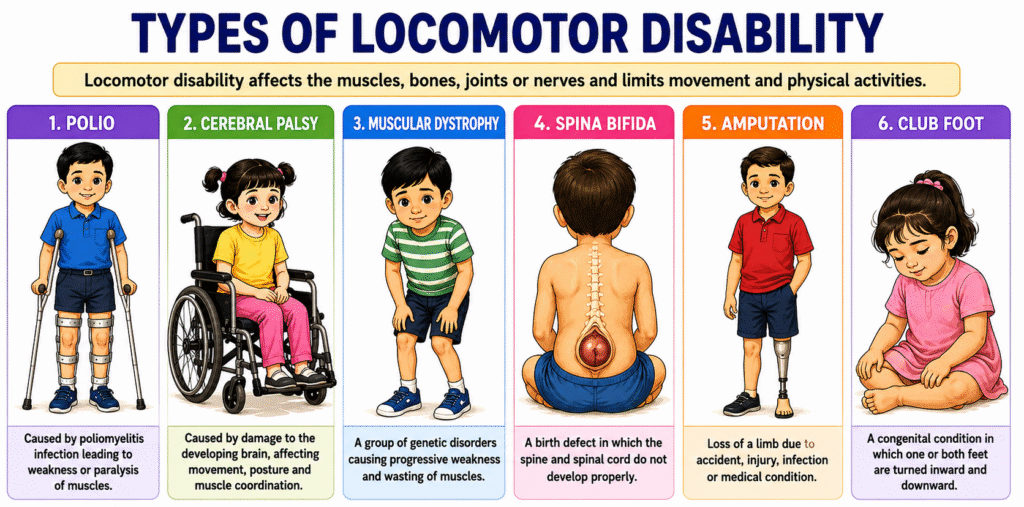
Locomotor disability types vary widely, and each one affects children differently. Knowing the right type helps doctors and therapists build a plan that actually fits your child.
1. Cerebral Palsy
Brain injury before, during, or shortly after birth causes cerebral palsy. It disrupts muscle tone, posture, and the ability to move in a smooth, controlled way. It is the most common neurological cause of locomotor disability in children. Learn more: Cerebral Palsy Disability: Types, Symptoms & Early Treatment.
2. Muscular Dystrophy
A set of inherited conditions where the muscles break down gradually over time. Children often first show signs when running, climbing stairs, or standing up from the floor becomes noticeably harder.
3. Poliomyelitis (Polio)
Polio is largely preventable today through vaccination. However, the poliovirus can permanently damage the nervous system, causing weakness or paralysis in one or more limbs in children who were not protected.
4. Clubfoot
A condition at birth where one or both feet are turned inward or downward out of position. Children who receive early treatment — through casting, stretching, and physiotherapy — typically do very well.
5. Spinal Cord Injury
Trauma, illness, or infection can damage the spinal cord and reduce or remove movement in the arms, legs, or both. Outcomes depend on where the injury sits along the spine and how quickly rehabilitation begins.
6. Amputation
Some children are born without a full limb. Others lose one because of an accident, disease, or surgery. Either way, it changes how the child moves and keeps balance. Prosthetics and therapy work together to help the child move with confidence again.
7. Arthrogryposis
A condition present at birth where several joints across the body are stiff and do not move freely. With consistent therapy and, where needed, supportive equipment, children with arthrogryposis can improve steadily over time.
Takeaway: Identifying the correct type of locomotor disability early means therapy can be built around exactly what your child needs.
Symptoms of Locomotor Disability in Children
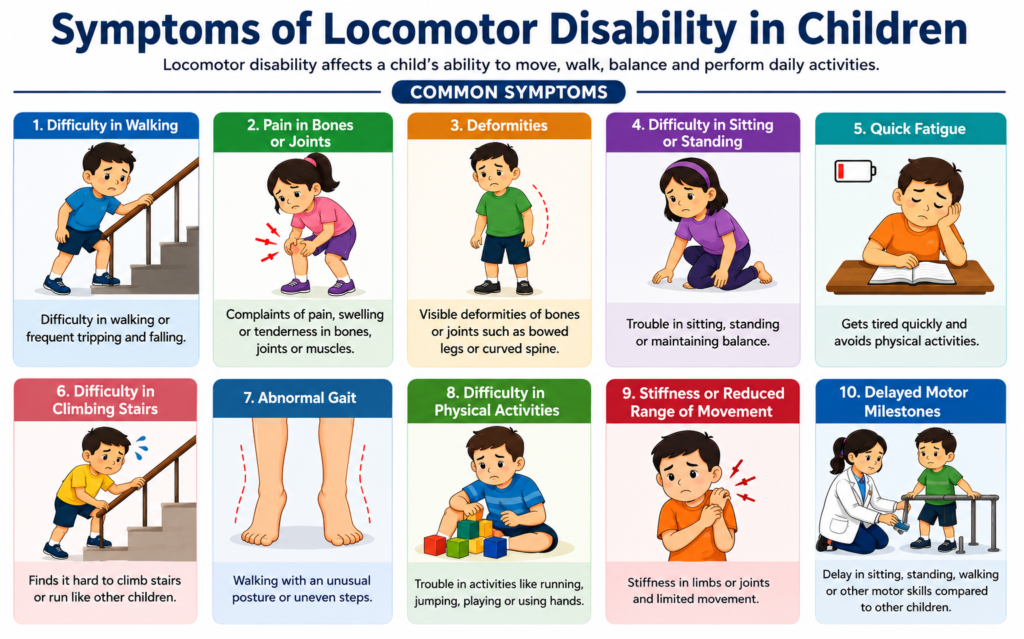
Symptoms depend on the type and how severe the condition is. Some appear in the first weeks of life. Others only show up when a child starts walking, attending school, or trying more demanding physical tasks.
Parents often say they noticed something was different long before anyone put a name to it. That gut feeling is always worth following up.
Signs in Babies and Toddlers
Late milestones: Your baby takes much longer than expected to roll over, sit up, crawl, or walk. Occasional delays are normal, but repeated ones deserve attention.
Muscle tone that feels off: The baby feels either very limp or very stiff and rigid when held. Both are worth discussing with a doctor.
Weak head control: Not being able to hold the head steady by the usual age is one of the earliest physical signs to watch.
Moving only one side: Your baby always reaches with one hand, drags one leg, or keeps one fist curled shut. This one-sidedness in early infancy is something to mention to your paediatrician.
Feeding struggles: Difficulty sucking or swallowing — especially in babies with a neurological condition — can be an early linked sign.
Signs in Older Children
Toe walking or limping: Walks on tiptoe or clearly favours one leg. The gait looks noticeably different from other children the same age.
Falls more than expected: Trips and falls much more often than peers, including on flat surfaces or while doing simple things.
Weak arms or legs: Has real difficulty running, climbing, carrying a school bag, or getting up from the floor unaided.
Stiff or painful muscles: Tightness, muscle spasms, or pain in the legs, arms, or back after physical activity.
Struggling with fine motor tasks: Cannot write neatly, button clothes, tie laces, cut with scissors, or handle a spoon and fork easily.
Tires very fast: Wears out much sooner than other children during play, sports, or even regular classroom activity.
If you are seeing more than one or two of these signs — or they are not improving — do not wait. Get it checked by a specialist.
Takeaway: Your instincts as a parent matter. If something about your child’s movement does not seem right, get it looked at sooner rather than later.
What Causes Locomotor Disability?
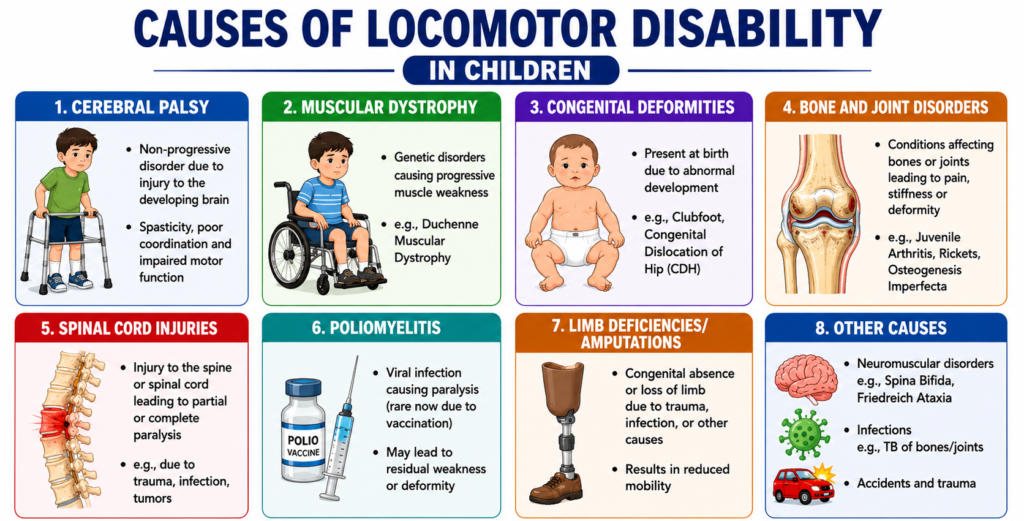
Causes vary from child to child. Some are there from the very beginning of life. Others build up over time or happen because of a sudden event.
Present from birth: Cerebral palsy from a difficult delivery, genetic conditions like muscular dystrophy, clubfoot, spina bifida, or being born without a full limb.
Building up during childhood: Severe Vitamin D deficiency leading to rickets, or a slow-developing neurological condition that was not spotted early enough.
Happening after birth: Road accidents, spinal injuries, infections like polio or spinal tuberculosis, and post-surgical complications. Diseases that affect the bones or nervous system also fall here.
Not every family gets a clear answer on the cause, and that is truly difficult to sit with. What helps is getting the right evaluation so that whatever the cause, a solid plan can be put in place.
Takeaway: Knowing the cause points therapy in the right direction right from the start.
Best Therapy Options for Children with Locomotor Disability
There is no single cure that works for every child. With the right therapy and the right timing, children get stronger and move better. They also gain independence in the parts of daily life that matter most.
At PediGym, every child gets a plan built specifically around their condition, their age, and their everyday goals. No child here gets a generic programme.
Physiotherapy
Builds muscle strength, improves joint movement, and develops the balance and posture a child needs to sit, stand, walk, and climb. Sessions are paced to match what each child can manage and progress from there.
Occupational Therapy
Occupational therapy works on the tasks children do every day — eating, getting dressed, writing, playing, and taking part in school. For children with locomotor disability, it covers both hand and arm coordination and finding practical ways to do things more independently.
Neurodevelopmental Therapy (NDT)
NDT is particularly effective when locomotor disability has a neurological cause, such as cerebral palsy. It works on the communication between the brain and the body, improving posture, movement patterns, and the physical control children need for daily life.
Dynamic Movement Intervention (DMI)
DMI is a specialist therapy that uses specific exercises to stimulate the nervous system and build purposeful, goal-directed movement. Dr. Nitin Gupta at PediGym is a certified DMI Level C Therapist — among very few in this region. Families here have access to specialist input that is rare to find elsewhere.
Sensory Integration Therapy
Sensory integration therapy helps children who have trouble processing what they feel — touch, pressure, body position, or movement. When the sensory system works better, coordination and balance follow. Many children with locomotor disability also carry sensory processing challenges, and treating both together speeds up progress.
Hydrotherapy (Aquatic Therapy)
Moving in water takes the strain off joints while still working the muscles. Children who find regular exercise painful or exhausting often respond well to hydrotherapy. It builds strength, improves movement range, and children tend to enjoy it — which means they keep coming back.
Early Intervention Programme
The younger a child starts therapy, the better the brain can adapt and respond to it. A structured Early Intervention Programme brings different therapies together under one plan, rather than treating each area separately. Children who start young generally make the strongest gains.
Assistive Devices and Orthotics
AFOs, walkers, splints, and wheelchairs are not a substitute for therapy — they support it. Used alongside treatment, they help children move more safely and comfortably through the day.
Home Programme and Parent Involvement
At PediGym, parents are a core part of the process — not just observers. Every family receives clear guidance on what to do between sessions at home. Simple daily practice, done consistently, makes a big difference to how fast a child progresses.
Takeaway: Early, personalised therapy — with parents fully involved — gives children with locomotor disability the strongest path forward.
When Should You Seek Help?
You do not need a diagnosis before you pick up the phone. If your child’s movement, strength, or development does not look the way you would expect, that is reason enough to speak to a specialist.
The first three years of life are when the brain adapts most readily. Therapy during this window tends to produce results that last. Waiting until school age is not the end of the road, but acting earlier makes things easier.
PediGym provides specialist paediatric therapy for children with locomotor disability at centres in Faridabad and Gurgaon. Our team — led by Dr. Nitin Gupta, DMI Level C Certified Therapist — builds individual plans for every child and works closely alongside their family throughout.
Takeaway: Do not wait for a diagnosis. Reach out as soon as you have a concern — the window for the best results is widest in the early years.
Conclusion
A diagnosis of locomotor disability does not put a limit on what your child can do. Families who find the right support early are often amazed at how much their children develop — in strength, movement, independence, and confidence.
If you are concerned about your child’s physical development, reach out to PediGym today for a free consultation at our centres in Faridabad and Gurgaon.
Takeaway: With the right support, the right team, and a family that keeps showing up — children with locomotor disability can go further than anyone first imagined.
Written and reviewed by Dr. Nitin Gupta, Founder — PediGym Child Development Center. DMI Level C Certified Therapist. Specialist in paediatric rehabilitation, neurodevelopmental therapy, and early intervention.

Dr. Nitin, Founder of PediGym Child Development Center, is a dedicated pediatric therapy expert and DMI Level C Certified Therapist leading structured, evidence-based therapy programs in Faridabad and Gurgaon. Under his guidance, PediGym provides comprehensive pediatric rehabilitation focused on improving motor skills, coordination, sensory processing, speech clarity, and functional independence through personalized intervention plans.