Imagine a child refusing to climb playground equipment while other children run and jump without hesitation. Or picture an adult gripping a stair rail tightly on a gentle slope that feels completely safe to everyone else. These reactions may be signs of gravitational insecurity, a sensory processing challenge in which the brain interprets ordinary movement as dangerous.
Gravitational insecurity is a type of sensory processing disorder linked to the vestibular system. People with this condition experience intense discomfort, fear, or instability during movement, balance changes, or shifts in body position, even when there is no real danger.
What Is Gravitational Insecurity?
Gravitational insecurity is a form of sensory processing disorder (SPD) involving over-responsiveness in the vestibular system. The vestibular system helps the brain process movement, balance, and spatial orientation. When this system becomes hypersensitive, everyday activities like climbing stairs, leaning backward, or swinging may feel unsafe.
One of the main gravitational insecurity causes involves dysfunction in the otolith organs, structures in the inner ear that detect gravity and movement. These organs normally help people feel stable while moving through space. In people with gravitational insecurity, the brain may misread these sensory signals and respond with fear.
This condition is different from a general fear of heights. Acrophobia is usually a cognitive fear, meaning the person consciously worries about danger. Gravitational insecurity is more automatic and neurological. The nervous system reacts before the person can logically assess the situation.
The brain also relies on proprioception, or body awareness, to understand where the body is in space. When vestibular and proprioceptive information do not work together correctly, movement may feel unpredictable or threatening.
The Vestibular System: Why It Matters
The vestibular system is a part of the inner ear that helps the brain understand balance, movement, and body position. It constantly tells the brain where the body is, how fast it is moving, and how gravity is affecting it.
Inside this system are two tiny structures called the utricle and saccule, also known as the otolith organs. Their job is to detect gravity and straight-line movements, such as going up, down, forward, or backward.
In children with gravitational insecurity, these organs are overly sensitive. Everyday movements that most people consider normal can feel unsafe or overwhelming to them. As a result, the brain reacts with fear, even when there is no real danger.
This reaction is not simply stubborn behavior, a tantrum, or typical anxiety. It happens because the brain has difficulty processing sensory information correctly at a neurological level.
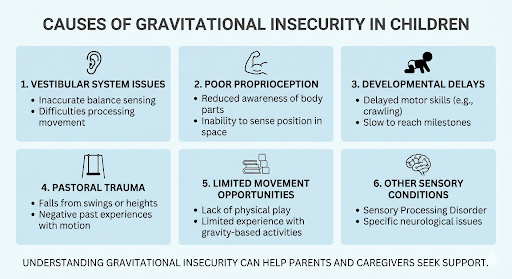
Gravitational Insecurity Causes
Gravitational insecurity causes are rooted in how well the central nervous system modulates vestibular input. The main factors our team at PediGym look for include:
Over-sensitive vestibular system
The inner ear contains tiny structures that detect movement and gravity. In some children, these structures are overly sensitive and send stronger-than-normal signals to the brain, making simple activities feel scary or overwhelming.
Poor sensory integration
The brain normally combines information from the vestibular system, vision, and muscles to create a sense of stability and safety. When these systems do not work together smoothly, a child may struggle to feel balanced and secure during movement.
Premature birth
The vestibular system continues developing during the later stages of pregnancy. Babies born prematurely may have an immature or underdeveloped sensory system, which can affect balance and movement processing later on.
Frequent ear infections in early childhood
Repeated middle-ear infections may interfere with the development and functioning of the inner ear, which plays a major role in balance and spatial awareness.
Difficulty regulating sensory responses
Some children have nervous systems that stay on “high alert.” Their brains may find it harder to calm down or filter out unnecessary movement signals, leading to fear or avoidance of certain activities.
Associated developmental conditions
Gravitational insecurity is more commonly seen in children with autism, ADHD, sensory processing challenges, or Developmental Coordination Disorder (DCD). However, it can also occur in children without any other diagnosis.
Limited movement experiences during infancy
Babies need regular opportunities to move, roll, crawl, and explore their environment. Too much time in car seats, swings, walkers, or bouncers — along with limited tummy time — may reduce important vestibular input needed for healthy sensory development.
Because every child’s nervous system develops differently, the causes of gravitational insecurity can vary from one child to another. Often, several factors work together rather than a single cause alone.
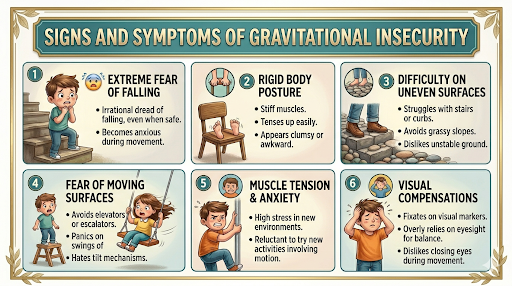
Signs and Symptoms of Gravitational Insecurity
The hallmark sign is a fear or distress reaction to movement that is dramatically out of proportion to the actual situation. A child with gravitational insecurity may feel completely calm near a high window but panic the moment they step off a 20 cm kerb. The responses are real, involuntary, and neurologically driven.
In Infants and Toddlers
- Crying or extreme distress when lifted, tilted, or placed on their back
- Resistance to tummy time or being placed face-down
- Startling excessively during routine handling like nappy changes
- Distress when the head is tilted back during bathing or feeding
In School-Age Children
- Refusing swings, slides, roundabouts, or monkey bars — even at low height or slow speed
- Meltdowns or freezing when feet leave the ground even briefly
- Avoiding stairs, escalators, ramps, and any surface that shifts or gives underfoot (grass, sand, gravel)
- Refusing to sit in chairs where feet cannot touch the floor — dangling feet feel genuinely threatening
- Distress during dental appointments, hair washing, or any activity requiring the head to tilt back
- Being labelled “clingy,” “over-sensitive,” or “dramatic” by teachers or extended family
Gravitational Insecurity in Adults
Gravitational insecurity in adults is more common than most people suspect. Many adults have spent decades quietly organising their lives around their triggers — choosing seats near walls, avoiding escalators, gripping handrails on open staircases — without ever knowing why. Adult presentations include:
- Significant anxiety as a car passenger, especially on winding roads or during sudden braking
- Avoidance of ladders, open staircases, glass elevators, or any moving platform
- Discomfort at the dentist, hairdresser, or any setting requiring a reclined position
- Feeling unsteady or panicky when bending forward to pick something up
- Limiting career choices or social activities to avoid known movement triggers
Adults benefit from sensory integration-based occupational therapy just as children do. It is never too late to seek assessment.
Gravitational Insecurity Assessment
A proper gravitational insecurity assessment is conducted by an occupational therapist trained in Ayres Sensory Integration® (ASI). It combines direct clinical observation, standardised tools, and detailed parent and caregiver input. It is not a single test — it is a comprehensive clinical picture.
Key components include:
- Clinical observation: the OT observes responses to positional changes, surface transitions, and head movements during structured and free play activities
- Standardised assessments: Sensory Processing Measure (SPM), Sensory Profile 2, and the Gravitational Insecurity Assessment by May-Benson & Koomar
- Postrotary nystagmus evaluation: assesses how the eyes respond after rotation, giving insight into vestibular processing efficiency
- Parent and caregiver interview: detailed history of daily triggers, avoidance behaviours, and movement responses across home, school, and community
At PediGym, our ASI-trained therapists conduct comprehensive sensory assessments through our Sensory Integration Therapy and Early Intervention programmes. No GP referral is needed — contact us directly to book.
Gravitational Insecurity Treatment
The good news: gravitational insecurity responds well to the right intervention. Children who once refused swings can, over time, learn to enjoy them. The gold-standard treatment is Ayres Sensory Integration® Therapy, which works not by forcing the child into feared situations, but by gradually recalibrating how the nervous system interprets vestibular input.
Gravitational Insecurity Occupational Therapy
In ASI-based occupational therapy, the therapist creates a rich sensory environment — suspended swings, platform swings, hammocks, bolsters — and uses what Ayres called the “just-right challenge”: activities that sit just at the edge of the child’s comfort zone. The child is always in control. Progress is gradual and cumulative.
What gravitational insecurity occupational therapy includes at PediGym:
- Linear vestibular input first: slow, front-to-back or side-to-side movement before any rotary (spinning) input, which is alerting and counterproductive early in treatment
- Proprioceptive co-input: heavy work activities (pushing, pulling, carrying) activate joint and muscle receptors that calm the vestibular alarm response
- Child-led pacing throughout: the child decides how much, how fast, and how long. Forced movement makes gravitational insecurity worse, not better
- Parent coaching: families learn exactly what to do at home and, critically, what to avoid — so progress carries beyond the clinic walls
- Environmental modifications: foot rests on chairs, stable seating, predictable daily routines, and verbal preparation before any positional change
Treatment timelines vary by the individual, but most families begin to see meaningful change within 10–16 weeks of consistent weekly sessions. More complex presentations may benefit from 12–24 months of ongoing therapy. The nervous system is plastic — change is always possible.
Never force movement on a child with gravitational insecurity. A single overwhelming experience can reinforce avoidance and set progress back significantly. The child must always feel in control.
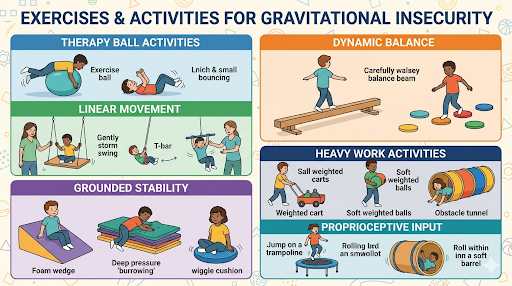
Gravitational Insecurity Exercises and Activities
These gravitational insecurity exercises can be helpful between occupational therapy sessions. The key is to move slowly, follow your child’s comfort level, and make every activity feel safe and predictable. Talk your child through each step before it happens, and stop if they become overwhelmed or distressed. Always check with your occupational therapist before starting a home program.
1. Slow Rocking Chair Movement
Gentle front-to-back rocking in a rocking chair can help children feel calm and secure. Keeping their feet close to the floor gives them a stronger sense of control and stability. Let your child decide how fast or slow the rocking feels comfortable.
2. Gentle Platform Swinging
Start with the swing completely still so your child can get comfortable sitting on it. Slowly introduce a soft front-to-back motion only if they feel ready. Avoid sudden movement or pushing the swing unexpectedly.
3. Log Rolls on a Mat
Rolling slowly across a soft mat helps children experience movement while still feeling supported by the ground. This can gently improve vestibular processing without making them feel unsafe.
4. Wheelbarrow Walking
In this activity, an adult holds the child’s legs while the child walks on their hands. The pressure through the arms and shoulders gives strong proprioceptive input, which often helps the nervous system feel more organized and grounded.
5. Heavy Work Activities
“Heavy work” includes activities like carrying books, pushing a laundry basket, digging in sand, or helping move lightweight objects. These activities provide calming proprioceptive input that can improve body awareness and reduce movement-related anxiety.
6. Weighted Support During Movement
Some children feel more secure when using a weighted vest or holding a small beanbag during movement activities. The added weight can help the body feel more stable and supported.
7. Gradual Stair Practice
Practice stairs slowly, one step at a time, using a handrail and adult support if needed. Praise effort instead of focusing on speed. Small gains over time help build confidence and trust in movement.
8. Water Play Activities
Water can feel calming because buoyancy reduces the body’s sense of gravity. Supervised water play or swimming activities may help children explore movement in a less intimidating way while still giving valuable vestibular input.
These exercises should always be guided by a qualified occupational therapist to ensure safety and proper progression.
When to Seek Help
Consider an assessment with an ASI-trained occupational therapist if:
- Your child has intense or distressing fear reactions to ordinary movement.
- Playground equipment, gym class, or school sports are consistently avoided or trigger meltdowns.
- Daily routines — hair washing, dental visits, the car seat — cause disproportionate distress.
- Your child’s movement avoidance is affecting friendships, learning, or family life.
- A professional has mentioned “sensory processing,” “vestibular sensitivity,” or “sensory integration” as a concern.
Early intervention is particularly powerful — the nervous system is most plastic during the first decade of life. But meaningful progress is achievable at any age. At PediGym, our Early Intervention Programme is designed specifically to support children whose sensory systems need early, structured input. Our Sensory Integration Therapy service is available for children of all ages and for adults.
Gravitational insecurity often appears alongside other developmental concerns. Our Occupational Therapy team regularly supports children also receiving Neurodevelopmental Therapy or Dynamic Movement Intervention (DMI) — because sensory and motor development are deeply interconnected.
Frequently Asked Questions
Q: Is gravitational insecurity the same as a fear of heights?
No. Fear of heights is usually a cognitive phobia, while gravitational insecurity involves vestibular hypersensitivity and automatic neurological responses to movement.
Q: Can adults have gravitational insecurity?
Yes. Many adults experience symptoms without receiving a diagnosis. They may avoid movement-heavy activities or rely heavily on stable supports.
Q: How long does treatment take?
Treatment timelines vary depending on severity and individual needs. Some people improve within months, while others benefit from longer-term occupational therapy support.
Q: Is gravitational insecurity a form of autism?
No. Gravitational insecurity is not autism itself, although sensory processing difficulties are common in autistic individuals.
Q: Can gravitational insecurity be cured?
There is no single cure, but symptoms often improve significantly with occupational therapy, sensory integration strategies, and environmental support.
Conclusion
Gravitational insecurity is a real neurological condition, not a behavior problem or a sign of weakness. Children and adults with this condition may feel unsafe during everyday movements because their brain processes balance and movement differently.
With the right support, confidence and movement skills can improve greatly over time. Occupational therapy and sensory integration treatment help individuals feel safer, more independent, and more comfortable in daily activities.
About Dr. Nitin Gupta & PediGym
Dr. Nitin Gupta is a DMI Level C Therapist and paediatric physiotherapist specializing in sensory integration and child development. He is the founder of PediGym, a child development centre in Faridabad and Gurgaon, Delhi NCR.
At PediGym, children receive evidence-based therapies including Ayres Sensory Integration® Therapy, Occupational Therapy, Speech Therapy, and neurodevelopmental support for conditions such as autism, cerebral palsy, developmental delay, and gravitational insecurity.
If you feel your child may be struggling with movement-related fear or balance challenges, the PediGym team offers sensory assessments, therapy, and parent guidance in a supportive environment. Free consultation available — no referral needed.

Dr. Nitin, Founder of PediGym Child Development Center, is a dedicated pediatric therapy expert and DMI Level C Certified Therapist leading structured, evidence-based therapy programs in Faridabad and Gurgaon. Under his guidance, PediGym provides comprehensive pediatric rehabilitation focused on improving motor skills, coordination, sensory processing, speech clarity, and functional independence through personalized intervention plans.