
If your child becomes overwhelmed by sounds, avoids certain textures, constantly seeks movement, or reacts strongly to everyday situations, there may be underlying sensory differences at play. Sensory Processing Disorder (SPD) describes differences in how the brain receives and responds to sensory information. With the right support, children can build stronger regulation skills and feel more comfortable across daily environments.
Parents often notice these signs long before they hear the term SPD—through clothing struggles, emotional exhaustion after school, difficulty in crowded places, or constant movement. Because these experiences can look like behavior or attention concerns, they are often misunderstood.
At PediGym Child Development Center, we often meet families who arrive feeling confused by behaviors that later turn out to be linked to sensory differences. For Gurgaon families navigating busy routines and high-stimulation environments, recognizing these patterns early can make everyday life easier to understand and support.
What Is Sensory Processing Disorder?
Sensory Processing Disorder is a condition in which the nervous system has difficulty organizing and responding appropriately to sensory input. Every day, children receive information that helps them move safely, understand their surroundings, regulate emotions, and manage daily activities. Most children process this automatically, but for some, everyday experiences may feel overwhelming, inconsistent, or difficult to interpret.
Although many people think only of the traditional five senses, children rely on a broader network of sensory systems working together continuously.
Understanding Eight Sensory Systems
Specialists commonly describe eight sensory systems, each contributing to how children experience and respond to the world:
- Tactile (touch): Helps children understand textures, temperature, pressure, and physical contact.
- Auditory (hearing): Processes sounds, volume, and background noise.
- Visual (sight): Supports visual attention and environmental awareness.
- Gustatory (taste): Helps interpret food preferences and flavors.
- Olfactory (smell): Supports scent recognition and environmental interpretation.
- Proprioceptive (body awareness): understanding body position through muscles and joints
- Vestibular (movement and balance): supporting posture, coordination, and movement
- Interoceptive (internal body awareness): Processes internal sensations such as hunger, thirst, temperature, tiredness, and needing the bathroom.
When these systems do not work together efficiently, children may respond too strongly, too weakly, or unpredictably to everyday sensory experiences. One child may become overwhelmed by bright lights or loud sounds, while another may constantly seek movement, deep pressure, or physical activity to feel regulated.
Research estimates vary, but studies suggest sensory processing differences may affect approximately 5–16% of children, with higher rates among neurodivergent populations.
Types of Sensory Processing Disorder
One of the most common misconceptions is that SPD only means being “sensitive.” In reality, sensory processing challenges can appear in different ways, and understanding those patterns often helps families make sense of behaviors that seem unrelated.
It is also helpful to know that sensory processing patterns do not always fit neatly into one category. Many children show a combination of responses across different sensory systems and situations. A child may be highly sensitive to sound but actively seek movement, or their sensory needs may shift as routines, environments, and developmental demands change over time.
Sensory Modulation Disorder
Sensory modulation refers to how strongly a child responds to sensory information.
Some children become over-responsive, where ordinary sounds, textures, movement, or environments feel overwhelming. These children may avoid sensory experiences, become distressed by change, or experience sensory overload quickly.
Others appear under-responsive, where they may not notice sensory information easily and seem unusually calm, less reactive, or unaware of physical cues.
A third pattern involves sensory-craving behavior, where children actively seek intense sensory experiences through spinning, climbing, touching objects, jumping, or constant movement.
For example, a child may become overwhelmed during a loud school assembly and need quiet time afterward, yet later spend the evening jumping on cushions, spinning, or seeking movement at home. Sensory responses can appear contradictory from the outside, but they often reflect different sensory needs rather than inconsistent behavior.
Sensory-Based Motor Disorder
This type affects movement, coordination, and the ability to organize physical actions efficiently. It may include challenges sometimes described as dyspraxia or postural disorder, where children know what they want to do but find it difficult to plan or execute movement smoothly.
Parents may notice difficulty with dressing, handwriting, balance, sports participation, climbing stairs, or completing multi-step physical activities. These children are often described as clumsy or hesitant with movement, even when motivation and understanding are present.
Sensory Discrimination Disorder
Sensory discrimination challenges occur when sensory information is received but not interpreted accurately.
Children may struggle to judge force while writing, identify objects through touch, understand body position, or distinguish between sounds and movement patterns. These challenges often become more noticeable when school routines demand greater coordination and independence.
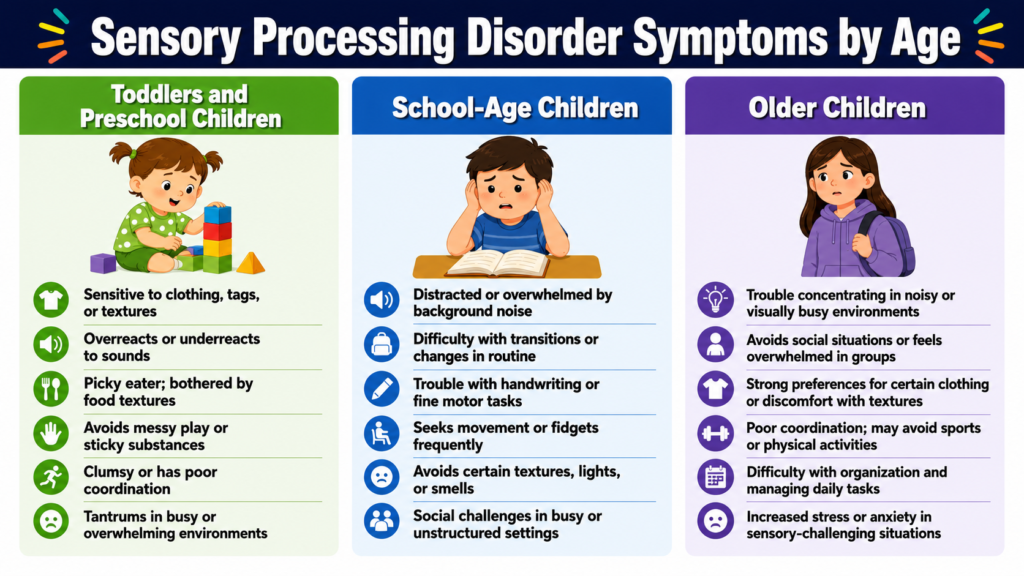
Sensory Processing Disorder Symptoms by Age
Sensory processing differences often become more visible as children grow because expectations change across stages of development. The same underlying challenge may appear very differently depending on age.
Toddlers and Preschool Children
Early signs often appear during routines and transitions. Parents may notice feeding difficulties, resistance to being held, sleep disruption, strong reactions during grooming, avoidance of messy play, distress around textures, or difficulty calming after stimulation.
Because these behaviors overlap with normal developmental variation, sensory difficulties at this stage are often mistaken for temperament or strong preferences.
School-Age Children
As school demands increase, sensory challenges often become easier to recognize.
Children may become overwhelmed in noisy classrooms, struggle with transitions, avoid group participation, show emotional exhaustion after school, fidget constantly, or experience challenges with attention and fine motor skills.
Many parents describe this period as “doing fine at school but melting down once they get home.”
Support at this stage often becomes more practical and environment-focused. Small accommodations can sometimes make a meaningful difference, such as allowing access to noise-reducing headphones during independent work, using fidget tools for regulation, offering movement breaks between tasks, creating a quieter workspace, or giving children a designated break card they can use when sensory overload begins building.
Older Children
Older children may become more aware of their own sensory experiences but still find them difficult to manage.
Sensory differences may appear as anxiety in stimulating environments, emotional fatigue, activity avoidance, challenges with self-regulation, or difficulty recognizing internal body signals.
What Causes Sensory Processing Disorder?
Families often ask whether sensory processing difficulties develop because of parenting choices, environment, or something they missed earlier.
Current understanding suggests the causes of Sensory Processing Disorder are more complex than a single environmental or parenting factor. Researchers continue studying how the nervous system receives and organizes sensory information, and current evidence points toward a combination of developmental, neurological, and biological influences.
Factors that may contribute include:
- Neurodevelopmental differences
- Genetic influences
- Premature birth history
- Developmental challenges
- Differences in sensory integration pathways
For many children, there is not one single identifiable explanation.
Sensory Processing Disorder and Autism: Understanding the Connection
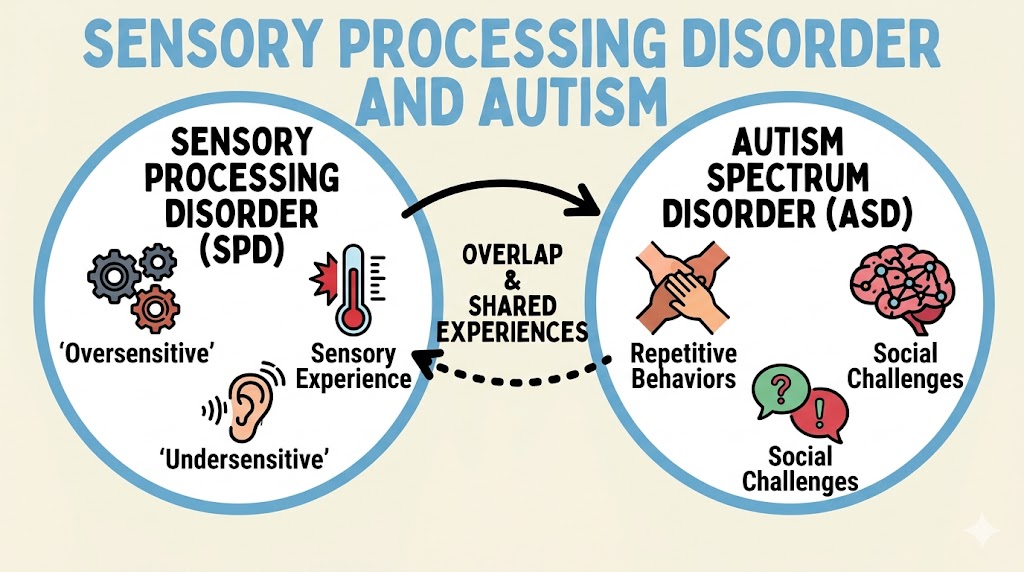
Sensory processing challenges are frequently discussed alongside autism, but they are not the same condition.
Many autistic children experience sensory sensitivities, yet children can also experience sensory processing challenges independently. Sensory differences may additionally appear alongside ADHD, developmental delays, learning differences, and anxiety.
This overlap is one reason assessment matters. Looking at a child’s complete developmental picture often provides more useful answers than focusing on one behavior or one label alone.
How Sensory Processing Disorder Diagnosis Works
One of the most common concerns parents have is understanding what actually happens during an evaluation.
Assessment often begins when a pediatrician, developmental specialist, teacher, or occupational therapist notices patterns affecting daily participation. Rather than relying on a single test, professionals usually build a broader picture of how the child experiences sensory information across environments.
The process may include parent interviews, structured sensory questionnaires, direct observation through movement and play, and evaluation of participation in areas such as learning, self-care, emotional regulation, motor development, and social interaction.
The goal of assessment is not simply assigning a label—it is understanding how a child experiences and responds to sensory information so support can be tailored appropriately.
It is also important for families to know that SPD is widely used in clinical and therapy settings but is not currently recognized as a standalone diagnosis in formal diagnostic manuals. Even so, identifying sensory processing patterns can play an important role in guiding meaningful support and improving daily participation.
Sensory Processing Disorder Treatment and Therapy
There is no universal approach that works for every child because sensory profiles differ significantly.
Support is usually most effective when therapy strategies extend beyond appointments and into everyday routines. Depending on the child’s needs, intervention may combine occupational therapy, sensory integration approaches, parent coaching, school collaboration, and practical home-based strategies.
The most common therapy approach families hear about is sensory integration support delivered within occupational therapy, which is why understanding how that process works can be helpful.
The Role of Sensory Integration Therapy and Occupational Therapy
One of the most commonly used approaches for supporting sensory differences is sensory integration therapy, often delivered by an occupational therapist trained in sensory integration approaches.
Sessions are designed around purposeful movement, play, and structured sensory experiences that help children build more adaptive responses over time. Activities are selected intentionally—not randomly—to support regulation, body awareness, motor planning, and participation in everyday tasks.
Support may focus on areas such as balance, coordination, vestibular processing, proprioceptive input, fine motor skills, emotional regulation, and self-regulation skills.
The goal is not forcing children to tolerate uncomfortable sensations. The goal is helping them engage more successfully in daily life.
Understanding the Sensory Diet Approach
Parents often hear therapists mention a sensory diet, and the term can sound confusing at first.
A sensory diet is not related to food. It refers to a personalized schedule of sensory activities integrated throughout the day to help children maintain regulation and participation.
Depending on a child’s needs, this may include movement breaks, deep pressure activities, quiet sensory spaces, jumping opportunities, structured transitions, sensory seating options, weighted lap support when professionally recommended, or short planned breaks throughout the day.
The goal is proactive support—helping children stay regulated before sensory overload builds.
Sensory Processing Disorder Activities Families Can Try at Home
Therapy works best when sensory support becomes part of everyday life rather than something that only happens in sessions.
Simple activities may include obstacle courses, animal walks, water play, playground climbing, texture exploration, yoga for children, and safe opportunities for carrying or pushing household items.
The most effective activities are not necessarily the most creative—they are the ones that match the child’s individual sensory profile and fit naturally into family routines.
Why Context and Early Support Matter
Sensory challenges do not happen in isolation—they appear in real environments.
For many Gurgaon families, sensory differences become more noticeable during school assemblies, crowded markets, indoor play zones, festival seasons with bright lights and loud sounds, or transitions between outdoor heat and air-conditioned environments.
Without understanding what is driving these reactions, children may begin avoiding situations, becoming emotionally exhausted, or feeling misunderstood over time. Early support is not about changing personality—it is about reducing unnecessary barriers and helping children participate more comfortably in everyday experiences.
Can occupational therapy diagnose Sensory Processing Disorder?
Occupational therapists play an important role in identifying sensory patterns, evaluating how sensory challenges affect daily life, and building intervention plans. Sensory Processing Disorder itself is not currently a standalone diagnosis in formal diagnostic manuals, so evaluation focuses on understanding functional sensory differences rather than confirming a separate medical condition.
When to Consider Professional Guidance
If sensory challenges are affecting school participation, emotional regulation, daily routines, or family life, it may be helpful to speak with a pediatric occupational therapist or developmental professional.
At PediGym Child Development Center, children receive individualized support through evidence-based pediatric therapy programs designed around their developmental profile. Under the clinical guidance of Dr. Nitin Gupta (DMI Level C Certified Therapist), the team focuses on structured assessment, goal-oriented intervention, sensory integration support, and active parent involvement to help children participate more confidently in everyday life.
Early conversations do not commit families to therapy. They often provide clarity, practical strategies, and a better understanding of what support may—or may not—be helpful.
Final Thoughts
A child refusing socks may not be difficult. A child who constantly moves may not simply have extra energy. And a child who melts down after school may not be choosing that reaction.
Many behaviors that appear challenging on the surface can sometimes reflect differences in how children experience and respond to the world around them. When families understand these patterns earlier, everyday life becomes less about managing reactions and more about creating environments where children feel understood, regulated, and confident.

Dr. Nitin, Founder of PediGym Child Development Center, is a dedicated pediatric therapy expert and DMI Level C Certified Therapist leading structured, evidence-based therapy programs in Faridabad and Gurgaon. Under his guidance, PediGym provides comprehensive pediatric rehabilitation focused on improving motor skills, coordination, sensory processing, speech clarity, and functional independence through personalized intervention plans.