
Research suggests that only 1 in 4 children with developmental delays receive early intervention before age 3—often because parents don’t recognise the early signs.
Every parent has wondered at some point:
“Is my child developing normally?” Maybe your baby isn’t crawling yet, your toddler isn’t talking as much as other children, or your preschooler seems to struggle with certain activities. These concerns are common, and it’s natural to have questions about your child’s growth and development.
Understanding child development milestones can help you track your child’s progress, recognise potential concerns early, and provide the right support when needed. While every child develops at their own pace, knowing what skills typically emerge at different ages can make parenting a little less overwhelming.
What Are Child Development Milestones?
certain age range. They serve as guideposts that help parents, pediatricians, educators, and child Therapy development professionals monitor a child’s growth and developmental progress.
These milestones generally fall into four key developmental domains.
Physical Development
Physical development includes both gross motor skills milestones and fine motor skills development. Gross motor skills involve larger body movements such as rolling, crawling, walking, running, climbing, and jumping. Fine motor skills involve smaller movements that require hand and finger control, such as grasping toys, stacking blocks, drawing, and using utensils.
Cognitive Development
Cognitive development milestones refer to how children learn, think, solve problems, remember information, and understand the world around them. These skills form the foundation for future learning and academic success.
Language Development
Language development milestones include understanding language, following directions, communicating needs, building vocabulary, and developing speech.
Social and Emotional Development
Social and emotional development in children involves learning how to interact with others, manage emotions, build relationships, develop empathy, and understand social expectations.
Understanding the 75% Milestone Standard
One important fact many parents don’t realize is that developmental milestones are not based on what the “average” child can do.
According to Centers for Disease Control and Prevention (CDC) Learn the Signs. Act Early. programme, developmental milestone checklists are designed around skills that approximately 75% of children can achieve by a specific age. This approach helps identify developmental concerns earlier and more consistently.
Missing one milestone does not automatically mean a child has a developmental delay. Children develop at different rates. However, consistently missing multiple milestones across physical, cognitive, language, or social-emotional domains may indicate the need for further evaluation and support.
Child Development Milestone Table
Age | Physical Development | Cognitive Development | Language Development | Social & Emotional Development |
0–3 Months | Lifts head briefly | Tracks faces and objects | Coos and responds to sounds | Smiles at caregivers |
4–6 Months | Rolls over, reaches for toys | Explores objects | Laughs and babbles | Enjoys social interaction |
7–12 Months | Crawls, pulls to stand | Understands object permanence | Responds to name | Shows attachment to caregivers |
12–18 Months | Walks independently | Imitates actions and simple cause-and-effect | Uses simple words and follows directions | Shows affection and independence |
18–24 Months | Runs and climbs | Engages in pretend play | Combines two words | Expresses emotions clearly |
2–3 Years | Jumps and climbs | Completes simple puzzles | Speaks in short sentences | Plays alongside peers |
3–4 Years | Hops and pedals a tricycle | Recognises colours and shapes | Tells simple stories | Develops friendships |
4–5 Years | Skips and dresses independently | Counts objects and begins recognising familiar letters | Speaks clearly and follows multi-step directions | Cooperates in group activities |
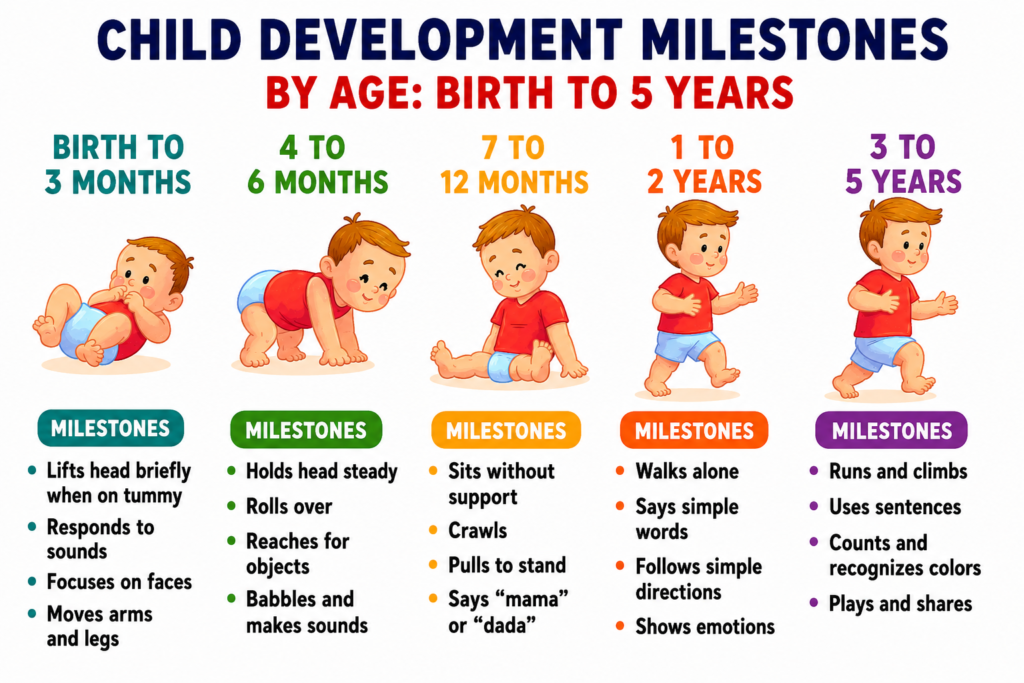
Birth to 3 Months: Newborn Development Milestones
The first three months of life represent one of the most rapid periods of brain development a child will ever experience. Although newborns appear small and dependent, they are constantly learning from every interaction, sound, touch, and movement around them.
During this stage, babies begin developing greater control of their bodies. Most newborns can briefly lift their heads during tummy time, move their arms and legs actively, and respond to sounds or voices. They start focusing on faces and tracking moving objects with their eyes.
Communication begins long before speech. Babies communicate through crying, facial expressions, and eventually cooing sounds. Around six to eight weeks, many parents witness one of the most memorable milestones of infancy—the first social smile.
Emotionally, babies become increasingly responsive to familiar caregivers. They often calm when held, soothed, or spoken to by familiar voices.
How Parents Can Support Development
The best way to support development during this stage is through simple daily interactions. Tummy time helps build the muscles needed for future movement milestones, while talking, singing, and reading expose babies to language long before they can understand words.
Face-to-face interactions are equally important. When parents respond consistently to their baby’s sounds, movements, and expressions, they help build the foundation for communication and emotional security.
🚩 Red Flags at 2 Months
Consider discussing development with your pediatrician if your baby:
- Does not respond to loud sounds.
- Rarely makes eye contact.
- Does not watch moving objects.
- Shows very limited movement.
- Does not bring hands toward the mouth.
What to do next: If you notice any of these signs, contact your child’s pediatrician and request a developmental screening.
4 to 6 Months: Rolling, Reaching, and Discovering
Between four and six months, babies become far more interactive and curious about the world around them. Their growing strength and coordination allow them to actively explore their environment rather than simply react to it.
Many babies begin rolling over during this stage, first from tummy to back and eventually from back to tummy. They gain better control of their head and neck, reach for toys intentionally, and bring objects to their mouths as a way of exploring textures and sensations.
Cognitive development becomes more visible as babies begin recognizing familiar faces, showing curiosity about new environments, and responding differently to people they know versus strangers.
Language development also accelerates. Babbling, laughing, squealing, and responding to voices become common. Parents often notice that their baby is beginning to engage in simple “conversations” through sounds and expressions.
How Parents Can Support Development
Encourage floor play, offer safe sensory toys, and create opportunities for reaching and grasping. Reading picture books and describing everyday activities can also help support early communication skills.
🚩 Red Flags at 4–6 Months
Speak with a healthcare professional if your baby:
- Does not reach for objects.
- Does not make sounds.
- Appears unusually stiff or floppy.
- Shows little interest in people.
- Does not smile or engage socially.
What to do next: Contact your pediatrician and ask whether a developmental screening is appropriate.
7 to 12 Months: Mobility and Communication Take Off
The second half of the first year is often filled with exciting firsts. Babies become increasingly mobile, curious, and communicative.
Most children learn to sit independently, crawl, pull themselves to standing positions, and cruise along furniture. Some may even take their first independent steps before their first birthday.
Crawling is particularly important because it helps develop balance, coordination, body awareness, and the ability to use both sides of the body together. While some children move directly to walking, crawling provides valuable opportunities for motor learning.
Cognitively, babies begin understanding object permanence—the realization that people and objects continue to exist even when they cannot be seen. They imitate actions, explore cause and effect, and become more interested in problem-solving.
Communication also becomes more intentional. Babies respond to their names, understand simple words such as “no” or “bye-bye,” and often say their first meaningful words.
How Parents Can Support Development
Interactive games such as peek-a-boo, singing songs with gestures, reading books, and encouraging movement across safe spaces can help strengthen multiple developmental domains simultaneously.
🚩 Red Flags at 9–12 Months
Talk to your pediatrician if your child:
- Does not babble.
- Does not respond to their name.
- Does not point, wave, or gesture.
- Shows limited interest in interaction.
- Is not bearing weight through their legs.
What to do next: Request a developmental screening if any of these concerns are present.
12 to 18 Months: First Steps and Growing Independence
Few stages of development bring as much excitement as the transition from infancy to toddlerhood. Children become increasingly independent as they learn to move, communicate, and explore their surroundings with confidence.
Most toddlers begin walking independently during this period. They learn to squat, climb, carry objects, and navigate different environments.
Language skills begin expanding rapidly. Many children use several meaningful words and understand far more language than they can express. Pointing, gesturing, and following simple directions become common.
Socially, toddlers begin showing affection, engaging in simple pretend play, and seeking greater independence while still relying heavily on caregivers for comfort and security.
🚩 Red Flags at 15 Months
Consult a professional if your child:
- Is not walking independently.
- Has no meaningful words.
- Does not point to objects of interest.
- Rarely imitates actions or sounds.
What to do next: Contact your pediatrician and request a developmental evaluation.
18 to 24 Months: The Language Explosion
Between eighteen and twenty-four months, many toddlers experience dramatic growth in communication skills. Vocabulary expands quickly, and children begin combining words into simple phrases.
At the same time, physical skills continue to improve. Toddlers run, climb, kick balls, and become increasingly confident in their movements.
Pretend play becomes more sophisticated, reflecting important advances in cognitive development. Children may feed dolls, imitate household activities, or create simple imaginative scenarios.
Socially, toddlers often display strong emotions and a growing desire for independence. While this stage can be challenging for parents, it reflects healthy emotional development.
Additional Sensory Concerns to Watch For
Parents should also discuss concerns with a professional if their child:
- Becomes extremely distressed by common sounds.
- Avoids certain textures, foods, or clothing materials.
- Seeks excessive spinning, crashing, or movement.
- Appears unusually sensitive to touch, light, or noise.
🚩 Red Flags at 18–24 Months
Seek professional guidance if your child:
- Is not walking independently.
- Has very limited vocabulary.
- Is not combining two words by age two.
- Shows no interest in pretend play.
- Loses previously acquired skills.
What to do next: Request a developmental screening and discuss concerns with your pediatrician.
2 to 3 Years: Toddler Development Milestones
Toddlerhood is often described as the age of discovery. Between ages two and three, children become increasingly curious, independent, and eager to understand how the world works.
Physically, children run more confidently, jump with both feet, climb playground equipment, and improve their balance and coordination. Fine motor skills also advance as they learn to stack blocks, turn book pages, and draw simple shapes.
Language development accelerates dramatically during this stage. Many children begin speaking in short sentences, asking questions, and engaging in simple conversations.
Socially, they start interacting more with peers and learning important skills such as sharing, taking turns, and following basic rules.
🚩 Red Flags at 2–3 Years
Consider professional support if your child:
- Uses fewer than 50 words.
- Is not combining words.
- Shows little interest in other children.
- Does not engage in pretend play.
- Struggles to follow simple instructions.
What to do next: Discuss developmental concerns with your pediatrician and ask about early intervention services.
3 to 4 Years: Preschool Child Development
Between three and four years, children become more coordinated, imaginative, and socially engaged. This stage lays the groundwork for school readiness and independent learning.
Physically, many children can hop on one foot, pedal a tricycle, catch a large ball, and use child-safe scissors. Fine motor control improves significantly, allowing them to draw simple shapes and complete basic puzzles.
Cognitively, preschoolers begin counting, recognizing colors and shapes, understanding concepts such as “same” and “different,” and engaging in increasingly imaginative play.
Language skills become more advanced as children speak in longer sentences, ask detailed questions, and tell simple stories.
Socially, they begin developing friendships, learning to cooperate, and understanding the importance of sharing and taking turns.
🚩 Red Flags at 3–4 Years
Talk to your healthcare provider if your child:
- Has difficulty speaking clearly.
- Shows limited interest in interacting with peers.
- Struggles significantly with simple play activities.
- Cannot follow basic directions.
What to do next: Request a developmental evaluation and discuss concerns with your child’s healthcare provider.
4 to 5 Years: School Readiness Milestones
The years leading up to school are marked by tremendous growth in independence, communication, and problem-solving.
Children between four and five years typically demonstrate better balance, coordination, and fine motor control. Many can skip, balance on one foot, dress independently, and draw recognizable people with multiple body parts.
Cognitively, they begin recognizing letters, numbers, colors, and shapes more consistently. They can follow multi-step instructions, solve simple problems, and understand basic sequencing concepts.
Language becomes more sophisticated as children tell detailed stories, express complex ideas, and participate in longer conversations.
Socially and emotionally, children become better at managing emotions, working cooperatively in groups, and building meaningful friendships.
🚩 Red Flags at 4–5 Years
Consult your healthcare provider if your child:
- Is difficult for unfamiliar adults to understand.
- Has significant difficulty following instructions.
- Avoids social interaction.
- Shows little interest in imaginative play.
What to do next: Contact your pediatrician and request a developmental assessment.
When Should Parents Seek a Developmental Evaluation?
Development rarely follows a perfectly predictable timeline. Missing one milestone is not usually cause for concern. However, a pattern of missed milestones, developmental regression, or significant differences across multiple areas deserves attention.
Parents should consider seeking an evaluation if their child:
- Loses previously learned skills.
- Misses several milestones across developmental domains.
- Has significant speech delays.
- Shows persistent movement or coordination difficulties.
- Demonstrates limited social engagement.
- Does not respond to their name consistently.
Trust your instincts. Parents are often the first to notice when something feels different. The American Academy of Pediatrics (AAP) recommends ongoing developmental surveillance and screening during routine healthcare visits to help identify concerns as early as possible.
Understanding Early Intervention
According to the World Health Organization (WHO), the first five years of life are critical for brain development, making early identification and intervention especially important for children experiencing developmental challenges. These services may include speech therapy, occupational therapy, physical therapy, developmental therapy, and sensory integration support.
Research consistently shows that earlier intervention leads to better outcomes because young children’s brains are highly adaptable. Early support can help build skills before developmental challenges become larger obstacles.
How PediGym Can Help
If you’re concerned about your child’s development, seeking guidance early can make a meaningful difference.
At PediGym, we support children experiencing:
- Gross motor delays
- Fine motor challenges
- Sensory processing difficulties
- Balance and coordination concerns
- School readiness challenges
- Developmental delays
- Early intervention needs
Our team works closely with families to identify strengths, understand challenges, and create individualized developmental support plans that help children thrive.
Frequently Asked Questions
When should my baby say their first word?
Most children say their first meaningful word between 10 and 14 months. By 18 months, many children use at least 10 to 20 words, and by age two, most begin combining words into simple phrases. If your child has very few words by 18 months or is not combining words by age two, it is worth discussing with your pediatrician.
Is it normal for a child to skip crawling?
Some children move directly from sitting to standing and walking without traditional crawling. While this can be perfectly normal, crawling helps develop core strength, bilateral coordination, balance, and body awareness. If your child skipped crawling entirely and shows other motor concerns, mention it during a developmental evaluation.
What should I do if my toddler stops using words they previously knew?
Loss of previously acquired skills, often called developmental regression, should always be taken seriously. Whether the lost skill involves language, movement, or social interaction, it is important to discuss the change with a healthcare professional as soon as possible.
How are developmental milestones determined?
Developmental milestones are based on large-scale child development research and population data. Current milestone frameworks are designed around skills that most children can achieve by a particular age, helping professionals identify concerns earlier and more consistently.
What is the difference between a developmental delay and a developmental disorder?
A developmental delay means a child is progressing in a skill area but more slowly than expected. A developmental disorder involves a different pattern of development that may affect learning, communication, movement, or behavior. Both situations can benefit from early assessment and appropriate support.
References
- Centers for Disease Control and Prevention (CDC) – Learn the Signs. Act Early.
- American Academy of Pediatrics (AAP) – Developmental Surveillance and Screening Guidelines.
- World Health Organization (WHO) – Early Childhood Development Framework.
- National Institute of Child Health and Human Development (NICHD) – Child Development Resources.
Final Thoughts
Understanding child development milestones by age helps parents navigate the early years with greater confidence. While every child develops differently, knowing what skills typically emerge during each stage can help you celebrate progress, recognize potential concerns, and provide meaningful support along the way.
Most importantly, remember that milestones are not a report card. They are simply tools that help families and professionals work together to support healthy child development and ensure every child has the opportunity to reach their full potential.

Dr. Nitin, Founder of PediGym Child Development Center, is a dedicated pediatric therapy expert and DMI Level C Certified Therapist leading structured, evidence-based therapy programs in Faridabad and Gurgaon. Under his guidance, PediGym provides comprehensive pediatric rehabilitation focused on improving motor skills, coordination, sensory processing, speech clarity, and functional independence through personalized intervention plans.