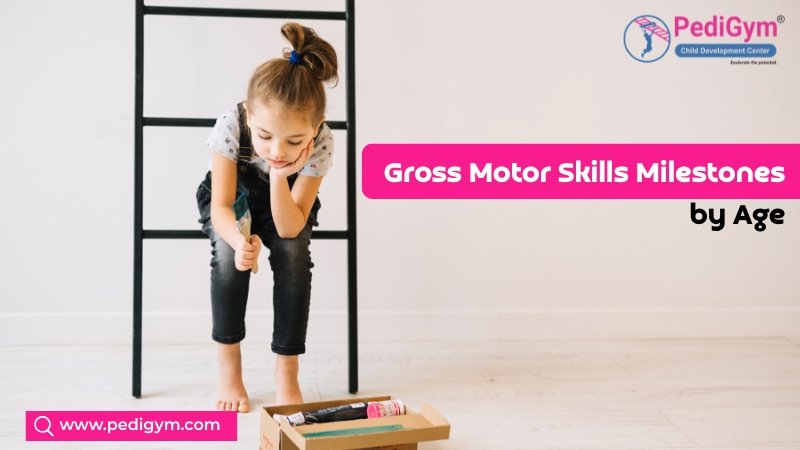
Gross motor skills are movements that involve the large muscles of the body, including the arms, legs, back, and core. These skills help children perform everyday activities such as sitting, crawling, walking, running, jumping, balancing, and climbing.
The development of gross motor skills follows a predictable pattern from infancy through childhood. While every child develops at their own pace, understanding gross motor skills milestones by age can help parents monitor healthy growth and identify potential developmental concerns early.
What Are Gross Motor Skills?
Gross motor skills involve movements that use the large muscles of the body, particularly the arms, legs, and core.
Examples include:
- Rolling over
- Sitting independently
- Crawling
- Standing and walking
- Running and jumping
- Climbing
These skills support mobility, exploration, and participation in daily activities.
Gross Motor Development Chart (Age-Wise Table)
Age | Developmental Milestones | Possible Implications if Not Achieved |
0–6 Months | • Rolls front to back and back to front<br>• Moves into sitting with support, and later independently | • Poor muscle development for locomotion<br>• Delayed independent play skills |
6–12 Months | • Crawls on belly, then hands and knees<br>• Sits independently and transitions between positions<br>• Pulls to stand<br>• Cruises along furniture<br>• May take 2–3 steps<br>• Rolls a ball in imitation | • Delayed sensory exploration of the environment<br>• Poor muscle development<br>• Delayed play and movement skills |
18 Months | • Sits, crawls, and walks<br>• Walking/running still clumsy with a wide gait<br>• Pushes a ball forward | • Delayed play skills<br>• Difficulty exploring the environment<br>• Poor muscle strength and coordination |
2 Years | • Walks smoothly and turns corners<br>• Begins running<br>• Pushes or carries toys while walking<br>• Climbs furniture independently<br>• Walks stairs with support<br>• Picks objects up from the floor easily | • Poor running and jumping development<br>• Delayed independent play<br>• Reduced social interaction opportunities |
3 Years | • Imitates standing on one foot<br>• Performs simple coordinated limb movements<br>• Climbs jungle gyms and ladders<br>• Pedals a tricycle<br>• Walks stairs alternating feet<br>• Jumps with both feet<br>• Walks on tiptoes<br>• Catches with the body | • Reduced confidence in active play<br>• Limited social participation<br>• Difficulty with playground activities<br>• Poor body awareness and movement planning |
4 Years | • Balances on one foot up to 5 seconds<br>• Kicks and throws a ball overarm<br>• Catches a bounced ball<br>• Runs around obstacles<br>• Walks on a line<br>• Hops on one foot<br>• Jumps over objects, landing on both feet | • Low confidence in movement activities<br>• Difficulty using playground equipment<br>• Reduced participation in peer group play |
5 Years | • Walks upstairs while holding an object<br>• Walks backward, toe-heel<br>• Jumps forward multiple times<br>• Skips after demonstration<br>• Hangs from a bar for 5+ seconds<br>• Throws a ball with correct coordination<br>• Catches a small ball with both hands | • Reduced self-esteem compared to peers<br>• Lack of confidence in sports<br>• Difficulty with cycling and active play |
6 Years | • Runs lightly on toes<br>• Walks a balance beam<br>• Skips with a rope<br>• Hops up to 2 meters<br>• Shows mature throwing and catching patterns<br>• Refined jumping skills | • Difficulty participating in sports<br>• Low confidence in physical activities<br>• Reduced coordination in group games |
Note: When you paste this into WordPress, use the block editor’s bullet-list option inside each table cell rather than relying on the • characters above – they’ll render more reliably across themes.
Why Gross Motor Development Is Important
Gross motor development supports:
- Physical strength, coordination, and improved movement skills
- Better balance, posture, and body awareness
- Greater independence in daily activities and movement
- Enhanced participation in play, school, and learning activities
- Overall physical development, confidence, and social engagement
- Progress toward age-appropriate developmental milestones
- Improved motor planning and functional mobility for everyday tasks
Factors That May Influence Development
Gross motor development can vary based on:
- Individual growth patterns – every child’s nervous system and muscle development matures on its own timeline, so a few months’ variation from the chart above is normal.
- Muscle strength and tone – children with lower muscle tone may take longer to build the stability needed for milestones like independent sitting or walking.
- Physical activity levels – kids who get more floor time, outdoor play, and hands-on movement generally practice (and refine) gross motor skills faster than those with limited activity.
- Health and nutrition – adequate nutrition and overall health support the energy and muscle development movement requires; frequent illness can temporarily slow progress.
- Early movement experiences – exposure to varied surfaces, spaces, and play opportunities early on gives children more chances to practice and build coordination.
Some variation in timing is generally normal and expected.
Signs of Gross Motor Delay
It may be appropriate to consult a healthcare professional if a child:
- Has poor head control after 4 months
- Cannot sit without support by around 9 months
- Is not walking by 15 – 18 months
- Shows persistent imbalance or weakness
- Uses one side of the body more than the other
- Loses previously acquired motor skills
Early evaluation can help identify whether additional support is needed – and the sooner concerns are addressed, the more effective early intervention tends to be.
Noticed a few of these signs in your child? Our pediatric therapy team offers a free consultation to assess your child’s gross motor development and recommend next steps if needed. Book a Free Consultation →
How Parents Can Support Gross Motor Development
Parents and caregivers can support gross motor development through:
- Supervised tummy time for infants – even a few minutes several times a day helps build the neck, shoulder, and core strength babies need for later milestones like sitting and crawling.
- Encouraging crawling and floor play – unstructured floor time gives infants and toddlers room to experiment with movement at their own pace.
- Providing safe walking practice areas – clear, cushioned spaces free of tripping hazards let new walkers practice without fear of injury.
- Outdoor play and running activities – open spaces encourage the bigger, faster movements that are harder to practice indoors.
- Ball games, climbing, and balance activities – these build the coordination and body awareness that more advanced gross motor skills depend on.
Frequently Asked Questions
When should a baby start rolling over?
Most babies begin rolling from front to back around 4 months, and back to front by around 6 months. If a baby isn’t rolling in either direction by 6 months, it’s worth a pediatric evaluation – a therapist can check muscle tone, symmetry, and core strength to rule out an underlying delay.
Is it normal for a 2-year-old to not run yet?
Most 2-year-olds are running, even if a bit unsteadily. If a child is walking well but shows no interest in or ability to run by 2.5 years, a gross motor assessment can help determine whether it’s simply pace variation or a coordination issue worth addressing early.
When should a child start walking independently?
Most children take their first independent steps between 12 and 15 months, with up to 18 months generally considered within the normal range. Walking after 18 months is one of the clearest signals for a formal pediatric physical therapy evaluation.
What’s the difference between gross motor and fine motor skills?
Gross motor skills use the large muscles (arms, legs, core) for whole-body movements like crawling, walking, and jumping. Fine motor skills use the smaller muscles in the hands and fingers for tasks like grasping, drawing, and buttoning. Both develop side by side, and a delay in one area often shows up alongside the other – which is why a full developmental evaluation covers both.
What should I do if my child seems behind on gross motor milestones?
Start with a pediatric evaluation rather than waiting to “see if they catch up.” At PediGym, our therapists assess gross motor development and, where needed, build a personalized intervention plan – which may include approaches like Dynamic Movement Intervention (DMI) for more significant delays, or targeted play-based therapy for milder ones. Early evaluation doesn’t mean something is wrong; it simply gives you clarity and, if support is needed, the earliest possible start.
Conclusion
Development of gross motor skills during childhood unfolds in a progression – from early rolling and sitting, through crawling and walking, to the coordinated running, jumping, and balancing that eventually blends with fine motor skills for more complex physical tasks. Every child progresses at their own rate, and minor variances from the standard timeline are normal and expected. What matters most is steady, forward progress. If a child appears to be falling noticeably behind or losing skills they’d previously mastered, an early conversation with a pediatrician or pediatric therapist is the best next step.
References: American Academy of Pediatrics (HealthyChildren.org). Motor Skill Milestones in Children
Medical Disclaimer
This article is for educational and informational purposes only and is not intended to replace professional medical advice, diagnosis, or treatment. Gross motor development varies from child to child. If you have concerns about a child’s development, please consult a qualified pediatrician or healthcare professional for proper evaluation and guidance.
Also Read: https://pedigym.com/gross-motor-skills-activities/

Dr. Nitin, Founder of PediGym Child Development Center, is a dedicated pediatric therapy expert and DMI Level C Certified Therapist leading structured, evidence-based therapy programs in Faridabad and Gurgaon. Under his guidance, PediGym provides comprehensive pediatric rehabilitation focused on improving motor skills, coordination, sensory processing, speech clarity, and functional independence through personalized intervention plans.