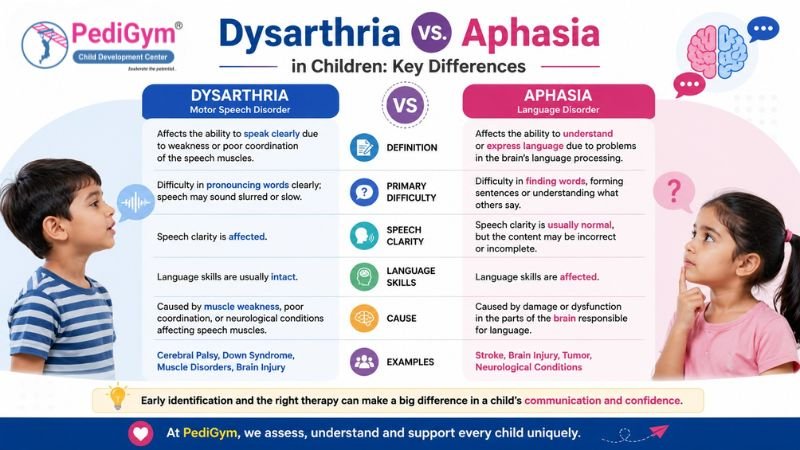
Dysarthria affects how a child speaks because the speech muscles are weak or difficult to control, while aphasia affects the brain’s ability to understand or use language.
If your child is having trouble communicating, understanding this difference is the first step toward getting the right evaluation and support. Although both conditions affect communication, they have different causes, symptoms, and therapy approaches. The quick comparison below will help you understand how they differ and when it’s time to seek professional help.
At a Glance
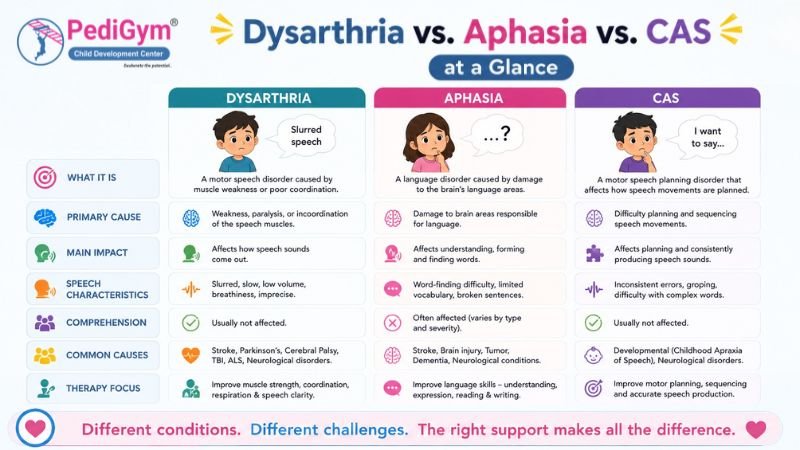
The key difference is simple: Dysarthria affects speech muscles, aphasia affects language processing, and Childhood Apraxia of Speech (CAS) affects speech motor planning.
- Dysarthria: Affects the muscles used for speaking, making speech sound slurred, slow, or difficult to understand.
- Aphasia: Affects the brain’s ability to understand, process, or express language.
- Childhood Apraxia of Speech (CAS): Affects the brain’s ability to plan and sequence speech movements, even though the speech muscles are not weak.
Because these conditions can have similar signs, a comprehensive speech and language assessment is the most reliable way to identify the underlying cause and choose the right therapy approach.
Dysarthria vs. Aphasia: Understanding the Difference
Although these conditions are sometimes used interchangeably, they affect completely different parts of communication.
Feature | Dysarthria | Aphasia |
Primary challenge | Producing clear speech | Understanding or using language |
What is affected? | Speech muscles | Language centers of the brain |
Child’s thoughts | Usually intact—the child knows what they want to say | May have difficulty understanding, organizing, or expressing thoughts through language |
Speech clarity | Often slurred, slow, or difficult to understand | Speech may sound clear, but the words or sentences may not make sense |
Understanding others | Usually not affected | May be affected depending on the type of aphasia |
Reading and writing | Usually unaffected | May also be affected |
Main therapy | Language therapy |
The most important difference is this:
- Dysarthria affects speech production.
- Aphasia affects language processing.
While both can make communication difficult, identifying the correct condition ensures your child receives the most appropriate therapy.
What Is Dysarthria in Children?
Dysarthria in children is a neurological condition that affects the muscles responsible for speaking. The child usually understands conversations and knows exactly what they want to say, but weakness or poor coordination of the lips, tongue, jaw, or breathing muscles makes speech difficult to produce clearly.
Because the challenge is physical rather than cognitive, children with childhood dysarthria often become frustrated when others cannot understand them, even though they know the correct words.
Dysarthria symptoms in children
Signs may include:
- Slurred or unclear speech
- Slow, fast, or uneven speaking rate
- Weak, breathy, or monotone voice
- Difficulty controlling volume
- Limited movement of the lips or tongue while speaking
- Speech becoming less clear when tired
- Difficulty coordinating breathing and speaking
The severity varies from child to child. Some children experience only mild speech clarity problems, while others may require ongoing communication support.
Important for parents: Dysarthria affects speech, not intelligence. Most children with dysarthria understand what others are saying and know what they want to communicate. Their difficulty lies in producing clear speech—not in thinking or learning.
What Is Aphasia in Children?
Aphasia is much less common in children than in adults and most often occurs after conditions such as traumatic brain injury, pediatric stroke, or other neurological disorders affecting the brain’s language centers.
Children with aphasia may struggle to understand what others are saying, find the right words, form meaningful sentences, or communicate their ideas effectively.
Aphasia symptoms in children
A child with aphasia may:
- Have difficulty finding the right words
- Use incorrect or unrelated words during conversation
- Struggle to understand spoken language
- Have trouble following instructions
- Experience expressive language difficulties
- Find reading or writing challenging, depending on their age
It’s important to remember that aphasia does not look the same in every child. Some children may speak fluently but use words that don’t make sense, while others may understand language well but struggle to express themselves.
Types of Aphasia in Children
Although aphasia is less common in children than adults, it can present in different ways depending on which language areas of the brain are affected.
Expressive Aphasia
Children generally understand what others are saying but have difficulty expressing their own thoughts. They may know exactly what they want to say but struggle to find the right words or build complete sentences.
Receptive Aphasia
Children can often speak fluently, but they may not fully understand what others are saying. They may also be unaware that their own words are confusing or incorrect.
Global Aphasia
This is the most severe form, affecting both understanding and expressing language. Children with global aphasia usually need comprehensive language intervention and ongoing support.
Because each type affects communication differently, an accurate diagnosis is essential before beginning therapy.
Is It Dysarthria, Aphasia, or Childhood Apraxia of Speech?
Parents often hear several different terms when their child is having difficulty communicating. While these conditions may seem similar, they have different underlying causes.
Condition | What It Affects |
Dysarthria | Weak or poorly coordinated muscles used for speech |
Aphasia | The brain’s ability to understand and use language |
Childhood Apraxia of Speech (CAS) | The brain’s ability to plan and sequence speech movements, even though the muscles themselves are not weak |
For example:
Imagine your child wants to say, “I want my toy.”
- A child with dysarthria knows exactly what they want to say, but their speech may sound slurred or difficult to understand because their speech muscles are weak or poorly coordinated.
- A child with aphasia may speak clearly but struggle to choose the correct words or understand the conversation.
- A child with Childhood Apraxia of Speech knows what they want to say and has normal muscle strength, but the brain has difficulty planning the precise movements needed to produce the words consistently.
Although these conditions may appear similar at home, each requires a different therapy approach. A comprehensive assessment by a qualified professional is the best way to identify the underlying cause.
Beyond Communication: The Emotional Impact
Communication challenges affect much more than speech and language. Children who are difficult to understand may become frustrated when others repeatedly ask them to repeat themselves. Some may avoid speaking in class, participating in group activities, or interacting with friends because they worry about being misunderstood.
Over time, these experiences can affect confidence, social participation, and learning. Early support not only improves communication skills but also helps children build self-esteem and feel more comfortable expressing themselves in everyday situations.
What Causes Dysarthria and Aphasia?
Although both conditions involve the nervous system, they affect different parts of the communication process.
Causes of Dysarthria in Children
Dysarthria develops when the nerves or muscles responsible for speech movement are affected. Common causes include:
- Cerebral palsy
- Conditions affecting cranial nerve function
- Neuromuscular disorders
- Traumatic brain injury affecting motor control
- Certain genetic conditions
These conditions interfere with the muscles needed for clear speech but do not directly affect a child’s understanding of language.
Causes of Aphasia in Children
Aphasia occurs when the brain’s language centers are damaged or disrupted. Possible causes include:
- Traumatic brain injury involving language areas
- Pediatric stroke
- Brain tumors
- Brain surgery
- Damage affecting language centers such as Broca’s or Wernicke’s areas
Although pediatric stroke is uncommon, it can cause sudden loss of speech or language skills. If your child suddenly stops speaking or has difficulty understanding language, seek immediate medical care.
How Are Dysarthria and Aphasia Diagnosed?
Dysarthria and aphasia are diagnosed through a comprehensive speech and language assessment. This evaluation helps identify whether your child’s communication difficulty is caused by a problem with speech production, language processing, or another communication disorder.
Because these conditions can have similar signs, it’s important not to rely on speech alone. For example, one child may have unclear speech because of weak speech muscles, while another may speak clearly but struggle to understand or express language.
During the assessment, a speech-language pathologist (SLP) will evaluate several areas, including:
- Speech clarity and how easily others can understand your child
- Strength and coordination of the lips, tongue, and jaw
- Understanding of spoken language
- Vocabulary, sentence formation, and overall language skills
- Communication during play and everyday interactions
- Developmental milestones and medical history
If the assessment suggests an underlying neurological condition, your child may also be referred to a pediatric neurologist or another specialist for further evaluation.
At PediGym, every assessment is personalized because no two children communicate in the same way. Understanding the root cause of your child’s communication difficulty allows us to create a therapy plan that addresses their individual needs, rather than just treating the symptoms.
Can a Child Have Both Dysarthria and Aphasia?
Yes. Although they are different conditions, dysarthria and aphasia can occur together, especially after a traumatic brain injury, pediatric stroke, or other neurological conditions.
For example, a child may:
Have difficulty controlling the muscles needed for speech (dysarthria), while also struggling to understand or express language (aphasia).
This is why an accurate diagnosis is so important. Treating only one aspect of communication may not address all of the child’s needs.
How Speech Therapy Helps
Once the underlying condition is identified, therapy is tailored to the child’s individual strengths, challenges, and developmental stage.
For Children with Dysarthria
Speech therapy for children focuses on improving the physical aspects of speech, such as:
- Increasing speech clarity
- Improving breath support for speaking
- Strengthening coordination of the lips, tongue, and jaw
- Enhancing voice quality and speech rate
- Teaching strategies to make communication easier in daily life
For Children with Aphasia
Language therapy for children focuses on helping children understand and use language more effectively by working on:
- Vocabulary development
- Sentence formation
- Language comprehension
- Word retrieval skills
- Functional communication in everyday situations
- Reading and writing skills when appropriate
Therapy goals are always individualized because every child’s communication needs are different.
How Parents Can Support Communication at Home
Professional therapy is most effective when families are actively involved. Simple everyday strategies can make communication less stressful and encourage your child’s progress.
You can support your child by:
- Giving them enough time to finish speaking without rushing.
- Using short, simple sentences during conversations.
- Reducing background noise, such as television or mobile devices.
- Encouraging communication through play, books, and daily routines.
- Praising their efforts instead of correcting every mistake.
- Maintaining eye contact and listening patiently.
Small changes at home can reinforce the skills children learn during therapy and help build confidence in everyday communication.
Why Early Assessment Matters
Many parents hope their child will “grow out of” communication difficulties. While some speech concerns improve with development, others require early intervention to prevent challenges with learning, social interaction, and confidence.
At PediGym, we understand that no two children communicate in exactly the same way. That’s why our assessment goes beyond simply listening to how a child speaks.
Our team takes a comprehensive, child-centered approach by evaluating:
- Speech production and clarity
- Language understanding and expression
- Oral-motor skills
- Developmental milestones
- Functional communication during play and daily activities
- Parent observations and concerns
This detailed assessment helps identify the root cause of the communication difficulty, allowing therapy to target the underlying issue rather than just the symptoms.
Families are involved throughout the therapy process because children make the greatest progress when strategies used during therapy are also practiced at home.
When Should You Seek Professional Help?
You should seek a professional evaluation if your child’s speech or language difficulties persist, worsen, or affect everyday communication. Early assessment can identify the underlying cause and help your child receive the right support.
Consider consulting a speech-language pathologist if your child:
- Is difficult for others to understand.
- Has trouble understanding simple instructions.
- Struggles to express their thoughts or needs.
- Suddenly loses speech or language skills.
- Shows little improvement over time.
- Becomes frustrated or avoids communicating.
An early evaluation doesn’t always mean your child needs long-term therapy, but it can provide clarity and guide the next steps.
Frequently Asked Questions
Is dysarthria the same as a speech delay?
No. Dysarthria is a neurological speech disorder caused by weakness or poor coordination of the muscles used for speaking, whereas a speech delay means a child develops speech more slowly than expected. While both can affect communication, their causes and treatment approaches are different.
Can aphasia improve in children?
Yes. Many children with aphasia make meaningful progress with early intervention and individualized language therapy. Recovery depends on the underlying cause, the severity of the condition, and how consistently therapy and home support are provided.
Can a child have both dysarthria and Childhood Apraxia of Speech (CAS)?
Yes, although it is uncommon. Some children may show characteristics of more than one motor speech disorder. A comprehensive assessment by a speech-language pathologist helps determine the correct diagnosis and develop the most appropriate therapy plan.
Who diagnoses dysarthria and aphasia in children?
A speech-language pathologist (SLP) is typically the first professional to assess and diagnose these communication disorders. Depending on the child’s medical history and symptoms, the SLP may also work with pediatricians, neurologists, or other specialists to confirm the diagnosis and plan treatment.
Does dysarthria affect a child’s intelligence?
No. Dysarthria affects how clearly a child speaks, not their intelligence, thinking abilities, or capacity to learn. Many children with dysarthria understand language well and know what they want to say but need support to produce speech more clearly.
Final Thoughts
Communication difficulties can affect a child’s confidence, learning, and everyday interactions, but the right support begins with the right diagnosis.
Whether the challenge is dysarthria, aphasia, or another communication disorder, an early assessment helps identify the underlying cause and guides the most appropriate therapy plan.
At PediGym, we believe every child deserves individualized, evidence-based care that supports not only communication but also participation in everyday life. If you have concerns about your child’s speech or language development, seeking professional guidance early can make a meaningful difference.
Author & Medical Review
Reviewed by: Dr. Nitin Gupta
Founder, PediGym Child Development Center
DMI Level C Certified Therapist
This article has been clinically reviewed for accuracy and is intended for educational purposes. It should not replace an individualized evaluation by a qualified healthcare professional.

Dr. Nitin, Founder of PediGym Child Development Center, is a dedicated pediatric therapy expert and DMI Level C Certified Therapist leading structured, evidence-based therapy programs in Faridabad and Gurgaon. Under his guidance, PediGym provides comprehensive pediatric rehabilitation focused on improving motor skills, coordination, sensory processing, speech clarity, and functional independence through personalized intervention plans.