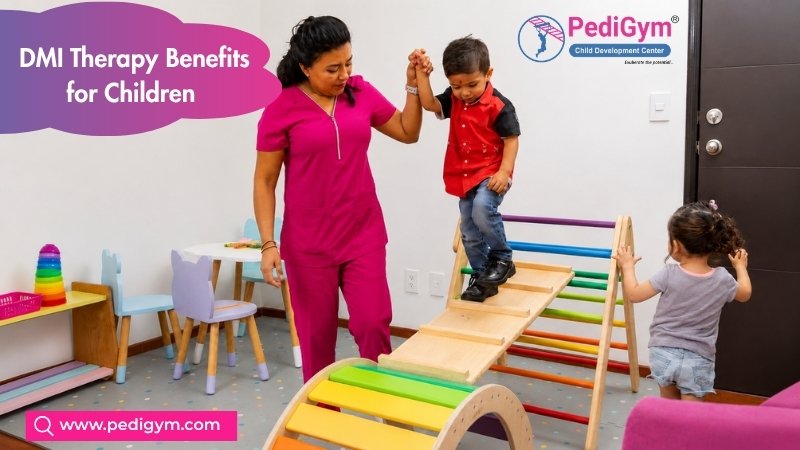
What is DMI therapy? Dynamic Movement Intervention (DMI) is a pediatric physiotherapy approach in which a therapist guides a child through active movement tasks. It focuses on head control, sitting, balance and walking in children with developmental delays, cerebral palsy, Down syndrome or low muscle tone. Research on its effectiveness is very limited, so it should not be considered an established treatment or a replacement for medical care.
Children develop movement skills at different rates. Some may need additional support to roll, sit, crawl, stand or walk. Early assessment can help identify their needs and guide suitable intervention. Parents may hear about DMI when searching for movement therapies.
At PediGym Child Development Center, children receive individualized therapy plans based on their abilities and developmental goals. Families can explore DMI therapy at PediGym in Faridabad and Gurugram and discuss available pediatric rehabilitation options with the therapy team.
What Is DMI Therapy? (DMI Meaning)
Dynamic Movement Intervention (DMI) is a pediatric therapy approach that uses therapist-guided movements and positioning to encourage children to develop active motor responses and improve functional movement skills. It focuses on developing head control, posture, balance, coordination and overall motor function.
DMI was introduced in 2021 by Jake Kreindler and Jo-Ann Weltman, according to WVU Medicine Children’s Hospital. It is related to Cuevas Medek Exercises (CME), another approach used in pediatric rehabilitation. A 2026 review further discusses the relationship between these two approaches.
How Does DMI Therapy Work?
DMI sessions are planned around a child’s current abilities and developmental goals. A therapist assesses the child’s posture, balance and movement, selects suitable guided activities, and adjusts the support according to the child’s responses. Families may also receive home activity recommendations.
For how sessions run at PediGym, see the DMI therapy page.
Who Is DMI Pediatric Therapy Offered To?
DMI is commonly offered to children with developmental delays or neurological conditions that affect movement and motor development.
Condition | Movement goals sometimes targeted |
Cerebral palsy | Posture, balance and motor control |
Down syndrome | Coordination and muscle activation |
Hypotonia (low muscle tone) | Strength and body stability |
Developmental delay | Practice of motor milestones |
Brain injury | Functional movement skills |
Genetic conditions | Postural control and coordination |
Premature birth | Support for motor development |
DMI is not suitable for every child. A pediatrician or qualified pediatric physiotherapist should assess the child’s needs before recommending this approach.
Potential Benefits of DMI Therapy
These are goals DMI sessions may target. They are not benefits proven by strong clinical research.
Movement goal | What DMI sessions target |
Head and neck control | Activating neck and upper-body muscles during guided positions |
Core stability | Abdominal and back muscle work for sitting and standing |
Balance and postural control | Controlled balance challenges while sitting, changing position or standing |
Walking preparation | Supported standing, weight shifting and stepping practice |
Muscle activation | Active muscle use during movement tasks |
Motor planning | Practicing transitions such as sitting to standing |
Daily participation | Movement skills for play and family routines |
Questions to Ask Before Starting DMI Therapy
Before starting DMI, parents can ask the therapist questions about their child’s movement goals, progress monitoring and available treatment options.
Question to ask the therapist | Why it matters |
What movement goals are appropriate for my child? | Helps clarify whether the activities match the child’s current abilities and developmental needs. |
How will my child’s progress be measured? | Helps parents understand how changes in movement and participation will be monitored. |
When will the therapy plan be reviewed? | Gives families a clear point to discuss progress and whether the plan needs adjustment. |
What other interventions have stronger research support? | Helps parents compare DMI with other available rehabilitation options. |
Could these sessions affect my child’s time for school, play or family activities? | Helps families consider how therapy fits into the child’s daily routine. |
How Much Does DMI Therapy Cost in India?
DMI therapy cost in India varies between centers and depends on the child’s individual treatment requirements. There is no single fixed fee for every child.
The overall cost may depend on:
- Initial assessment and consultation
- Therapist qualifications and experience
- Duration and frequency of sessions
- Individual therapy goals and complexity of needs
- Clinic location and available facilities
- Additional pediatric physiotherapy or rehabilitation services
PediGym offers a free initial consultation so parents can discuss their child’s needs and understand the available options.
Before starting, parents should ask the center:
- Is the fee charged per session or as a therapy package?
- How long does each session last?
- Is advance payment required?
- Are assessment charges included in the package?
- What happens if a session needs to be canceled or rescheduled?
These questions can help families understand the total expected cost before committing to a therapy plan.
How Many Sessions Are Needed?
The number of DMI therapy sessions varies from child to child. The therapist sets the frequency after assessment and reviews it regularly.
The therapist considers the child’s age, developmental level, medical condition, existing movement abilities and response to activities.
Parents should ask for written therapy goals and review dates to understand how progress will be monitored. There is no guaranteed timeline for achieving specific motor milestones.
Is DMI Therapy Safe for Children?
Safety depends on a thorough assessment and skilled supervision. Activities should be adjusted according to the child’s physical abilities and medical needs.
When DMI Therapy May Not Be Suitable
DMI may need to be postponed, modified or avoided when a child has:
- Uncontrolled seizures
- An acute illness or infection
- Severe pain or medical instability
- Restrictions on physical activity from a doctor
- Serious heart or lung conditions without medical clearance
Parents should share their child’s medical history with the therapist before starting. DMI should never replace prescribed medical treatment or other necessary rehabilitation services.
What Does Research Say About DMI Therapy?
Evidence for DMI therapy is very limited. A 2026 review published in Pediatric Physical Therapy concluded that almost no published empirical evidence supports DMI. The authors also questioned its theoretical foundation, arguing that it relies on older reflex-based models rather than contemporary motor learning principles .
The review also raised concerns about the financial costs families may face when choosing intensive interventions without established effectiveness.
Correspondence in the same journal includes a response from the review’s authors and colleagues to a separate letter. This shows the topic is being debated but does not establish DMI’s effectiveness.
Until stronger independent studies are available, DMI should be treated as an unproven therapeutic approach, not an established evidence-based treatment.
Parents can also explore other pediatric rehabilitation options, including Neurodevelopmental Therapy and the Early Intervention Program. The most suitable approach depends on the child’s individual assessment and needs.
Frequently Asked Questions About DMI Therapy
1. What does DMI mean in therapy?
DMI stands for Dynamic Movement Intervention. It is a pediatric physiotherapy approach that uses guided movement activities to encourage motor responses. It focuses on movement goals such as sitting, standing, balance and walking.
2. How much does DMI therapy cost in India?
The cost depends on the initial assessment, therapist’s qualifications, session frequency, treatment duration and clinic location. PediGym offers a free initial consultation to help parents discuss their child’s needs and available options.
3. How is DMI different from regular pediatric physiotherapy?
DMI follows a specific approach involving therapist-guided positioning and movement challenges to encourage active motor responses. Regular pediatric physiotherapy can include strengthening, balance activities, functional task practice and mobility training.
The main difference is the treatment approach and activities used. DMI also has less established research support than several conventional rehabilitation approaches. A therapist should recommend interventions based on the child’s needs and available evidence.
4. At what age can a child start DMI therapy?
There is no single starting age that applies to every child. Suitability depends on developmental needs, physical abilities and medical history. A qualified pediatric therapist should assess the child before recommending therapy.
5. How long before results show with DMI therapy?
The time needed to notice changes varies between children. It depends on the child’s condition, starting abilities, therapy frequency and individual response. No specific result or timeline can be guaranteed.
6. Is DMI therapy evidence-based?
Currently, strong empirical evidence supporting DMI therapy is lacking. A 2026 review in Pediatric Physical Therapy questioned its theoretical foundation and reported that published research was insufficient to establish its effectiveness [1]. Parents should discuss these limitations and other research-supported treatment options with their child’s healthcare team.
7. Is DMI the same as Cuevas Medek Exercises (CME)?
DMI and Cuevas Medek Exercises are related but separately named therapeutic approaches. DMI has a historical relationship with CME, as discussed in the 2026 review [1]. However, they should not be treated as identical interventions.
Parents should ask their therapist which specific approach is being used and what research supports it.
Book a Pediatric Therapy Consultation
If your child experiences difficulties with sitting, standing, balance, coordination or walking, a developmental assessment can help identify suitable support.
PediGym Child Development Center provides pediatric rehabilitation services. Dr. Nitin Gupta, Founder and DMI Level C Certified Therapist, leads structured therapy programs tailored to children’s developmental needs.
Families can discuss their child’s requirements, available interventions and treatment options with the PediGym team.
Contact PediGym:
- Phone: +91 98739 71012
- Email: pedigym@gmail.com
- Contact PediGym for a Free Consultation
Disclaimer: This article is for informational purposes only and is not a substitute for professional medical advice, diagnosis or treatment.
References
[1] Paleg G, Pool D, Hidalgo-Robles Á, et al. (2026). Where’s the Evidence? Challenging Therapists to Stop Legitimizing Dynamic Movement Intervention and Cuevas Medek Exercises. Pediatric Physical Therapy, 38(1), 138–143. DOI: 10.1097/PEP.0000000000001261.
[2] Pool D, Novak I, Dusing S, et al. (2026). Letter of Response to Clarifying the Scientific Basis and Clinical Relevance of Dynamic Movement Intervention Therapy. Pediatric Physical Therapy, 38(3), 403–404. DOI: 10.1097/PEP.0000000000001310.
Author
Dr. Nitin Gupta, Founder, PediGym Child Development Center | DMI Level C Certified Therapist
Disclosure: PediGym provides DMI therapy. The author is associated with a center that offers this intervention.

Dr. Nitin, Founder of PediGym Child Development Center, is a dedicated pediatric therapy expert and DMI Level C Certified Therapist leading structured, evidence-based therapy programs in Faridabad and Gurgaon. Under his guidance, PediGym provides comprehensive pediatric rehabilitation focused on improving motor skills, coordination, sensory processing, speech clarity, and functional independence through personalized intervention plans.