Content reviewed by: Dr. Nitin, Founder, PediGym Child Development Center
Credentials: DMI (Developmental Movement Intervention) Level C Certified Therapist
Serving: Faridabad and Gurgaon
Review date: August 27, 2026
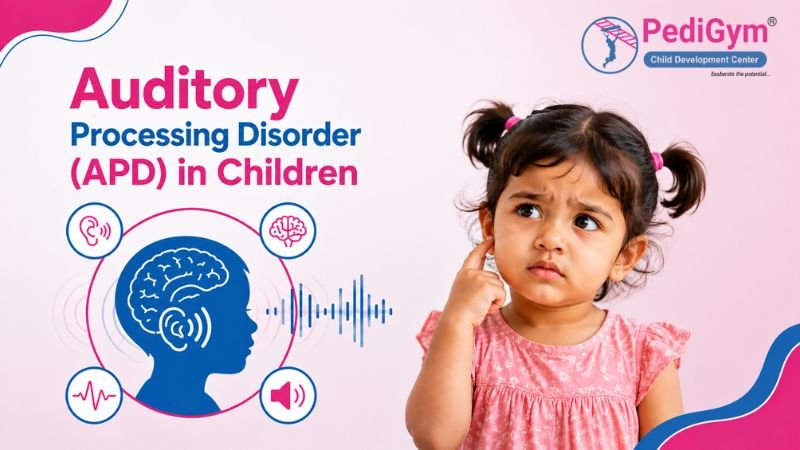
Auditory Processing Disorder (APD) is a condition in which a child may hear sounds normally but have difficulty understanding, organizing, or interpreting what they hear. The difficulty is often more noticeable when there is background noise, rapid speech, or several people speaking at once. With appropriate assessment and support, children can learn strategies to manage listening difficulties at home, in school, and in social situations.
Dr. Nitin, Founder of PediGym Child Development Center, is a dedicated pediatric therapy expert and DMI Level C Certified Therapist leading structured, evidence-based therapy programs in Faridabad and Gurgaon.
Important: APD should be evaluated by a qualified audiologist. Pediatric therapy professionals can support children with related developmental, communication, and functional difficulties, but they do not replace a specialist audiological assessment.
What Is Auditory Processing Disorder?
Auditory Processing Disorder in Children affects the way the brain processes and interprets sounds, rather than simply the ability to hear them. A child may hear a teacher’s words clearly but still struggle to understand what was said, particularly in a noisy classroom or when instructions are lengthy.
The condition is also called central auditory processing disorder (CAPD). In typical hearing, the ears send sound information to the brain, where it is recognized and given meaning. With APD, the brain can have difficulty handling that information efficiently.
According to Nemours KidsHealth, APD affects approximately 3%–5% of school-aged children. It can influence listening, communication, reading, spelling, following directions, and classroom participation.
For example, a child may understand a parent easily in a quiet room but become confused at a birthday party, playground, cafeteria, or classroom where several sounds compete for attention.
It is also important to distinguish APD from autism spectrum disorder (ASD). They are different conditions, although they can occur together and may have some overlapping communication challenges.
Signs Your Child May Have APD
Auditory Processing Disorder symptoms usually involve difficulty understanding spoken information, especially when listening conditions are challenging. Symptoms can be mild or significant, and not every child will experience the same difficulties.
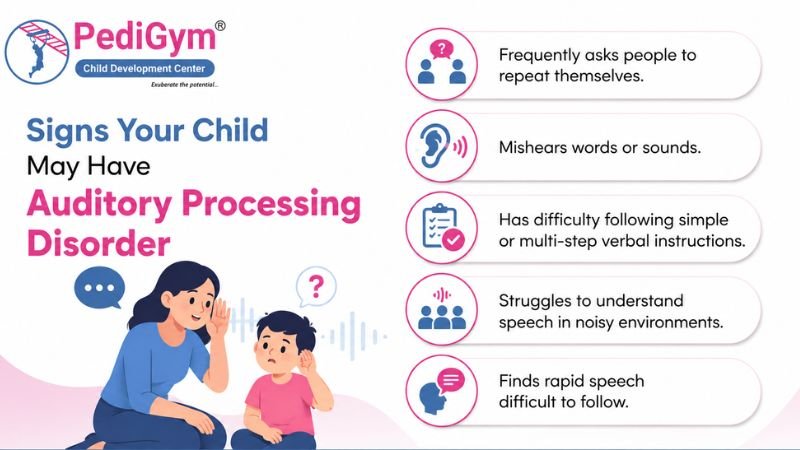
Parents may notice that their child:
- Frequently asks people to repeat themselves.
- Mishears words or sounds.
- Has difficulty following simple or multi-step verbal instructions.
- Struggles to understand speech in noisy environments.
- Finds rapid speech difficult to follow.
- Has difficulty distinguishing between similar-sounding words.
- Takes longer to respond during conversations.
- Finds long conversations difficult to follow.
- Has difficulties with reading, spelling, or phonics.
- Struggles with verbal or word-based math problems.
- Has difficulty remembering spoken information.
- Understands information better when it is presented visually.
- Finds jokes, sarcasm, tone, or changes in intonation difficult to interpret.
A common pattern is that the child appears to listen much better in a quiet environment. For instance, they may follow a parent’s instructions at home but struggle to understand the same type of instruction at school.
However, these signs do not automatically mean a child has APD. Similar difficulties can occur with hearing loss, speech-language difficulties, ADHD, learning problems, or other developmental conditions. This is why professional assessment is important rather than relying on symptoms alone.
What Causes It?
The exact Auditory Processing Disorder causes are not always known. However, certain medical, developmental, and neurological factors have been associated with a higher likelihood of auditory processing difficulties.
Possible risk factors include:
- Frequent or repeated ear infections, particularly during early childhood.
- Premature birth or low birth weight.
- Head injury or head trauma.
- Certain neurological conditions.
- Seizure disorders.
- Genetic factors.
- Some neurodevelopmental conditions, including ADHD or autism.
Having one of these factors does not mean that a child will develop APD. In many children, there is no single identifiable cause.
The basic issue is that the brain has difficulty efficiently interpreting information coming from the ears. This can make listening particularly demanding when the child needs to separate important speech from competing sounds.
APD and Speech Delay
Auditory processing disorder and speech delay are related but different concerns. A child with APD may struggle to understand spoken information, while a child with a speech or language disorder may have difficulty understanding, using, or expressing language.
Sometimes the two difficulties occur together. For example, a child who repeatedly misses parts of spoken instructions may have difficulty learning new words or responding appropriately during conversations.
This is why a child with communication concerns may need more than one type of evaluation. Hearing, auditory processing, speech, language, attention, and learning abilities may all need to be considered.
Parents should therefore avoid assuming that a child is simply “not listening” or “not paying attention.” Understanding why the child is having difficulty is more useful than focusing only on the behavior.
Getting a Diagnosis
Auditory Processing Disorder diagnosis requires specialized assessment, and a standard hearing test alone cannot establish the condition. An audiologist typically evaluates hearing first and may then use specialized listening tests to examine how the child processes different types of auditory information.
An assessment may also consider speech and language abilities or other concerns that can produce similar symptoms. Cleveland Clinic describes several categories that may be considered during evaluation, including auditory processing tests, hearing tests, language tests, and psychological testing for concerns such as ADHD or similar conditions.
What Does an Auditory Processing Assessment Check?
A comprehensive auditory processing assessment may examine several specific listening abilities:
Auditory figure-ground: The child’s ability to understand speech when background noise or competing sounds are present. This is particularly important in busy classrooms.
Auditory closure: The ability to understand speech when some information is unclear, incomplete, muffled, or spoken quickly.
Dichotic listening: The ability to process competing speech or meaningful sounds presented at the same time.
Temporal processing: The ability to recognize the timing and differences between sounds. This can contribute to distinguishing speech sounds and understanding aspects such as pitch and intonation.
Binaural interaction: The ability to use information from both ears and determine where sounds are coming from.
These areas help professionals understand which auditory processing skills are difficult for an individual child, rather than simply describing the child as having poor listening skills.
Cleveland Clinic uses a somewhat different framework and describes types including decoding, integration, organizational, and prosodic difficulties. These categories overlap in some areas with the listening abilities described above but use different terminology to explain how auditory information may be processed.
At What Age Can APD Be Tested?
Many traditional APD tests are generally designed for children around 7 years and older, although some newer electrophysiological approaches may provide information about the auditory system in younger children. The appropriate testing approach depends on the child’s age, development, abilities, and clinical concerns.
Age is important because auditory abilities continue to develop throughout childhood. KidsHealth notes that the auditory system is not fully developed until around age 14, and some children may develop stronger listening abilities as their auditory system matures.
This does not mean parents should simply wait if their child is struggling. Early identification of listening difficulties can help families and schools introduce useful strategies while the child continues to develop.
Treatment and Therapy Options
Auditory Processing Disorder treatment focuses on managing the child’s specific listening difficulties and improving access to spoken information. There is no single treatment that is appropriate for every child, so support should be based on assessment findings and individual needs.
Therapy for Listening Skills
Auditory processing disorder therapy may use structured activities to work on specific listening abilities identified during assessment. Depending on the child’s needs, intervention may target sound discrimination, listening accuracy, speech understanding, or other auditory processing skills.
At PediGym Child Development Center, families can also explore Therapeutic Listening as a structured auditory-based approach that may be considered as part of an individualized therapy plan when appropriate.
The goal is not simply to make a child “listen harder.” Therapy should help the child develop practical ways to process and understand auditory information more effectively. Any listening-based intervention should be selected according to the child’s individual needs and professional assessment.
Speech and Language Therapy
If a child also has speech or language difficulties, speech-language therapy may be recommended. It can support language comprehension, vocabulary, communication, and the ability to understand spoken information.
A multidisciplinary approach can be particularly useful when listening difficulties overlap with communication, learning, or developmental concerns.
Classroom and Environmental Support
Changing the listening environment can make a significant difference. Helpful strategies may include:
- Seating the child closer to the teacher.
- Reducing unnecessary background noise.
- Speaking clearly and at a comfortable pace.
- Giving shorter instructions.
- Breaking multi-step directions into smaller parts.
- Supporting spoken information with visual cues.
- Allowing additional time to process information.
- Providing written instructions for important tasks.
A remote microphone system, sometimes called an FM system, can also help some children. The speaker wears a small microphone that transmits their voice wirelessly to a receiver used by the child. This emphasizes the speaker’s voice over competing background noise, making speech easier to understand.
Helping Your Child at Home and School
Simple changes at home and school can reduce listening demands and help a child use their auditory processing skills more effectively.
At Home
Parents can:
- Reduce television, music, and other background noise when speaking.
- Get the child’s attention before giving instructions.
- Use short and clear sentences.
- Break longer instructions into smaller steps.
- Ask the child to repeat important directions.
- Use written notes, checklists, calendars, or visual schedules.
- Encourage the child to look toward the speaker for additional visual information.
- Give the child time to process information before expecting an answer.
- Encourage the child to tell adults when they have not understood something.
Speaking louder is not always the solution. In many situations, reducing competing noise and speaking clearly is more helpful.
At School
Teachers can support a child by using:
- Preferential seating near the main speaker.
- Visual aids and written instructions.
- Pre-teaching of unfamiliar words.
- Shorter, clearly structured instructions.
- Reduced background noise where possible.
- Recorded lessons or material for later review when appropriate.
- Regular communication with parents and relevant professionals.
Children with these difficulties may become frustrated when others assume they are ignoring instructions. A supportive environment helps them understand that listening difficulties are real and manageable.
Persistent communication difficulties can also affect a child’s confidence and emotional well-being. Providing support early may help reduce frustration and make communication and learning experiences more positive.
With appropriate strategies, children can participate successfully in school and everyday activities.
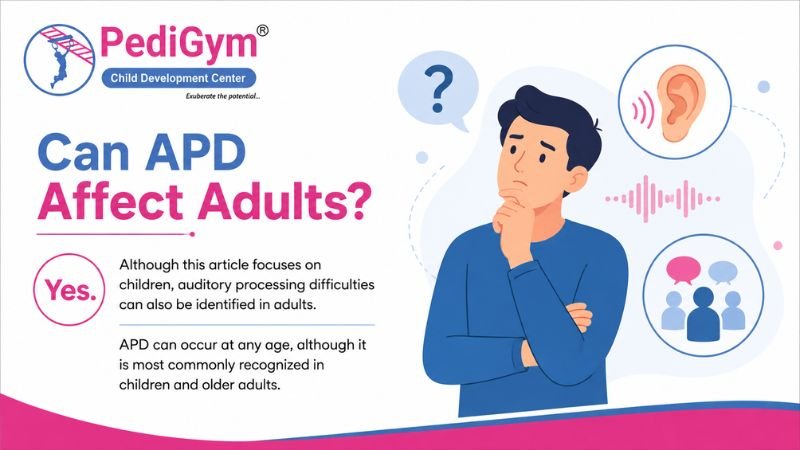
Can APD Affect Adults?
Yes. Although this article focuses on children, auditory processing difficulties can also be identified in adults. APD can occur at any age, although it is most commonly recognized in children and older adults.
The causes and assessment considerations may differ depending on age, so adults with persistent difficulty understanding speech should also seek appropriate professional evaluation.
Frequently Asked Questions
Can a child have APD with normal hearing?
Yes. A child can have normal basic hearing but still have difficulty processing and interpreting spoken information, especially in noisy or complex environments.
Is APD a form of autism?
No. APD and autism spectrum disorder are separate conditions. However, they can occur together, which is one reason a comprehensive assessment is important when a child has communication or listening concerns.
Can auditory processing difficulties cause speech delay?
They can contribute to difficulty understanding spoken language, but they are not the same as speech or language delay. Some children may experience both, so hearing, language, and auditory processing should be considered together when appropriate.
Does APD improve with age?
Some children may show improvement as their auditory system matures. Listening abilities can continue developing through childhood, but persistent difficulties should not be ignored. Appropriate strategies and professional support can help a child manage challenges while development continues.
Who can diagnose APD?
An audiologist generally conducts the specialized auditory assessment used to identify APD. Other professionals, such as speech-language pathologists, ENT specialists, psychologists, and pediatric therapy professionals, may contribute to evaluating related concerns.
When should parents seek an assessment?
Parents should consider professional guidance when a child repeatedly struggles to understand spoken instructions, has significant difficulty listening in noisy environments, frequently asks for repetition, or experiences related communication or learning difficulties despite apparently normal hearing.
Supporting Your Child With the Right Approach
Auditory Processing Disorder does not mean that a child cannot learn or communicate successfully. The key is to understand which listening skills are difficult and provide strategies that match the child’s needs.
At PediGym Child Development Center, Dr. Nitin, Founder and DMI (Developmental Movement Intervention) Level C Certified Therapist, leads structured, evidence-based pediatric therapy programs in Faridabad and Gurgaon.
When a child has persistent listening, speech, language, or developmental concerns, an individualized evaluation can help families understand the challenges and determine appropriate support.
If you are concerned about your child’s listening or communication, speak with a qualified audiologist, pediatrician, speech-language professional, or developmental specialist rather than trying to diagnose the condition from symptoms alone.
Medical Disclaimer
This article is for educational purposes and does not replace professional medical, audiological, speech-language, or developmental evaluation. Diagnosis and treatment should be based on the individual child’s needs and assessment findings.

Dr. Nitin, Founder of PediGym Child Development Center, is a dedicated pediatric therapy expert and DMI Level C Certified Therapist leading structured, evidence-based therapy programs in Faridabad and Gurgaon. Under his guidance, PediGym provides comprehensive pediatric rehabilitation focused on improving motor skills, coordination, sensory processing, speech clarity, and functional independence through personalized intervention plans.