Written by: Nitin Gupta
Published: August 27, 2026
Last Updated: November 3, 2026
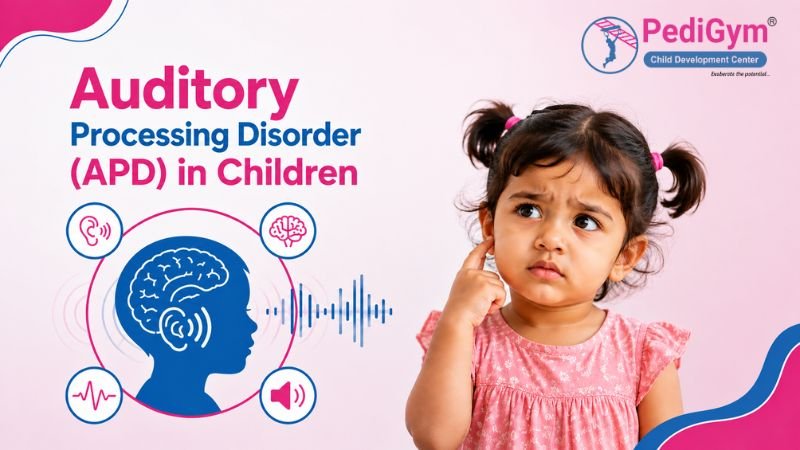
Auditory processing disorder (APD) means your child can hear sounds but has difficulty understanding and interpreting them, especially in noisy environments. An audiologist usually diagnoses APD from around age 7 or 8. There is no medicine that cures APD. Treatment combines classroom changes, coping strategies and listening-skills training based on your child’s assessment results.
Key Takeaways
- Children with APD often have normal hearing but struggle to understand spoken information.
- Common APD symptoms include difficulty following instructions and understanding speech in noise.
- An audiologist uses specialized listening tests to diagnose APD.
- Most standard APD tests are suitable for children aged 7 or 8 and above.
- APD treatment includes environmental changes, coping strategies and listening-skills training.
- Support at home and school helps children manage everyday listening difficulties.
What Is Auditory Processing Disorder (APD) in Children?
Auditory processing disorder affects how the brain recognizes and interprets sounds. Your child’s ears may detect sounds normally, but the brain has difficulty processing the information.
APD is also called Central Auditory Processing Disorder (CAPD). Your child might hear a teacher speaking but struggle to understand instructions in a noisy classroom.
According to Great Ormond Street Hospital, roughly 3–5% of children may experience APD. However, estimates vary between studies and diagnostic methods.
APD can affect listening, communication, reading, spelling and classroom participation. It can also overlap with ADHD, language disorders and learning difficulties. Specialists sometimes disagree about its diagnosis because symptoms and assessment methods can overlap with other conditions. This debate is also discussed in an Oxford study published in 2008.
APD Symptoms in Children
APD symptoms usually become noticeable when children struggle to understand spoken information, particularly when several sounds compete for attention.
APD Symptoms at Home
Parents may notice these signs:
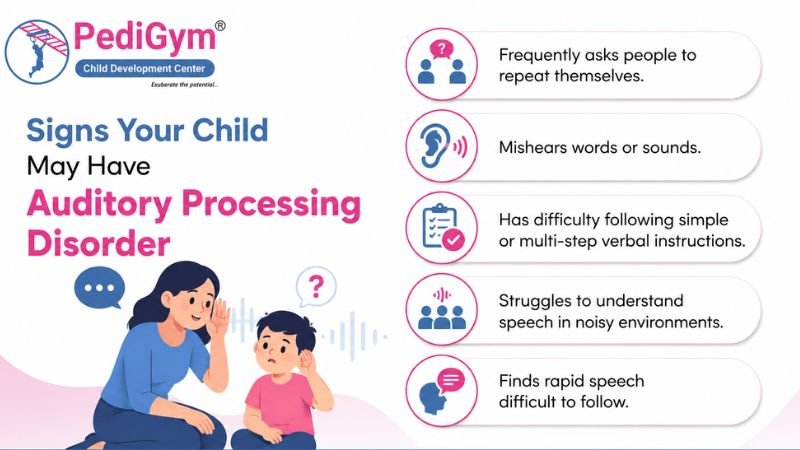
- Frequently asking others to repeat sentences.
- Misunderstanding spoken words or instructions.
- Difficulty following multi-step directions.
- Struggling to understand conversations in noisy places.
- Taking longer to respond to questions.
- Difficulty remembering spoken information.
- Understanding instructions better when they are written or demonstrated.
- Confusing similar-sounding words.
APD Symptoms at School
Teachers may notice that your child:
- Struggles to follow classroom instructions.
- Finds group discussions difficult.
- Has difficulty understanding the teacher in noisy classrooms.
- Experiences challenges with reading, spelling or phonics.
- Needs additional time to process verbal information.
- Finds word-based mathematical problems difficult.
These signs do not automatically confirm APD. Hearing loss, ADHD and speech-language difficulties can cause similar challenges.
What Causes APD?
Doctors do not know exactly what causes APD. A small Oxford study from 2008 of 89 children referred to a hospital clinic found that the factors it examined did not clearly separate children diagnosed with APD from those who were not. APD is not caused by poor parenting or by a child not trying hard enough to listen.
For more information, read Great Ormond Street Hospital’s explanation of APD.
APD vs ADHD, Autism, Hearing Loss and Speech Delay
APD can look similar to other developmental and communication conditions. Understanding the differences helps parents seek the right assessment.
Condition | Main difficulty |
APD | Understanding and processing sounds, particularly in noisy environments |
ADHD | Attention, impulsivity and activity regulation |
Autism | Social communication, interaction and restricted or repetitive behaviors |
Hearing loss | Reduced ability to detect sounds |
Speech delay | Difficulty developing age-appropriate speech or language skills |
APD and ADHD can occur together. Autism and APD are also separate conditions, although some communication challenges can overlap.
Auditory processing difficulties and speech delay are not the same. A child with speech delay may struggle to understand or express language, while a child with APD primarily experiences difficulty processing auditory information.
How Is APD Diagnosed?
An audiologist diagnoses APD through specialized auditory processing assessments. A standard hearing test alone cannot confirm the condition.
The assessment usually begins with a hearing evaluation. The audiologist then selects suitable listening tests based on your child’s age, language abilities and concerns. Speech-language, attention and learning assessments may also be recommended.
What Does an APD Test Check?
An APD test examines different listening abilities to identify where your child experiences difficulty.
Test area | What it checks |
Auditory figure-ground | Understanding speech with background noise |
Auditory closure | Understanding speech when some sounds are missing or unclear |
Dichotic listening | Processing two different sounds presented at the same time |
Temporal processing | Recognizing the timing and patterns of sounds |
Binaural interaction | Using both ears together to understand and locate sound |
At What Age Can a Child Be Tested for APD?
Most standard APD tests are designed for children aged 7 or 8 and above. Younger children can have hearing and language assessments first.
An audiologist considers age, language abilities, attention and developmental skills when deciding whether formal testing is suitable.
If your child is younger than 7:
- Arrange a hearing test.
- Note when your child struggles to understand spoken instructions.
- Speak to a pediatrician or speech-language pathologist (SLP).
- Try simple home strategies, such as reducing background noise and using visual instructions.
Do not delay hearing or speech-language assessments simply because your child is younger than seven.
APD Treatment for Kids: What Helps?
There is no medicine that cures APD. APD treatment aims to make listening easier and build skills that help your child understand spoken information.
According to the American Speech-Language-Hearing Association (ASHA), treatment focuses on changing the learning environment, building coping strategies and improving specific auditory skills.
The treatment plan depends on your child’s assessment results.
Treatment approach | What it involves | Who provides it |
Environmental changes | Seating near the teacher, reducing noise and giving shorter instructions | Parents and teachers |
Coping strategies | Visual cues, repeating instructions and written notes | Parents, teachers and SLP |
Listening-skills training | Activities targeting sound discrimination and listening in noise | Audiologist and SLP |
Speech-language therapy | Support with understanding and using language | |
Remote microphone (FM) system | Sending the teacher’s voice directly to a receiver used by the child | Audiologist |
Supportive therapy programs | Listening and sensory activities within a wider therapy plan when suitable for the child’s needs | Therapist |
Listening and Supportive Therapy
Listening-skills training can target specific difficulties identified during an APD assessment. Activities may focus on recognizing sounds, distinguishing similar words and understanding speech in noise.
At PediGym, Therapeutic Listening may be considered within a therapy plan when appropriate. However, research evidence for listening-based programs in APD is limited.
Therapeutic Listening is not a cure for APD, and it does not replace an audiologist’s assessment.
Many children improve as they grow and develop coping skills. The extent of improvement varies between children.
How to Help Your Child at Home and School
Consistent support at home and school can reduce listening difficulties and improve everyday communication.
Strategies to Try at Home
- Reduce background noise when speaking to your child.
- Get your child’s attention before giving instructions.
- Use short, clear sentences.
- Break lengthy instructions into smaller steps.
- Support spoken information with pictures and visual schedules.
- Give your child enough time to understand and respond.
- Ask your child to repeat important instructions in their own words.
Strategies to Use at School
- Seat your child near the teacher.
- Provide written instructions for important activities.
- Reduce unnecessary classroom noise.
- Repeat or rephrase instructions when needed.
- Use pictures and visual learning materials.
- Allow extra time to process verbal information.
A remote microphone system may also help some children hear the teacher more clearly. An audiologist can advise whether this device is suitable.
Simple Listening Activities
Ask your child’s audiologist or SLP which activities are suitable before starting them.
- Sound identification: Ask your child to identify familiar sounds, such as a bell or running water.
- Sound matching: Play two familiar sounds and ask whether they are the same or different.
- Following directions: Give short instructions during play, such as placing a toy inside a box.
- Listening and remembering: Read a short sentence and ask your child to recall one or two details.
Keep activities short and enjoyable. Stop if your child becomes tired or frustrated.
Getting an APD Assessment in India
If you suspect APD in your child, start with a hearing evaluation and consult a qualified audiologist. A pediatrician or ENT specialist can also guide you toward the appropriate assessment.
During the first visit, the specialist discusses your child’s medical history, hearing concerns, language development and difficulties at home or school. The audiologist then recommends suitable tests.
Parents in India should discuss their child’s language background before testing. Many standard APD tests use English materials and scores compared against children who speak English. If your child speaks Hindi and English at home, the audiologist should consider language exposure and proficiency when interpreting the results.
You can check an audiologist’s or speech-language professional’s registration through the Rehabilitation Council of India (RCI) CRR Register. Search by the professional’s name or registration number.
How PediGym Can Help
PediGym Child Development Center supports children’s developmental, sensory and communication needs through therapy programs.
Our centers in Faridabad and Gurugram provide services such as Speech Therapy, Sensory Integration Therapy, Occupational Therapy and Early Intervention.
PediGym’s therapy services do not replace formal APD diagnosis or audiological treatment.
Contact PediGym to discuss your child’s developmental and therapy needs.
When Should You See a Specialist?
Consult a qualified professional if your child regularly struggles to understand spoken instructions, frequently asks for repetition or has difficulty following conversations in noisy environments.
Seek guidance if listening difficulties affect your child’s classroom participation, reading, spelling or everyday communication.
Important: A sudden change in hearing, ear pain or fluid coming from the ear needs prompt medical attention from a doctor or ENT specialist. These symptoms should not be treated as APD.
Frequently Asked Questions
What Is the Best APD Treatment for Kids?
The best APD treatment for kids depends on their listening difficulties. It can include classroom changes, coping strategies, listening-skills training and speech-language therapy. An audiologist uses assessment results to recommend suitable treatment options.
Can APD Be Cured?
No. There is currently no established medicine or procedure that cures APD. However, treatment and practical listening strategies can help children manage everyday difficulties. Some children also develop stronger coping skills as they grow.
At What Age Can a Child Be Tested for APD?
Most standard APD tests are suitable for children aged 7 or 8 and above. Younger children can receive hearing and language assessments to identify their needs before formal APD testing.
Can a Child Have APD With Normal Hearing?
Yes. A child with APD can have normal basic hearing but struggle to understand spoken information. The difficulty is in processing sounds rather than detecting them.
Is APD the Same as ADHD or Autism?
No. APD, ADHD and autism are different conditions. However, they can occur together and share some communication, attention or learning difficulties. Specialist assessments help identify the child’s needs.
Does APD Improve With Age?
Some children develop stronger listening abilities and coping strategies as they grow. However, improvement varies, and difficulties can continue into adulthood. Classroom adjustments and suitable treatment can help manage these challenges.
How Is APD Different From Speech Delay?
APD affects how the brain processes sounds, while speech delay involves difficulties developing age-appropriate speech or language skills. Both can occur together and may require separate assessments.
Who Diagnoses APD in India?
A qualified audiologist conducts the specialized tests required to diagnose APD. Pediatricians and ENT specialists can guide families toward assessment. Speech-language pathologists and occupational therapists may provide additional support.
Does APD Affect Reading and Spelling?
Yes. Some children with APD struggle with phonics, reading and spelling because they find it difficult to distinguish and process speech sounds. Other learning difficulties can cause similar problems, so assessment is important.
When Should I See a Specialist?
Consult an audiologist if your child frequently misunderstands spoken instructions or struggles to follow conversations in noisy places. Seek an assessment if these difficulties persist or affect school and everyday communication.
Medical Disclaimer
This article is for educational purposes only. It does not replace professional medical, audiological or speech-language assessment. Consult a qualified specialist for diagnosis and treatment recommendations.
About the Author
Nitin Gupta is the founder of PediGym Child Development Center and a Level C certified Dynamic Movement Intervention (DMI) practitioner who works with children’s developmental needs.

Dr. Nitin, Founder of PediGym Child Development Center, is a dedicated pediatric therapy expert and DMI Level C Certified Therapist leading structured, evidence-based therapy programs in Faridabad and Gurgaon. Under his guidance, PediGym provides comprehensive pediatric rehabilitation focused on improving motor skills, coordination, sensory processing, speech clarity, and functional independence through personalized intervention plans.