Medically reviewed by: Dr. Nitin, DMI Level C Certified Therapist
A Speech-Language Pathologist (SLP) is a trained professional who evaluates and treats difficulties related to speech, language, communication, fluency, voice, and certain feeding or swallowing concerns. For children, an SLP helps identify why a child has unclear speech, limited vocabulary, difficulty understanding language, stuttering, or other communication challenges, and creates an individualized therapy plan.
At PediGym Child Development Center, Dr. Nitin, Founder, is a dedicated pediatric therapy expert and DMI Level C Certified Therapist leading structured, evidence-based therapy programs in Faridabad and Gurgaon.
When Should a Child See a Speech-Language Pathologist?
A child should be evaluated when there are ongoing concerns about speech clarity, understanding language, using words or sentences, social communication, fluency, or other communication skills. A professional speech assessment for children helps determine whether the child’s development is progressing as expected and whether speech and language therapy is appropriate.
Parents do not need to wait for a communication difficulty to become severe before seeking guidance. Developmental milestones provide useful reference points, but every child develops differently. The CDC recommends monitoring developmental milestones and discussing concerns with a child’s doctor.
What Is a Speech-Language Pathologist?
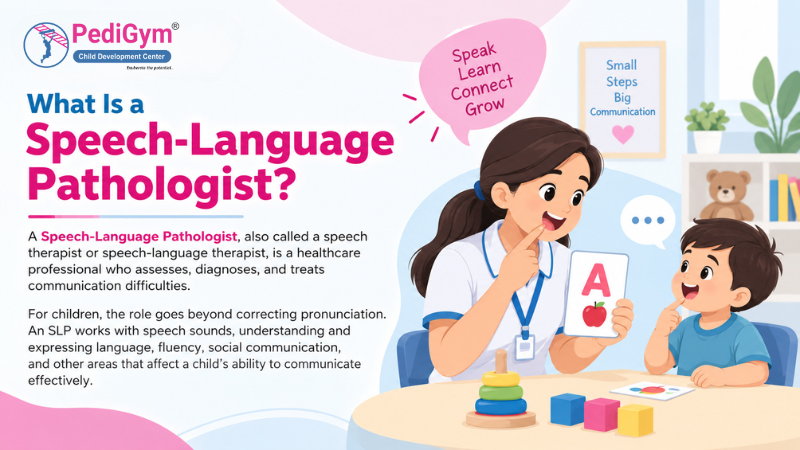
A Speech-Language Pathologist, also called a speech therapist or speech-language therapist, is a healthcare professional who assesses, diagnoses, and treats communication difficulties.
For children, the role goes beyond correcting pronunciation. An SLP works with speech sounds, understanding and expressing language, fluency, social communication, and other areas that affect a child’s ability to communicate effectively.
The American Speech-Language-Hearing Association (ASHA) describes SLPs as professionals involved in screening, assessment, diagnosis, treatment, prevention, education, and support for communication and related disorders.
What Does a Speech-Language Pathologist Do?
A Speech-Language Pathologist first evaluates the child’s communication skills and then develops goals based on the child’s specific needs.
An SLP:
- Assesses speech and language development
- Identifies speech and language disorders
- Evaluates pronunciation and speech sound patterns
- Works on vocabulary, grammar, sentences, and storytelling
- Improves understanding and use of language
- Supports social communication and conversation skills
- Addresses stuttering and other fluency difficulties
- Works with children who have motor-speech difficulties
- Supports certain voice, feeding, and swallowing concerns
- Recommends alternative or augmentative communication when appropriate
- Guides parents and collaborates with other professionals
Assessment is not based on one observation alone. ASHA notes that a thorough evaluation can include caregiver information, communication samples, observation, formal or informal assessment, and consideration of the child’s developmental and language background.
What Conditions Can a Speech-Language Pathologist Help With?
A Speech-Language Pathologist works with children experiencing different types of communication difficulties.
1. Speech Sound and Articulation Disorders
An articulation disorder affects how a child produces particular speech sounds. Some children also have phonological disorders, where they use sound patterns that make their speech difficult to understand.
Therapy focuses on helping the child produce and use sounds more accurately in words and everyday communication.
2. Speech Delay in Children
Speech delay in children can involve difficulty producing sounds, using words, or developing speech at an expected rate. The underlying reason varies from child to child.
A child speech therapist evaluates the child’s overall communication rather than focusing only on the number of words spoken.
3. Language Delay
Language delay can affect either understanding language or expressing thoughts. A child may struggle with vocabulary, sentence formation, following directions, answering questions, or telling a story.
The CDC’s 30-month milestones include using about 50 words and combining two or more words, while its 5-year milestones include maintaining several back-and-forth conversational exchanges and telling a story with at least two events.
4. Childhood Apraxia of Speech and Motor-Speech Difficulties
Some children have difficulty planning and coordinating the movements needed for speech. Childhood apraxia of speech is one example of a motor-speech disorder that requires specialized assessment.
The treatment approach depends on the child’s individual speech characteristics and functional communication needs.
5. Stuttering and Other Fluency Difficulties
A child may repeat sounds or words, prolong sounds, or experience interruptions in speech. A Speech-Language Pathologist evaluates fluency and provides individualized support.
6. Social Communication Disorders
Communication also involves taking turns, responding to others, understanding conversational expectations, and using verbal and nonverbal communication appropriately.
An SLP assesses these skills and develops practical goals for everyday interactions.
7. Feeding and Swallowing Difficulties
SLPs also work with children who have certain feeding and swallowing difficulties. These concerns require appropriate assessment because swallowing problems can affect safe eating and drinking.
Signs Your Child May Need a Speech Therapist
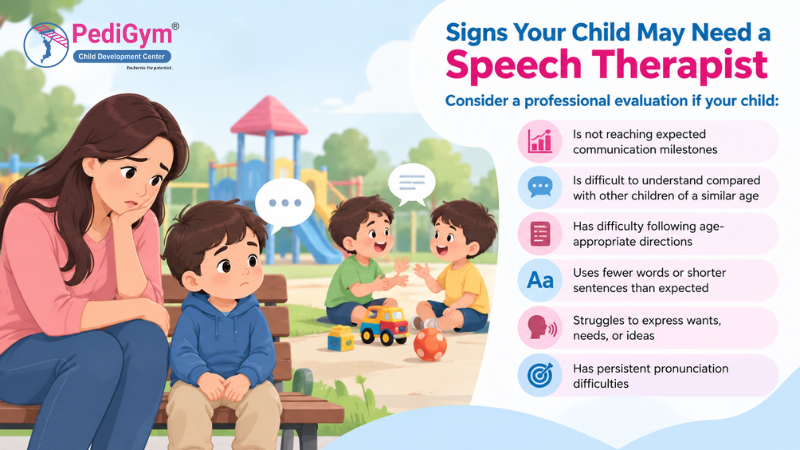
Consider a professional evaluation if your child:
- Is not reaching expected communication milestones
- Is difficult to understand compared with other children of a similar age
- Has difficulty following age-appropriate directions
- Uses fewer words or shorter sentences than expected
- Struggles to express wants, needs, or ideas
- Has persistent pronunciation difficulties
- Frequently becomes frustrated while trying to communicate
- Stutters or shows noticeable difficulty with speech fluency
- Has difficulty participating in back-and-forth conversations
- Has concerns related to chewing, eating, or swallowing
These signs of speech delay do not automatically mean that a child has a communication disorder. An assessment helps identify the child’s actual strengths and areas requiring support.
What Happens During a Speech Therapy Evaluation?
A speech therapy evaluation is designed to understand how the child communicates in different situations.
The assessment includes:
- Parent interview: The therapist discusses developmental history, communication concerns, medical history, and languages used at home.
- Observation: The child’s natural communication is observed through play, conversation, or structured activities.
- Speech assessment: The SLP examines speech sounds, pronunciation, intelligibility, and sound patterns.
- Language assessment: Receptive and expressive language skills are evaluated.
- Social communication assessment: Interaction, turn-taking, gestures, and conversational skills are considered.
- Individualized planning: Findings are used to establish practical therapy goals.
For multilingual children, ASHA recommends that assessment consider the child’s languages and cultural-linguistic background rather than treating normal differences between languages as a disorder.
What Does Speech Therapy for Kids Look Like?
Speech therapy for kids is designed around the child’s age, interests, abilities, and therapy goals.
Sessions can include:
- Play-based communication activities
- Picture and object-based activities
- Storytelling and book activities
- Speech-sound practice
- Vocabulary-building activities
- Modeling and repetition
- Conversation and social communication practice
- Parent-guided activities for use at home
The exact approach depends on the child’s assessment findings. A young child may practice communication through play, while an older child may work on sentence structure, speech clarity, storytelling, or classroom communication.
Benefits of Speech and Language Therapy
The benefits of speech and language therapy depend on the child’s individual needs and treatment goals. Therapy can help children:
- Communicate wants and needs more effectively
- Improve speech clarity
- Build vocabulary and sentence skills
- Understand spoken language
- Participate more effectively in conversations
- Develop social communication skills
- Work on fluency difficulties
- Use appropriate communication supports when needed
The goal is functional communication not simply increasing the number of words a child says.
Frequently Asked Questions
What is the difference between a speech therapist and a Speech-Language Pathologist?
The terms are often used interchangeably. A Speech-Language Pathologist has a broader professional scope that includes speech, language, communication, fluency, voice, and certain feeding or swallowing concerns.
When should I take my child to a speech therapist?
Seek professional guidance when you have persistent concerns about your child’s speech, language, understanding, communication, or fluency. Reviewing developmental milestones with your pediatrician and considering a speech therapy evaluation as recommended by the CDC can help clarify the next step.
Does every child with speech delay need therapy?
Not necessarily. The appropriate next step depends on the child’s age, communication profile, developmental history, and assessment findings. A professional evaluation helps determine whether therapy, monitoring, or another referral is appropriate.
How long does speech therapy take?
There is no single timeline. Therapy duration depends on the type and severity of the communication difficulty, the child’s response to intervention, attendance, and progress toward individualized goals.
Can multilingual children have speech or language difficulties?
Yes. However, speaking multiple languages does not itself indicate a communication disorder. Assessment should consider all relevant languages and the child’s cultural and linguistic background, in line with ASHA guidance.
Final Takeaway
A Speech-Language Pathologist helps children develop effective communication by assessing and treating difficulties involving speech sounds, language, fluency, social communication, and related areas. If you notice persistent speech delay in children, unclear speech, limited language development, or difficulty communicating, a professional assessment can provide a clearer understanding of your child’s needs.
At PediGym Child Development Center, Dr. Nitin leads structured, evidence-based pediatric therapy programs in Faridabad and Gurgaon, with individualized support based on each child’s developmental needs.
Disclaimer
This article is for educational purposes and does not replace an individualized assessment or medical advice from a qualified healthcare professional.

Dr. Nitin, Founder of PediGym Child Development Center, is a dedicated pediatric therapy expert and DMI Level C Certified Therapist leading structured, evidence-based therapy programs in Faridabad and Gurgaon. Under his guidance, PediGym provides comprehensive pediatric rehabilitation focused on improving motor skills, coordination, sensory processing, speech clarity, and functional independence through personalized intervention plans.