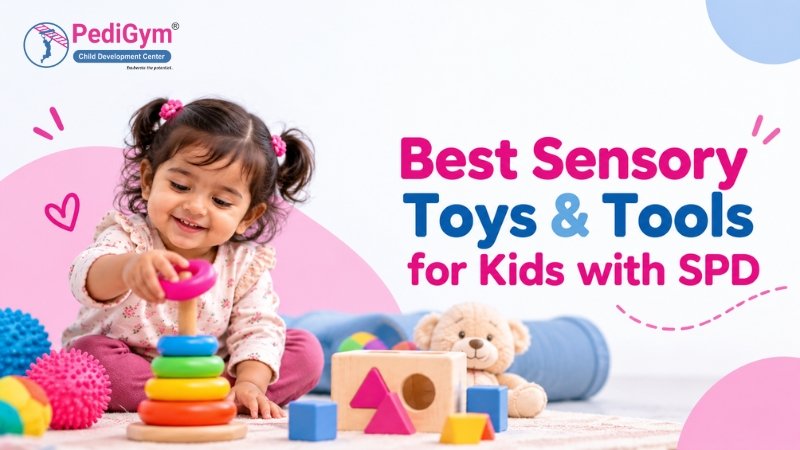
The best sensory toys for kids with SPD depend on the type of sensory input a child seeks, avoids, or finds difficult to process. Tactile toys, proprioceptive activities, vestibular tools, quiet fidgets, visual and auditory tools, calming resources, and oral sensory tools can all be useful when matched to a child’s individual needs, age, development, and safety requirements.
At PediGym Child Development Center, Dr. Nitin, Founder and DMI Level C Certified Therapist, leads structured, evidence-based pediatric therapy programs in Faridabad and Gurgaon. His approach focuses on understanding each child’s sensory and developmental needs before recommending specific activities or tools.
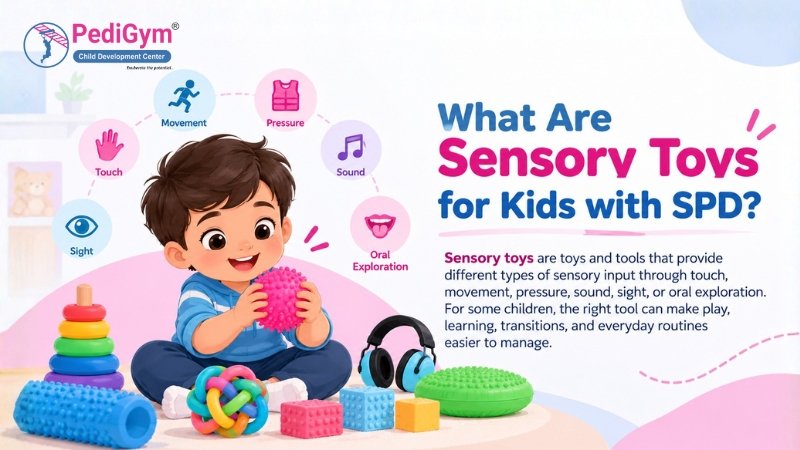
What Are Sensory Toys for Kids with SPD?
Sensory toys are toys and tools that provide different types of sensory input through touch, movement, pressure, sound, sight, or oral exploration. For some children, the right tool can make play, learning, transitions, and everyday routines easier to manage.
Children with sensory processing difficulties do not all respond to sensory input in the same way. Some may seek movement, touch, or pressure, while others may become overwhelmed by sounds, textures, lights, or movement.
Therefore, the goal is not to find one toy that works for every child. The goal is to choose sensory tools for kids with SPD according to the child’s individual sensory needs.
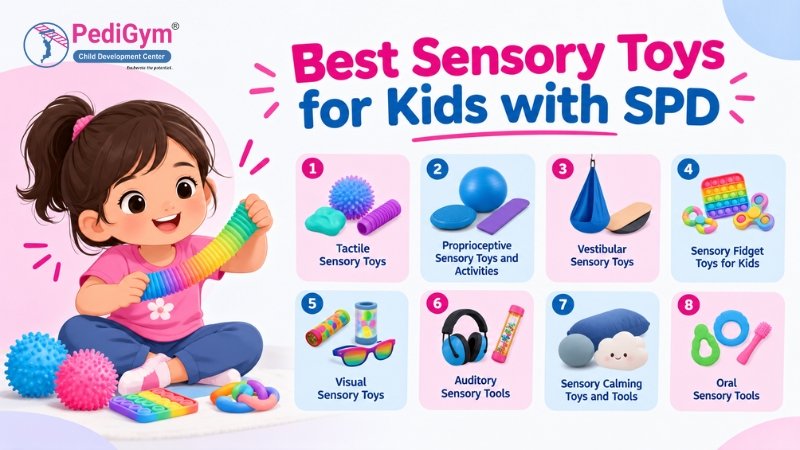
Best Sensory Toys for Kids with SPD
1. Tactile Sensory Toys
Tactile sensory toys provide sensory input through touch. They can be useful for children who enjoy touching, squeezing, manipulating, or exploring different textures.
Examples include textured sensory balls, therapy putty, play dough, sensory bins with age-appropriate materials, and touch-and-feel books for younger children.
These sensory play toys can be included naturally in everyday play.
However, do not force a child to touch a texture they find distressing. A child who avoids tactile input may need gradual exposure and professional guidance rather than stronger sensory stimulation.
2. Proprioceptive Sensory Toys and Activities
Proprioceptive sensory toys provide resistance and body-based input through pushing, pulling, lifting, or squeezing activities.
Useful options include resistance bands, therapy putty, therapy balls, push-and-pull games, wall push-ups, supervised jumping activities, and obstacle courses.
These activities may be useful for children who frequently jump, push objects, crash into cushions, or seek strong body movement.
More sensory input is not always better. The American Occupational Therapy Association (AOTA) recommends that sensory-based interventions be connected to a child’s documented sensory difficulties rather than provided routinely without assessment.
3. Vestibular Sensory Toys
Vestibular sensory toys involve movement and balance. Examples include therapy balls, balance boards, rocking chairs, platform or disc swings, scooter boards, and supervised movement equipment.
These tools may appeal to sensory-seeking children who enjoy spinning, rocking, jumping, climbing, or frequent movement.
However, movement can also overwhelm children who are sensitive to vestibular input. Swings, balance equipment, and other movement-based sensory equipment for kids should therefore be used carefully, particularly when a child becomes uncomfortable or distressed with movement.
4. Sensory Fidget Toys for Kids
Sensory fidget toys for kids are small tools that children can manipulate with their hands. Examples include therapy putty, Tangle-style manipulatives, stretchy bands, and quiet squeeze toys.
A useful approach is to choose quiet fidgets first. If a fidget produces lights, sounds, or excessive movement, it may become a distraction rather than helping the child participate.
Fidgets should not be considered a universal solution for attention. Their usefulness depends on the individual child and the activity.
A Simple “Don’t Buy” Rule
Do not choose a fidget simply because it is marketed as a “focus toy.” If it is noisy, highly stimulating, difficult to use appropriately, or becomes the child’s primary focus, it may not support participation.
For younger children, also check carefully for small detachable parts and choking hazards.
5. Visual Sensory Toys
Visual input is another important category when choosing sensory stimulation toys. Some children enjoy watching predictable visual movement, while others may become overwhelmed by bright or rapidly changing lights.
Options include liquid motion bubblers, sensory bottles, calm-down glitter jars, simple kaleidoscopes, slow-moving visual toys, and age-appropriate light projectors.
Choose visual tools that are predictable and easy to stop or put away. Bright or flashing products are not automatically better sensory tools.
6. Auditory Sensory Tools
Children who are sensitive to everyday sounds may benefit more from reducing overwhelming input than from adding another sound-based toy.
Useful sensory tools for children may include ear defenders, noise-reducing headphones, white-noise machines during appropriate routines, and soft musical instruments for children who actively seek sound.
For a child who covers their ears during loud environments, creating a quieter environment may be more helpful than adding additional auditory stimulation.
7. Sensory Calming Toys and Tools
Some children benefit from predictable, low-stimulation sensory experiences during transitions or periods of overwhelm.
Options can include soft cushions, body pillows, calm-down sensory bottles, appropriately selected weighted lap pads, a quiet sensory corner, and soft tactile toys.
A sensory calming toy should support regulation rather than be used to restrain or physically control a child.
Weighted products require particular caution. They should not be selected simply because they are advertised for SPD. Professional guidance can be helpful when considering weighted sensory equipment.
8. Oral Sensory Tools
Some children frequently chew clothing, pencils, toys, or other objects. An age-appropriate oral sensory tool may provide a safer alternative.
Examples include appropriate silicone chew tools, chewable pencil toppers, textured teethers for suitable ages, and crunchy or chewy foods when appropriate for the child.
Choose these products carefully, inspect them regularly for damage, and supervise their use. Frequent or unsafe chewing may require professional assessment, particularly when feeding difficulties are also present.
Sensory Toys by Need: A Quick Guide
Sensory need | Possible tool | What to watch for |
Touch seeking | Putty, textured balls, sensory bins | Do not force unwanted textures |
Movement seeking | Therapy ball, obstacle course, balance activities | Watch for dizziness or overstimulation |
Body-pressure seeking | Resistance bands, pushing activities | Use appropriate resistance |
Hand fidgeting | Quiet putty, stretchy bands | Avoid highly distracting fidgets |
Visual seeking | Sensory bottles, motion toys | Avoid excessive stimulation |
Sound sensitivity | Ear defenders, quieter spaces | Do not avoid every normal sound |
Calming needs | Quiet corner, soft cushions | Allow the child to leave freely |
Oral seeking | Appropriate chew tools | Check for wear and choking risks |
Sensory Toys for Toddlers vs. Older Children
For Toddlers
For toddlers, choose simple and durable products that encourage supervised exploration. Large textured balls, play dough when developmentally appropriate, touch-and-feel books, stacking activities, and simple sensory bins can be useful.
Safety is especially important because toddlers commonly explore objects with their mouths. Avoid small loose parts, damaged chewable products, and materials that create a choking risk.
For School-Age Children
School-age children can often use more targeted sensory integration toys, such as resistance bands, therapy putty, balance activities, and quiet fidgets.
Connect the tool to a specific routine, for example, using a quiet hand tool during a seated activity rather than allowing unrestricted fidget use throughout the day.
For Tweens
Older children can participate more actively in choosing their tools. A child may prefer a quiet fidget, movement break, resistance activity, or headphones depending on the environment.
Giving children appropriate choices can also encourage independence and awareness of their own sensory preferences.
No-Cost Sensory Activities for Kids with SPD
You do not need to buy expensive sensory toys for children to provide useful sensory experiences.
Try simple activities such as:
- Animal walks: Walk like a bear, crab, or frog.
- Pillow obstacle course: Crawl and move around cushions safely.
- Wall pushes: Push against a wall during a short, structured activity.
- Texture-based cooking: Knead dough or mix suitable ingredients.
- Indoor movement games: Jump, crawl, or balance according to the child’s ability.
- Quiet corner: Create a predictable, low-stimulation space for breaks.
Home activities should still be individualized. An activity that helps one child may not be appropriate for another.
Do Sensory Toys Actually Work?
The answer depends on the child, the sensory need, and how the tool is used.
Research supports some structured sensory-integration approaches, but this does not mean that every sensory product works for every child. A 2025 systematic review of nine randomized controlled trials found strong evidence that Ayres Sensory Integration® supported autistic children in meeting individualized goals related to occupational performance, function, and participation. The review also found no benefit for behaviors of concern such as noncompliance or irritability, and noted that further research is needed for other child populations.
AOTA also emphasizes individualized assessment and intervention rather than automatically providing sensory-based strategies. Its Practice Smart recommendation specifically advises against providing sensory-based interventions to individual children without documented assessment of difficulties processing or integrating sensory information.
This is why understanding a child’s sensory needs can be more useful than simply buying a collection of products.
Sensory Toys for Autism and SPD: Are They the Same?
Sensory toys for autism and SPD can overlap, but they are not automatically the same.
Autistic children can have sensory differences, but sensory needs vary considerably. One child may seek movement and pressure, while another may avoid sound, touch, or bright visual input.
Therefore, choose sensory products based on the child’s actual responses and functional needs rather than diagnosis alone.
Frequently Asked Questions
Are sensory toys the same as fidget toys?
No. Fidget toys are one type of sensory tool, generally designed for hand manipulation. Sensory products can also provide tactile, movement, visual, auditory, proprioceptive, or oral input.
What age can a child start using sensory toys?
There is no single age for every product. Toddlers can use age-appropriate sensory play materials with supervision, while products containing small parts or requiring advanced motor skills may be unsuitable. Always follow age recommendations and consider the child’s developmental abilities.
Can sensory toys help children with anxiety?
Some children may find predictable sensory input calming, but sensory toys for anxiety should not be presented as a treatment for anxiety itself. If anxiety significantly affects a child’s daily life, seek appropriate professional support.
Do children with ADHD benefit from sensory toys?
Some children with ADHD may benefit from individual sensory strategies, but sensory toys are not a treatment for ADHD. A tool should support participation in a specific activity rather than being recommended solely because of a diagnosis.
Should every child with SPD have sensory toys?
No. A child may benefit from environmental changes, movement activities, therapy, or other strategies instead of a particular toy. Individual assessment is more useful than building a large collection of products.
Final Takeaway
The best sensory toys for kids with SPD are those that match the child’s individual sensory needs, developmental level, and everyday goals. Tactile toys, proprioceptive activities, vestibular equipment, quiet fidgets, visual tools, auditory supports, calming resources, and oral sensory tools can all have a place, but not every child needs every type.
If a child frequently becomes overwhelmed by everyday sensations, seeks intense movement or pressure, avoids particular textures or sounds, or struggles to participate in daily activities, professional assessment can help identify the child’s sensory needs.
At PediGym Child Development Center, Dr. Nitin, Founder and DMI Level C Certified Therapist, provides structured, evidence-based pediatric therapy programs in Faridabad and Gurgaon with an individualized approach to developmental and sensory needs.
Medical note
Sensory products are supportive tools, not guaranteed treatments or cures. Their suitability depends on the individual child. For children with significant sensory, developmental, feeding, motor, or behavioral difficulties, consult an appropriately qualified pediatric therapy professional.

Dr. Nitin, Founder of PediGym Child Development Center, is a dedicated pediatric therapy expert and DMI Level C Certified Therapist leading structured, evidence-based therapy programs in Faridabad and Gurgaon. Under his guidance, PediGym provides comprehensive pediatric rehabilitation focused on improving motor skills, coordination, sensory processing, speech clarity, and functional independence through personalized intervention plans.