Medically reviewed by Dr. Nitin, Founder, PediGym Child Development Center | DMI Level C Certified Therapist
ADHD in children is a neurodevelopmental disorder that causes persistent difficulties with attention, hyperactivity, impulsivity, or a combination of these symptoms, affecting a child’s everyday functioning. Symptoms must be persistent and significant enough to interfere with areas such as school, relationships, or home life; occasional distraction or high energy does not automatically mean a child has ADHD.
For parents in Faridabad and Gurgaon, understanding the signs, possible causes, diagnosis, and treatment options can help you decide when professional evaluation may be appropriate.
At a Glance for ADHD in Children
- ADHD stands for attention-deficit/hyperactivity disorder.
- It can involve inattention, hyperactivity-impulsivity, or both.
- Symptoms must begin during childhood, with diagnostic criteria requiring several symptoms to have been present before age 12.
- ADHD is not simply “bad behaviour” or poor parenting.
- Proper assessment considers behaviour across different settings, such as home and school.
- Treatment may include behaviour therapy, parent training, school-based support, and medication when clinically appropriate.
- ADHD can occur alongside learning difficulties, anxiety, autism, tic disorders, and other conditions.
What Is ADHD in Children?
ADHD in children is a developmental disorder characterised by persistent symptoms of inattention, hyperactivity, and/or impulsivity that interfere with daily life. Some children mainly experience difficulty focusing and organising tasks, while others are more affected by restlessness and impulsive behaviour. Some experience both patterns.
ADHD is sometimes mistakenly called an “ADHD disease,” but it is more accurately described as a neurodevelopmental disorder. It is not simply the result of poor discipline or a child choosing to misbehave.
There are three commonly recognised presentations:
- Predominantly inattentive: Difficulty maintaining attention, remembering instructions, organising tasks, or completing activities.
- Predominantly hyperactive-impulsive: Restlessness, excessive activity, interrupting, difficulty waiting, or acting without sufficient self-control.
- Combined presentation: Significant symptoms of both inattention and hyperactivity-impulsivity.
How Common Is ADHD in Children?
According to the CDC’s 2024 National Survey of Children’s Health data, an estimated 7 million U.S. children aged 3–17 years, or 11.7%, had a current ADHD diagnosis. This is U.S. national data and should not be treated as a prevalence estimate for children in India. (cdc.gov)
ADHD is diagnosed more often in boys than girls. However, girls may more often show predominantly inattentive symptoms, which can be less disruptive and therefore easier to miss.
ADHD Symptoms in Children
The ADHD symptoms in children can look different from one child to another. A child does not need to display every possible symptom to have ADHD.
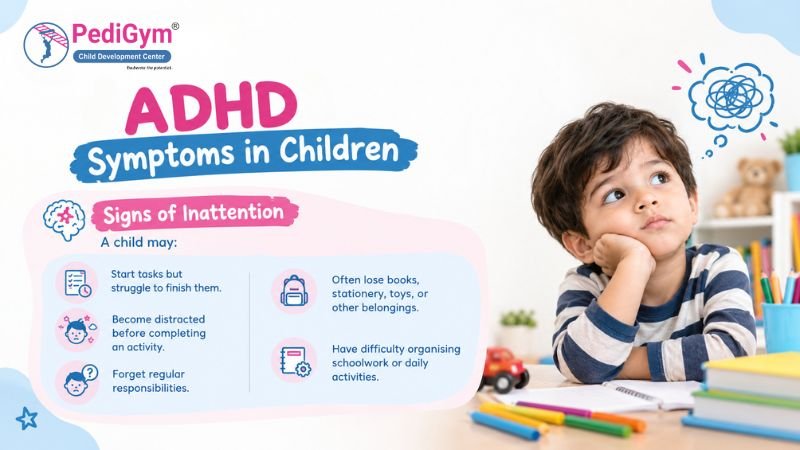
Signs of Inattention
A child may:
- Find it difficult to stay focused during homework, conversations, or activities.
- Miss details or make avoidable mistakes despite understanding the task.
- Need frequent reminders to follow through on instructions.
- Often lose books, stationery, toys, or other belongings.
- Have difficulty organising schoolwork or daily activities.
- Start tasks but struggle to finish them.
- Become distracted before completing an activity.
- Forget regular responsibilities.
- Avoid activities that require prolonged mental effort.
Signs of Hyperactivity and Impulsivity
Possible signs include:
- Frequent fidgeting, tapping, or difficulty remaining still.
- Getting out of their seat when they are expected to remain seated.
- Appearing to be constantly active or “on the go.”
- Talking excessively.
- Speaking over others or interrupting conversations.
- Answering before a question has been completed.
- Finding it difficult to wait for a turn.
- Acting quickly without considering possible consequences.
These behaviours alone do not establish ADHD. Children naturally differ in attention, energy, and behaviour. The important issue is whether the pattern is persistent, inappropriate for the child’s developmental level, occurs in more than one setting, and interferes with everyday functioning.
How Early Can ADHD Be Identified?
ADHD symptoms must have begun before age 12 for a diagnosis. Some children show noticeable difficulties during the preschool years, while others become more obviously affected as academic, social, and organisational demands increase.
This is why comparing a child only with siblings or classmates can be misleading. A professional assessment considers developmental stage, behaviour, learning, relationships, and functioning across different situations.
What Causes ADHD in Children?
The exact causes of ADHD in children are not fully understood. Research indicates that genetics have an important role, while differences in brain development, neurobiology, and certain environmental factors may also contribute.
Factors associated with ADHD risk can include:
- Family history of ADHD or related conditions.
- Premature birth or low birth weight.
- Prenatal exposure to alcohol, tobacco, or certain substances.
- Environmental exposure to toxins such as lead.
Having one of these factors does not mean that a child will necessarily develop ADHD. These are risk factors rather than direct explanations for every individual child’s symptoms.
A common misconception is that sugar causes ADHD. Current evidence does not support the idea that simply eating sugar causes the disorder.
How Is ADHD Diagnosed?
There is no single blood test, brain scan, or quick test that confirms ADHD. Diagnosis involves a detailed clinical assessment of the child’s developmental history, symptoms, behaviour, and everyday functioning.
The DSM-5-TR (Diagnostic and Statistical Manual of Mental Disorders) provides a commonly used diagnostic framework. For children, symptoms must have persisted for at least six months, occur in at least two settings, and interfere with social, school, or other important areas of functioning. Symptoms must also have begun before age 12.
An assessment may include:
- Talking with parents or caregivers.
- Reviewing developmental and school history.
- Gathering relevant information from teachers.
- Using standardised behaviour rating scales.
- Assessing learning and functional difficulties.
- Considering other possible explanations for the behaviour.
Sleep difficulties, anxiety, depression, learning disabilities, and some physical or developmental conditions can produce symptoms that resemble ADHD. A thorough assessment helps distinguish these possibilities.
Conditions That Can Occur Alongside ADHD
ADHD may occur together with other developmental, behavioural, emotional, or learning conditions, including:
- Oppositional defiant disorder
- Conduct disorder
- Learning disabilities
- Anxiety disorders
- Mood disorders
- Autism spectrum disorder
- Tic disorders
- Sleep difficulties
Identifying co-occurring conditions is important because a child’s support plan may need to address more than attention, activity level, or impulsivity alone.
What Happens If ADHD Is Not Properly Addressed?
Persistent ADHD-related difficulties can affect a child’s school performance, friendships, family relationships, confidence, and ability to manage everyday routines. Children with ADHD can also have increased risks of injuries, social difficulties, family stress, and academic problems.
This does not mean every child with ADHD will experience these difficulties. Early recognition and appropriate support can help reduce the impact of symptoms and help children build on their strengths.
When Should Parents Seek an Evaluation?
Consider seeking professional evaluation when difficulties with attention, activity level, impulsivity, or self-regulation persist over time and begin affecting your child’s schoolwork, friendships, home routines, or other daily activities.
It is particularly helpful to seek guidance when:
- Concerns are noticeable both at home and at school.
- Teachers regularly report difficulty with attention or behaviour.
- Homework and everyday routines consistently become challenging.
- Impulsive or hyperactive behaviour creates safety or social concerns.
- Your child’s academic performance is being affected.
- You are unsure whether the behaviour reflects typical development or something that needs further assessment.
The goal of an evaluation is not to label a child. It is to understand why the difficulties are occurring and what support may be appropriate.
Treatment for ADHD in Children
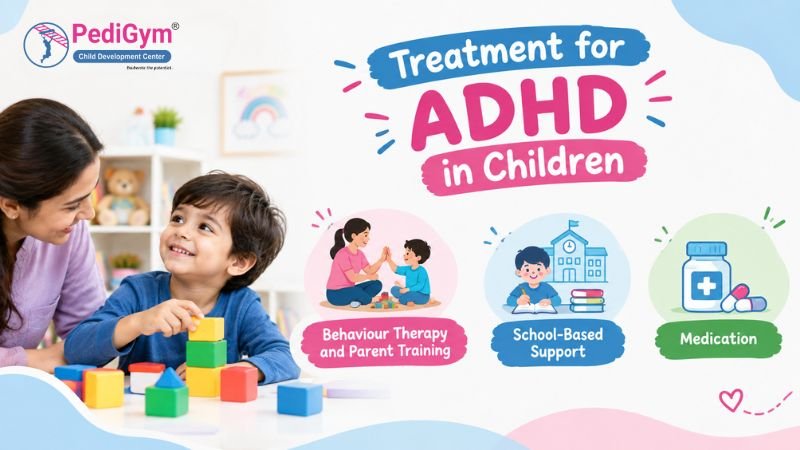
The appropriate treatment for ADHD in children depends on the child’s age, symptoms, functional needs, and assessment findings. There is no single treatment plan that works for every child.
Behaviour Therapy and Parent Training
Behavioural interventions can help children develop self-regulation and practical skills. Parent training can help caregivers establish predictable routines, communicate expectations clearly, reinforce positive behaviour, and respond consistently to challenging situations.
Parent education is an important part of treatment because children often benefit when strategies are used consistently across everyday environments.
School-Based Support
Teachers can support children through:
- Clear and brief instructions.
- Predictable classroom routines.
- Breaking larger assignments into smaller steps.
- Positive reinforcement.
- Organisational support.
- Appropriate classroom accommodations.
Coordinating strategies between home and school can provide children with more consistent support.
Medication
For some children, medication may form part of an ADHD treatment plan. It should be recommended and monitored by an appropriately qualified healthcare professional based on the child’s individual needs.
Medication can help reduce core symptoms such as inattention, hyperactivity, and impulsivity. As with any medicine, potential benefits and side effects should be discussed with the prescribing professional.
What Should Parents Bring to an Assessment?
Before an appointment, parents can make the evaluation more useful by noting:
- When the concerns were first noticed.
- Examples of behaviour at home and school.
- Teacher observations or school reports.
- Homework and learning difficulties.
- Sleep patterns and daily routines.
- Previous developmental or therapy assessments.
- Concerns about speech, learning, behaviour, social interaction, or motor skills.
- Questions about possible treatment options.
This information can help the professional understand the child’s difficulties across different settings.
ADHD Support at PediGym in Faridabad and Gurgaon
At PediGym Child Development Center, Dr. Nitin, Founder and DMI Level C Certified Therapist, leads structured, evidence-based paediatric therapy programmes in Faridabad and Gurgaon.
The approach focuses on understanding each child’s developmental and functional needs and creating appropriate therapy strategies rather than assuming that every child with attention or behaviour concerns requires the same intervention.
Parents in Faridabad and Gurgaon who notice persistent difficulties with attention, impulsivity, activity level, learning, or self-regulation can seek professional guidance to better understand their child’s needs.
Frequently Asked Questions
What is ADHD in children?
ADHD is a neurodevelopmental disorder involving persistent difficulties with attention, hyperactivity-impulsivity, or both that interfere with everyday functioning.
What are the most common ADHD symptoms in children?
Common signs include difficulty sustaining attention, forgetfulness, disorganisation, excessive activity, restlessness, interrupting, impulsive actions, and difficulty waiting for turns.
At what age can ADHD be diagnosed?
Symptoms must have begun before age 12 for an ADHD diagnosis. Some children show noticeable difficulties during the preschool years, while others become more clearly affected as school and social demands increase.
What are the causes of ADHD in children?
There is no single cause. Genetics appear to play an important role, alongside differences in brain development, neurobiology, and certain biological or environmental factors.
What is the best ADHD treatment?
There is no universal “best” treatment. Depending on the child’s age and needs, treatment may involve behaviour therapy, parent training, school-based support, medication, or a combination of approaches.
Does an active child automatically have ADHD?
No. High energy, occasional forgetfulness, or difficulty concentrating can be part of normal childhood development. ADHD involves a persistent pattern of symptoms that causes significant difficulties across relevant settings.
Medical Disclaimer
This article is for educational purposes and should not be used to diagnose or treat a child without professional evaluation. If you are concerned about your child’s attention, behaviour, learning, or development, consult an appropriately qualified healthcare professional.
Sources for Further Reading
- Centers for Disease Control and Prevention (CDC) — ADHD Data
- National Institute of Mental Health (NIMH) — ADHD: What You Need to Know
- NIMH — ADHD Health Topic
- DSM-5-TR: Diagnostic and Statistical Manual of Mental Disorders, Fifth Edition, Text Revision, American Psychiatric Association.

Dr. Nitin, Founder of PediGym Child Development Center, is a dedicated pediatric therapy expert and DMI Level C Certified Therapist leading structured, evidence-based therapy programs in Faridabad and Gurgaon. Under his guidance, PediGym provides comprehensive pediatric rehabilitation focused on improving motor skills, coordination, sensory processing, speech clarity, and functional independence through personalized intervention plans.