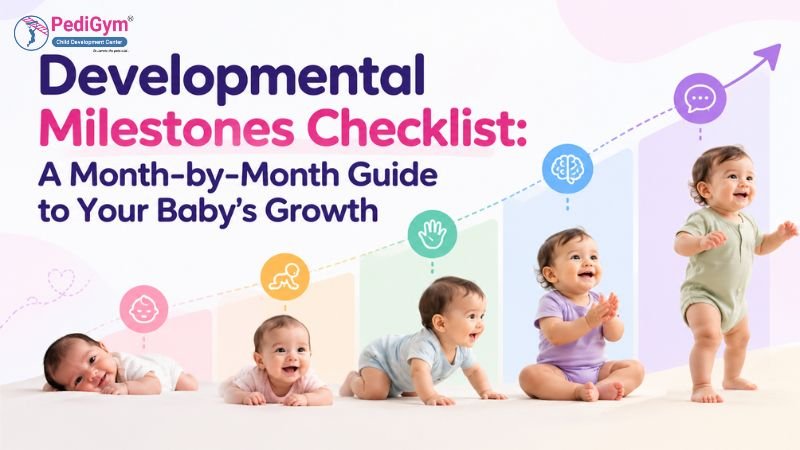
A developmental milestones checklist helps you understand how your baby learns, moves, communicates and interacts during the first year. Developmental milestones are skills that most children (75% or more) can do by a certain age. Most babies smile when you talk to them by 2 months, roll from tummy to back by 6 months, sit without support by 9 months and pull up to stand by 12 months. Babies develop at different rates, but tracking these skills can help you recognise progress and identify when your child may benefit from additional support.
Key Takeaways of Developmental Milestones Checklist
- Developmental milestones describe skills most babies achieve by a particular age.
- The four main developmental domains are social and emotional, language and communication, cognitive, and movement and physical development.
- Babies may reach milestones at different times.
- CDC milestone checklists cover specific ages, including 2, 4, 6, 9 and 12 months during the first year.
- If your baby loses a skill they previously had or you have concerns about their development, speak with your pediatrician.
What Are Developmental Milestones?
Developmental milestones are skills that most children achieve as they grow. They help parents and healthcare professionals understand how a child is progressing in areas such as movement, communication, learning and social interaction.
For example, a baby may begin smiling at people, holding their head up, reaching for toys, babbling or sitting without support as they grow.
Milestones are useful developmental guidelines, not strict deadlines. Every baby develops at an individual pace. However, understanding typical developmental milestones can help parents notice progress and recognise when professional guidance may be helpful.
According to the CDC’s developmental milestone guidance, milestones describe skills that 75% or more of children can do by a particular age.
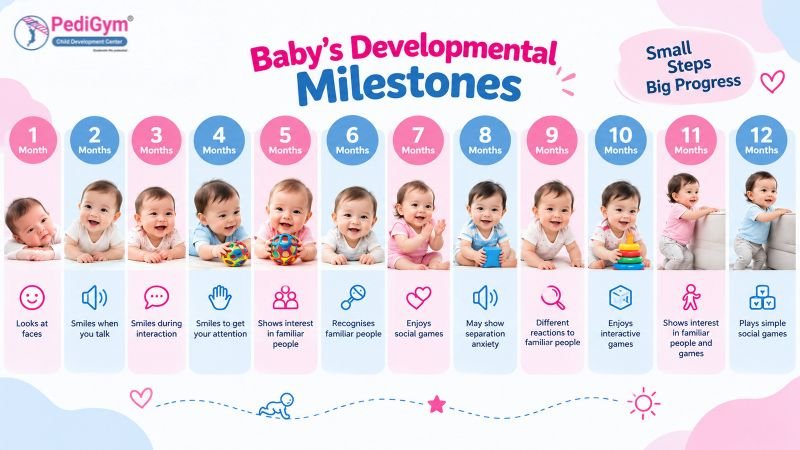
Baby Developmental Milestones Chart (1–12 Months)
The following developmental milestones chart provides a general overview of skills babies may begin developing during their first year. It is a guide for parents and should not be treated as a diagnostic checklist.
Age | Social and emotional development | Language and communication | Cognitive development | Movement and physical development |
1 month | Briefly looks at faces | Reacts to familiar sounds | Looks at nearby faces and objects | Moves arms and legs; briefly lifts head |
2 months | Smiles when you talk to them | Makes sounds other than crying | Watches you as you move | Holds head up during tummy time |
3 months | Smiles during interaction | Begins cooing and making vowel sounds | Watches moving objects | Develops better head control |
4 months | Smiles to get your attention | Makes sounds back when you talk | Looks at their hands with interest | Holds head steady without support while being held; holds a toy placed in their hand |
5 months | Shows interest in familiar people | Makes a wider range of sounds | Explores objects by looking and touching | Rolls or attempts to roll |
6 months | Recognises familiar people | Takes turns making sounds with you | Reaches for toys and explores objects with their mouth | Rolls from tummy to back and pushes up with straight arms |
7 months | Enjoys social games | Babbling becomes more varied | Explores objects using hands and mouth | Sits with support and may begin sitting independently |
8 months | May show separation anxiety | Responds to familiar words and sounds | Explores objects by shaking, banging or dropping them | Some babies begin sitting without support |
9 months | May show different reactions to familiar and unfamiliar people | Makes repeated sounds such as “mamamama” | Looks for objects that are dropped out of sight | Gets into a sitting position and sits without support |
10 months | Enjoys interactive games | Uses gestures and varied babbling | Explores how objects move and work | May pull up to stand with support |
11 months | Shows interest in familiar people and games | May understand familiar words | Uses objects during play | May pull up to stand and cruise along furniture |
12 months | Plays simple social games | Waves bye-bye and may say a special name for a parent | Puts objects into containers and looks for hidden objects | Pulls up to stand, walks holding furniture and picks up small items between thumb and finger |
Important: This chart is a general month-by-month overview. The CDC publishes milestone checklists for specific ages rather than every month. Use the official CDC checklists at 2, 4, 6, 9 and 12 months to monitor your baby’s development.
What Are the Developmental Milestones by Month?
Babies develop new skills throughout their first year. The following month-by-month guide explains common developmental changes and simple activities that can encourage learning and movement.
Warning signs are listed at CDC checklist ages (2, 4, 6, 9 and 12 months). The other monthly descriptions are general developmental observations, not separate CDC checklists.
Monthly Milestone Guide
- 1-Month Baby Milestones
- 2-Month Baby Milestones
- 3-Month Baby Milestones
- 4-Month Baby Milestones
- 5-Month Baby Milestones
- 6-Month Baby Milestones
- 7-Month Baby Milestones
- 8-Month Baby Milestones
- 9-Month Baby Milestones
- 10-Month Baby Milestones
- 11-Month Baby Milestones
- 12-Month Baby Milestones
1-Month Baby Milestones
During the first month, babies are beginning to adjust to their surroundings.
Some common developmental observations include:
- Briefly looking at a parent’s face.
- Reacting to loud or familiar sounds.
- Moving both arms and legs.
- Briefly lifting their head when lying on their tummy.
- Showing reflexive movements such as grasping.
At home: Hold your baby close, talk softly and make eye contact during everyday interactions.
2-Month Baby Milestones
At around two months, most babies become more responsive to people and their surroundings.
Other common skills include:
- Looking at your face.
- Smiling when you talk to them.
- Reacting to loud sounds.
- Looking at a toy for several seconds.
- Holding their head up during tummy time.
- Moving both arms and legs.
Talk to your pediatrician if: Your baby is not yet smiling when you talk to them, making sounds other than crying or reacting to loud sounds. These are examples of skills on the CDC 2-month checklist. Also discuss any lost skills or other developmental concerns.
At home: Talk, read and sing to your baby. Pause after making sounds to give them an opportunity to respond.
3-Month Baby Milestones
By three months, some babies begin showing more interest in people and objects.
You may notice that your baby:
- Makes more vowel-like sounds.
- Smiles during face-to-face interactions.
- Watches people and objects.
- Shows better head control.
- Enjoys looking at familiar faces.
- Moves their arms and legs more actively.
At home: Show your baby a safe toy and move it slowly from side to side while they lie on their back during supervised play.
4-Month Baby Milestones
At around four months, most babies become more expressive and physically active.
Other common skills include:
- Chuckling when you try to make them laugh.
- Turning their head towards the sound of your voice.
- Looking at their hands with interest.
- Holding their head steady without support while you hold them.
- Holding a toy when you place it in their hand.
- Swinging their arm towards toys.
- Bringing their hands to their mouth.
- Pushing up onto their elbows or forearms during tummy time.
Talk to your pediatrician if: Your baby is not yet smiling to get your attention, making sounds back when you talk or holding their head steady without support while you hold them. These are examples of skills on the CDC 4-month checklist. Also discuss any lost skills or other developmental concerns.
At home: Offer safe toys within your baby’s reach so they can practise looking, reaching and swinging their arms.
5-Month Baby Milestones
During the fifth month, babies may become more interested in exploring objects and interacting with people.
Some developmental observations include:
- Reaching towards nearby toys.
- Exploring objects with their hands.
- Making a wider range of sounds.
- Recognising familiar people.
- Rolling or attempting to roll.
- Showing interest in their surroundings.
At home: Place a safe toy nearby during supervised floor play and give your baby time to reach towards it.
6-Month Baby Milestones
At six months, most babies become more active and interested in their environment.
You may notice that your baby:
- Recognises familiar people.
- Laughs and makes sounds during interactions.
- Takes turns making sounds with you.
- Reaches to grab a toy they want.
- Rolls from tummy to back.
- Pushes up with straight arms during tummy time.
- Leans on their hands for support while sitting.
Talk to your pediatrician if: Your baby is not yet recognising familiar people, taking turns making sounds with you or rolling from tummy to back. These are examples of skills on the CDC 6-month checklist. Also discuss any lost skills or other developmental concerns.
At home: Copy your baby’s sounds, smile back and name objects they look at during play.
7-Month Baby Milestones
At seven months, babies may show more interest in exploring objects and interacting with familiar people.
Some common observations include:
- Babbling with repeated sounds.
- Showing interest in social games.
- Reaching for toys.
- Exploring objects using their hands and mouth.
- Sitting with support.
- Trying to move towards nearby objects.
At home: Place toys at different safe positions during floor play to encourage reaching, turning and movement.
8-Month Baby Milestones
During the eighth month, babies may become more aware of familiar people and their surroundings. Some may show separation anxiety or become cautious around unfamiliar people.
Other developmental observations include:
- Responding to familiar voices.
- Using varied babbling sounds.
- Exploring objects by shaking, banging or dropping them.
- Some babies begin sitting without support.
- Trying to move around independently.
- Showing interest in simple interactive games.
At home: Play simple games such as peek-a-boo and give your baby safe objects to explore.
9-Month Baby Milestones
At around nine months, most babies respond when you call their name, use a variety of repeated sounds and show interest in finding objects.
Some common skills include:
- Looking when you call their name.
- Making different sounds such as “mamamama” or “babababa”.
- Looking for objects that are dropped out of sight.
- Getting into a sitting position.
- Sitting without support.
- Moving things from one hand to the other.
Talk to your pediatrician if: Your baby is not yet looking when you call their name, making different repeated sounds or sitting without support. These are examples of skills on the CDC 9-month checklist. Also discuss any lost skills or other developmental concerns.
At home: Repeat your baby’s sounds and introduce simple words. Place a toy slightly out of reach during supervised play to encourage movement.
10-Month Baby Milestones
By ten months, babies may become more confident when exploring their surroundings.
You may notice that your baby:
- Uses varied babbling sounds.
- Reaches towards objects they want.
- Enjoys simple interactive games.
- Explores toys by shaking, banging or dropping them.
- May pull up to stand with support.
- Moves around to reach familiar people or objects.
At home: Give your baby safe opportunities to move on the floor and explore toys with different shapes and textures.
11-Month Baby Milestones
At eleven months, babies may become more active and interested in communicating. Some babies begin pulling up to stand and cruising along furniture.
Other developmental observations include:
- Using gestures to communicate.
- Responding to familiar words.
- Making different babbling sounds.
- Exploring objects and toys.
- Practising pulling up to stand.
- Moving along furniture while holding on.
At home: Name objects your baby points towards and respond to their gestures and sounds.
12-Month Baby Milestones
By twelve months, most babies show growing independence in communication, movement and exploration.
Some common developmental skills include:
- Playing simple games with familiar people.
- Waving bye-bye.
- Calling a parent “mama”, “dada” or another special name.
- Understanding “no”.
- Putting objects into a container.
- Looking for objects that you hide.
- Pulling up to stand.
- Walking while holding furniture.
- Drinking from a cup without a lid when you hold it.
- Picking up small items between their thumb and pointer finger.
Talk to your pediatrician if: Your baby is not yet waving bye-bye, putting an object into a container or pulling up to stand. These are examples of skills on the CDC 1-year checklist. Also discuss any lost skills or other developmental concerns.
At home: Offer safe objects that your baby can put into and take out of a container. Supervise closely and avoid small items that could cause choking.
What Are the Four Main Types of Developmental Milestones?
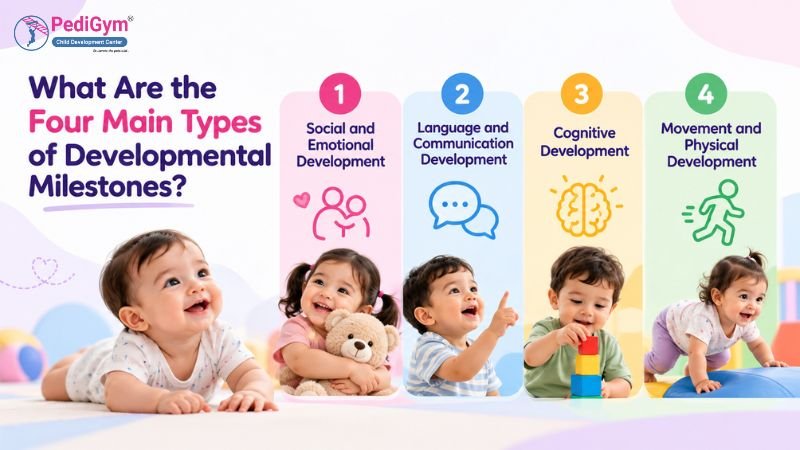
Developmental milestones are grouped into four main areas. These domains help parents and healthcare professionals understand different aspects of a child’s growth.
1. Social and Emotional Development
Social and emotional milestones relate to how babies interact with people, express feelings and respond to their surroundings.
Examples include:
- Smiling at familiar people.
- Enjoying face-to-face interactions.
- Responding to familiar voices.
- Showing interest in social games.
- Expressing discomfort or excitement.
2. Language and Communication Development
Language and communication milestones describe how babies understand sounds, communicate needs and gradually develop speech.
Examples include:
- Reacting to sounds.
- Making cooing sounds.
- Babbling.
- Responding to their name.
- Using gestures such as waving.
- Saying simple words as they grow.
Communication includes sounds, facial expressions, gestures and body movements, not only spoken words.
3. Cognitive Development
Cognitive milestones relate to how babies learn, explore, remember and understand the world around them.
Examples include:
- Watching moving objects.
- Exploring toys with their hands.
- Looking for objects that are hidden.
- Recognising familiar people and objects.
- Learning through cause and effect, such as banging two objects together to hear the sound.
4. Movement and Physical Development
Movement and physical milestones describe how babies develop control over their bodies and use their muscles.
This area includes gross motor skills, such as rolling, sitting, crawling and walking, as well as fine motor skills, such as reaching, grasping and picking up objects.
Examples include:
- Holding the head steady.
- Rolling over.
- Reaching for toys.
- Sitting without support.
- Pulling up to stand.
- Picking up small objects between the thumb and finger.
Crawling is not a required milestone on the CDC’s age-specific checklist. Babies may use different ways to move around, and some do not crawl in the typical hands-and-knees pattern.
How to Track Your Baby's Developmental Milestones
Tracking developmental milestones can help you understand your baby’s progress and discuss any concerns with a healthcare professional. You do not need to compare your baby with other children. Instead, observe the skills your baby is developing over time.
Here are some simple ways to monitor development:
- Observe everyday activities: Notice how your baby responds to sounds, faces, toys and familiar people.
- Record new skills: Write down when your baby starts smiling, rolling, sitting or making new sounds.
- Use milestone checklists: Review age-specific checklists to understand which skills are commonly expected.
- Encourage play: Provide safe opportunities for tummy time, reaching, grasping, talking and interaction.
- Discuss concerns: Share your observations with your pediatrician during routine appointments.
You can also use the free CDC Milestone Tracker to monitor your child’s development and explore age-specific milestones.
Developmental Monitoring and Developmental Screening
Developmental monitoring and developmental screening are related but different processes.
Developmental monitoring involves regularly observing your child’s development, discussing progress and noting any concerns. Parents, caregivers and healthcare professionals can all take part.
Developmental screening is a more formal process that uses standardised questionnaires or tools to identify whether a child may need further assessment.
The American Academy of Pediatrics recommends general developmental screening at 9, 18 and 30 months, and autism-specific screening at 18 and 24 months. These screenings are recommended in addition to ongoing developmental surveillance. Read the AAP guidance on developmental surveillance and screening.
Should You Use Corrected Age for Premature Babies?
Often, yes. Babies born prematurely are usually assessed using corrected age during the first two years. Corrected age accounts for how early a baby was born and can provide a more appropriate picture of developmental progress.
For example, a 4-month-old baby born 8 weeks early has a corrected age of about 2 months.
To calculate corrected age, subtract the number of weeks your baby was born early from their actual age. The American Academy of Pediatrics explains how to calculate corrected age for premature babies.
Your pediatrician can confirm how corrected age should be used when monitoring your baby’s development.
When Should You Be Concerned About Your Baby's Development?
Babies develop at different rates, so reaching a milestone later does not automatically mean there is a developmental delay. However, it is important to speak with your pediatrician if:
- Your baby is not meeting one or more skills on the relevant age-specific CDC milestone checklist.
- Your baby loses a skill they previously developed.
- Your baby does not respond to sounds or show interest in interacting.
- You notice ongoing difficulties with movement, communication or social interaction.
- You have concerns about your baby’s development, even if they are meeting other milestones.
Do not wait for your baby to reach the next age milestone if you have concerns. Your pediatrician can review your observations, carry out developmental screening when appropriate and recommend further assessment or support.
If your baby is not trying to move, does not bear weight on their legs or consistently favours one side of their body, discuss these concerns with your pediatrician. You can also find out about assessment and developmental support at PediGym.
Frequently Asked Questions
1. What are the most important developmental milestones in the first year?
Important developmental milestones during the first year include smiling at familiar people, responding to sounds, making cooing and babbling sounds, holding the head steady, rolling over, sitting without support, reaching for objects and pulling up to stand.
These skills develop across social and emotional, language and communication, cognitive, and movement and physical areas.
2. Are developmental milestones the same for every baby?
No. Developmental milestones are not the same for every baby. Some children develop certain skills earlier or later than others. Milestone checklists provide general guidelines, not strict deadlines.
However, if your baby is not meeting a milestone on the relevant checklist or has lost a skill they previously developed, speak with your pediatrician.
3. When should a baby sit without support?
Most babies sit without support by about 9 months. Some babies may develop this skill earlier or later. The CDC includes sitting without support in its 9-month milestone checklist.
If your baby is not sitting without support by this age, discuss your concerns with your pediatrician.
4. What are the four main areas of child development?
The four main areas of child development are:
- Social and emotional development.
- Language and communication development.
- Cognitive development.
- Movement and physical development.
5. When should I consult a pediatrician about developmental milestones?
Talk to your pediatrician if your baby is missing skills on their age’s CDC checklist, has lost a skill they previously developed or you are concerned about their development.
Examples of skills to discuss include:
- At 2 months: Not making sounds other than crying or not reacting to loud sounds.
- At 4 months: Not smiling to get your attention or not holding their head steady without support while you hold them.
- At 6 months: Not recognising familiar people or not rolling from tummy to back.
- At 9 months: Not looking when you call their name or not sitting without support.
- At 12 months: Not waving bye-bye, putting an object into a container or pulling up to stand.
These are examples from the CDC’s age-specific checklists, not a complete list of possible concerns. You do not need to wait until your baby misses several milestones before asking for guidance.
6. Can premature babies reach milestones later?
Yes. Babies born prematurely may reach some milestones later when measured by their actual age. Healthcare professionals often use corrected age during the first two years.
Your pediatrician can guide you on how to monitor your baby’s milestones using corrected age.
7. Is crawling a required developmental milestone?
No. Crawling is not listed as a required milestone on the CDC’s age-specific checklists. Babies may move in different ways, and some do not crawl in the typical hands-and-knees pattern.
Talk to your pediatrician if your baby is not trying to move, does not bear weight on their legs or consistently favours one side of their body.
8. How can I support my baby’s development at home?
You can support your baby’s development through everyday activities, including:
- Talking, singing and reading to your baby.
- Providing supervised tummy time while your baby is awake.
- Offering safe toys to encourage reaching and grasping.
- Playing simple interactive games.
- Responding to your baby’s sounds and gestures.
- Providing safe opportunities for movement and exploration.
Choose activities that are suitable for your baby’s age and abilities.
About the Author
Nitin Gupta, Founder of PediGym Child Development Center, is a DMI Level C Certified Therapist supporting child development in Faridabad and Gurgaon. DMI stands for Dynamic Movement Intervention, an approach focused on motor development.
Medical Disclaimer
This article is intended for general educational purposes only. Developmental milestones are guidelines and cannot replace an individual assessment by a qualified healthcare professional. If you have concerns about your baby’s development, consult your pediatrician for appropriate guidance.
Sources and References
Get Support for Your Child's Development
If you have concerns about your baby’s developmental progress, seeking professional guidance can help you understand their needs and identify appropriate next steps.
At PediGym Child Development Center, families can access child development and therapy support in Faridabad and Gurgaon.
Contact PediGym for assessment enquiries and information about its Faridabad and Gurgaon locations.

Dr. Nitin, Founder of PediGym Child Development Center, is a dedicated pediatric therapy expert and DMI Level C Certified Therapist leading structured, evidence-based therapy programs in Faridabad and Gurgaon. Under his guidance, PediGym provides comprehensive pediatric rehabilitation focused on improving motor skills, coordination, sensory processing, speech clarity, and functional independence through personalized intervention plans.