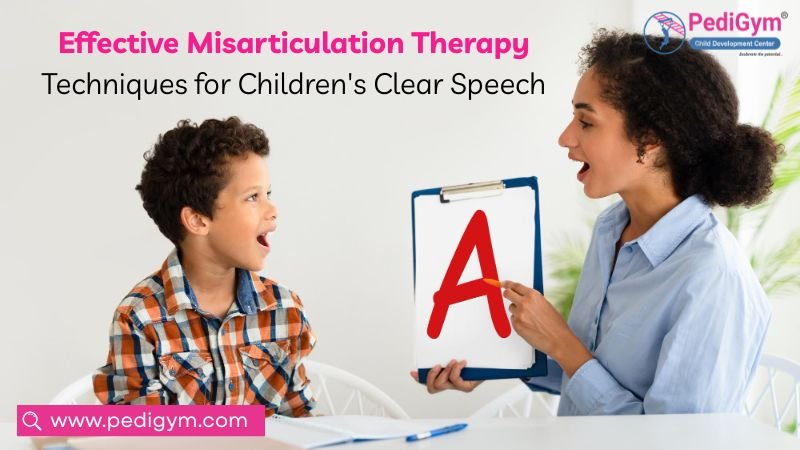
Misarticulation therapy is a specialized approach that helps correct unclear pronunciation and speak clearly. It supports children in developing accurate sounds and confidence. At PediGym, Dr. Nitin Gupta’s expert team in Faridabad & Gurgaon provides personalized, evidence-based care for children with communication difficulties.
What is Misarticulation in Children?
Misarticulation is a speech sound disorder in which a child has difficulty producing certain sounds clearly and correctly. They may replace sounds, leave them out, or pronounce words unclearly—for example, saying “wabbit” instead of “rabbit” or “thoap” instead of “soap.”
Unlike stuttering or language delay, children usually know what they want to say but have difficulty producing the sounds accurately. Speech development varies from child to child, but if speech remains unclear beyond expected developmental milestones, professional support may be helpful.
Types of Misarticulation in Children
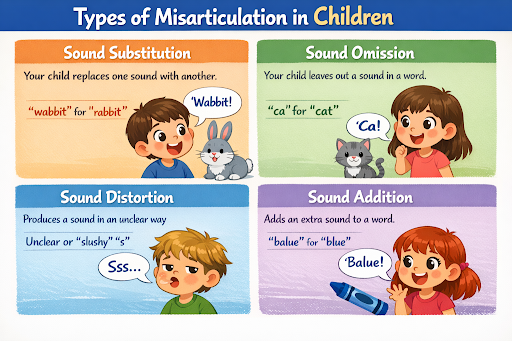
Children with articulation difficulties may show different speech patterns. Common types include:
Substitution: One sound is replaced with another. Example: saying “wed” instead of “red.”
Omission: A sound is left out completely. Example: saying “nana” instead of “banana.”
Distortion: The sound is produced incorrectly or unclearly, often sounding slurred.
Addition: An extra sound is added to a word. Example: saying “buhlack” instead of “black.”
Understanding the type of error helps speech therapists create the right therapy plan.
What Causes Misarticulation?
Common Causes of Misarticulation
- Delayed speech and language development
- Hearing loss or frequent ear infections
- Weak oral muscles or poor speech coordination
- Sensory processing differences
- Autism spectrum disorder (ASD) or ADHD
- Neurological speech disorders such as childhood apraxia of speech and dysarthria
- Structural conditions like tongue-tie or cleft palate
- Limited exposure to clear speech models
When Support May Be Needed
In many children, no single clear cause is identified. However, if speech remains unclear beyond expected developmental milestones, it may indicate the need for a speech and language evaluation.
Early assessment helps identify the underlying difficulty and supports the development of clearer, more confident communication skills.
When Does Misarticulation Resolve Naturally?
Some speech sound errors are completely normal in early childhood. Many children outgrow mild
articulation difficulties as their speech muscles strengthen and language skills develop.
However, parents should pay closer attention if speech difficulties continue beyond the expected
developmental age.
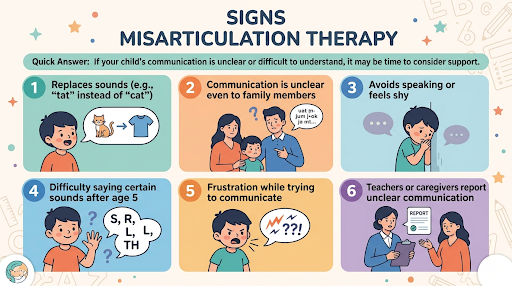
Signs That Therapy May Be Needed
Speech therapy may be needed when a child’s speech is not clear for their age or begins to affect everyday communication.
- Speech is difficult to understand after age 3–4
- Parents, teachers, or caregivers often struggle to understand speech
- The child becomes frustrated while speaking
- Speech errors continue beyond expected developmental milestones
- The child avoids speaking or social interaction
A speech-language therapist can help determine whether the child will naturally outgrow these challenges or benefit from structured therapy support.
Why early evaluation helps:
Early assessment can identify speech difficulties sooner and support clearer communication, better confidence, and improved participation at home and in school.
Effective Misarticulation Therapy Techniques
Speech therapy helps children hear, practice, and correctly produce speech sounds through structured, guided, and engaging activities. Therapy is tailored based on the child’s speech pattern, attention level, and developmental needs.
Assessment & Diagnosis: Therapy begins with a detailed speech and language evaluation to identify affected sounds and understand whether the issue is related to articulation, motor planning, hearing, or developmental factors. This helps design a targeted therapy plan.
Articulation Therapy: The therapist teaches the correct placement of the lips, tongue, and jaw to produce target sounds clearly.
Auditory Discrimination Training: Children learn to hear the difference between correct and incorrect sounds, improving self-awareness during speech.
Repetition and Motor Practice: Repeated practice strengthens speech motor planning and coordination.
Visual and Tactile Cueing: Therapists use mirrors, touch prompts, or visual demonstrations to guide sound production.
Minimal Pairs Training: Children practice words that sound similar but differ by one sound, such as “bat” and “pat.” This helps them understand how small sound changes affect meaning.
Mirror Technique: Mirrors help children observe lip, tongue, and mouth placement while producing sounds, improving self-monitoring and accuracy.
Play-Based Speech Therapy: Games, storytelling, and interactive activities help children practice speech naturally without pressure.
Home Practice Activities: Parents are given simple speech exercises to reinforce therapy goals at home. Consistent practice and positive reinforcement support progress.
How Parents Can Support Speech Development at Home
Parents play a key role in improving a child’s speech and communication skills. Daily interaction at home can strongly support progress made during therapy.
Practical strategies parents can use:
- Speak slowly and clearly during daily conversations
- Model correct words instead of directly correcting mistakes
- Repeat words naturally in conversation to reinforce sound patterns
- Read aloud daily to build vocabulary and sound awareness
- Encourage turn-taking in conversations to build communication confidence
- Practice speech sounds during play-based activities
Consistency, patience, and encouragement are more effective than pressure or frequent correction. A supportive environment helps children become more confident and willing to communicate.
Age-Based Speech Red Flags
By Age 2
- Very limited spoken words or unclear speech most of the time
- Difficulty copying simple sounds
- Parents struggle to understand basic communication
By Age 3
- Speech is still difficult for unfamiliar people to understand
- Frequent sound omissions or substitutions
- Frustration when trying to communicate
By Age 4–5
- Speech is still unclear for age, especially with later-developing sounds like S, L, R, and blends
- Difficulty participating confidently in school or group conversations
- Avoidance of speaking in social situations due to embarrassment
When to Take Action
If speech clarity does not improve with age, an early evaluation can help identify the cause and guide appropriate speech therapy support. Early intervention is often linked with better communication confidence and smoother participation in school and social settings.
Frequently Asked Questions
Q: At what age should a child’s speech become clear?
Most children become understandable to familiar adults by age 3 and much clearer to unfamiliar listeners by age 4. Some speech errors are developmentally normal, especially with difficult sounds like “R,” “L,” or “TH.” However, if speech remains difficult to understand or affects confidence and learning, a speech assessment is recommended.
Q: Is misarticulation the same as stuttering?
No. Misarticulation affects how speech sounds are produced, while stuttering affects the flow and rhythm of speech. A child with misarticulation may pronounce sounds incorrectly, whereas a child who stutters may repeat sounds, prolong words, or struggle to begin speaking.
Q: Can misarticulation improve without therapy?
Some mild articulation errors improve naturally as children grow older. However, persistent speech difficulties often benefit from early intervention. Therapy can prevent frustration, improve communication confidence, and support better social and academic participation.
Q: How long does speech therapy take?
The timeline depends on the child’s age, the type of speech difficulty, consistency of home practice, and whether other developmental conditions are present. Some children improve within a few months, while others may require longer-term support.
Q: When should parents seek speech therapy?
Parents should consider an evaluation if speech is difficult to understand, if the child becomes frustrated while communicating, or if speech errors continue beyond the expected developmental age. Early support often leads to faster and more effective progress.
Why Choose PediGym in Faridabad & Gurgaon?
PediGym is a leading child development centre in Faridabad and Gurgaon, offering evidence-based Speech Therapy, Occupational Therapy, Sensory Integration Therapy, and developmental intervention programmes for children.
The PediGym team works closely with families to improve communication skills, confidence, and overall developmental outcomes through child-friendly and goal-based therapy.
If you are concerned about your child’s speech clarity or communication development, you can book a consultation with the PediGym team for a professional assessment and guidance.
Conclusion
Misarticulation therapy plays a key role in helping children speak clearly and confidently. Early intervention prevents long-term challenges. At PediGym, Dr. Nitin Gupta and his expert team provide personalized care in Faridabad & Gurgaon. With the right support, clear communication is achievable.

Dr. Nitin, Founder of PediGym Child Development Center, is a dedicated pediatric therapy expert and DMI Level C Certified Therapist leading structured, evidence-based therapy programs in Faridabad and Gurgaon. Under his guidance, PediGym provides comprehensive pediatric rehabilitation focused on improving motor skills, coordination, sensory processing, speech clarity, and functional independence through personalized intervention plans.