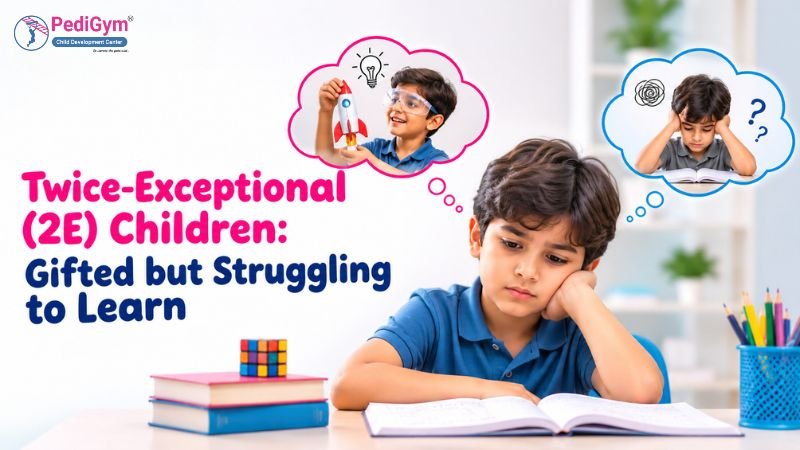
Twice-exceptional (2e) children have high abilities in one or more areas, such as reasoning, mathematics, creativity or music, alongside a learning, developmental or neurological difference such as ADHD, autism or dyslexia. The term describes a combination of strengths and challenges; it is not a formal medical diagnosis.
A child might understand advanced concepts but struggle with reading, writing, attention or social communication. These differences can make everyday learning difficult, even when the child demonstrates exceptional potential.
Understanding twice-exceptionality helps parents and teachers recognise why a child’s abilities and academic performance do not always match. Early identification and appropriate support can help children manage their difficulties while developing their strengths.
Key Takeaways for Twice-Exceptional (2E) Children
- Twice-exceptional (2e) children have gifted abilities alongside one or more learning or developmental differences.
- Masking occurs when strengths hide difficulties or learning challenges overshadow a child’s abilities.
- ADHD, autism and dyslexia are among the conditions that can occur alongside giftedness.
- Uneven academic performance, emotional sensitivity and difficulty completing everyday tasks can indicate a need for further evaluation.
- Individualised learning strategies and coordinated support can help twice-exceptional students succeed at school and at home.
What Are the Characteristics of Twice-Exceptional Children?
The characteristics of twice-exceptional children include advanced reasoning, creativity, curiosity and strong abilities in particular areas, alongside challenges with learning, communication, attention or emotional regulation.
Their development may also be uneven, a pattern known as asynchronous development. For example, a child may demonstrate advanced intellectual reasoning while having age-appropriate or delayed emotional, social or motor skills.
Common characteristics include:
- Advanced reasoning: Strong problem-solving abilities, pattern recognition and an understanding of complicated concepts.
- High curiosity: An interest in exploring unfamiliar subjects and asking detailed questions.
- Uneven abilities: Exceptional performance in mathematics or science alongside difficulties with reading, spelling or writing.
- Sensory sensitivity: Strong responses to sounds, lights, textures, smells or crowded environments.
- Perfectionism: High personal expectations and frustration when work does not meet those expectations.
- Deep interests: Strong concentration and enthusiasm for particular subjects or activities.
- Emotional intensity: Strong reactions to disappointment, changes in routine or challenging situations.
A common misconception is that gifted children should perform exceptionally well in every subject. In reality, giftedness can appear in specific areas, and difficulties elsewhere do not cancel out a child’s abilities.
Why Is Twice-Exceptionality Often Missed? Understanding Masking
Masking is one of the main reasons twice-exceptional children are difficult to identify. It occurs when a child’s strengths and difficulties hide each other, making their complete learning profile less obvious.
Three patterns are commonly recognised:
- Giftedness hides difficulties: A child uses strong reasoning and problem-solving skills to compensate for a learning challenge, making the difficulty less noticeable.
- Difficulties hide giftedness: ADHD, dyslexia or another learning difference affects classroom performance, causing teachers to overlook the child’s advanced abilities.
- Both remain unnoticed: Strengths and challenges influence performance in different ways, making the child’s overall academic achievement appear average.
For example, a child might understand a science topic at an advanced level but struggle to organise and present the information in a classroom assignment.
Some children reach grade level by using strong reasoning and hard work to compensate, yet still need support as school demands increase (Gilman et al., 2013).
The National Association for Gifted Children (NAGC) 2026 position statement explains that twice-exceptional students can face barriers to appropriate identification. When schools fail to recognise both their strengths and challenges, students may not receive the support they need.
What Are the Signs of Twice-Exceptionality in Children?
The signs of twice-exceptionality in children often appear as a difference between what they understand and what they can demonstrate in everyday situations. These patterns can change as children grow.
Preschool Children
- Show advanced vocabulary, curiosity or problem-solving abilities.
- Become frustrated with activities involving fine motor skills or following instructions.
- React strongly to certain sounds, textures or changes in routine.
- Demonstrate advanced understanding in some areas but need additional help with everyday tasks.
Accurate IQ determinations are difficult before about age six. For younger children, assessment may instead use checklists, parent and teacher input, interviews, observation and portfolios, as explained in the NAGC assessment guidance.
Primary School Children
- Understand lessons but struggle to complete written assignments.
- Show strong mathematical or creative abilities alongside reading difficulties.
- Have difficulty organising schoolwork and remembering instructions.
- Become frustrated when classroom expectations do not match their learning abilities.
Teenagers
- Perform exceptionally well in preferred subjects but struggle in others.
- Avoid activities where they fear making mistakes.
- Experience anxiety, low confidence or academic frustration.
- Find time management, planning and independent study challenging.
These signs are not diagnostic. Parents should consider consistent patterns across home, school and social environments rather than relying on one behaviour.
Can Gifted Children Have ADHD, Autism or Dyslexia?
Yes. Gifted children can also have ADHD, autism spectrum disorder (ASD), dyslexia or other learning differences. When giftedness occurs alongside one or more of these conditions, the child may be described as twice-exceptional.
Combination | Possible strengths | Possible challenges |
Giftedness and ADHD | Advanced thinking, creativity and problem-solving | Attention, impulse control, organisation and completing routine tasks |
Giftedness and autism | Strong memory, detailed knowledge and focused interests | Social communication, flexibility and sensory processing |
Giftedness and dyslexia | Complex reasoning and strong verbal expression | Reading accuracy, spelling and written language |
These are possible patterns, not a checklist. Every child’s abilities and support needs are different.
Can Giftedness Be Mistaken for ADHD or Autism?
Yes. The Child Mind Institute explains that gifted children’s intensity, restlessness and sensitivity can resemble ADHD or autism, while also noting that a child can genuinely have both.
Some characteristics, such as intense interests or difficulty with repetitive activities, may overlap. However, a child should not be assumed to have ADHD or autism based on these behaviours alone. A comprehensive assessment by qualified professionals can help distinguish overlapping characteristics from co-occurring conditions.
How Are Twice-Exceptional Children Identified?
Identifying twice-exceptional children requires an assessment of both their abilities and their learning or developmental difficulties. Academic grades or a single intelligence score cannot provide a complete picture.
The Davidson Institute describes three common identification patterns: children identified as gifted but not as having a disability, children identified with a disability but whose giftedness is overlooked, and children whose strengths and difficulties both remain unrecognised. These patterns reflect how masking can affect identification.
A neuropsychological evaluation can help build a detailed understanding of cognitive abilities, academic performance, attention, memory and other relevant areas.
There is no universally accepted definition of giftedness. The Child Mind Institute discusses how some clinicians use an IQ score of approximately 130, corresponding to the top 2% of the population, as a reference for intellectual giftedness. However, giftedness can also involve exceptional creative, artistic or specific academic abilities.
Assessment should consider individual test scores and patterns rather than relying only on an overall score. For example, a child may demonstrate strong verbal reasoning but comparatively weaker working memory or processing speed.
Why Language and Cultural Background Matter During Assessment
Assessment should account for a child’s language exposure, cultural background and educational experiences. This is particularly important for multilingual children in India who may use different languages at home and school.
Parents should share information about the child’s language development, strongest language, schooling history and everyday communication. The Davidson Institute highlights approaches such as oral questioning and additional time to demonstrate understanding. Where appropriate, professionals can also consider non-verbal assessment.
The NAGC assessment guidance highlights the importance of multiple assessment methods and avoiding bias against children from different linguistic and cultural backgrounds. It also notes that reviewing individual test subscores can help prevent twice-exceptional children from being overlooked.
How to Support Twice-Exceptional Children at Home and School
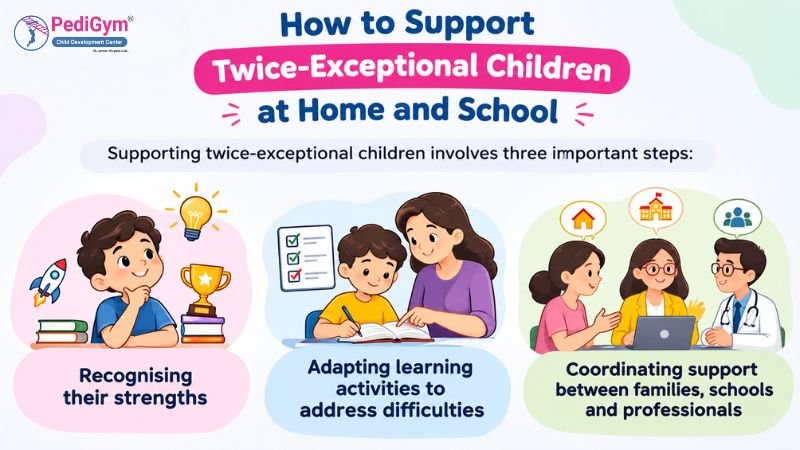
Supporting twice-exceptional children involves three important steps: recognising their strengths, adapting learning activities to address difficulties, and coordinating support between families, schools and professionals. These steps help twice-exceptional students access appropriate learning opportunities without overlooking their support needs.
The NAGC 2026 position statement recommends strength-based, talent-focused and inclusive identification and intervention so that both the abilities and vulnerabilities of twice-exceptional children receive attention.
Encourage Individual Strengths
Provide opportunities to explore interests through reading, science experiments, puzzles, art, music and creative activities. Enrichment outside school can help children develop their abilities without being limited by difficulties in other subjects.
Break Learning Activities into Smaller Steps
Instead of asking a child to complete an entire homework assignment at once, divide it into manageable tasks.
For example:
- Read one page.
- Answer two questions.
- Take a short break.
- Complete the next section.
This can make assignments easier to manage and reduce frustration.
Use Visual Routines and Reminders
A simple visual schedule can help children understand what comes next. A morning routine might include getting dressed, eating breakfast, packing a schoolbag and preparing for school.
Support Emotional Well-Being
Avoid describing children as lazy, careless or difficult when they struggle with certain tasks. Encourage them to express their feelings, recognise their efforts and understand that needing help does not reduce their abilities.
Request Appropriate School Support
Parents can arrange a meeting with the class teacher, special educator and school counsellor, where available. Discuss assessment findings and practical accommodations, such as:
- Additional time when appropriate.
- Written instructions for complex tasks.
- Reduced copying demands.
- Alternative ways to demonstrate knowledge.
- Enrichment opportunities in areas of strength.
Some parents feel they must choose between advanced learning opportunities and support for learning difficulties. However, both needs should be discussed together.
In India, available provisions and eligibility requirements can differ between individual schools and education boards, including CBSE, CISCE and state boards. Ask the school to document agreed accommodations and review their effectiveness rather than assuming that one set of rules applies everywhere.
Work with Qualified Professionals
Depending on the child’s needs, support may involve a clinical psychologist, neuropsychologist, developmental specialist, occupational therapist, speech-language therapist or special educator.
A coordinated approach can address learning, communication, sensory and developmental concerns without overlooking the child’s abilities.
How Can Unrecognised Twice-Exceptionality Affect Emotional Well-Being?
When a child’s strengths and difficulties are not recognised together, repeated academic struggles and criticism can affect emotional well-being. The Child Mind Institute explains that children may be labelled lazy or oppositional when adults do not understand the reasons behind their difficulties. This can contribute to frustration, anxiety and low self-esteem.
Possible effects include:
- Low self-esteem: Children may begin to doubt their abilities when their performance does not match their understanding.
- Anxiety: Fear of making mistakes or disappointing others can make learning stressful.
- Frustration: Repeated difficulty with tasks that appear easy for classmates can affect motivation.
- Social difficulties: Feeling misunderstood by peers or adults can affect relationships.
- School avoidance: Some children may avoid activities where they expect to struggle or receive criticism.
Recognising these emotional challenges early allows parents and educators to provide encouragement, appropriate accommodations and professional support when needed.
When Should Parents Seek Professional Support?
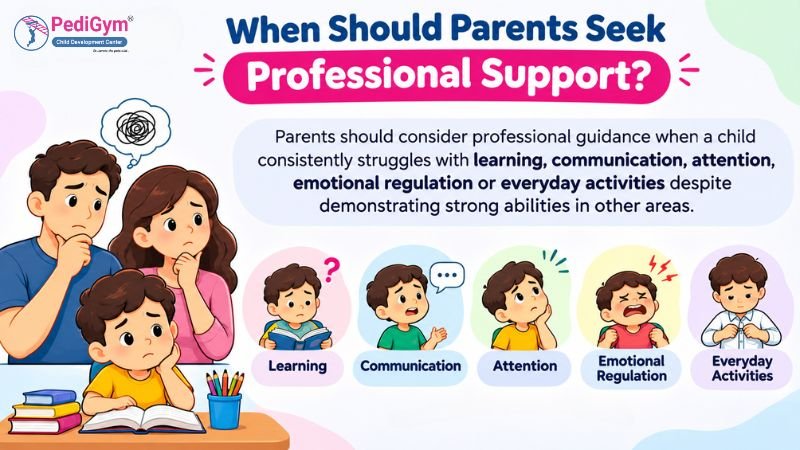
Parents should consider professional guidance when a child consistently struggles with learning, communication, attention, emotional regulation or everyday activities despite demonstrating strong abilities in other areas.
A qualified psychologist or neuropsychologist can assess cognitive abilities and learning differences. Other professionals can help address specific developmental, communication or therapy needs.
At PediGym Child Development Center, families in Faridabad and Gurgaon can discuss developmental concerns and explore appropriate therapy support based on their child’s individual needs.
If you have concerns about your child’s development or everyday functioning, contact PediGym to discuss the next appropriate step for developmental support.
Frequently Asked Questions
Is Twice-Exceptionality a Medical Diagnosis?
No. Twice-exceptionality is a descriptive term, not a formal medical diagnosis. It refers to the combination of gifted abilities and one or more learning, developmental or neurological differences. A child may receive a separate diagnosis, such as ADHD, autism or dyslexia, following an appropriate professional evaluation.
How Common Are Twice-Exceptional Children?
The exact number is unknown because many children are identified in only one area or in neither. The Davidson Institute estimates that about 6% of US students receiving special education services under IDEA may also be academically gifted. Other sources report lower and higher ranges. These are estimates, not measured global rates, and there is no confirmed India-specific figure.
Is a Twice-Exceptional Child the Same as a Child with ADHD?
No. ADHD is one possible condition that can occur alongside giftedness. Twice-exceptionality also includes children with other learning or developmental differences, such as autism and dyslexia. A child with ADHD is not automatically twice-exceptional; giftedness must also be recognised.
Can Twice-Exceptional Children Do Well in School?
Yes. With appropriate educational support, enrichment opportunities and accommodations, twice-exceptional children can perform well academically. Their progress depends on whether their learning environment recognises both their abilities and challenges rather than focusing on only one side of their development.
How Can Parents Get an Assessment in Faridabad or Gurgaon?
Parents can consult a qualified clinical psychologist or neuropsychologist experienced in assessing cognitive abilities and learning differences. Depending on the concerns, additional developmental or educational assessments may be recommended. PediGym can help families discuss developmental concerns and appropriate therapy needs; giftedness testing should be arranged with a suitably qualified assessment professional.
What Happens During an Assessment for a Possibly Twice-Exceptional Child?
An assessment usually considers a child’s cognitive abilities, academic skills and possible learning or developmental differences. A qualified psychologist or neuropsychologist may review test results, including individual subscores, developmental history, school performance and information from parents and teachers. The aim is to understand both the child’s strengths and areas where support may be needed.
What Is Asynchronous Development in Twice-Exceptional Children?
Asynchronous development means a child’s skills grow at different rates. A seven-year-old may reason like an older child, read below grade level and still need help managing frustration. This gap between abilities can cause difficulty when adults expect all skills to match.
Important: This article is for educational purposes and does not replace an individual developmental, psychological or medical assessment.
About the Author
Dr. Nitin, Founder of PediGym Child Development Center, is a DMI Level C Certified Therapist who leads paediatric therapy programmes in Faridabad and Gurgaon. He focuses on supporting children’s developmental needs through individualised therapy approaches and family-centred care.
References
- National Association for Gifted Children – Identifying and Serving Gifted Children Who Are Twice-Exceptional (2026)
- National Association for Gifted Children – Assessments and Tests
- Davidson Institute – Twice Exceptional: Definition, Characteristics & Identification
- Child Mind Institute – Twice-Exceptional Kids: Both Gifted and Challenged
- Gilman, B. J., et al. (2013). Critical Issues in the Identification of Gifted Students with Co-Existing Disabilities: The Twice-Exceptional.

Dr. Nitin, Founder of PediGym Child Development Center, is a dedicated pediatric therapy expert and DMI Level C Certified Therapist leading structured, evidence-based therapy programs in Faridabad and Gurgaon. Under his guidance, PediGym provides comprehensive pediatric rehabilitation focused on improving motor skills, coordination, sensory processing, speech clarity, and functional independence through personalized intervention plans.