Medically reviewed by: Dr. Nitin, DMI Level C Certified Therapist, Founder of PediGym Child Development Center
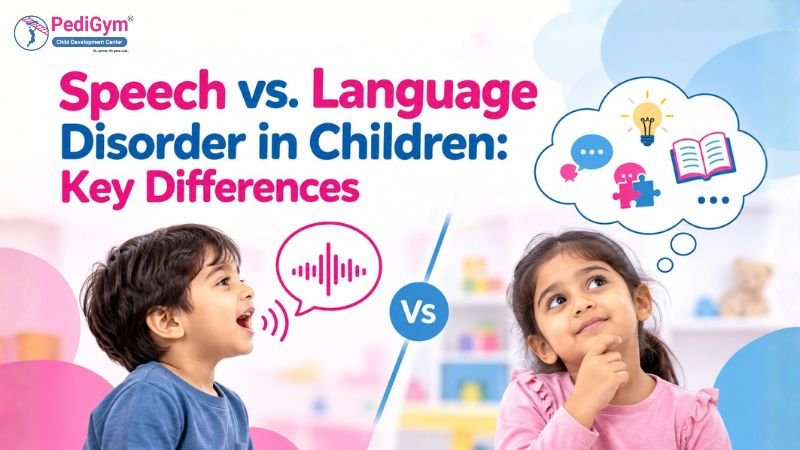
A speech sound disorder affects how a child produces speech sounds, while a language disorder affects how a child understands or uses words, sentences, and conversation. Speech disorders are broader and can also involve fluency, voice, or motor-speech skills. A child may have a speech difficulty, a language difficulty, or both.
Knowing whether a child’s difficulty is with sounds or with language helps parents choose the right kind of assessment.
Key Takeaways for Speech And Language Disorder
- Speech sound disorders mainly affect how children produce or organize speech sounds.
- Language disorders affect understanding, vocabulary, grammar, sentence formation, or social communication.
- A child can have both speech and language difficulties.
- Speech delay and language delay are not interchangeable terms.
- Learning more than one language does not cause a speech or language disorder.
- An RCI-registered speech-language pathologist can assess speech, language, communication, and related concerns.
Speech Sound Disorder vs. Language Disorder: What's the Difference?
Area | Speech Sound Disorder | Language Disorder |
Main difficulty | Producing or organizing speech sounds | Understanding or using language |
What parents may notice | Sounds are replaced, omitted, or produced incorrectly | Limited vocabulary, difficulty forming sentences, or trouble understanding |
Example | Saying “top” instead of “stop” | Knowing the word “cat” but struggling to explain what the cat is doing |
Communication impact | Speech may be difficult for others to understand | The child’s message may be incomplete or hard to organize |
Common types | Articulation disorder, phonological disorder | Receptive, expressive, or pragmatic language disorder |
What Is a Speech Sound Disorder?
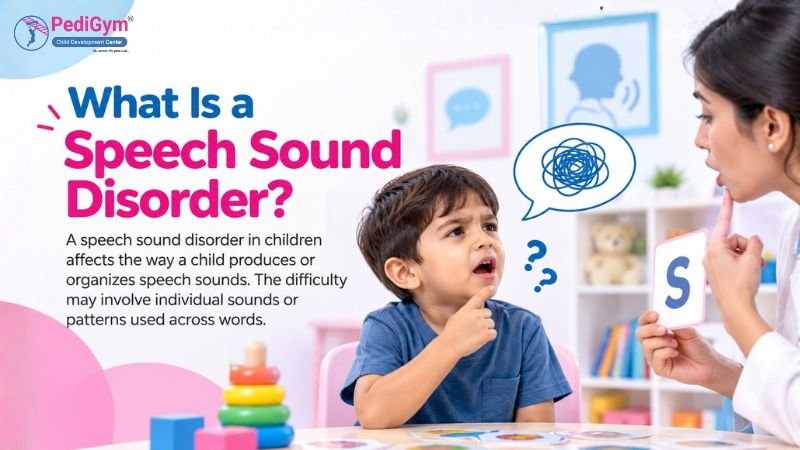
A speech sound disorder in children affects the way a child produces or organizes speech sounds. The difficulty may involve individual sounds or patterns used across words. ASHA: Articulation and Phonology
Articulation vs. Phonological Disorder
An articulation disorder involves difficulty producing particular speech sounds. For example, a child may consistently have trouble producing /r/, /s/, or another sound.
A phonological disorder involves patterns in how sounds are organized and used. A child may simplify several groups of sounds in a consistent pattern.
Speech Sound Disorder Symptoms
Common signs may include:
- Leaving sounds out of words
- Replacing one sound with another
- Adding or changing sounds
- Using unusual sound patterns
- Being difficult to understand compared with children of a similar age
- Becoming frustrated when others cannot understand them
Other Types of Speech Disorders
Speech disorders can involve more than speech sounds. They may also include:
- Fluency disorders, such as stuttering
- Voice disorders, which can affect pitch, loudness, or quality
- Motor-speech disorders, such as childhood apraxia of speech or dysarthria
Childhood apraxia of speech requires specialist assessment because it cannot be diagnosed from a few pronunciation errors alone. ASHA: Childhood Apraxia of Speech
What Is a Language Disorder?
A language disorder affects how a child understands or uses language. It can affect listening, vocabulary, grammar, sentence formation, or social communication. NIDCD describes developmental language disorder as a condition that can affect a child’s ability to learn, understand, and use language. NIDCD: Developmental Language Disorder
Receptive Language
Receptive language refers to understanding language.
A child with receptive language difficulties may:
- Struggle to follow age-appropriate directions
- Have difficulty understanding questions
- Find it hard to understand new words
- Struggle to understand concepts or sentences
Expressive Language
Expressive language refers to communicating thoughts using words and sentences.
Possible language disorder symptoms include:
- Limited vocabulary
- Difficulty combining words into sentences
- Trouble describing events
- Difficulty learning and using new words
- Persistent difficulty using grammar
- Difficulty explaining thoughts or answering questions
Social or Pragmatic Language
Some children also have difficulty using language socially, including:
- Taking turns in conversation
- Staying on topic
- Adjusting communication for different people or situations
- Understanding meaning from tone, context, or body language
Speech Delay vs. Language Delay
Speech delay generally refers to slower development of speech production skills, while language delay refers to slower development of understanding or using language.
For example, a child may understand instructions and know many words but have trouble pronouncing sounds clearly. That points more toward a speech concern.
Another child may pronounce sounds clearly but use very few words or struggle to understand simple instructions. That points more toward a language concern.
Some children experience both speech and language difficulties.
Developmental Language Disorder: Is It the Same as a Late Talker?
No. A late talker may have slower early expressive language development but can continue to develop language without meeting criteria for developmental language disorder.
Developmental Language Disorder (DLD) is a persistent difficulty with language development that affects everyday communication and is not simply explained by limited exposure to a language. NIDCD: Developmental Language Disorder
A proper assessment looks at the child’s broader communication profile rather than counting words alone.
Speech and Language Milestones: What Should Parents Watch For?
Children develop at different rates, but developmental milestones can help parents and professionals identify when further assessment may be useful. NIDCD provides speech and language milestones from birth through age five and notes that children may develop at different rates. NIDCD: Speech and Language Developmental Milestones
The red flags below are parent guidance based on these developmental references and speech-language research, not diagnostic cutoffs.
Age | Skills to monitor | Possible red flags |
Around 12 months | Babbling, gestures such as waving, responding to name, and a few first words | No babbling or gestures, or no response to sounds |
Around 18 months | Roughly 8–10 words and following simple requests | Very few or no words, or does not seem to understand simple requests |
Around 24 months | Combines words such as “more milk” and follows simple commands | No word combinations |
2–3 years | Uses two- or three-word phrases and increasingly communicates needs and ideas | Rarely combines words, very limited vocabulary, or speech is consistently difficult for familiar people to understand |
3–4 years | Uses longer sentences and communicates more effectively in everyday situations | Major difficulty expressing basic needs or understanding everyday language; less than half of the child’s speech is understood by age 4 |
4–5 years | Uses increasingly complex language for conversation, stories, and explanations | Persistent major difficulty forming understandable sentences, following conversations, or communicating ideas |
Any age | Continues developing previously acquired communication skills | Loss of previously acquired speech, language, or communication skills |
How Understandable Should a Child's Speech Be?
Speech intelligibility varies by age, listener, context, and the type of speech being assessed. Older parent-report estimates suggest about 50% intelligibility at 22 months, 75% at 37 months, and near 100% by 47 months.
A later study of English-speaking children found that unfamiliar listeners understood about 50% of single words at 31 months, 75% at 49 months, and 90% at 83 months. The researchers concluded that children should be at least 50% intelligible by 48 months. These figures come from English-speaking samples, so they should be treated as developmental guides rather than strict cutoffs. ASHA: Articulation and Phonology
What Causes Speech Sound Disorder and Language Disorder?
The causes of speech and language disorders can vary from child to child.
Factors associated with speech or language difficulties may include:
- Hearing loss or other hearing difficulties
- Structural differences affecting speech
- Motor or neurological conditions
- Developmental differences
- Family history or genetic factors, particularly in developmental language disorder
- Other developmental conditions
Some children have no single identified cause. ASHA and NIDCD describe speech and language difficulties as having multiple possible contributing factors rather than one universal cause. ASHA: Articulation and Phonology NIDCD: Developmental Language Disorder
How Is Speech or Language Disorder Diagnosed?
Diagnosis should be based on more than whether a child “sounds behind.”
An RCI-registered speech-language pathologist may assess:
- Speech sound production
- Speech intelligibility
- Receptive language
- Expressive language
- Vocabulary and grammar
- Fluency and voice when relevant
- Social communication
- Oral-motor and motor-speech skills when indicated
A hearing assessment may also be recommended because hearing difficulties can affect speech and language development.
Why Multilingual Assessment Matters in India
Children in India may grow up using Hindi, Punjabi, English, or other languages at home, school, and in the community. Learning multiple languages does not automatically indicate a speech or language disorder.
Some standardized language assessments are designed for specific language populations, so assessment should consider the child’s language exposure, home languages, and communication abilities across languages.
Research on bilingual children also shows that identifying DLD can be complex because there is limited agreement about which linguistic measures best distinguish bilingual children with DLD from typically developing peers. For example, recent research has examined Dutch-as-a-second-language children, rather than Indian language populations, so those findings should not be presented as India-specific evidence. ASHA Journal: Narrative Measures in Bilingual Children
Research involving Spanish-English bilingual children found that the amount of code-switching alone should not be used as an indicator of DLD. ASHA Journal: Code-Switching in Bilingual Children
How Can Parents Support Speech and Language Development at Home?
Parents can create many natural opportunities for communication every day.
1. Talk during everyday activities
Describe what you are doing while cooking, bathing, dressing, or travelling.
2. Read together
Ask simple questions about pictures and give your child time to respond.
3. Expand what your child says
If your child says, “car,” you can respond, “Yes, a big red car.”
4. Follow your child’s interests
Use toys, books, and activities your child already enjoys to encourage communication.
5. Encourage turn-taking
Simple games, songs, and back-and-forth play create natural opportunities to communicate.
6. Make space for face-to-face interaction
Conversation, play, reading, and interaction with caregivers provide important opportunities for communication development.
When Should Parents Seek an Assessment?
Consider seeking professional guidance if your child:
- Is not meeting expected communication milestones
- Is difficult to understand for their age
- Has difficulty understanding everyday instructions
- Uses very few words or sentences
- Struggles to communicate needs and ideas
- Has persistent speech sound errors
- Shows difficulty with social communication
- Becomes frustrated because communication is difficult
- Loses speech or communication skills they previously had
Early evaluation can help distinguish speech, language, hearing, and broader developmental concerns and guide appropriate support.
About PediGym Child Development Center
Dr. Nitin, Founder of PediGym Child Development Center, is a dedicated pediatric therapy expert and DMI Level C Certified Therapist leading structured, evidence-based therapy programs in Faridabad and Gurugram (Gurgaon).
DMI Level C is a movement-based pediatric therapy certification and is not a speech-language qualification. Speech and language concerns should therefore be assessed by an appropriately qualified speech-language professional.
Frequently Asked Questions
Is a language disorder a speech disorder?
No. A language disorder primarily affects understanding or using language, while a speech disorder can affect speech sounds, fluency, voice, or motor-speech skills.
Can a child have both a speech sound disorder and a language disorder?
Yes. Some children have difficulties with both speech production and language development. A comprehensive assessment can identify the areas that need support.
Will a speech sound disorder go away on its own?
Some speech sound difficulties resolve as speech develops, while others persist and may need intervention. The expected course depends on the child’s age, speech pattern, and individual development. A speech-language assessment can help determine whether support is appropriate.
Does bilingualism cause speech or language delay?
No. Learning Hindi, Punjabi, English, or another combination of languages does not by itself cause a speech or language disorder.
Mixing languages is normal, and a bilingual child’s vocabulary may be split across languages, so professionals should consider the child’s total vocabulary and language abilities.
The amount of code-switching alone should not indicate DLD.
What is the difference between articulation and phonological disorder?
Articulation difficulty involves producing particular speech sounds, while phonological difficulty involves patterns in how sounds are organized and used. A speech-language assessment can determine which pattern is present.
Can screen time cause speech delay?
Screen time alone does not establish a speech or language disorder, but heavy passive screen use can crowd out face-to-face interaction, especially in children under 18 months. Young children benefit from interaction with caregivers through talking, playing, reading, and responding to communication. HealthyChildren.org: Why to Avoid TV for Infants & Toddlers
How long does speech therapy take?
It varies from child to child. Duration depends on the type and severity of the difficulty, the child’s age, therapy goals, consistency of practice, and response to intervention. A speech-language professional can provide a more individualized estimate after assessment.
When should my child see a speech-language professional?
If you are concerned about your child’s speech, language, understanding, or communication, an assessment can provide clarity. Parents do not need to wait until a child becomes significantly frustrated before seeking professional guidance.
Get Professional Speech and Language Support
If your child has difficulty with speech sounds, understanding language, using words and sentences, or communicating with others, PediGym Child Development Center can connect families with appropriate pediatric therapy support.
Book a Speech and Language Assessment
Phone/WhatsApp: +9198739 71012, +918368430528
Appointment: https://pedigym.com/contact/
Final Takeaway
The key difference between speech sound disorder vs. language disorder is the area of communication affected.
A speech sound disorder primarily affects how a child produces or organizes speech sounds. A language disorder affects how a child understands, uses, and organizes language.
Because children can experience speech, language, hearing, or broader developmental difficulties together, persistent concerns are best evaluated rather than diagnosed from individual milestones or isolated speech errors.
Medical Disclaimer
This article is intended for general educational purposes and does not replace an individualized evaluation, diagnosis, or treatment plan. If you have concerns about your child’s speech, language, hearing, or development, consult an appropriately qualified healthcare or speech-language professional.
Sources
- ASHA — Articulation and Phonology
- ASHA — Childhood Apraxia of Speech
- NIDCD — Speech and Language Developmental Milestones
- NIDCD — Developmental Language Disorder
- ASHA Journal — Code-Switching in Bilingual Children
- ASHA Journal — Narrative Measures in Bilingual Children
- HealthyChildren.org — Why to Avoid TV for Infants & Toddlers

Dr. Nitin, Founder of PediGym Child Development Center, is a dedicated pediatric therapy expert and DMI Level C Certified Therapist leading structured, evidence-based therapy programs in Faridabad and Gurgaon. Under his guidance, PediGym provides comprehensive pediatric rehabilitation focused on improving motor skills, coordination, sensory processing, speech clarity, and functional independence through personalized intervention plans.