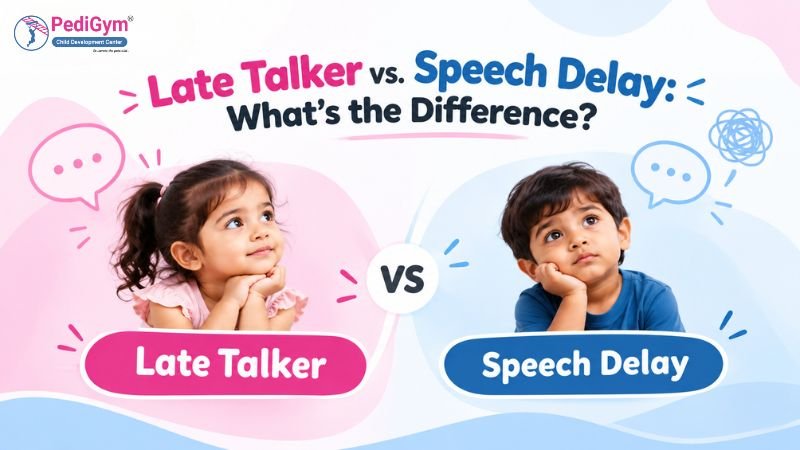
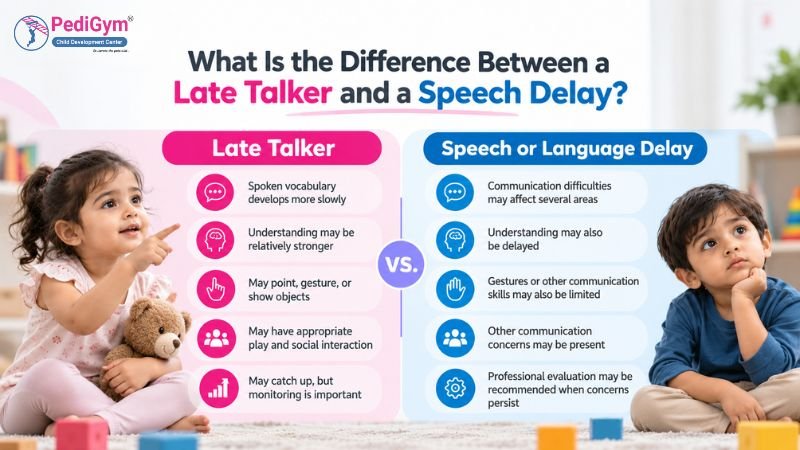
A late talker is typically a toddler whose spoken language is developing more slowly than expected, while understanding, gestures, and social skills may be relatively stronger. Late language concerns are often discussed around 18–30 months. A speech or language delay is broader and may also affect speech sounds, understanding, or communication. If your child is not progressing or loses skills, seek an evaluation.
What Is the Difference Between a Late Talker and a Speech Delay?
The main difference is what part of communication is affected.
Late Talker | Speech or Language Delay |
Usually refers to slower development of spoken vocabulary and early word combinations | May involve speech sounds, understanding, vocabulary, grammar, or broader communication |
Understanding may be relatively stronger | Understanding may also be delayed |
Gestures, social interaction, and play may be relatively strong | Social communication or other developmental areas may also be affected |
Some children catch up with continued development and monitoring | Some children need targeted speech-language support |
Speech refers mainly to how a child produces sounds and words. Language includes understanding and using words, combining them, and communicating ideas.
The Indian Speech-Language and Hearing Association (ISHA) identifies speech-language pathologists as professionals who assess and manage communication difficulties, including language delays affecting comprehension and expression.
What Does “Late Talker” Mean?
A late talker, also called a child with late language emergence (LLE), is a young child whose expressive language is developing more slowly than expected, without necessarily having difficulties in other developmental areas.
ASHA describes LLE in children approximately 2–4 years of age. One commonly used clinical criterion is that by 24 months, a child has fewer than 50 words and is not yet combining two words. This criterion was developed for monolingual English-speaking children, so it should not be treated as a strict cutoff for every multilingual child.
For a multilingual child, clinicians should consider communication across the languages the child uses rather than judging development from English vocabulary alone. Learning more than one language does not itself cause a language disorder.
A speech-language evaluation also looks beyond word count. Important areas include:
- Vocabulary growth
- Understanding of language
- Speech sounds
- Word combinations and grammar
- Gestures and other communication
- Social communication
- Symbolic and pretend play
- Progress over time
Because development can change quickly during the toddler years, children with late language emergence may be reviewed periodically, often at intervals such as six months, depending on the child’s individual needs.
At What Age Should a Toddler Talk?
Children develop language at different rates, but developmental milestones provide useful reference points. The CDC describes milestones as skills that 75% or more of children can do by a given age.
Age | Examples of communication milestones |
12 months | Waves bye-bye, uses mama/dada or another special name, and understands “no.” |
18 months | Tries to say at least 3 words besides mama/dada and follows a one-step direction without gestures. |
19–24 months | Uses and understands a growing vocabulary and begins combining words, such as “more water” or “go outside.” |
24 months | Says at least two words together, such as “more milk.” |
30 months | Uses around 50 words and combines two or more words, including an action word. |
These milestones are guides, not diagnostic tests. A child who is not meeting one milestone does not automatically have a speech or language disorder, but a consistent lack of progress is a reason to discuss development with a pediatrician or qualified speech-language professional.
When Should Parents Get a Toddler Evaluated?
Consider discussing an evaluation if your toddler:
Age or situation | What to watch for |
Around 12 months | Limited communication attempts, few gestures, or limited response to people or sounds |
Around 18 months | Very few spoken words or little progress in communication |
Around 24 months | No two-word combinations or a very limited vocabulary |
Around 30 months | Vocabulary or word combinations are noticeably behind expected development |
Any age | Loss of words, communication skills, or other previously acquired skills |
Early evaluation does not mean a child will definitely need therapy. It helps identify whether the concern is mainly expressive language, involves understanding as well, relates to speech sounds, or occurs alongside another developmental concern.
What to Prepare for a Speech and Language Evaluation
Parents can make an evaluation more useful by bringing:
- Examples of words and phrases the child currently uses
- The languages used at home and outside the home
- Previous hearing reports or a history of frequent ear infections
- Notes or videos showing how the child’s communication has changed over time
A hearing assessment may also be recommended because hearing difficulties can affect speech and language development.
What Are the Signs of a Late Talker vs. Speech or Language Delay?
Signs That May Fit a Late Talker
A toddler may:
- Use fewer words than expected for age
- Understand many everyday instructions
- Use pointing, gestures, facial expressions, or other ways to communicate
- Show interest in people
- Engage in age-appropriate play
- Continue making gradual progress in vocabulary
Signs That May Suggest a Broader Speech or Language Delay
A child may:
- Have difficulty understanding simple language
- Have very limited vocabulary
- Struggle to combine words
- Have difficulty communicating wants and needs
- Have speech that is harder to understand than expected for their age
- Show limited gestures or social communication
- Have difficulty with age-appropriate play or interaction
When several areas are affected, an evaluation is more important than simply counting words.
What Are the Risk Factors for Late Language Emergence?
The exact cause of late language emergence is not always known in otherwise healthy children. Research links late language emergence with factors such as family history, prematurity or low birth weight, delayed motor development, male sex, and slower early language development around 12 months.
Language abilities during the second year and the child’s overall developmental pattern can help clinicians understand whether a child is likely to catch up or may need closer monitoring.
Hearing also matters. If there is concern about a child’s response to sounds or speech development, a pediatrician may recommend a hearing assessment.
Late Talker vs. Autism: Is There a Connection?
Being a late talker does not automatically mean a child has autism.
Some children with isolated late language development continue to show:
- Interest in people
- Eye contact and shared attention
- Pointing and other gestures
- Social smiles and interaction
- Pretend or symbolic play
- Attempts to communicate even when spoken words are limited
Autism involves a broader pattern of differences in social communication and restricted or repetitive behaviors. Signs that may warrant a broader developmental evaluation include:
- Limited response to name
- Limited pointing or showing
- Reduced shared attention
- Limited interest in social interaction
- Repetitive movements or behaviors
- Unusual sensory responses
- Loss of previously acquired communication or social skills
The M-CHAT-R is a parent-report autism screening tool validated for toddlers 16–30 months. The M-CHAT-R/F follow-up process has also been studied in children up to 48 months. Screening is not the same as diagnosis, and professional evaluation may still be appropriate when parents or clinicians have concerns.
How Can Parents Encourage Language Development at Home?
Simple daily interactions can provide many opportunities for language learning.
1. Use Self-Talk
Talk about what you are doing:
- “Mama is washing the cup.”
- “Cut apple.”
- “Daddy is opening the door.”
2. Use Parallel Talk
Describe what your child is doing:
- “You are pushing the car.”
- “Car go!”
- “Red car!”
3. Offer Choices
Instead of asking only yes/no questions, offer two choices:
- “Do you want milk or water?”
- “Red ball or blue ball?”
4. Use a Time Delay
Pause during familiar routines and give your child time to communicate. For example, hold the bubbles and wait before blowing them.
5. Follow Your Child’s Interests
Join the activity your child already enjoys and add simple words to it.
6. Read and Talk Every Day
Shared book reading gives children repeated opportunities to hear words, point to pictures, answer simple questions, and talk about events.
Daily book sharing and informal play are also identified as protective factors for language development.[1]
7. Keep Screen Use Age-Appropriate
For children under 18 months, avoid routine screen media other than video chatting. Between 18 and 24 months, if parents introduce screen media, choose high-quality content and watch it together rather than relying on independent screen use.
Speech Therapy for Toddlers in Faridabad and Gurgaon
At PediGym Child Development Center, speech and language concerns can be assessed as part of a broader developmental picture. When needed, assessment and therapy are coordinated through an appropriately qualified speech-language professional, with hearing concerns referred to an appropriate audiology service.
An assessment may consider:
- Understanding of language
- Vocabulary
- Word combinations
- Gestures
- Speech sounds
- Social communication
- Play skills
The purpose is not simply to label a child as a “late talker.” The goal is to understand the child’s communication profile and determine whether monitoring, parent guidance, speech-language therapy, hearing assessment, or broader developmental evaluation may be appropriate.
ISHA’s professional guidance recognizes assessment and management of language delays involving both comprehension and expression within the scope of speech-language pathology in India.
Also Read This Blog: https://pedigym.com/speech-language-pathologist/
What We See at PediGym
Every toddler has a different communication profile. In practice, the important question is not only “How many words does my child say?” but also “How does my child understand, communicate, interact, and progress over time?”
A section describing PediGym’s specific clinical approach should be reviewed and approved by the center’s actual speech-language professional before publication.
Frequently Asked Questions
Is every late talker considered to have a speech delay?
No. A late talker may mainly have slower expressive language development while understanding, gestures, social interaction, and play are relatively strong. A broader speech or language delay can involve additional areas.
What is the difference between speech delay and language delay?
Speech delay mainly concerns producing speech sounds clearly and appropriately. Language delay involves understanding or using language, including vocabulary, word combinations, grammar, and communication.
Also Read This Blog: https://pedigym.com/speech-vs-language-disorder-in-children-key-differences/
At what age is late talking usually noticed?
Late language concerns are often discussed during the toddler years, particularly around 18–30 months. ASHA’s clinical discussion of late language emergence covers children approximately 2–4 years of age.
Should a toddler understand words before speaking many words?
Understanding language is an important part of development. A toddler who understands familiar words, follows simple directions, uses gestures, and communicates socially may have a different developmental profile from a child who has difficulty both understanding and expressing language.
Does being bilingual cause a child to talk late?
No. Learning two languages does not by itself cause late language emergence. Children can develop multiple languages through everyday talking, playing, reading, and interaction. Assessment should consider the child’s communication across the languages they use.
Can hearing problems cause speech or language delay?
Yes. Hearing difficulties can affect a child’s ability to hear and learn speech and language. A hearing assessment may therefore be recommended when there are concerns about communication development.
Do late talkers eventually catch up?
Many do, but not all children follow the same developmental path. ASHA reports that approximately 50%–70% of children with late language emergence catch up to peers by late preschool or school age.[1] Longitudinal research also shows that some former late talkers continue to have weaker language skills or later language difficulties, which is why monitoring remains important.
When should I worry about my toddler’s speech?
Consider seeking professional guidance if your toddler has very few words, is not combining words when expected, has difficulty understanding language, is difficult to understand for their age, shows limited social communication, is not making progress, or loses previously acquired skills.
Final Takeaway
A late talker usually has a smaller spoken vocabulary or slower early word combinations while other communication skills may be relatively stronger. A speech or language delay can affect a broader range of communication skills, including understanding, vocabulary, grammar, speech sounds, or social communication.
Many late talkers make substantial progress, but continued monitoring is important because outcomes vary. If your child is not progressing, has difficulty understanding or communicating, or loses previously acquired skills, an evaluation can help identify what support is appropriate.
For parents in Faridabad and Gurgaon, PediGym Child Development Center can help coordinate developmental and speech-language assessment when concerns arise.
Book Your Appointment
About the Author
Dr. Nitin
DMI Level C, Child Development and Motor Therapy
Medical Disclaimer
[1] ASHA — Late Language Emergence — clinical information on late language emergence, risk factors, monitoring, protective factors, and reported outcomes.
[2] ASHA — Learning More Than One Language — multilingual language development and practical guidance for families.
[3] ASHA — Spoken Language Disorders — multilingualism and assessment of spoken-language difficulties.
[4] CDC — Developmental Milestones — developmental milestone framework.
[5] CDC — 1-Year Milestones — communication milestones around 12 months.
[6] CDC — 18-Month Milestones — communication milestones around 18 months.
[7] CDC — 30-Month Milestones — communication milestones around 30 months.
[8] HealthyChildren.org — Language Delays in Toddlers — hearing assessment and speech-language evaluation guidance.
[9] HealthyChildren.org — How Active Is Your Toddler? — age-appropriate screen-use guidance.
[10] Indian Speech-Language and Hearing Association (ISHA) — professional association and Indian speech-language/hearing context.
[11] ISHA — Scope of Speech-Language Pathology — language delays, assessment, and speech-language pathology services.
[12] ISHA — Nomenclature for Speech, Language, Swallowing, Hearing and Balance Disorders in the Indian Context — Indian professional terminology and assessment framework.
[13] Indian Academy of Pediatrics — Guidelines for Parents — Indian pediatric guidance resources, including developmental and hearing concerns.
[14] Late Talkers: A Population-Based Study of Risk Factors and School Readiness Consequences — population-based longitudinal research on late talkers.
[15] Late Talkers: Do Good Predictors of Outcome Exist? — longitudinal review of late-talker outcomes.
[16] Beyond Toddlerhood: Rates of Impairment, Strengths, and Challenges in the Communication Outcomes of Former Late Talkers — recent follow-up research on outcomes after late talking.
[17] Early Language Development in Indian Children: A Population-Based Pilot Study — research on early language development in young children in urban North India.

Dr. Nitin, Founder of PediGym Child Development Center, is a dedicated pediatric therapy expert and DMI Level C Certified Therapist leading structured, evidence-based therapy programs in Faridabad and Gurgaon. Under his guidance, PediGym provides comprehensive pediatric rehabilitation focused on improving motor skills, coordination, sensory processing, speech clarity, and functional independence through personalized intervention plans.