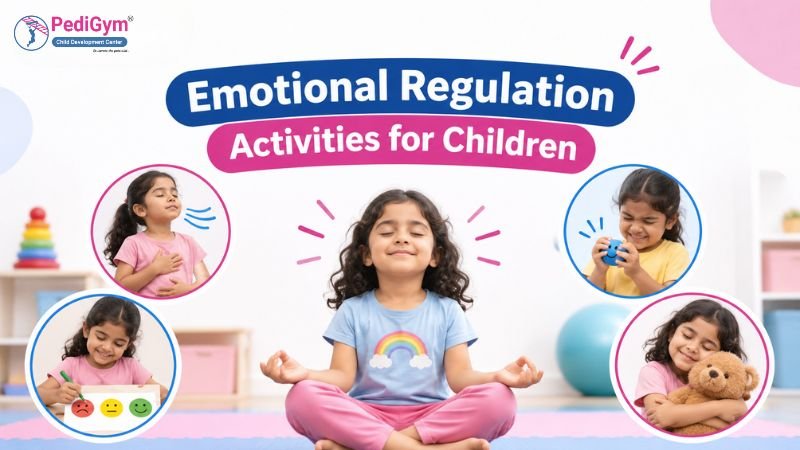
Emotional regulation activities for children are simple, play-based exercises, such as balloon breathing, emotion charts, calm-down corners, and role-play, that help children name their feelings, calm their bodies, and choose safe responses. Practised regularly during calm moments, these activities help children handle frustration, disappointment, and big emotions more independently.
Children do not automatically know how to manage strong emotions. They develop these skills through everyday experiences, supportive relationships, play, and consistent parental guidance. Whether a child becomes upset while sharing toys, struggles with schoolwork, or feels overwhelmed in a crowded environment, appropriate emotional regulation strategies can help them respond more calmly.
Key Takeaways for Emotional Regulation Activities
- Emotional regulation helps children recognise, understand, and manage their feelings.
- Activities such as breathing exercises, emotion charts, storytelling, and sensory play provide practical opportunities to practise these skills.
- Younger children need more adult guidance, while older children can gradually learn independent calming strategies.
- Co-regulation, predictable routines, and positive parental responses support emotional development.
- Persistent emotional difficulties affecting everyday activities may require professional assessment.
What Is Emotional Regulation in Children?
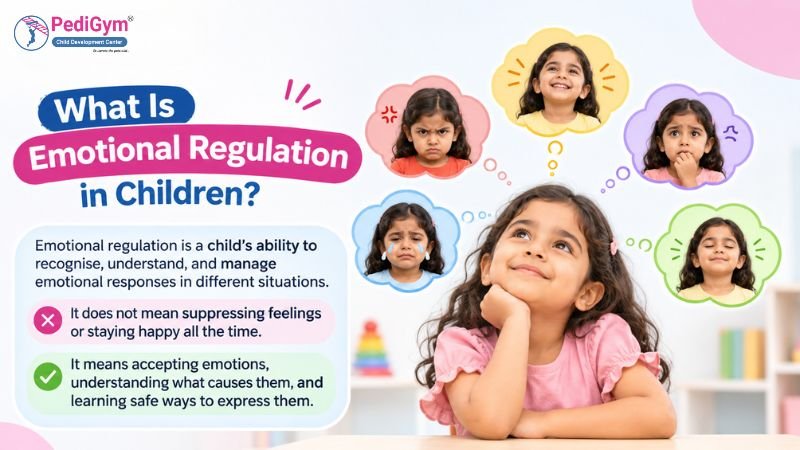
Emotional regulation is a child’s ability to recognise, understand, and manage emotional responses in different situations. It does not mean suppressing feelings or staying happy all the time. It means accepting emotions, understanding what causes them, and learning safe ways to express them.
Emotional regulation, also called emotion regulation, is closely related to self-regulation, which is broader and involves managing thoughts and feelings to support goal-directed actions.
For example, when a child loses a game, they may initially feel angry or disappointed. With guidance, they can learn to communicate their feelings, take a break, and try again instead of throwing objects or shouting.
Psychologist James Gross’s process model explains that emotions can be regulated at five stages: choosing a situation, changing a situation, directing attention, changing how an event is interpreted, and managing the emotional response.
These ideas can be applied to children’s everyday activities. A calm-down corner changes the environment, storytelling helps children consider different ways of interpreting situations, and balloon breathing helps them practise managing their physical response.
Developing these skills helps children improve communication, manage frustration, build relationships, and participate more comfortably in everyday activities.
Age-Wise Guide to Emotional Regulation Activities
Use this quick guide to match each activity to your child’s age, the time it takes, and the materials you need.
Activity | Suggested age | Time needed | Materials |
Feelings and emotion chart | 2–12 years | 5–10 minutes | Emotion cards |
Balloon breathing | 3–12 years | 3–5 minutes | None |
Emotion colour game | 3–8 years | 10 minutes | Crayons and paper |
Calm-down corner | 2–12 years | 5–10 minutes | Cushions, books, toys |
Storytelling and role-play | 3–12 years | 10–15 minutes | Books and puppets |
Sensory play | 2–8 years | 10–15 minutes | Playdough, sensory materials |
Feelings drawing | 4–12 years | 10–15 minutes | Paper and colours |
Stop, Think, and Choose | 5–12 years | 5–10 minutes | Situation cards |
Movement and dance | 2–12 years | 5–10 minutes | Music |
Gratitude jar | 5–12 years | 5–10 minutes | Jar and paper |
These are suggested activity ranges, not strict developmental milestones. Children’s emotional abilities develop at different rates, and the level of adult assistance they need varies.
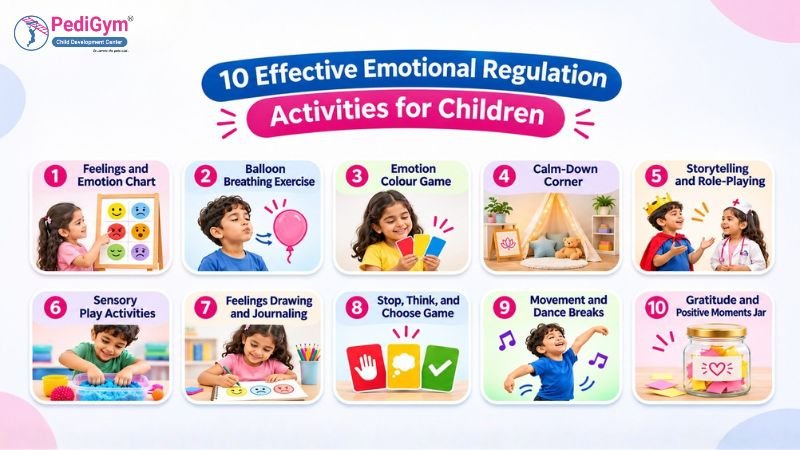
10 Effective Emotional Regulation Activities for Children
Parents can introduce emotional regulation activities through simple games and everyday interactions. Choose activities according to your child’s age, interests, and developmental needs.
1. Feelings and Emotion Chart
An emotion chart helps children identify and name different feelings.
How to do it:
- Create a chart with pictures showing happiness, sadness, anger, fear, and excitement.
- Ask your child to point to the face that matches their current feeling.
- Encourage them to explain what happened.
- Discuss what might help them feel comfortable.
For younger children, use familiar Hindi words such as ख़ुश (happy), उदास (sad), and गुस्सा (angry).
Benefits: Builds emotional awareness and helps children communicate their needs.
2. Balloon Breathing Exercise
Deep breathing is one of the simplest calming strategies for kids.
How to do it:
- Ask your child to imagine their tummy is a balloon.
- Encourage them to breathe in slowly through their nose.
- Let their tummy expand gently.
- Ask them to breathe out slowly through their mouth.
- Repeat three to five times without forcing the breathing.
Benefits: Helps children practise slowing their breathing and responding to overwhelming situations.
3. Emotion Colour Game
This activity connects colours with different emotional experiences.
How to do it:
- Introduce colours as examples, such as red for anger, blue for sadness, and yellow for happiness.
- Let your child choose a colour for their current mood.
- Give your child coloured paper or crayons and encourage them to draw something related to that feeling.
There are no correct or incorrect colour choices. The aim is to let children express how they experience their emotions.
Benefits: Develops emotional identification and creative expression.
4. Calm-Down Corner
A calm-down corner is a comfortable space where children can take a break when they feel overwhelmed.
How to do it:
- Choose a peaceful corner at home.
- Add cushions, picture books, emotion cards, and a favourite soft toy.
- Explain that the space is available whenever they need a break.
- Allow your child to choose a calming activity.
For toddlers around 2 years old, an adult should guide and stay with the child in this space. Avoid using it as punishment or forced isolation.
Benefits: Helps children recognise when they need a break and develop independent calming routines over time.
5. Storytelling and Role-Playing
Stories help children understand emotions through situations they can relate to.
How to do it:
- Read stories involving characters experiencing anger, fear, or disappointment.
- Ask, “How do you think the character feels?”
- Discuss what the character could do differently.
- Use puppets to practise situations such as sharing toys or waiting for a turn.
Benefits: Builds empathy, communication, and problem-solving skills.
6. Sensory Play Activities
Sensory play allows children to explore different textures and movements through hands-on experiences.
How to do it:
- Offer playdough for squeezing and shaping.
- Provide supervised water play using cups and containers.
- Let children explore soft fabrics or sensory balls.
- Introduce age-appropriate sand or rice activities.
Avoid small loose items, including rice, for children under 3 because they can pose a choking risk. Supervise activities involving small objects and water.
Observe your child’s preferences because sensory experiences that feel comfortable to one child may feel overwhelming to another.
Benefits: Provides opportunities for comfortable sensory exploration and engagement.
Parents can also explore sensory processing difficulties in children to understand how different sensory experiences may affect children’s responses.
7. Feelings Drawing and Journaling
Drawing and journaling give children another way to express emotions when they find verbal communication difficult.
How to do it:
- Give your child a notebook or drawing sheet.
- Ask them to draw something that made them happy, upset, or worried.
- Encourage older children to write a few words about their day.
- Discuss their drawings without judging them.
Benefits: Encourages reflection and helps children communicate experiences.
8. Stop, Think, and Choose Game
This game teaches children to pause before reacting to a difficult situation.
How to do it:
- Explain three steps: Stop, Think, and Choose.
- Give an example, such as someone taking their favourite toy.
- Ask your child to identify their feelings.
- Discuss possible responses, such as asking for the toy back or taking turns.
- Practise through role-playing.
Benefits: Supports impulse control and decision-making.
9. Movement and Dance Breaks
Physical movement provides an enjoyable opportunity for children to release energy and change activities.
How to do it:
- Play your child’s favourite music.
- Encourage dancing, jumping, or stretching.
- Try animal walks, such as walking like a bear or hopping like a frog.
- Finish with a quiet activity.
Benefits: Encourages body awareness and helps children practise transitions between active and quiet activities.
10. Gratitude and Positive Moments Jar
This activity encourages children to notice positive experiences and talk about their day.
How to do it:
- Keep an empty jar and small pieces of paper.
- Ask your child to share one positive moment from their day.
- Write or draw that moment on paper.
- Put it inside the jar and revisit the notes together.
Benefits: Encourages reflection and positive family interaction.
How Can Parents Support Emotional Regulation at Home?
Children often need adults to help them manage strong emotions before they can regulate their feelings independently. This process is called co-regulation.
Co-regulation is a supportive, interactive process in which parents and caregivers help children manage emotions through warm relationships, predictable environments, and guidance. Over time, children learn to use these strategies themselves.
Parents can support this learning through the following approaches:
- Acknowledge feelings: Say, “I understand that you are upset because your toy broke.”
- Stay calm: Regulate your own response before addressing your child’s behaviour.
- Offer reassurance: Say, “I am here. We can work through this together.”
- Give simple choices: Ask, “Would you like to draw or sit quietly?”
- Maintain routines: Consistent sleep, meal, play, and study schedules can make transitions easier.
- Practise regularly: Introduce calming strategies during relaxed moments rather than waiting for an emotional outburst.
Teaching emotional regulation strategies when children are calm gives them an opportunity to understand and practise these skills before they experience difficult emotions.
Avoid saying things such as “Stop crying” or “There is nothing to be upset about.” Instead, acknowledge the emotion while setting clear boundaries around unsafe behaviour. Harsh or punitive responses may make it harder for children who already struggle with emotional regulation to manage their behaviour.
What Are the Signs of Emotional Dysregulation in Children?
Emotional dysregulation occurs when a child has difficulty managing the intensity, duration, or expression of emotions. Occasional emotional outbursts are common, particularly during early childhood, but persistent difficulties may need additional support.
Some possible examples of behaviours parents may notice include:
- Toddlers (2–4 years): Tantrums, difficulty with transitions, and trouble expressing basic feelings. Tantrums are common during toddlerhood and the preschool years [5].
- Preschoolers (4–6 years): Difficulty sharing, frustration during everyday activities, and challenges recovering from disappointment.
- School-age children (7–12 years): Difficulty handling criticism, frequent emotional outbursts, and problems managing frustration or social situations.
These are general examples, not clinical or diagnostic signs. These behaviours do not automatically indicate a developmental or mental health condition. Their frequency, intensity, and effect on everyday activities are important considerations. If you are concerned about your child’s emotional development, discuss it with a qualified professional.
What If My Child Refuses to Try These Activities?
Not every child responds positively to every activity. If your child refuses, avoid forcing participation.
Try these alternatives:
- Offer two simple activity choices.
- Demonstrate the activity yourself first.
- Start with shorter sessions.
- Use toys, pictures, or familiar characters.
- Practise when your child is relaxed.
- Observe whether the activity itself is uncomfortable or overwhelming.
The aim is to help children discover strategies that work for them, not to make them follow a fixed routine.
When Should Parents Seek Professional Support?
Consider professional guidance when emotional difficulties regularly affect your child’s participation at home, school, or in social situations.
An assessment may be helpful if your child:
- Has frequent and intense emotional outbursts.
- Finds it difficult to communicate basic feelings or needs.
- Struggles with everyday transitions.
- Experiences persistent anxiety or frustration.
- Becomes overwhelmed by certain sounds, textures, or environments.
- Shows ongoing difficulties with peer interactions.
Children with autism, ADHD, or anxiety may experience additional challenges with emotional regulation. Their support needs vary, so strategies should be individualised rather than assuming the same approach works for everyone.
Depending on the assessment, support may involve counselling, occupational therapy, speech therapy, or other developmental services.
Parents in Faridabad and Gurugram can explore PediGym’s occupational therapy support for children with autism when sensory or developmental difficulties affect their child’s everyday participation.
Frequently Asked Questions
1. What are the best emotional regulation activities for children?
Useful emotional regulation activities include emotion charts, balloon breathing, storytelling, sensory play, drawing, role-playing, and movement games. These activities help children identify feelings, practise calming strategies, and communicate their needs. Choose activities according to your child’s age, interests, and developmental abilities.
2. At what age should children learn emotional regulation?
Emotional regulation starts developing in infancy through responsive caregiving, so there is no single age to begin. Parents can start naming feelings early and introduce simple activities such as emotion charts or breathing games from around age 2 or 3, with adult support. Older children gradually use these strategies more independently. Development varies from child to child [4].
3. How can I help my child calm down when angry?
Start by acknowledging your child’s feelings and making sure everyone is safe. Speak calmly, reduce unnecessary stimulation, and offer a familiar strategy such as slow breathing, drawing, or taking a break. Avoid lengthy explanations during an emotional outburst. Discuss what happened once your child feels calmer and is ready to communicate.
4. Can sensory activities help with emotional regulation?
Sensory activities may help some children engage comfortably with different textures, movements, and materials. For example, playdough, water play, and sensory balls provide opportunities for hands-on exploration. However, sensory preferences vary. Observe your child’s responses and avoid activities that cause discomfort or distress.
5. Can children with autism develop emotional regulation skills?
Yes. Children with autism can develop emotional regulation skills with appropriate support, predictable routines, visual communication tools, and individualised strategies. Activities should respect their sensory preferences and communication needs. Depending on the child’s assessment, occupational therapy, speech therapy, or counselling may also support their developmental needs.
6. How do I teach a toddler to regulate emotions?
Start by naming your toddler’s feelings using simple words such as happy, sad, or angry. Offer comfort when they become upset and demonstrate simple strategies such as slow breathing or sitting together in a quiet space. Toddlers need adult guidance and repeated practice. Keep activities short, playful, and appropriate for their developmental abilities.
7. Is emotional regulation the same as self-regulation?
Emotional regulation is an important part of self-regulation. Emotional regulation focuses on recognising and managing feelings, while self-regulation is broader and involves managing thoughts and feelings to support goal-directed actions. Both skills help children respond to challenges and participate in everyday activities .
8. How long does it take to see improvement in emotional regulation?
There is no fixed timeline because every child develops at a different pace. Some children may begin using a familiar calming strategy after repeated practice, while others need ongoing adult support. Signs of progress may include recovering from frustration more quickly, expressing feelings more clearly, or using a calming strategy without being reminded.
Conclusion
Emotional regulation activities for children help them recognise their feelings, communicate their needs, and respond to everyday challenges. Breathing exercises, emotion charts, sensory play, storytelling, and movement games provide practical opportunities to develop these skills.
Every child develops at a different pace. Consistent encouragement, parental co-regulation, and appropriate professional support can help children gradually use healthy emotional regulation strategies in daily life.
At PediGym Child Development Center, children in Faridabad and Gurugram (Gurgaon) can access structured developmental support based on their individual needs.
Looking for guidance for your child’s developmental needs? Contact PediGym to discuss an assessment and suitable support options.
About the Author
Dr. Nitin Gupta, Founder of PediGym Child Development Center, is a paediatric therapy professional and a Level C Certified Dynamic Movement Intervention (DMI) Therapist. He leads structured therapy programmes in Faridabad and Gurugram, focusing on supporting children’s developmental needs through individualised care.
References
- Gross, J. J. (1998). The Emerging Field of Emotion Regulation: An Integrative Review. Review of General Psychology, 2(3), 271–299.
https://doi.org/10.1037/1089-2680.2.3.271 - Rosanbalm, K. D., & Murray, D. W. (2017). Co-Regulation from Birth through Young Adulthood: A Practice Brief. Administration for Children and Families, Office of Planning, Research, and Evaluation.
https://acf.gov/opre/report/co-regulation-birth-through-young-adulthood-practice-brief - Harvard Health Publishing (2024, April 3). Co-regulation: Helping children and teens navigate big emotions.
https://www.health.harvard.edu/blog/co-regulation-helping-children-and-teens-navigate-big-emotions-202404033030 - Weir, K. (2023, April 21). How to Help Kids Understand and Manage Their Emotions. American Psychological Association.
https://www.apa.org/topics/parenting/emotion-regulation - Centers for Disease Control and Prevention (CDC). Understanding the Early Years: Toddlers and Preschoolers.
https://www.cdc.gov/parenting-toddlers/understanding-the-early-years/index.html

Dr. Nitin, Founder of PediGym Child Development Center, is a dedicated pediatric therapy expert and DMI Level C Certified Therapist leading structured, evidence-based therapy programs in Faridabad and Gurgaon. Under his guidance, PediGym provides comprehensive pediatric rehabilitation focused on improving motor skills, coordination, sensory processing, speech clarity, and functional independence through personalized intervention plans.