

Written by: Dr. Nitin Gupta, Founder, PediGym Child Development Center
Picky eating is usually about food preferences, while a feeding problem can involve difficulty chewing, swallowing, managing textures, or eating enough to support growth. Persistent gagging, coughing, food pocketing, avoiding entire food groups, or poor weight gain may indicate a feeding difficulty that needs professional assessment. These signs can sometimes be linked to oral-motor challenges.
If your child regularly struggles during meals, understanding the difference between selective eating and a feeding problem can help you decide when to seek support.
Key takeaways For Picky Eating or a Feeding Problem
- Picky eating usually involves food preferences; a feeding problem may affect eating skills, nutrition, safety, or growth.
- Frequent gagging, coughing, food pocketing, and difficulty chewing age-appropriate textures deserve attention.
- Children gradually move from mashed foods to lumpy, chopped, and family foods as their skills develop.
- A pediatrician and a qualified feeding and swallowing professional can help identify the cause.
Important safety note: Frequent coughing, choking, breathing difficulties, or a wet, gurgly voice during or after meals can indicate a swallowing problem. Other warning signs include weight loss, falling off the growth curve, dehydration, or refusing most food and fluids. Seek prompt medical assessment if these occur. Breathing difficulty or serious choking requires immediate medical attention.
Picky Eating vs. Problem Feeding: How to Recognize the Difference
Picky eating generally involves food preferences. A child may reject vegetables, prefer familiar foods, or take time to accept new foods. However, they can usually manage age-appropriate textures and eat comfortably.
Problem feeding involves persistent difficulties that affect eating skills, nutrition, safety, or participation in family meals.
Typical Picky Eating | Possible Feeding Problem |
Prefers familiar foods | Refuses several food textures or entire food groups |
Sometimes rejects new foods | Frequently gags or coughs during meals |
Eats a reasonable variety over time | Has a very restricted food range |
Chews and swallows comfortably | Struggles to chew, move, or swallow food |
Usually manages mealtimes | Experiences prolonged or stressful meals |
Maintains expected growth | Has poor weight gain or nutritional concerns |
There is no universal number of accepted foods that distinguishes a picky eater from a problem feeder. The variety, nutritional quality, eating skills, and impact on daily life matter more than a food count alone.
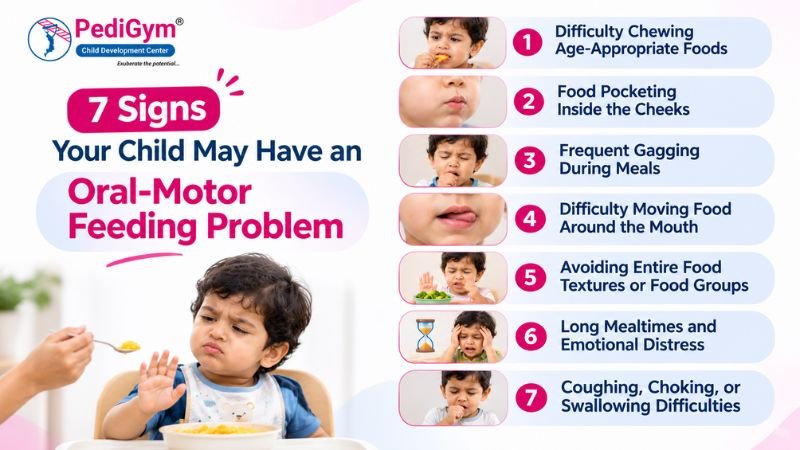
7 Signs Your Child May Have an Oral-Motor Feeding Problem
The following signs can help parents identify when eating difficulties may involve oral skills, sensory processing, or swallowing.
1. Difficulty Chewing Age-Appropriate Foods
Difficulty chewing means a child struggles to break down food using coordinated jaw and tongue movements. They may prefer soft foods such as mashed potatoes or khichdi but struggle with age-appropriate pieces of vegetables, fruit, or chapati.
Watch for unusually long chewing, swallowing food before adequately chewing it, or avoiding foods that require more effort.
2. Food Pocketing Inside the Cheeks
Food pocketing means a child holds food inside the cheeks instead of moving it efficiently toward the back of the mouth for swallowing.
You may notice food remaining inside the cheeks even after your child appears to have finished eating. This can indicate difficulty with oral awareness or food movement.
3. Frequent Gagging During Meals
Frequent gagging means a child’s gag reflex repeatedly triggers on certain textures, tastes, or portion sizes, interrupting the meal.
Some children gag when introduced to lumpy foods, mixed textures, or foods that require more chewing. Occasional gagging can happen while learning new textures, but repeated episodes that interfere with eating deserve attention.
4. Difficulty Moving Food Around the Mouth
Difficulty moving food means a child struggles to use the tongue to move food between the teeth for chewing.
You may notice that your child chews only on one side, keeps food near the front of the mouth, or struggles to manage different food consistencies.
5. Avoiding Entire Food Textures or Food Groups
Persistent avoidance of food textures can indicate sensory or feeding skill difficulties.
For example, your child may comfortably eat pureed dal or mashed khichdi but refuse soft pieces of idli, cooked sabzi, roti, or fruit. Some children also become distressed by particular food smells, appearances, or textures.
6. Long Mealtimes and Emotional Distress
Repeatedly prolonged meals can indicate that eating is difficult or uncomfortable for a child.
Watch for:
- Regularly taking more than 30 minutes to finish meals. ² ¹
- Crying, meltdowns, or anxiety when food is presented.
- Refusing meals because of particular smells or textures.
- Vomiting or repeated gagging during meals.
- Avoiding family meals or becoming distressed around food.
These behaviors should be understood alongside the child’s eating skills, medical history, and nutritional needs rather than treated simply as misbehavior.
7. Coughing, Choking, or Swallowing Difficulties
Coughing or choking while eating and drinking can indicate difficulty swallowing safely.
Other warning signs include:
- A wet or gurgly voice after swallowing.
- Frequent throat clearing during meals.
- Food or liquids leaking from the mouth or nose.
- Congestion during or after eating.
- Recurrent respiratory infections.
These symptoms may be associated with dysphagia (swallowing difficulties) and require professional assessment.
What Causes Feeding Difficulties in Children?
Feeding difficulties can have several contributing factors. They are not always caused by oral-motor challenges.
Common factors include:
- Sensory sensitivities: Certain tastes, smells, temperatures, and textures may feel uncomfortable.
- Developmental differences: Some children need additional support to develop age-appropriate feeding skills.
- Medical concerns: Reflux, gastrointestinal conditions, and swallowing difficulties can affect eating.
- Negative feeding experiences: Previous choking, gagging, or discomfort can contribute to food avoidance.
Children may experience more than one contributing factor. Understanding the underlying concern is important when planning appropriate support. You can also read our guide to oral-motor difficulties and when therapy may be considered for a detailed explanation.
When Do Children Develop Different Food Texture Skills?
Most children progress from soft, well-mashed foods at around 6 months to lumpy foods during 6–9 months, finely chopped foods that require chewing from 9 months, and family foods from 12 months. India’s National Health Mission (NHM) describes this progression in its Mother-Child Protection Card Guidebook.
Age | Food Texture and Examples |
On completion of 6 months | Begin complementary foods with thick porridge and soft, well-mashed foods such as vegetables, fruits, and dal. |
6–9 months | Gradually increase food consistency and introduce mashed and lumpy foods, such as khichdi and dalia. |
9–12 months | Introduce finely chopped foods that require chewing and soft foods the child can pick up. |
12–24 months | Progress to family foods, chopped or mashed as needed. |
These are general feeding recommendations, not rigid developmental deadlines. Readiness, developmental abilities, and safe food preparation matter. Children with feeding difficulties may need individual guidance before progressing to more complex textures.
If your child is well past these age ranges and still cannot manage lumpy or chopped foods, or consistently refuses them, discuss the difficulty with a pediatrician or feeding specialist.
Choking safety: Avoid giving children foods such as whole nuts, whole grapes, and raw carrot pieces until their chewing and swallowing abilities are sufficiently developed.
The NHM Mother-Child Protection Card Guidebook provides age-specific complementary feeding guidance. The NHM guidebook also identifies developmental warning signs at 3 years, including being unable to eat without help and continuous drooling. Children showing these signs may need assessment and referral to a District Early Intervention Centre (DEIC).
What Is Pediatric Feeding Disorder (PFD), and How Is It Different from ARFID?
Persistent feeding difficulties can sometimes fall under two recognized clinical conditions: Pediatric Feeding Disorder (PFD) and Avoidant/Restrictive Food Intake Disorder (ARFID).
Pediatric Feeding Disorder (PFD) refers to age-inappropriate oral intake associated with medical, nutritional, feeding skill, or psychosocial difficulties, lasting at least two weeks. It can affect a child’s ability to eat enough food, manage appropriate textures, or participate comfortably in meals (Goday et al., 2019).
Avoidant/Restrictive Food Intake Disorder (ARFID) involves persistent food restriction or avoidance that results in significant nutritional, growth, or psychosocial consequences. It is not simply ordinary picky eating.
PFD and ARFID have overlapping features, but they are not interchangeable diagnoses. ASHA notes that ARFID does not cover feeding difficulties primarily caused by a skill problem, such as dysphagia. PFD and ARFID can occur separately or together.
A qualified healthcare professional must assess the child’s symptoms and determine the appropriate referral or diagnosis. The 2025 US-based consensus paper by Estrem et al. discusses their diagnostic overlap and differences.
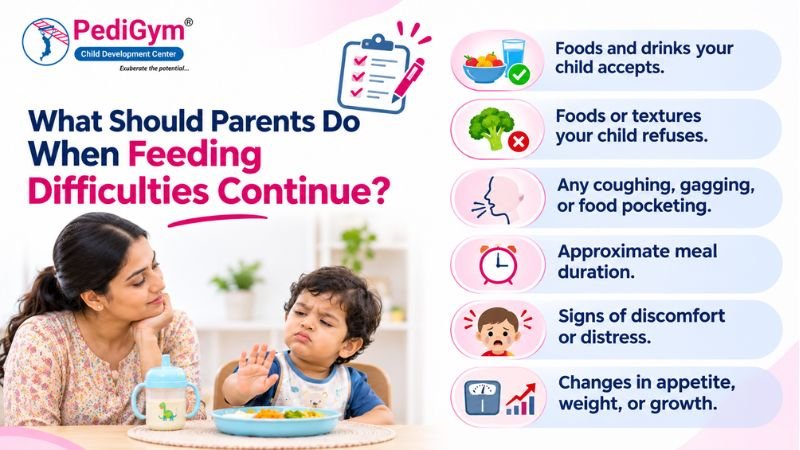
What Should Parents Do When Feeding Difficulties Continue?
If your child regularly struggles with chewing, swallowing, or managing different food textures, consider a professional feeding assessment.
A useful first step is to maintain a simple food diary for seven days. Record:
- Foods and drinks your child accepts.
- Foods or textures your child refuses.
- Any coughing, gagging, or food pocketing.
- Approximate meal duration.
- Signs of discomfort or distress.
- Changes in appetite, weight, or growth.
Also watch for signs of dehydration, such as reduced urination, dry mouth, or unusual tiredness. If your child cannot or will not drink, seek medical help the same day. For babies who cannot breastfeed or drink, seek immediate medical assessment.
A pediatrician can review medical and growth concerns. A speech-language pathologist with pediatric feeding and swallowing expertise can assess chewing, oral coordination, and swallowing. An occupational therapist may contribute when sensory processing, positioning, or self-feeding skills are involved. A dietitian can help evaluate nutritional adequacy. A psychologist may be involved when anxiety, ARFID, or significant food-related distress is suspected. ¹
An assessment helps identify the child’s actual needs. Not every child with selective eating requires therapy. Read our guide to oral-motor therapy to understand when this type of support may be considered.
Feeding Assessment at PediGym Child Development Center
When feeding difficulties affect a child’s daily routine, an individualized assessment can help families understand the challenges and identify suitable support.
PediGym Child Development Center offers feeding-related therapy services for families in Faridabad and Gurugram.
Parents can explore the following services:
- Oro-Motor and Feeding Therapy in Faridabad
- Oro-Motor and Feeding Therapy in Gurugram
- Speech Therapy for Children
- Sensory Integration Therapy
Dr. Nitin Gupta, Founder of PediGym Child Development Center, is a pediatric therapy professional and DMI Level C Certified Therapist. He leads the center’s pediatric developmental programs, with an individualized approach to children’s developmental needs.
If your child regularly struggles with chewing, food textures, or mealtimes, contact PediGym.
Call: +91 98739 71012
WhatsApp: Chat with PediGym
Visit: Contact PediGym to discuss your child’s needs and available assessment options.
Frequently Asked Questions
1. How can I tell if my child is a picky eater or has a feeding problem?
A picky eater generally prefers familiar foods but can chew and swallow comfortably. A feeding problem may involve persistent gagging, coughing, food pocketing, difficulty managing textures, or poor growth. Consider the child’s overall eating skills, nutritional intake, and mealtime experience rather than food preferences alone.
2. How many foods should a child eat before it becomes a concern?
There is no universally accepted food-count threshold for diagnosing a feeding problem. A child’s nutritional variety, accepted food groups, ability to manage age-appropriate textures, and growth are more important. A very restricted diet or exclusion of entire food groups warrants professional assessment.
3. Will my child grow out of picky eating?
Some children gradually accept more foods as they grow and become familiar with different tastes and textures. However, persistent food restriction, chewing difficulties, frequent gagging, or nutritional concerns should not be ignored. Early assessment can help identify whether additional support is needed.
4. Who should assess my child’s feeding difficulties?
A pediatrician can evaluate medical and growth concerns. A speech-language pathologist with pediatric feeding expertise can assess chewing and swallowing skills, while an occupational therapist may help with sensory and self-feeding difficulties. A dietitian can assess nutrition, and a psychologist can support anxiety or suspected ARFID. The appropriate team depends on the child’s symptoms.
5. Can children with autism or developmental delays have feeding difficulties?
Yes. Some children with autism or developmental delays experience sensory sensitivities, restricted food preferences, or difficulties developing age-appropriate feeding skills. However, these challenges vary between children. An individualized assessment helps identify whether medical, sensory, nutritional, or oral-motor factors are involved.
6. Is gagging normal in toddlers, and when is it a concern?
Occasional gagging can occur when toddlers learn to manage unfamiliar food textures. However, frequent gagging that interrupts meals, causes vomiting, or leads to food refusal deserves assessment. Gagging accompanied by coughing, choking, or breathing difficulties requires prompt medical attention because it may indicate a swallowing concern.
7. When should lumpy foods be introduced?
NHM complementary feeding guidance recommends gradually introducing mashed and lumpy foods during 6–9 months, followed by finely chopped foods that require chewing from 9 months. Children progress at different rates, so persistent difficulty managing these textures should be discussed with a pediatrician or feeding specialist.
References
- American Speech-Language-Hearing Association (ASHA) – Pediatric Feeding and Swallowing
- Goday et al. (2019) – Pediatric Feeding Disorder: Consensus Definition and Conceptual Framework
- National Health Mission – Guidebook for Mother-Child Protection Card (2018), Complementary Feeding
- Estrem et al. (2025) – A US-Based Consensus on Diagnostic Overlap and Distinction for Pediatric Feeding Disorder and Avoidant/Restrictive Food Intake Disorder
- National Health Mission – Handbook for ASHA on Home Based Care for Young Child
Medical disclaimer
This article is intended for educational purposes and does not replace professional medical advice, diagnosis, or treatment.

Dr. Nitin, Founder of PediGym Child Development Center, is a dedicated pediatric therapy expert and DMI Level C Certified Therapist leading structured, evidence-based therapy programs in Faridabad and Gurgaon. Under his guidance, PediGym provides comprehensive pediatric rehabilitation focused on improving motor skills, coordination, sensory processing, speech clarity, and functional independence through personalized intervention plans.