Reviewed By: Dr. Nitin Gupta
Founder, PediGym Child Development Center | DMI Level C Certified Therapist
Dr. Nitin Gupta is a pediatric therapy expert specializing in evidence-based rehabilitation for children with developmental challenges. He leads personalized therapy programs focused on improving motor development, sensory processing, speech, coordination, and functional independence, helping children achieve their developmental potential through structured intervention.
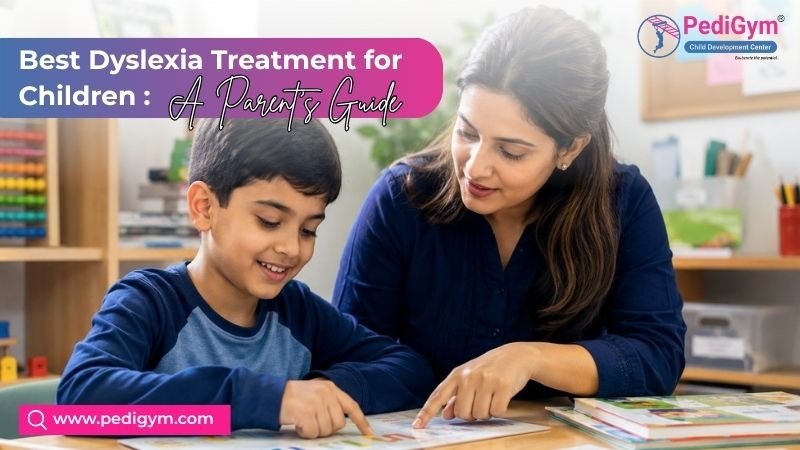
The best dyslexia treatment isn’t a single therapy or programme it’s an evidence-based, personalised approach that helps your child learn in the way their brain processes language. Research from the International Dyslexia Association (IDA) recommends structured literacy, systematic phonics instruction, and early intervention as the most effective ways to support children with dyslexia.
The earlier dyslexia treatment for children begins, the better the chances of improving reading, spelling, writing, and confidence. Alongside professional support, parents play a vital role by creating a positive learning environment and practising dyslexia learning strategies at home.
In this guide, you’ll learn how dyslexia is diagnosed, which interventions have the strongest evidence, and how to choose the right support for your child.
Key Takeaways for Dyslexia Treatment
- Dyslexia is a lifelong learning difference, not a disease.
- There is no cure, but the right dyslexia treatment can significantly improve reading and learning outcomes.
- Early intervention for dyslexia helps children build stronger literacy skills and confidence.
- Structured literacy and phonics-based instruction are considered the most effective evidence-based interventions by leading literacy organisations.
- Every child benefits from an individualised learning plan based on their strengths and challenges.
Dyslexia Treatment at a Glance
Question | Answer |
Can dyslexia be cured? | No. Dyslexia is lifelong, but evidence-based intervention helps children develop strong reading and learning skills. |
What is the best dyslexia treatment? | Structured literacy, phonics-based reading intervention, and personalised educational support. |
Who diagnoses dyslexia? | Educational psychologists, developmental specialists, or multidisciplinary assessment teams. |
When should intervention begin? | As soon as persistent reading difficulties are recognised. |
Can children with dyslexia succeed? | Yes. With the right support, children with dyslexia can thrive academically and personally. |
Why Choosing the Right Dyslexia Treatment Matters
Watching your child struggle to read can be worrying. You may notice they avoid books, take longer to complete homework, or become frustrated when reading aloud. Many parents initially believe their child simply needs more practice, but persistent reading difficulties in children may indicate an underlying learning difference such as dyslexia.
The good news is that dyslexia is highly manageable with the right support.
Effective dyslexia treatment focuses on teaching children how to read using structured, evidence-based methods rather than expecting them to “pick it up” naturally. When children receive appropriate support early, they are more likely to improve literacy skills, participate confidently in class, and develop a positive attitude towards learning.
What Is Dyslexia?
Dyslexia is a specific learning difference that affects the way the brain processes written language. It primarily impacts reading accuracy, spelling, word recognition, and reading fluency, but it does not affect intelligence or a child’s ability to succeed.
According to the International Dyslexia Association (IDA), dyslexia is characterised by difficulties with accurate and fluent word recognition, spelling, and decoding. These challenges are often linked to differences in phonological processing—the ability to recognise and work with the sounds in language.
Children with dyslexia may experience:
- Difficulty recognising letter sounds
- Slow or inaccurate reading
- Frequent spelling mistakes
- Trouble reading unfamiliar words
- Difficulty remembering sequences
- Challenges following written instructions
These child learning difficulties often become more noticeable as academic expectations increase. Early recognition allows families to seek appropriate dyslexia support for children before confidence and school performance are affected.
What Causes Dyslexia?
One of the biggest misconceptions is that dyslexia develops because a child isn’t trying hard enough.
Research shows the opposite.
Dyslexia is a neurodevelopmental learning difference with a strong genetic component. Children with a family history of dyslexia are more likely to experience similar reading challenges, although the severity and symptoms can vary. The National Institute of Child Health and Human Development (NICHD) also notes that dyslexia is related to differences in how the brain processes language—not intelligence or motivation.
Importantly, dyslexia is not caused by:
- Poor parenting
- Low intelligence
- Lack of effort
- Poor teaching alone
- Too much screen time
Understanding the cause helps parents focus on finding the right treatment for dyslexia in kids instead of blaming themselves or their child.
How Is Dyslexia Diagnosed?
Many parents searching for dyslexia treatment are actually asking another important question first:
“How do I know if my child has dyslexia?”
There isn’t a single medical test that diagnoses dyslexia. Instead, a qualified professional carries out a comprehensive assessment to understand how your child learns and whether their reading challenges are consistent with dyslexia or another learning difference.
A comprehensive assessment may include:
1. Developmental and Family History
A specialist will discuss:
- Early speech and language milestones
- Family history of dyslexia or learning differences
- School performance
- Reading development
- Behaviour and attention concerns
Because dyslexia often runs in families, this information helps build a clearer picture of your child’s learning profile.
2. Reading and Language Assessments
Children complete age-appropriate activities that assess:
- Phonological awareness
- Letter-sound knowledge
- Reading fluency
- Word decoding
- Spelling
- Reading comprehension
These assessments identify strengths as well as areas requiring targeted dyslexia intervention.
3. Vision and Hearing Screening
Although vision and hearing problems do not cause dyslexia, professionals may recommend screening to rule out other conditions that could affect learning.
4. Cognitive and Learning Assessments
Depending on the child’s needs, specialists may also evaluate memory, language processing, attention, and other cognitive skills. This information helps create a personalised intervention plan rather than a one-size-fits-all recommendation.
Why Early Assessment Matters
A diagnosis is not a label—it’s the first step towards understanding how your child learns best.
Research consistently shows that early intervention for dyslexia leads to better literacy outcomes because children receive targeted support before reading gaps become more difficult to close. Identifying challenges early also helps families access appropriate school accommodations, such as an Individualized Education Plan (IEP) or other educational support where available.
Can Dyslexia Be Cured?
One of the most common questions parents ask is:
“Can dyslexia be cured?”
The answer is no.
Dyslexia is a lifelong learning difference, not an illness that can be cured with medication or a single therapy. However, this does not mean children cannot become successful readers.
With the right dyslexia treatment, evidence-based teaching methods, and consistent support, children can make significant progress in reading, spelling, writing, and overall academic confidence.
Parents should also be cautious of programmes that promise a “quick cure” or dramatic improvements in a short time. Effective intervention focuses on developing skills gradually through structured teaching and regular practice not miracle solutions.
Why Early Intervention Makes a Lasting Difference
One of the most important factors in successful dyslexia treatment is when support begins.
Many parents are advised to “wait and see” if their child catches up with classmates. However, if reading difficulties persist despite good teaching and regular practice, delaying support can make learning more challenging.
As children progress through school, they move from learning to read to reading to learn. When reading remains difficult, it can affect every subject, including science, mathematics, and social studies.
According to the National Institute of Child Health and Human Development (NICHD), children who receive early intervention for dyslexia are more likely to develop stronger literacy skills and experience better long-term academic outcomes.
Early support can help children:
- Improve reading fluency and decoding skills
- Strengthen spelling and writing
- Increase reading confidence
- Reduce frustration and school-related anxiety
- Develop effective lifelong learning strategies
The key message for parents is simple: don’t wait for your child to “grow out of it.” Seeking professional guidance early provides the best opportunity for success.
What Is the Best Dyslexia Treatment for Children?
There is no universal dyslexia treatment that works for every child because every child has unique strengths, challenges, and learning needs.
Instead, the most effective dyslexia treatment for children combines evidence-based teaching methods with an individualised intervention plan. The goal is not just to improve reading but also to build confidence, independence, and a positive attitude towards learning.
Below are the interventions most widely recommended by literacy experts.
Evidence-Based Dyslexia Treatment Options
Intervention | How It Helps | Recommended For |
Structured Literacy | Explicit, systematic reading instruction | All children with dyslexia |
Phonics-Based Reading Intervention | Improves decoding and word recognition | Early readers and struggling readers |
Multisensory Learning Techniques | Reinforces learning using multiple senses | Reading, spelling, and memory development |
Educational Therapy | Develops literacy and learning strategies | Children needing personalised academic support |
Speech Therapy | Improves language processing and phonological awareness | Children with speech or language difficulties |
Occupational Therapy | Supports handwriting, fine motor, and sensory skills | Children with additional motor or sensory challenges |
Important: The best results usually come from combining several evidence-based approaches rather than relying on a single therapy.
1. Structured Literacy Approach
The structured literacy approach is widely recognised as the gold standard for dyslexia intervention.
The International Dyslexia Association (IDA) recommends structured literacy because it teaches reading in a clear, explicit, and systematic way. Instead of expecting children to recognise words naturally, they are taught how sounds, letters, syllables, and words work together.
Structured literacy focuses on:
- Phonemic awareness
- Letter-sound relationships
- Decoding skills
- Spelling patterns
- Vocabulary development
- Reading comprehension
Because learning is introduced step by step, children develop a strong foundation before moving to more advanced reading skills.
2. Phonics-Based Reading Intervention
A phonics-based reading intervention teaches children how letters represent sounds and how those sounds combine to form words.
Many children with dyslexia struggle to decode unfamiliar words. Systematic phonics instruction helps them recognise sound patterns instead of memorising words by sight.
An effective phonics programme should be:
- Explicit
- Sequential
- Structured
- Cumulative
- Regularly reviewed
When delivered consistently, phonics instruction improves reading accuracy, spelling, and fluency, making it one of the most effective forms of reading intervention for dyslexia.
3. Multisensory Learning Techniques
Children with dyslexia often learn more effectively when they can see, hear, and physically engage with information at the same time.
Multisensory learning techniques involve activities such as:
- Tracing letters while saying sounds aloud
- Building words with magnetic letters
- Colour-coding spelling patterns
- Writing in sand or textured materials
- Using movement, rhythm, or songs to reinforce learning
These approaches help strengthen memory and make reading lessons more engaging.
4. Educational Therapy for Dyslexia
Educational therapy for dyslexia goes beyond traditional tutoring by focusing on how a child learns rather than simply helping with homework.
An educational therapist may help children improve:
- Reading comprehension
- Writing and spelling
- Organisation and study skills
- Executive functioning
- Independent learning strategies
Sessions are personalised to the child’s learning profile, allowing them to progress at a pace that builds confidence as well as academic skills.
5. Speech Therapy for Dyslexia
Not every child with dyslexia requires speech therapy. However, children who also have difficulties with spoken language, sound awareness, or language processing may benefit from speech therapy for dyslexia.
Speech-language therapists may work on:
- Phonological awareness
- Vocabulary development
- Listening skills
- Language comprehension
- Sentence formation
- Communication confidence
Improving language skills often supports better reading because spoken and written language are closely connected.
6. Occupational Therapy for Dyslexia
Although dyslexia mainly affects literacy, some children also experience difficulties with handwriting, fine motor coordination, attention, or sensory processing.
In these cases, occupational therapy for dyslexia can complement educational support by helping children improve:
- Pencil grip and handwriting
- Fine motor control
- Classroom participation
- Organisation during learning tasks
Occupational therapy does not replace reading instruction, but it can remove physical and sensory barriers that affect learning.
Evidence-Based Reading Programmes Parents Should Know About
Parents often search for a specific programme, hoping to find the “best” solution. While no programme is right for every child, several internationally recognised approaches are supported by structured literacy principles.
Orton-Gillingham Approach
The Orton-Gillingham Approach is one of the most established methods for supporting children with dyslexia. It uses explicit, sequential, and multisensory instruction to teach reading, spelling, and writing skills.
Wilson Reading System®
The Wilson Reading System® is designed for children who require intensive literacy support. It focuses on phonics, decoding, spelling, and reading fluency through carefully structured lessons.
Barton Reading & Spelling System®
The Barton Reading & Spelling System® is a one-to-one programme that helps children strengthen phonemic awareness, spelling, and reading skills using a structured sequence of lessons.
Remember: A successful programme depends not only on the method but also on accurate assessment, qualified professionals, regular practice, and active parent involvement.
Evidence-Based Treatments vs Quick Fixes
Parents naturally want the fastest solution, but it’s important to distinguish between interventions supported by research and programmes that make unrealistic promises.
Evidence-Based Approaches | Approaches to Be Cautious About |
Structured literacy | Programmes claiming to “cure” dyslexia |
Systematic phonics instruction | Guaranteed overnight results |
Orton-Gillingham Approach | Treatments without published evidence |
Wilson Reading System® | One-size-fits-all learning plans |
Personalised educational therapy | Methods that ignore individual learning needs |
If a programme promises a “miracle cure” or guarantees dramatic improvements within a few weeks, it’s worth asking for the evidence behind those claims. Effective dyslexia treatment builds skills progressively through structured, consistent instruction—not quick fixes.
How to Help a Child with Dyslexia at Home
Professional dyslexia treatment is most effective when learning continues beyond therapy sessions or the classroom. Parents don’t need to become teachers, but creating a supportive home environment can reinforce the progress children make during intervention.
Here are practical ways to provide dyslexia support for children at home:
Read Together Every Day
Spending 15–20 minutes reading together helps build vocabulary, comprehension, and confidence. If reading feels difficult, try shared reading or audiobooks alongside printed books so your child can follow the text while listening.
Keep Practice Short and Consistent
Children with dyslexia often benefit from shorter, focused practice sessions rather than long study periods. A consistent daily routine is usually more effective than occasional lengthy sessions.
Use Multisensory Activities
Reinforce learning with simple activities such as:
- Building words with magnetic letters
- Tracing letters in sand or shaving foam
- Playing rhyming and sound-matching games
- Using flashcards with pictures and sounds
These multisensory learning techniques make learning more engaging while strengthening memory and reading skills.
Celebrate Progress
Every child progresses at their own pace. Praise effort, persistence, and improvement rather than focusing only on accuracy. Small successes help children develop resilience and confidence.
Supporting Your Child's Emotional Wellbeing
Dyslexia doesn’t only affect reading—it can also affect a child’s confidence.
Children who struggle with reading may begin to believe they are “not good at school” or avoid activities where they fear making mistakes. Supporting emotional wellbeing is therefore an important part of any dyslexia treatment plan.
Parents can help by:
- Explaining that dyslexia is a different way of learning, not a measure of intelligence.
- Recognising strengths in creativity, problem-solving, sports, music, or art.
- Encouraging effort instead of perfection.
- Maintaining open communication with teachers and specialists.
- Helping children understand that many successful people have dyslexia.
When children feel supported emotionally, they are more willing to practise new skills and overcome learning challenges.
Common Myths About Dyslexia
Many misconceptions still surround dyslexia. Understanding the facts helps parents make informed decisions.
Myth: Children will outgrow dyslexia.
Fact: Dyslexia is lifelong, but the right dyslexia treatment helps children develop effective reading and learning strategies.
Myth: Dyslexia means low intelligence.
Fact: Dyslexia is unrelated to intelligence. Many children with dyslexia are highly creative, capable, and talented in a wide range of areas.
Myth: Reading more books alone will solve the problem.
Fact: Reading practice is valuable, but children with dyslexia also need structured, evidence-based instruction such as phonics-based reading intervention and the structured literacy approach.
Myth: Every child needs the same treatment.
Fact: Every child learns differently. The best treatment for dyslexia in kids is always personalised to their individual strengths and learning needs.
How Pedigym Supports Children with Dyslexia
At Pedigym, we recognise that no two children experience dyslexia in exactly the same way. That’s why our approach focuses on understanding each child’s individual learning profile before recommending intervention strategies.
Our programmes combine evidence-informed practices with personalised support to help children strengthen literacy skills, improve confidence, and develop practical learning strategies. Parent involvement is encouraged throughout the intervention process because consistent support at home and in therapy often leads to better outcomes.
Rather than focusing only on academic performance, our goal is to help children become confident, independent learners who can participate successfully at school and in everyday life.
If you’re concerned about your child’s reading or learning development, booking an assessment is the first step towards understanding their needs and identifying the most appropriate support.
Frequently Asked Questions
What is the most effective dyslexia treatment?
The most effective dyslexia treatment combines structured literacy, systematic phonics instruction, multisensory learning techniques, and personalised educational support based on the child’s needs.
Can dyslexia be cured?
No. Dyslexia is a lifelong learning difference. However, with early intervention and evidence-based support, children can significantly improve their reading, writing, spelling, and learning outcomes.
When should dyslexia intervention begin?
Support should begin as soon as persistent reading difficulties in children are identified. Research shows that early intervention for dyslexia leads to better academic and emotional outcomes.
Does every child with dyslexia need therapy?
Not necessarily. Some children benefit from structured literacy instruction alone, while others may also benefit from speech therapy for dyslexia, occupational therapy for dyslexia, or educational therapy for dyslexia, depending on their individual needs.
How can parents support a child with dyslexia?
Parents can help by reading together daily, encouraging consistent practice, using multisensory activities, celebrating progress, and working closely with teachers and specialists.
Final Thoughts
Choosing the right dyslexia treatment starts with understanding that every child learns differently. There is no single programme that works for everyone, but there is strong evidence that early intervention, structured literacy, phonics-based reading intervention, and personalised support can help children build the skills they need to succeed.
Equally important is recognising your child’s strengths. Dyslexia may present challenges with reading and writing, but it does not define a child’s intelligence, creativity, or future potential. With evidence-based intervention, encouragement from parents, and support from experienced professionals, children with dyslexia can become confident learners and achieve success in school and beyond.
If you’ve noticed ongoing reading or learning challenges, seeking professional guidance early can provide clarity and help your child receive the support they need at the right time.
About the Reviewer
Dr. Nitin Gupta is the Clinical Director at Pedigym and reviews educational content to ensure it reflects evidence-informed practices and Pedigym’s approach to supporting children with developmental and learning challenges.
References
This article is informed by guidance and research from:
- International Dyslexia Association (IDA) – Structured Literacy and dyslexia guidance.
- National Institute of Child Health and Human Development (NICHD) – Research on dyslexia and early intervention.
- American Academy of Pediatrics (AAP) – Clinical guidance on identifying and supporting children with learning differences.
- International Literacy Association (ILA) – Best practices for literacy instruction.

Dr. Nitin, Founder of PediGym Child Development Center, is a dedicated pediatric therapy expert and DMI Level C Certified Therapist leading structured, evidence-based therapy programs in Faridabad and Gurgaon. Under his guidance, PediGym provides comprehensive pediatric rehabilitation focused on improving motor skills, coordination, sensory processing, speech clarity, and functional independence through personalized intervention plans.