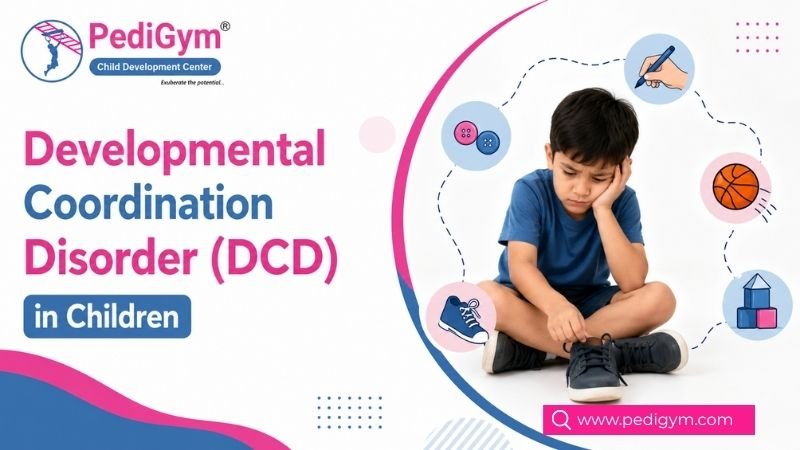
Is your child often called “clumsy” because they fall frequently, struggle with handwriting, have difficulty catching a ball, or take longer to learn everyday tasks? These challenges may be more than ordinary clumsiness. Developmental Coordination Disorder (DCD) is a condition that affects motor coordination and can make everyday activities, schoolwork, sports and self-care more difficult.
DCD affects approximately 5–6% of school-aged children. It causes persistent difficulties with motor coordination, such as handwriting, dressing, sports and balance, that are below what would be expected for the child's age and interfere with everyday activities.
Medically reviewed by Dr. Nitin, DMI Level C Certified Therapist and Founder of PediGym Child Development Center.
What Is DCD in Children?
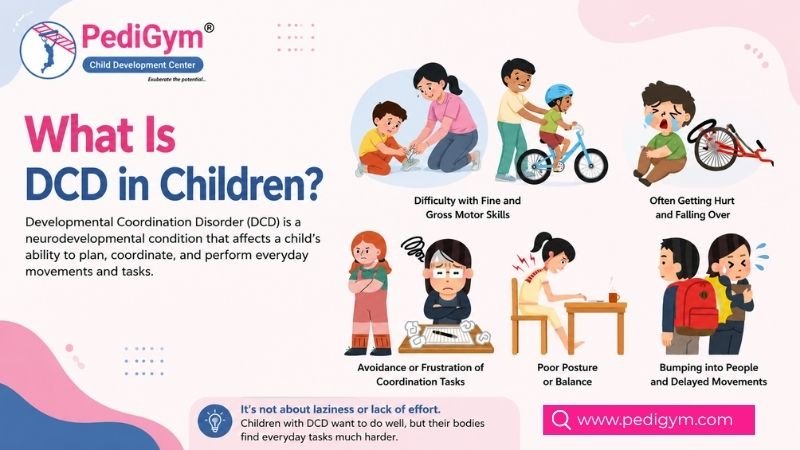
Developmental Coordination Disorder (DCD) is a condition in which a child’s ability to learn and perform coordinated motor skills is significantly below what would be expected for their age. It can affect handwriting, dressing, sports, balance, self-care and other everyday activities.
DCD is sometimes called dyspraxia or developmental dyspraxia. Children with DCD may understand what they want to do but have difficulty planning, organizing or carrying out the required movements efficiently.
It is important to remember that not every child who appears clumsy has DCD. Occasional falls, spills or difficulty learning a new physical skill can be a normal part of childhood. DCD is considered when motor difficulties are persistent, significantly below the expected level and interfere with daily life, school or play.
At PediGym Child Development Center, we provide structured, evidence-based pediatric therapy for children with DCD in Faridabad and Gurgaon.
Key Takeaways About DCD
- DCD affects approximately 5–6% of school-aged children.
- It involves persistent difficulties with motor coordination, rather than simply being “clumsy.”
- Children may have fine motor, gross motor, balance and hand-eye coordination difficulties.
- Diagnosis is based on clinical and motor assessment; there is no single blood test or scan that confirms DCD.
- Occupational therapy and physical therapy can help children develop practical skills, strategies and greater independence.
- DCD can continue into adolescence and adulthood, but children can learn effective strategies to manage many everyday challenges.
DCD Symptoms: What Should Parents Look For?
DCD symptoms can vary from child to child. Some children primarily experience fine motor difficulties, while others have greater problems with balance, sports or whole-body movement.
Common DCD symptoms include:
- Frequent tripping, falling or bumping into objects
- Difficulty running, jumping, hopping or climbing stairs
- Difficulty catching, throwing or kicking a ball
- Poor handwriting, drawing or scissor skills
- Difficulty with buttons, zippers or shoelaces
- Problems using cutlery or completing self-care tasks
- Difficulty learning new motor skills
- Poor balance or hand-eye coordination
- Avoiding sports, playground activities or physical education
- Taking considerably longer to complete tasks involving movement
These difficulties may affect fine motor skills, gross motor skills, balance, coordination and everyday independence.
Some children may also experience difficulties with concentration, following instructions, organization or self-esteem.
Early Signs of DCD in Toddlers and Preschool Children
Parents sometimes ask about signs of DCD in toddlers. Some children may take longer to acquire skills such as rolling, sitting, crawling, walking, using cutlery or playing with construction toys.
However, early motor milestones are not always delayed in children who later receive a DCD diagnosis. The difficulty may become more apparent when children are expected to learn increasingly complex motor skills.
For this reason, parents should look at the overall pattern of development and functional ability, rather than using one delayed milestone to identify DCD.
What Causes DCD?
The exact causes of Developmental Coordination Disorder are not completely understood.
Coordinated movement requires multiple areas of the brain and nervous system to work together.
DCD appears to involve differences in the development and processing of motor skills rather than simply a lack of strength or effort.
Some factors associated with an increased likelihood of DCD include:
- Premature birth
- Low birth weight
- Family history of DCD or motor coordination difficulties
- Certain prenatal factors
However, having one of these factors does not mean that a child will develop DCD.
DCD is also not caused by poor parenting or a child being lazy.
DCD and Other Developmental Conditions
DCD often occurs alongside other developmental or learning difficulties. Common co-occurring conditions include:
- ADHD
- Dyslexia and other learning difficulties
- Autism spectrum disorder
- Speech and language difficulties
- Difficulties with attention, organization or emotional regulation
This is one reason a comprehensive developmental assessment can be useful when a child has difficulties across several areas.
DCD vs Dyspraxia vs Apraxia: What's the Difference?
DCD and dyspraxia are often used to describe childhood difficulties with movement and coordination. In clinical settings, Developmental Coordination Disorder is generally the preferred diagnostic term, while “dyspraxia” is commonly used by families and organizations.
Apraxia is a broader term referring to difficulty planning or performing learned movements and can have different causes. It should not automatically be treated as another name for DCD.
How Is DCD Diagnosed?
Developmental Coordination Disorder diagnosis involves looking at a child’s developmental history, motor performance and the impact of coordination difficulties on everyday functioning.
There is no single medical test that confirms DCD. Assessment may involve a pediatrician or developmental specialist together with occupational and physical therapy professionals.
In India, depending on the child’s presentation, assessment may involve a pediatrician, developmental pediatrician, pediatric neurologist, child psychologist, occupational therapist or pediatric physiotherapist.
A standardized motor assessment may be used to compare a child’s performance with what is expected for their age.
DSM-5 Diagnostic Criteria for DCD
The diagnostic framework described in the DSM-5 requires four key areas to be considered:
- Motor skill performance is below the expected level
The child has difficulty learning and performing coordinated motor skills appropriate for their age, considering their opportunities to learn and practice those skills. - The motor difficulties affect daily life
The coordination problems significantly interfere with activities of daily living, school performance, play, leisure or other age-appropriate activities. - The difficulties begin during the developmental period
The symptoms originate during childhood development. - Another condition does not better explain the difficulties
The motor problems are not better explained by intellectual disability, visual impairment or another neurological or medical condition affecting movement.
Importantly, motor milestones are not necessarily delayed in every child with DCD. The difficulty may become more noticeable when the child needs to acquire increasingly complex motor skills.
At What Age Can DCD Be Diagnosed?
DCD may be suspected during the preschool years, but a firm diagnosis is usually not made before around age 5. Before this age, many children are still developing fundamental motor skills, which can make it difficult to distinguish DCD from normal variation.
Concerned About Your Child's Coordination?
If your child consistently struggles with handwriting, dressing, balance, sports, catching a ball or other age-appropriate motor activities, consider seeking a professional developmental assessment.
DCD Treatment: What Helps?
There is currently no cure for DCD, but appropriate intervention can help children manage their difficulties, improve participation and develop greater independence.
Treatment should be based on the child’s specific functional challenges rather than using the same program for every child.
Occupational Therapy for DCD
Occupational therapy for DCD can help children who struggle with fine motor skills and everyday activities.
An occupational therapist may work on:
- Handwriting and pencil control
- Dressing and fastening clothes
- Using scissors
- Eating and utensil skills
- Classroom activities
- Personal care
- Task planning and sequencing
- Strategies for greater independence
A task-oriented approach can focus on the specific activities the child finds difficult, breaking them into manageable steps and practicing the relevant skills.
Physical Therapy for DCD
Physical therapy for DCD may help children who have difficulties with balance, gross motor skills, movement, posture or physical activity.
A pediatric physiotherapist may work on:
- Balance
- Running and jumping
- Stair skills
- Ball skills
- Postural control
- Strength and endurance
- Motor coordination
- Participation in physical activities
The goal is not simply to make a child “less clumsy.” Therapy should help them perform meaningful activities more successfully.
DCD Activities and Exercises for Children
Parents often search for Developmental Coordination Disorder activities and home exercises. Activities should be safe, age-appropriate and matched to the child’s current ability.
1. Ball Activities
Start with rolling or catching a large soft ball and gradually increase the challenge.
2. Balance Activities
Walking along a marked line, stepping between floor markers or completing simple balance games can make practice engaging.
3. Obstacle Courses
Create a simple, safe course involving stepping, crawling, walking around objects and changing direction.
4. Fine Motor Activities
Puzzles, building blocks, play dough, peg activities and age-appropriate crafts can provide opportunities to practice hand skills.
5. Hand-Eye Coordination Activities
Balloon tapping, target throwing and simple catching games can be adapted to the child’s ability.
6. Functional Practice
Practice real-life activities such as dressing, opening containers, using utensils or organizing a school bag.
For many children, functional and task-oriented practice is more meaningful than simply performing repetitive exercises. The activities should relate to skills the child needs and wants to use in everyday life.
How to Use DCD Activities at Home
Start with activities that match your child’s current ability and gradually increase the difficulty. Keep practice short, enjoyable and focused on a meaningful goal, such as improving handwriting, dressing, balance or ball skills.
If an activity is consistently frustrating or difficult, a pediatric occupational therapist or physiotherapist can help adapt it to your child’s needs.
How Can Parents Support a Child With DCD?
Parents can make a significant difference by creating opportunities for success rather than focusing on mistakes.
Try to:
- Break complicated tasks into smaller steps.
- Give your child additional time.
- Use clear and simple instructions.
- Practice difficult skills regularly without excessive pressure.
- Encourage enjoyable physical activities.
- Use adaptive equipment when recommended.
- Work with teachers on practical classroom accommodations.
- Praise effort, persistence and problem-solving.
- Avoid repeatedly calling your child “clumsy.”
A child’s emotional wellbeing matters too. Persistent difficulty with sports, schoolwork or everyday tasks can affect confidence and participation.
Supportive adults can help children recognize their strengths while developing strategies for areas that remain challenging.
DCD: Long-Term Outlook
DCD can continue into adolescence and adulthood, but its impact can often be managed with appropriate strategies and support.
Children may remain below average in some motor skills while becoming better at adapting tasks, using assistive strategies and choosing activities that suit their strengths.
The goal of therapy is therefore not to promise a “cure,” but to help the child become more capable, confident and independent in meaningful everyday activities.
When Should You Seek Professional Help?
Consider seeking an assessment if your child’s coordination difficulties are persistent and:
- Interfere with dressing, eating or other self-care
- Affect handwriting or schoolwork
- Make sports and playground activities unusually difficult
- Cause frequent falls or accidents
- Lead your child to avoid physical activities
- Affect confidence or participation
- Seem significantly different from what you observe in other children of the same age
Early identification can help families understand the child’s difficulties and put appropriate support in place.
Expert Pediatric Therapy Support in Faridabad & Gurgaon
At PediGym Child Development Center, Dr. Nitin, Founder and DMI Level C Certified Therapist, leads structured, evidence-based pediatric therapy programs based on each child’s individual developmental and functional needs.
If your child has persistent motor skills difficulties, poor coordination, balance problems, handwriting difficulties or challenges with everyday activities, professional assessment can help identify the underlying concerns and determine whether occupational therapy, physical therapy or another intervention may be appropriate.
Book an assessment with Dr. Nitin at PediGym Child Development Center if you are concerned about your child’s coordination or motor development.
Early assessment can help you understand your child’s difficulties and put practical support in place at home and school.
Frequently Asked Questions
Is Developmental Coordination Disorder the same as being clumsy?
No. DCD is more than occasional clumsiness. It involves persistent motor coordination difficulties that are significantly below what is expected for the child’s age and interfere with everyday activities, school or play.
Can Developmental Coordination Disorder be cured?
There is currently no cure for DCD, but it can be managed. Occupational therapy, physical therapy, activity-based intervention and practical adaptations can help children participate more successfully in everyday activities.
Is dyspraxia the same as DCD?
Dyspraxia is commonly used to describe the movement and coordination difficulties associated with DCD. However, Developmental Coordination Disorder is the preferred clinical term in many healthcare settings.
At what age is DCD diagnosed?
A definite diagnosis is usually not made before approximately 5 years of age. DCD may be suspected earlier, but younger children are still developing fundamental motor skills, making diagnosis more difficult.
What therapy is best for a child with DCD?
The most appropriate therapy depends on the child’s individual difficulties and functional goals. Occupational therapy can address fine motor and daily living skills, while physical therapy can address balance, gross motor skills and physical participation.
Can children with DCD participate in sports?
Yes. Children with DCD should generally be encouraged to participate in suitable physical activities. Activities can be adapted to the child’s ability so that exercise remains enjoyable and achievable.
References
- CanChild — Developmental Coordination Disorder: prevalence, diagnostic criteria and characteristics of DCD.
CanChild — Developmental Coordination Disorder - NHS — Developmental co-ordination disorder (dyspraxia) in children: symptoms, causes, diagnosis and age considerations.
NHS — Developmental Coordination Disorder - Cleveland Clinic — Dyspraxia / Developmental Coordination Disorder: overview, symptoms and management.
Cleveland Clinic — Dyspraxia / DCD - Cincinnati Children’s — Developmental Coordination Disorder: symptoms, diagnosis and treatment information.
Cincinnati Children’s — Developmental Coordination Disorder
Medical Disclaimer
This article is intended for general educational information and does not replace an individualized medical, developmental or therapy assessment.

Dr. Nitin, Founder of PediGym Child Development Center, is a dedicated pediatric therapy expert and DMI Level C Certified Therapist leading structured, evidence-based therapy programs in Faridabad and Gurgaon. Under his guidance, PediGym provides comprehensive pediatric rehabilitation focused on improving motor skills, coordination, sensory processing, speech clarity, and functional independence through personalized intervention plans.