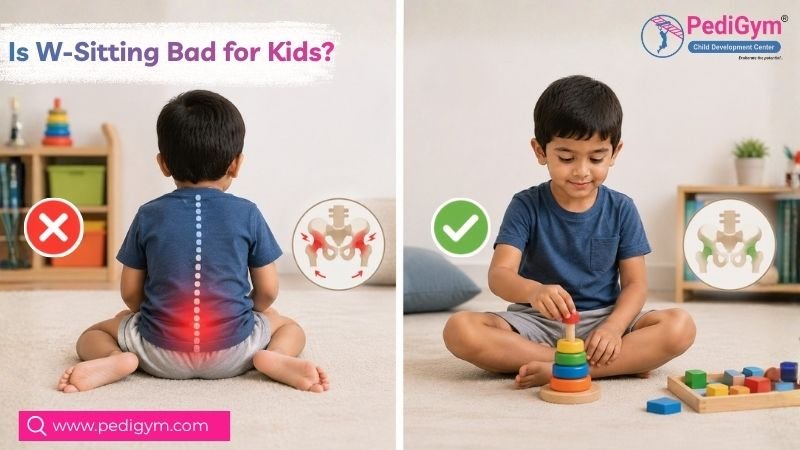
Occasional W-sitting is common in young children and current research does not show that it causes hip dysplasia or developmental delay. It is generally not a concern when a child can comfortably use other positions and has no pain, balance problems, or motor delays.
Parents do not need to panic when they notice their child sitting this way. Instead, the focus should be on movement variety, overall motor development, strength, balance, and the child’s ability to comfortably move between different positions.
Dr. Nitin, Founder of PediGym Child Development Center, is a dedicated pediatric therapy expert and DMI Level C Certified Therapist leading structured, evidence-based therapy programs in Faridabad and Gurgaon.
What Is W-Sitting in Children?
W-sitting is a floor-sitting posture in which a child sits with their knees bent and feet positioned outside the hips. When viewed from above, the child’s legs resemble the letter “W.”
This position is commonly seen in toddlers and preschool-aged children. A child may naturally choose it while playing with toys, reading, drawing, or participating in other floor activities.
The posture provides a broad base of support, which can make floor sitting feel stable and comfortable. For many children, it is simply one of several positions they use during play.
More attention may be appropriate when a child strongly prefers this position, has difficulty using alternative sitting positions, or has other movement or developmental concerns.
Is W-Sitting Bad for Kids?
No, not necessarily. Occasional W-sitting is generally considered a normal variation in children’s movement. Current evidence has not established that this posture causes developmental hip dysplasia or developmental delay.
A 2025 systematic review examined the available research on W-sitting and found no scientific evidence to recommend avoiding the position in children or an association with hip dysplasia. 2025 Systematic Review — PubMed
This means parents generally do not need to treat the position itself as a medical problem.
Instead, look at the child’s overall movement. Can they sit in different positions? Can they transition between sitting, crawling, kneeling, squatting, and standing? Do they maintain good balance? Can they reach for toys on either side of their body?
These observations provide more useful information about development than focusing on one sitting posture alone.
Why Do Toddlers Prefer This Sitting Position?
Young children naturally experiment with different ways of sitting and moving. This position can feel comfortable because it provides a stable base while they play on the floor.
Some children may also have individual differences in hip anatomy and flexibility that influence which sitting positions feel natural to them.
A child who frequently chooses this position may also have other movement characteristics, such as:
- Reduced trunk or core control
- Balance difficulties
- Coordination challenges
- Difficulty changing between positions
- Gross motor delays
However, seeing a child W-sit does not mean that any of these issues are present.
The position should therefore be considered as part of the child’s overall movement pattern rather than automatically being viewed as the cause of a developmental or motor problem.
Effects of W-Sitting: What Does Research Say?
There are many claims online about the possible effects of this posture. Some suggest that it can damage the hips, cause orthopedic problems, weaken the core, or interfere with development.
The available evidence is more nuanced. The 2025 systematic review found no evidence to recommend avoiding the position and reported no association with hip dysplasia.It also found no evidence of a difference in trunk muscle activation based on sitting position. 2025 Systematic Review — PubMed
1. W-Sitting and Hip Development
One of the most common parental concerns is whether this posture can negatively affect hip development.
The position places the hips in flexion, adduction, and internal rotation. However, current research does not demonstrate that ordinary W-sitting causes developmental dysplasia of the hip.
Within the 2025 systematic review, a cohort study of 104 children, including 18 children with hip dysplasia and 86 without hip dysplasia, included 48 children who were W-sitters. The study found no association between the position and hip dysplasia, a finding consistent with the review’s overall conclusion. Read the 2025 systematic review on PubMed
A pediatric orthopedic review from Weill Cornell Medicine and Hospital for Special Surgery also found no scientific evidence that W-sitting causes developmental dysplasia of the hip, contractures, hip dislocations, or functional deficits. Pediatric Orthopedic Mythbusters — PubMed
Children who already have an orthopedic condition, significant mobility restrictions, or hip, knee, or leg pain should still receive individualized advice from their pediatrician, orthopedic specialist, or pediatric therapist.
2. W-Sitting and Core Strength
Another common concern is that this posture weakens a child’s core muscles.
However, there is not sufficient evidence to conclude that W-sitting causes core weakness. The 2025 systematic review reported no evidence of different trunk muscle activation based on sitting position.
Rather than focusing on eliminating one particular sitting posture, parents can encourage children to participate in a variety of active movements.
Crawling, kneeling, reaching, squatting, climbing, and moving between sitting and standing all provide opportunities to develop strength, balance, and postural control.
The goal is to provide a broad range of movement experiences rather than assuming that one sitting position is responsible for weakness.
3. W-Sitting and Trunk Rotation
Parents may also wonder whether this posture affects a child’s ability to rotate the trunk during play.
When a child sits with the legs positioned on either side of the body, they may choose to move less through the trunk compared with some other positions. However, there is not strong evidence that occasional W-sitting causes functional deficits.
Children can be encouraged to participate in activities that naturally involve reaching, turning, shifting weight, and changing positions.
For example, placing toys on different sides of the child, playing games that require reaching across the body, crawling, and transitioning between positions can provide natural opportunities for varied movement.
4. W-Sitting and Muscle Tightness
Some children with neurological or musculoskeletal conditions have differences in muscle tone, flexibility, or range of motion.
In these situations, a preferred sitting posture may be one part of a broader movement pattern that deserves professional assessment.
It is therefore important not to assume that this posture is the cause of a child’s mobility problem.
A pediatric therapist can assess strength, flexibility, muscle tone, balance, coordination, posture, transitions, and functional movement to understand whether there is an underlying concern that needs support.
W-Sitting and Developmental Delay
Parents often search for information about W-sitting and developmental delay when they notice that their child frequently chooses this position.
Current evidence does not show that W-sitting causes developmental delay. It should also not be used on its own to diagnose autism, cerebral palsy, or another developmental disorder.
A child may prefer a stable floor-sitting position for many different reasons, including normal anatomical variation or individual preference.
Instead of focusing only on sitting posture, parents should consider the child’s broader development.
Ask:
- Is the child meeting age-appropriate motor milestones?
- Can the child sit in several different positions?
- Can they move between sitting, crawling, kneeling, squatting, and standing?
- Do they have age-appropriate balance and coordination?
- Can they reach and play comfortably on both sides?
- Do they experience pain or stiffness?
- Are there other developmental concerns?
If several concerns are present, a pediatric assessment can provide a clearer understanding of the child’s individual needs.
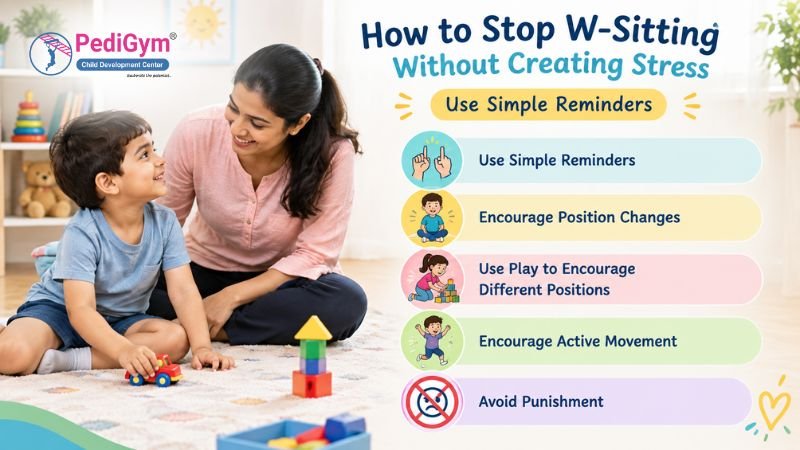
How to Stop W-Sitting Without Creating Stress
You do not need to constantly tell your child to stop W-sitting.
A better approach is to gently introduce other positions, encourage movement variety, and make alternative postures part of normal play.
1. Use Simple Reminders
Toddlers generally respond better to short, positive instructions than repeated criticism.
You can say:
“Let’s put your feet in front.”
or:
“Let’s try sitting criss-cross.”
The purpose is to offer another option rather than make the child feel that their natural movement is wrong.
2. Encourage Position Changes
Children do not need to remain in one sitting position for an entire activity.
Encourage your child to move naturally between sitting, kneeling, crawling, squatting, and standing.
Frequent movement provides opportunities to experience different positions without making posture correction the focus of play.
3. Use Play to Encourage Different Positions
Alternative positions can be introduced naturally through activities the child already enjoys.
For example:
- Read a book while sitting with the legs extended.
- Draw or color while sitting cross-legged.
- Play with toys while side-sitting.
- Reach for toys while kneeling.
- Build blocks while sitting with the legs forward.
The activity remains enjoyable while the child gets opportunities to explore different postures.
4. Encourage Active Movement
Crawling, climbing, squatting, kneeling, reaching, and getting up from the floor provide opportunities to develop balance, coordination, strength, and postural control.
These activities are more useful than repeatedly telling a child to “sit properly.”
5. Avoid Punishment
The goal should be movement variety, not making a child anxious about how they sit.
If your child returns to the position after you redirect them, calmly offer another option. Consistent opportunities to explore different positions can help expand their movement experiences without creating unnecessary stress.
Alternatives to W-Sitting
There is no single perfect sitting position for toddlers.
Rather than trying to make a child maintain one “correct” posture, encourage several comfortable positions throughout the day.
1. Criss-Cross Sitting
The child sits with both legs bent and crossed in front of the body.
This position works well for activities such as reading, drawing, puzzles, and playing with toys.
2. Long Sitting
In long sitting, both legs are extended forward.
This can be a comfortable option for activities where the child needs to face forward, such as playing with toys or looking at a book.
3. Side Sitting
The child bends both knees and moves the legs to one side of the body.
Parents can encourage the child to change sides during play so they experience movement in different directions.
4. Kneeling
Kneeling can be naturally incorporated into floor play.
It also gives children an opportunity to move between kneeling, sitting, squatting, and standing.
5. Squatting
Squatting is another functional position children naturally use during play.
Picking up toys from the floor, playing with objects at a low surface, or reaching for something nearby can encourage this movement.
The objective is not to eliminate one sitting position completely. It is to give children opportunities to explore different sitting positions and movement patterns.
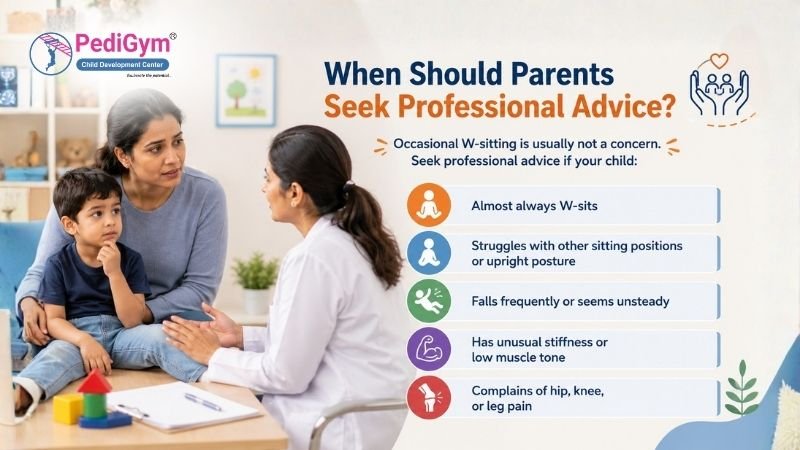
When Should Parents Seek Professional Advice?
Occasional W-sitting without other concerns usually does not require immediate intervention.
However, parents should consider speaking with a pediatrician or pediatric therapist if their child:
- Almost always chooses this sitting position
- Struggles to sit comfortably in other positions
- Has difficulty maintaining an upright posture
- Frequently falls or appears unusually unsteady
- Has significant stiffness or low muscle tone
- Complains of hip, knee, or leg pain
- Has difficulty running, jumping, climbing, or performing other age-appropriate movements
- Shows gross or fine motor delays
- Has difficulty transitioning between positions
- Has an existing orthopedic or neurological condition
A professional assessment can look beyond sitting posture and evaluate the child’s strength, balance, flexibility, muscle tone, coordination, posture, transitions, and overall motor development.
This is especially important when several concerns occur together.
Frequently Asked Questions About W-Sitting
Does W-sitting cause hip dysplasia?
Current research does not show that W-sitting causes developmental hip dysplasia. Both a cohort study and a 2025 systematic review found no demonstrated association between the position and hip dysplasia.
Children with an existing hip condition or pain should still receive individualized medical advice.
Does W-sitting cause developmental delay?
No. There is no evidence that W-sitting itself causes developmental delay.
Some children with existing motor difficulties may prefer a stable sitting position, but the posture should not be considered the cause of the delay.
Does W-sitting cause autism?
No. W-sitting does not cause autism and should not be used as a sign to diagnose autism.
Development should be assessed using appropriate communication, social, behavioral, and developmental milestones rather than sitting posture alone.
At what age should children stop W-sitting?
There is no universally established age at which every child must stop using this position.
Occasional use is generally not considered a problem. The focus should be on whether the child can comfortably use different positions and move between them.
If an older child consistently relies on one posture and has difficulty using alternatives, a professional assessment can help identify why.
How can I stop my child from W-sitting?
Use gentle redirection rather than constant correction.
Offer alternatives such as criss-cross sitting, long sitting, side sitting, and kneeling. Encourage active floor play and regular position changes.
If your child struggles to use other positions or appears to rely on this posture because of balance or motor difficulties, consult a pediatric therapist.
Should I worry if my toddler W-sits occasionally?
Usually, no.
Occasional W-sitting is common among toddlers. However, pain, significant stiffness, poor balance, frequent falls, difficulty changing positions, or motor delays are reasons to seek professional advice.
When Professional Pediatric Therapy May Help
If you are concerned about your child’s sitting posture or overall motor development, an individualized assessment can provide more useful information than trying to correct the position at home.
A pediatric therapist can assess how your child moves during everyday activities and determine whether difficulties with strength, balance, coordination, flexibility, muscle tone, or motor planning are affecting movement.
At PediGym Child Development Center, Dr. Nitin and the pediatric therapy team provide structured, evidence-based therapy programs designed around each child’s individual developmental needs.
Families in Faridabad and Gurgaon can seek professional guidance when they notice persistent motor concerns, developmental delays, difficulty with movement transitions, or other issues affecting everyday activities.
Final Takeaway
W-sitting is common in young children and does not automatically mean something is wrong.
Current evidence does not establish that this sitting position causes hip dysplasia or developmental delay. Parents can gently encourage a variety of sitting positions and active play without creating anxiety around occasional W-sitting.
If the position is persistent and occurs alongside pain, poor balance, difficulty changing positions, stiffness, frequent falls, or motor delays, a professional evaluation can help determine whether additional support is needed.
Research References
The medical claims in this article are supported by peer-reviewed research. A 2025 systematic review found no scientific evidence to recommend avoiding W-sitting in children and no association between the position and hip dysplasia. 2025 Systematic Review — PubMed
A pediatric orthopedic review from Weill Cornell Medicine and Hospital for Special Surgery also found no association between W-sitting and developmental dysplasia of the hip and found no scientific evidence that it causes contractures, hip dislocations, or functional deficits. Pediatric Orthopedic Mythbusters — PubMed

Dr. Nitin, Founder of PediGym Child Development Center, is a dedicated pediatric therapy expert and DMI Level C Certified Therapist leading structured, evidence-based therapy programs in Faridabad and Gurgaon. Under his guidance, PediGym provides comprehensive pediatric rehabilitation focused on improving motor skills, coordination, sensory processing, speech clarity, and functional independence through personalized intervention plans.